Markets I: The Ecosystem and Exchange-Traded Markets · Markets
18Futures Contracts and Their Exchanges
With the index at 6 000, one E-mini S&P 500 future is an exposure to $300 000 of American shares. It costs nothing to enter: nobody pays $300 000, and the deposit the clearing house asks for is a small fraction of it. The contract can be sold short as easily as bought, trades from Sunday evening to Friday afternoon, and its smallest price step, a quarter of a point, is worth $12.50. Every one of those facts is a line in a rulebook, and different for each of the thousands of futures listed around the world. A firm that trades futures begins by turning rulebooks into a table. This chapter builds the table; the next three explain how orders match, how the deposit is computed, and how a futures price relates to the thing it is a future on.
18.1 The contract
Definition 18.1 (Futures contract)
A futures contract is a standardised agreement, listed by an exchange and guaranteed by its clearing house (Chapter 5), to buy or sell a specified quantity of an underlying at a specified future date, at a price agreed today. Gains and losses are settled in cash every day; at expiry the contract is either settled in cash against a reference price or by delivery of the underlying.
Standardisation is the product. Two parties who want a forward on crude oil must agree on grade, place, date, size, credit and documentation. The exchange fixes all of these once, so that the only thing left to negotiate is price, and every contract of a given month is interchangeable with every other: a position bought from one counterparty can be closed by selling to another.
Definition 18.2 (Multiplier, tick and tick value)
The contract multiplier converts the quoted price into money: the contract’s notional value is price times multiplier. The tick is the minimum price increment, and the tick value is tick times multiplier, the profit or loss of one contract for one tick.
Definition 18.3 (Expiry month code and front month)
A futures symbol is a product root followed by an expiry month code, one letter for the month (F, G, H, J, K, M, N, Q, U, V, X, Z for January to December), and the last digit of the year. The front month is the nearest listed expiry, usually the most traded.

18.2 The exchange groups
Futures liquidity is concentrated by product, and each product lives on one exchange: unlike shares (Chapter 9), a future is the intellectual property of the exchange that lists it and clears only at that exchange’s clearing house. A position opened on one exchange cannot be closed on another. The consequence is a small number of groups, each a near-monopoly in its products: in the United States one group owns the Chicago and New York exchanges that list the benchmark equity-index, interest-rate, energy, metal and agricultural contracts; an Atlantic group lists Brent crude and European short-term rates in London and soft commodities in New York; the German exchange group lists the euro area’s equity-index and government-bond futures; and national exchanges in Asia and Latin America list their own indices, rates and commodities. Competition between exchanges happens at the launch of a product, rarely afterwards.
18.3 Six specifications
| Contract | Unit | Tick | Tick value | Expiries | Settlement |
|---|---|---|---|---|---|
| E-mini S&P 500 (ES) | $50 index | 0.25 | $12.50 | quarterly | cash |
| EURO STOXX 50 (FESX) | € 10 index | 1 | € 10 | quarterly | cash |
| 10-year T-note (ZN) | $100 000 face | $15.625 | quarterly | delivery | |
| Euro-Bund (FGBL) | € 100 000 face | 0.01 | € 10 | quarterly | delivery |
| WTI crude (CL) | 1 000 barrels | $0.01 | $10 | monthly | delivery |
| Brent crude (B) | 1 000 barrels | $0.01 | $10 | monthly | cash or EFP |
As of September 2026 — Details from the rulebooks
ES: final settlement is in cash against a special opening quotation of the index, computed from the opening prices of its component stocks on the third Friday of the contract month; calendar spreads trade in increments of 0.05. FESX: the twelve nearest quarterly months are listed; trading ends at 12:00 CET on the third Friday and the final settlement price is the average of the index between 11:50 and 12:00; regular trading runs from 02:10 to 22:00 CET. ZN: deliverable notes have a remaining maturity of at least six and a half and less than eight years; prices are quoted in points and thirty-seconds. FGBL: a notional 6% bond; deliverable bonds have 8.5 to 10.5 years remaining. CL: delivery at Cushing, Oklahoma. B: up to 156 consecutive months listed; trading ends on the last business day of the second month before the contract month; settlement by exchange for physical with an option to settle in cash against an index.
Bond futures are quoted in a base that predates computers. A price of 112-165 means : the first two digits after the dash count thirty-seconds of a point and a third digit, 2, 5 or 7, a quarter, a half or three quarters of a thirty-second. With a tick of half a thirty-second, of a point on $100 000 of face value, the tick value is $15.625. Every system that touches these prices should hold them as integers of ticks: a price is then never “almost” on the grid, equality tests are exact, and no P&L depends on rounding. (One sixty-fourth happens to be exact in binary floating point; 0.01, the tick of three other contracts in the table, is not.)
18.4 Sessions, settlement and limits
Definition 18.4 (Daily settlement price)
The daily settlement price is the price published by the exchange each day at which every open position is marked and variation margin is computed. It is determined by a rule, typically a volume-weighted average of trades in a short window, not by the last trade.
Definition 18.5 (Open interest)
Open interest is the total of all contracts entered into and not yet offset by a transaction, by delivery or by exercise. Each open contract has one long and one short; a trade raises open interest when both sides open, lowers it when both close, and leaves it unchanged when one side hands its position to the other.
Definition 18.6 (Price limit)
On a future, a price limit (for shares, Definition 12.2) is a bound, set by the exchange relative to a reference price, beyond which the contract may not trade during a session or a part of it; reaching it may trigger a halt.
As of September 2026 — How ES settles each day and when it stops
The daily settlement of the lead-month E-mini is the volume-weighted average price of trades between 14:59:30 and 15:00:00 Chicago time, with the midpoint of the bid and ask as fallback; other months are settled from calendar-spread prices. Downward price limits of 7%, 13% and 20% from a reference price apply during US stock-market hours, coordinated with the stock market’s circuit breakers (Chapter 14), and a symmetric band applies overnight (5% either way in the 2016 rule filing consulted; read the current rule).
Since all months of a product settle at three o’clock and a position is marked there, the last thirty seconds before the settlement are, for a futures desk, what the closing auction is for an equity desk.
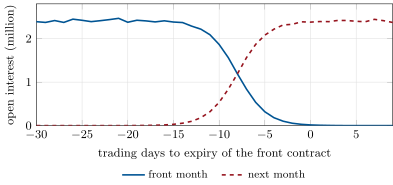
Volume moves from one expiry to the next in a few days before expiry: the roll. Holders who want to keep their exposure sell the front month and buy the next as a calendar spread; open interest migrates, and the front month of the data changes. A price series stitched across rolls without adjustment contains jumps that are not returns (Chapter 21).
18.5 Who trades futures
Definition 18.7 (Hedger and speculator)
A hedger holds futures to offset a risk it has elsewhere: a producer’s crop, a fund’s shares, a dealer’s bonds. A speculator holds them for the exposure itself. The US regulator’s weekly report on positions classifies large traders as commercial, those who use the contract for hedging as its regulation defines it, and non-commercial.
The textbook pair hides the population that matters to a trading firm: asset managers equitising cash and managing duration; leveraged funds in basis, trend and relative-value trades; dealers hedging swaps and options; and market makers, who hold little overnight and account for much of the volume. A future is also the hedge of choice for every delta-one instrument of Chapter 17, which ties its price to the cash market within the bands of Chapter 21.
Method 18.8 (Sizing a futures hedge)
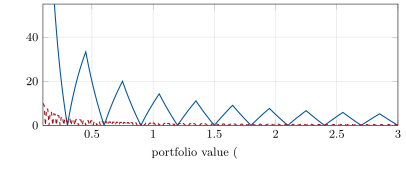
To hedge a portfolio of value and beta to the index with a future at price and multiplier : sell contracts, rounded to the nearest integer. The residual exposure is , at most half a contract; for small portfolios use the smaller contract if one exists. Beta is an estimate: its error is usually far larger than the rounding.
18.6 Tutorial: a contract table
Goal. Hold six contract specifications in one structure and derive notional, tick value, tick in basis points, leverage and hedge sizes from it. End state: the three data figures of this chapter.
One record per contract. Bond multipliers are expressed per price point: $100 000 of face value quoted in percent is $1 000 a point.
@dataclass(frozen=True)
class Spec:
    root: str
    multiplier: float            # currency per full price point
    tick: float
    currency: str
    ref_price: float             # an illustrative price, not a quote

    @property
    def tick_value(self) -> float:
        return self.multiplier * self.tick

    @property
    def notional(self) -> float:
        return self.multiplier * self.ref_price

    @property
    def tick_bp(self) -> float:
        """One tick as basis points of the contract's value."""
        return self.tick / self.ref_price * 1e4
Listing 18.1. A specification and the three numbers derived from it. code/markets-1/18-futures-contracts-and-exchanges/python/futures_basics.py Hedge sizing. Round to the nearest contract and report what is left.
def hedge(portfolio_value: float, beta: float, spec: Spec) -> tuple[int, float]:
    """Contracts to sell (nearest integer) and the residual exposure left, in currency."""
    exact = beta * portfolio_value / spec.notional
    n = math.floor(exact + 0.5)
    return n, beta * portfolio_value - n * spec.notional
Listing 18.2. Contracts to sell and the residual exposure. code/markets-1/18-futures-contracts-and-exchanges/python/futures_basics.py - Leverage. Divide notional by the initial margin your broker quotes today (Chapter 20); with a margin of 5% of notional a 2% move is 40% of the deposit.
What to change next. Add four contracts from the exchanges’ product pages, a short-term interest-rate future among them, whose price is 100 minus a rate and whose tick value comes from a day-count, not from a price.
18.7 Build: the contract master
Purpose. Every component of the miniature firm that touches a future (the P&L keeper of Chapter 7, the margin engine of Chapter 20, order entry) asks one module what the contract is.
Interface. ContractMaster.from_csv(path); spec(root) with exact multiplier, tick_size, tick_value, to_ticks(price), from_ticks(n), notional(price); parse(symbol, today) returning an instrument; expiry(instrument); parse_thirty_seconds(text).
Rules. All arithmetic in exact fractions; a price off the tick grid is an error, never rounded. A single-digit year resolves to the first such year that is not in the past. A month code not listed for the product is an error. Expiry rules that need an exchange calendar raise rather than guess.
Data. data/markets-1/contracts_sample.csv, six rows transcribed from this chapter’s sources: a test fixture, not reference data.
Acceptance tests. code/firm/contracts/tests/: exact tick values; round trips through integer ticks; Treasury quotes; symbols and third Fridays; validation.
Stretch. Load an exchange’s daily reference-data file and diff it against yesterday’s: tick-size and listing changes are events (Chapter 28).
Sources and further reading
- CME, Rulebook Chapter 358 (E-mini S&P 500 futures) and Chapter 351, as filed with the CFTC (March 2016); CME Group, daily settlement procedures for equity-index futures, as filed with the CFTC (January 2018).
- CBOT, Rulebook Chapter 19 (Treasury note futures), and the CFTC filing of 21 February 2025 on deliverable grades; NYMEX, Rulebook Chapter 200.
- Eurex, product pages EURO STOXX 50 Index Futures and Euro-Bund Futures; ICE Futures Europe, Brent Crude Futures product page.
- US Commodity Futures Trading Commission, Commitments of Traders: Explanatory Notes.
18.8 Exercises
Exercise 18.1 ★
A trader is long 12 E-minis from 6 012.50; the price falls to 5 987.25. Give the move in ticks and the loss.
Exercise 18.2 ★
The 10-year note future goes from 111-245 to 112-080. Give both prices in decimal, the move in ticks and the profit on one long contract.
Exercise 18.3 ★
Today is 18 September 2026. Decode FESXH7 and give its last trading day. What would ESH6 mean today?
Solution
Solution of Exercise 18.3.
EURO STOXX 50 future, March (H) of the first year ending in 7 that is not past: March 2027. Last trading day: the third Friday, 19 March 2027, at 12:00 CET. ESH6 cannot be March 2026, which has expired: read today it means March 2036, which is not listed. A symbol with a one-digit year is ambiguous without a date, which is why reference data carries full expiry dates.
Exercise 18.4 ★★
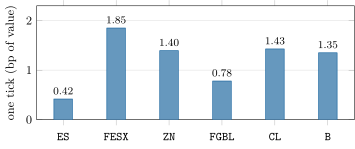
From Figure 18.2, the tick of FESX is more than four times that of ES relative to value. Give two consequences for a market maker and one for a fund crossing the spread on € 50 million.
Solution
Solution of Exercise 18.4.
Market maker: the minimum spread, one tick, is 1.85 basis points against 0.42, so each round trip captured earns more, and the queue at each price is long: priority in the queue, hence speed and the matching algorithm, decides who earns it. Prices move less often, so quotes are safer for longer. Fund: € 50 million is 926 contracts; crossing a one-tick spread costs half a tick, , 0.93 basis point, where the same trade in a contract with the finer tick would cost about a quarter of that.
Exercise 18.5 ★★
A broker asks $21 000 of initial margin per E-mini at 6 000. Give the leverage and the index move that loses the whole deposit. Why is the deposit not the right measure of the money needed to hold the position?
Solution
Solution of Exercise 18.5.
times; a move of 7% loses the deposit. The deposit is the minimum the clearing house demands today. Losses must be paid in cash every day as variation margin, and the initial margin itself is raised when volatility rises: the money needed to hold the position through a bad week is several times the deposit (Chapter 20).
Exercise 18.6 ★★
A new contract lists. Trades: A buys 5 from B; C buys 3 from A; B buys 2 from C; D buys 4 from A. Give the open interest and each trader’s position after each trade. What were volume and open interest at the end?
Solution
Solution of Exercise 18.6.
After A buys 5 from B: A , B , open interest 5. C buys 3 from A: A , C , B ; A has passed 3 contracts to C, open interest 5. B buys 2 from C: B , C ; both closed, open interest 3. D buys 4 from A: A , D ; A closes 2 and opens 2 short, D opens 4: open interest 5 (longs: C 1, D 4; shorts: A 2, B 3). Volume 14, open interest 5.
Exercise 18.7 ★★★
Coding. From residual.csv: for portfolios of $1 million and more, report the largest residual with the $300 000 contract and with the contract one tenth its size. State the general bound and check it.
Solution
Solution of Exercise 18.7.
Largest residual: 14.29% with the $300 000 contract (at $1.05 million, half a contract unhedged) and 1.00% with the small one. The residual is at most half a contract: and , that is and at million; the data respect both bounds.
Exercise 18.8 ★★★
Find the flaw. A commentary reads: “Open interest in the front contract rose 20% today while the price rose: new buyers are pouring in, and buyers now outnumber sellers.” Correct it, and say what the same data can legitimately tell you.
Solution
Solution of Exercise 18.8.
Every open contract has a buyer and a seller: buyers never outnumber sellers in contracts. A rise in open interest says that new longs and new shorts opened positions; the price rose because the buyers were the more impatient side, which the price already says. What the data can tell: whether a move comes with new positions (rising open interest) or with liquidation (falling); where the roll stands; and, combined with the regulator’s weekly report, which class of trader holds which side.
18.9 Problem: Sizing a Hedge
Problem 18.1
Weekend problem — a transatlantic portfolio and two futures
On 18 September 2026 a fund wants to remove the market exposure of two sleeves for three months: $187 million of US shares with a beta of 1.15 to the S&P 500, and € 43 million of euro-area shares with a beta of 0.90 to the EURO STOXX 50. The E-mini is at 6 000 and the FESX at 5 400.
Part I — The contracts.
- Give the notional of one contract of each.
- Give the exact and the rounded number of E-minis to sell, and the residual.
- Same for the FESX.
- Which expiry should the fund sell, with its symbol and last trading day, if it does not want to roll?
- With initial margin at 5% of notional, give the deposit for the US hedge.
Part II — A bad day. The S&P 500 falls 2%.
- Give the gain on the futures and the expected loss on the US sleeve.
- When does the cash from the futures arrive, and when is the loss on the shares realised? Why does the difference matter on a good day?
- The sleeve actually loses 2.9%. Give the hedged P&L and name its source.
- The fund’s beta estimate has a standard error of 0.10. Compare the corresponding exposure with the rounding residual.
Part III — Details.
- In December the fund extends the hedge by a quarter and rolls to March. The calendar spread has a tick of 0.05. Give the cost of paying one spread tick on the whole position.
- The European hedge is in euros and the fund reports in dollars. What exposure has the hedge not removed?
- The E-mini’s daily settlement is a thirty-second average at 15:00 Chicago time, which is 16:00 in New York; the shares are valued at their closing auction at the same moment. What appears in the daily P&L?
- Why might the fund hedge the US sleeve with ES even if most of it is small-capitalisation stocks, and what does it give up?
- The hedge will be in place for three months. Using Chapter 17, what does it cost or earn besides commissions?
Part IV — Judgement.
- After the hedge, what risks does the fund still run?
- A 7% fall triggers the first price limit during US hours. What happens to the hedge, and to the shares?
- Would a contract one tenth the size improve the hedge here?
- Why do funds hedge with futures and not by selling the shares?
- State the named result: the number of E-minis and the residual exposure.
- In one sentence: what does a futures contract standardise, and what does it leave to the trader?
Solution
Solution of Problem 18.1.
1. $300 000 and € 54 000. 2. : sell 717. Residual : over-hedged by a sixth of a contract. 3. : sell 717; residual . 4. December 2026, ESZ6 and FESXZ6, last trading day Friday 18 December 2026, exactly three months away. The E-mini settles against the opening quotation of that day and the FESX at noon: the hedge ends some hours before the close of the last day. 5. . 6. Futures: . Sleeve: million . 7. The futures gain is paid in cash the next morning; the loss on the shares is unrealised. On a good day it is the reverse: the fund must pay $4.3 million of variation margin in cash against an unrealised gain, and must hold or borrow that cash. 8. : the sleeve fell 0.6% more than its beta predicted. This is the idiosyncratic and factor risk of the portfolio, which an index hedge does not remove. 9. million million of index exposure, 374 times the rounding residual. 10. . 11. The currency: the sleeve is a euro asset for a dollar fund, and the FESX gains and losses are in euros too. The hedge removes the equity beta, not the € 43 million of euro exposure (in fact it adds a small euro exposure on its margin and P&L). 12. A small noise with zero mean: the two prices are taken at the same moment by different mechanisms, a thirty-second average for the future and a single auction price for each share. On ordinary days it is a basis point or two; on index-rebalance and expiry days, when the closing auction moves, it is larger, and it reverses the next day. 13. Liquidity and cost: the E-mini is the cheapest hedge per dollar. It gives up the match: a small-capitalisation sleeve hedged with a large-capitalisation index keeps the size spread, which can move several percent in a quarter. A small-capitalisation index future hedges better and costs more to trade. 14. A short future earns the implied financing rate less dividends: the fund receives the benchmark rate plus the futures’ funding spread on the hedged notional, in exchange for giving up the equity premium. 15. Stock selection (intended), beta error, size and sector mismatch, currency on the European sleeve, liquidity for variation margin, and the hours each day when futures trade and shares do not. 16. The future cannot trade below the limit while the stock market is halted; when both reopen the next limit applies. The hedge still marks correctly at settlement, but cannot be adjusted during the halt, and the shares cannot be sold either. 17. Barely: the residual would fall from $50 000 to at most $15 000, on a position whose beta uncertainty is worth $18.7 million. It matters for portfolios a hundred times smaller. 18. Cost and reversibility: selling $187 million of shares costs tens of basis points, realises taxes, and abandons the stock selection; 717 futures cost about a basis point and leave the portfolio intact. 19. Sell 717 E-minis; residual . 20. It standardises everything except the price, the quantity and the choice of which contract approximates the risk one actually has.
18.10 Interview questions
Interview question 18.1 ★ trader, developer, researcher
What is the tick value of an E-mini S&P 500 future, and what is the contract worth?
Interview question 18.2 ★ trader, researcher
What is open interest, and how does it differ from volume?
Solution
Solution of Interview question 18.2.
Volume counts contracts traded during a period; open interest counts contracts in existence at a moment. A trade between two new participants adds to both; a trade in which one side closes leaves open interest unchanged; a trade between two closers reduces it. A day trader generates volume and no open interest.
What the interviewer is looking for: the three cases.
Interview question 18.3 ★★ developer, researcher
How would you represent futures prices in a trading system, and why?
Solution
Solution of Interview question 18.3.
As integer ticks, with the tick size and multiplier held once, exactly, in reference data. Comparisons and keys are exact, arithmetic is fast, prices off the grid cannot exist, and money is obtained by one multiplication at the edge. Decimal strings such as 0.01 or prices in thirty-seconds are parsed once on input. Tick sizes change (and differ for spreads and options), so the conversion belongs to the instrument and the date.
What the interviewer is looking for: integers, one conversion point, and awareness that tick sizes change.
Interview question 18.4 ★★ trader, researcher
Why does a future trade on only one exchange when a share trades on many venues?
Solution
Solution of Interview question 18.4.
A share is issued by a company and any venue may trade it; a future is created by an exchange, which owns the contract and clears it in its own clearing house. Open interest is not fungible across clearing houses, so a competitor’s identical contract starts with no liquidity and no margin offsets against the incumbent’s other products. Liquidity then attracts liquidity.
What the interviewer is looking for: clearing as the lock-in, not the trading.
Interview question 18.5 ★★ researcher, mle
You are given ten years of daily front-month prices. What must you do before computing returns?
Solution
Solution of Interview question 18.5.
Find out how the series was built: on which day it switches contract and whether it is adjusted. Compute each day’s return from two prices of the same contract, switching contracts on a roll date chosen by a rule (volume or open interest crossing, or fixed days before expiry), so that the roll gap never enters a return. Decide between ratio- and difference-adjusted levels according to use; check settlement against last trade; align the settlement time with any other series used with it.
What the interviewer is looking for: returns from same-contract prices; an explicit roll rule.
Interview question 18.6 ★★★ trader, researcher
You must hedge $200 million of equities for a quarter. Walk me through every decision.
Solution
Solution of Interview question 18.6.
Which index: the one closest to the portfolio, traded off against liquidity. Beta: estimated how, over what window, with what error. Contracts: , rounded. Expiry: front month and roll, or the month that covers the horizon. Execution: a schedule against the hedge’s urgency, perhaps at the close to match the portfolio’s valuation. Margin: the deposit, plus cash for variation margin on rallies. Currency, if any. Monitoring: beta drift, residual factor exposures, the roll. Exit: the same in reverse.
What the interviewer is looking for: the cash for variation margin, which most candidates forget.