Markets I: The Ecosystem and Exchange-Traded Markets · Markets
21Basis, Roll and Delivery
The index is at 6 000 and its December future trades at 6 043. A commentator reads the forty-three points as optimism. They are interest: the buyer of the future keeps $300 000 in the bank for three months instead of paying for shares, earns about $3 185 on it, forgoes about $1 050 of dividends, and the difference, divided by the multiplier, is forty-three points to the decimal. The premium will melt to nothing by the third Friday of December whatever the market does. On 20 April 2020 the same mechanism ran in reverse in crude oil: holders of a future one day from expiry, facing delivery of barrels they could not store, paid others $37.63 a barrel to take the contracts away. A future is tied to its underlying by an arbitrage and by a delivery procedure, and both have costs. This chapter prices the tie.
21.1 Cost of carry and fair value
Definition 21.1 (Basis)
The basis of a future is the difference between its price and the spot price of its underlying, here future minus spot. It converges to zero at expiry, because at expiry the future is the underlying.
Definition 21.2 (Cost of carry and fair value)
The cost of carry of an asset is what it costs to hold it until a future date: financing, plus storage and insurance for a commodity, minus the income it pays. The fair value of a future is the spot price plus the cost of carry to expiry: the futures price at which buying the asset and selling the future earns exactly the financing rate.
Proposition 21.3 (Fair value of an index future)
Let be the index, the financing rate (simple, actual/360), the time to expiry and the dividends, in index points, paid at times . Then
Proof. Borrow , buy the basket, sell one future at . Invest each dividend to expiry. At expiry deliver the basket’s value against the future: the cash is whatever the index does. With no initial outlay and no risk it must be zero. ∎
Example 21.4 (Forty-three points)
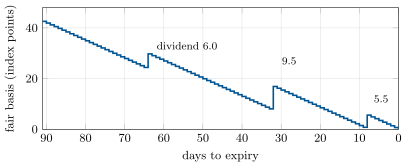
On 18 September 2026 with , , expiry on 18 December (91 days) and dividends of 6.0, 9.5 and 5.5 points paid on 15 October, 16 November and 10 December: interest is points, the dividends are worth 21.09 at expiry, and . A market price of 6 047.20 corresponds to an implied financing rate of 4.50%: the funding spread of Chapter 17, 30 basis points, seen from the other side.
21.2 Index arbitrage
Proposition 21.5 (The arbitrage band)
With one-way trading costs on the basket and on the future (as fractions of value), a financing spread for the arbitrageur when long the basket and a borrow fee when short it, the future can trade without arbitrage anywhere in
The band is narrower for firms with lower costs, shrinks as expiry approaches, and is asymmetric when borrowing the basket costs more than financing it.
Example 21.6 (A band of seventeen points)
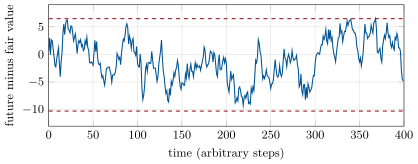
With and basis points, and basis points a year, the band of Example 21.4 runs from to : from 6 032.35 to 6 049.09. At 6 050.50 the future is 7.89 points rich and the trade, buy the basket and sell the future, locks in 1.41 points, $70 a contract, held to expiry. Most index arbitrage is not held to expiry: the position is unwound when the mispricing reverses, which earns the round trip of the mispricing and pays trading costs twice more.
21.3 The roll
Definition 21.7 (Roll)
To roll a futures position is to close it in the expiring contract and reopen it in a later one, normally as one calendar-spread trade (Definition 19.6). The price of the roll is the calendar spread; its richness is the spread’s excess over the difference of the two fair values, usually quoted as an annualised rate.
For an equity index the roll prices three months of financing less three months of dividends. A long holder rolling at a spread 4.55 points above fair value on an index of 6 000 pays 30 basis points a year more than the benchmark for its leverage; the short holder on the other side earns them. The roll takes place over about a week (Figure 18.3), and since everyone must do it, its richness is the cleanest public measure of the price of balance sheet.
Definition 21.8 (Contango and backwardation)
A futures curve is in contango when later expiries trade above nearer ones, and in backwardation when they trade below.
For a financial asset the curve’s slope is arithmetic: rate minus yield. For a commodity it includes storage and a convenience yield, the value of having the physical commodity to hand, which is high when inventories are low. The slope is a return: a long position rolled down a backwardated curve earns the slope even if the spot price never moves, and one rolled up a contango curve pays it.
21.4 Delivery and final settlement
Definition 21.9 (Cash settlement and physical delivery)
At expiry a cash-settled future pays a last variation margin against a final settlement price and disappears. A physically delivered future obliges the short to deliver, and the long to receive and pay for, the underlying, under the exchange’s delivery rules: grade, location, dates, and, for bond futures, a choice among deliverable issues.
Definition 21.10 (Special opening quotation)
A special opening quotation is a final settlement value of an index computed from the opening prices of each of its components on the settlement day. It is not an index level that anyone saw: the components open at different moments, and the quotation can lie outside the day’s range of the published index.
As of September 2026 — How three contracts end
E-mini S&P 500: trading in the expiring contract stops at the scheduled opening of the New York Stock Exchange on the third Friday; final settlement is a special opening quotation from that morning’s opening prices. EURO STOXX 50 future: trading stops at noon on the third Friday, against the average of the index over the last ten minutes. WTI crude: physical delivery at Cushing; trading ends some days before the delivery month begins, and a holder who is still long then owns oil in a pipeline hub in Oklahoma.
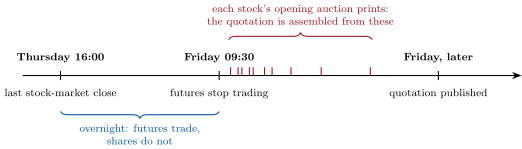
An index arbitrageur who is long the basket and short the expiring future exits by selling every stock in its opening auction on expiry morning: the proceeds are, by construction, the special opening quotation, and the position disappears with no basis risk. This is why the third Friday’s opening auctions are among the largest of the quarter (Chapter 13).
Example 21.11 (Minus thirty-seven dollars)
The May 2020 WTI future was due to expire on 21 April. On 20 April it opened the session at $17.73; between about 14:08 and the end of the settlement period at 14:30 New York time it traded below zero, for the first time since the contract was listed in 1983, touched and settled at . Every other expiry settled at a positive price. The regulator’s interim report cites an oversupplied market, the collapse of demand in the pandemic and concern about storage at the delivery point, and records that about a fifth of that day’s volume in the contract was traded at settlement, at a price to be known only after 14:30. A long who cannot take delivery must sell before expiry at whatever price clears; the convergence of future and spot is enforced by those who can deliver and store, and on that day few could.
21.5 Trading at a price not yet known
Definition 21.12 (Exchange for physical)
An exchange for physical (EFP) is a privately negotiated transaction, reported to the exchange, in which one party buys the cash asset and sells the future and the other does the opposite, at an agreed price difference. It moves a position between the cash and futures markets without touching either order book.
Definition 21.13 (Trade at settlement and basis trade at index close)
A trade at settlement (TAS) is a futures trade executed during the session at a price equal to that day’s settlement price, plus or minus an agreed number of ticks, which is known only after the settlement. A basis trade at index close (BTIC) is a futures trade at a price equal to that day’s official closing level of the index plus an agreed basis.
Both answer the same need: a fund valued at the close wants futures at the close, or at a fixed distance from it, without trading in the last thirty seconds. A BTIC quote is a direct quote of the basis, and so of the implied financing rate: it is where the funding spread of index futures is most cleanly observed. Both also concentrate risk in the settlement window: the counterparties of TAS orders hedge in the market before the settlement, and on 20 April 2020 that hedging pressed on a market with no buyers.
21.6 Tutorial: fair value with discrete dividends
Goal. Compute the fair value of an index future from dated dividends, invert it for the implied financing rate, draw the basis over the contract’s life and the arbitrage band. End state: the three data figures of this chapter.
Fair value, with each dividend reinvested to expiry.
def dividends_to_expiry(divs: list[Dividend], today: dt.date, expiry: dt.date, rate: float) -> float:
    """Value at expiry of the dividends paid in (today, expiry]."""
    return sum(d.points * (1.0 + rate * _frac(d.pay_date, expiry)) for d in divs if today < d.pay_date <= expiry)


def fair_value(spot: float, rate: float, today: dt.date, expiry: dt.date, divs: list[Dividend]) -> float:
    return spot * (1.0 + rate * _frac(today, expiry)) - dividends_to_expiry(divs, today, expiry, rate)
Listing 21.1. Dividends carried to expiry, and the fair value. code/firm/fairvalue/firm_fairvalue.py Implied rate by bisection, since the dividends’ reinvestment depends on the rate too.
def implied_rate(future: float, spot: float, today: dt.date, expiry: dt.date, divs: list[Dividend],
                 tol: float = 1e-12) -> float:
    """The financing rate at which the market price is fair (bisection: dividends depend on it too)."""
    lo, hi = -0.5, 1.0
    for _ in range(200):
        mid = 0.5 * (lo + hi)
        if fair_value(spot, mid, today, expiry, divs) < future:
            lo = mid
        else:
            hi = mid
        if hi - lo < tol:
            break
    return 0.5 * (lo + hi)
Listing 21.2. The financing rate at which the market price is fair. code/firm/fairvalue/firm_fairvalue.py The band, asymmetric when the basket is dear to borrow.
def arbitrage_band(spot: float, rate: float, today: dt.date, expiry: dt.date, divs: list[Dividend],
                   costs: ArbCosts) -> tuple[float, float]:
    """Futures prices outside (lower, upper) pay: above, buy the basket and sell the future;
    below, short the basket and buy the future. Round-trip trading costs on both legs."""
    fv = fair_value(spot, rate, today, expiry, divs)
    t = _frac(today, expiry)
    trading = 2.0 * (costs.stock_bp + costs.future_bp) * 1e-4 * spot
    upper = fv + trading + costs.funding_spread_bp_annual * 1e-4 * t * spot
    lower = fv - trading - costs.borrow_bp_annual * 1e-4 * t * spot
    return lower, upper
Listing 21.3. Futures prices beyond which index arbitrage pays. code/firm/fairvalue/firm_fairvalue.py A rolled position in a commodity curve.
def rolled_index(curves: np.ndarray) -> np.ndarray:
    """Value of 1 invested in the front contract, rolled each period into the next one.
    curves[t] = (front, second) at the start of period t; at the end of the period the second
    has become the front. Excess return only (collateral interest ignored)."""
    value = [1.0]
    for t in range(len(curves) - 1):
        value.append(value[-1] * curves[t + 1][0] / curves[t][1])
    return np.array(value)
Listing 21.4. Value of a long position rolled each period. code/markets-1/21-basis-roll-and-delivery/python/basis_demo.py
What to change next. Make the dividends uncertain: shift each by and see how much of the band that uses up for a one-year future. This is why long-dated index futures and dividend futures exist as separate markets (Chapter 22).
21.7 Build: the fair-value calculator
Purpose. The miniature firm’s futures market maker quotes around fair value, its index-arbitrage strategy trades against it, and its risk system uses it to split futures P&L into index, carry and mispricing.
Interface. Dividend(pay_date, points); fair_value(spot, rate, today, expiry, divs); implied_rate(future, spot, today, expiry, divs); ArbCosts; arbitrage_band(…) returning the lower and upper no-arbitrage prices; roll_richness_bp(spread_market, spot, rate, today, near, far, divs).
Rules. Simple interest, actual/360; dividends counted if paid after today and on or before expiry; expiry dates from the contract master (Section 18.7); dividend points from the corporate-action adjuster and index weights (Section 8.7); borrow fees from the borrow book (Section 16.7).
Acceptance tests. code/firm/fairvalue/tests/: simple interest with no dividends; the chapter’s example by hand; the implied rate as inverse; the asymmetric band; a roll 30 basis points rich.
Stretch. A term structure of rates instead of one ; dividends in the index’s currency for a quanto future; an ex-date, not pay-date, convention, with the difference reported.
Sources and further reading
- CME, Rulebook Chapter 358, rules 35802.G and 35803.A (termination of trading and final settlement), as filed with the CFTC.
- US Commodity Futures Trading Commission, Interim Staff Report: Trading in NYMEX WTI Crude Oil Futures Contract Leading up to, on, and around April 20, 2020, November 2020.
- US Commodity Futures Trading Commission, Futures Glossary (exchange for physicals); CME Group, Basis Trade at Index Close (BTIC).
- Eurex, EURO STOXX 50 Index Futures, product page.
21.8 Exercises
Exercise 21.1 ★
With , , 91 days and no dividends, give the fair value and the basis.
Exercise 21.2 ★
Add the three dividends of Example 21.4, paid 64, 32 and 8 days before expiry. Give their value at expiry and the fair value.
Exercise 21.3 ★
A crude-oil curve has its first two monthly contracts at 70.00 and 70.84. Name the shape and give the annualised roll yield of a long position. Same for 70.00 and 69.30.
Solution
Solution of Exercise 21.3.
Contango; a long rolls from 70.00 into 70.84 each month and, if nothing moves, sees 70.84 become 70.00: a year. Backwardation; a year.
Exercise 21.4 ★★
With the costs of Example 21.6, the future trades at 6 050.50. Describe the arbitrage, leg by leg, and give its locked-in profit per contract. What could still go wrong?
Solution
Solution of Exercise 21.4.
The future is points rich, beyond the upper bound of . Sell the future at 6 050.50; buy the basket, $300 000 per contract, in index proportions; finance it at the benchmark plus 15 basis points; collect and reinvest the dividends; on expiry morning sell every stock in its opening auction. Locked in: points, $70 a contract. What can go wrong: legging (the basket of 500 stocks is not bought in one instant); dividends cut or moved; the financing rate rising; stocks halted at the open on expiry day; variation margin on the short future during a rally, to be funded while the basket’s gain is unrealised.
Exercise 21.5 ★★
The future of Example 21.4 trades at 6 047.20. Verify the implied financing rate. If the benchmark rises by 25 basis points tomorrow with the index unchanged, by how much does the fair value change?
Solution
Solution of Exercise 21.5.
Bisection on gives : check, , dividends 21.09, , the rest being rounding of the rate. A rise of 25 basis points adds points of interest and a negligible amount of reinvestment: the fair value rises by 3.79 points with the index unchanged. Futures are interest-rate instruments too.
Exercise 21.6 ★★
On an expiry Friday the published index opens at 5 990, trades between 5 985 and 6 020 during the day, and the special opening quotation is 5 982. Explain how the quotation can lie below the day’s low. Who cares?
Solution
Solution of Exercise 21.6.
The published index at 09:30 mixes stocks that have opened with the previous close of those that have not; it is 5 990 only by that convention. The quotation uses each stock’s own opening print, whenever it occurs. If the stocks that open late open low, their opening prices enter the quotation but their contribution to the “day’s low” of the published index comes later, at other stocks’ then-current prices: the quotation is a portfolio of prices taken at different times and need not lie within the range of any simultaneous index. Holders of expiring futures and options settle on it; arbitrageurs who sell their baskets in the opening auctions receive exactly it.
Exercise 21.7 ★★★
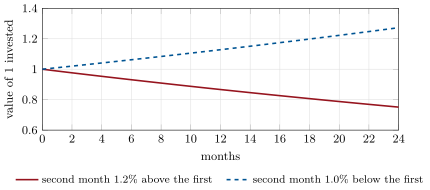
Coding. With rolled_index reproduce the two end values of Figure 21.3. Then let the contango shrink linearly from 1.2% to zero over the 24 months and report the end value.
Solution
Solution of Exercise 21.7.
0.751 in contango and 1.273 in backwardation after 24 monthly rolls. With a contango shrinking linearly from 1.2% to zero: 0.861. Half the slope on average costs roughly half the loss.
Exercise 21.8 ★★★
Find the flaw. “S&P futures are trading 43 points above the index this morning: futures traders expect the market to rise.” Correct the statement. What would the futures tell you before the stock market opens?
Solution
Solution of Exercise 21.8.
The premium is carry: three months of interest less three months of dividends, 42.6 points at these rates, and it would be the same if everyone expected a crash. Expectations move the index and the future together. What the future tells you before the open is the change: compare the future with yesterday’s fair value at the close (yesterday’s close plus the fair basis); that difference, not the raw premium, is the market’s overnight move.
21.9 Problem: Rolling a Billion
Problem 21.1
Weekend problem — the quarterly cost of staying long
A fund holds $1 billion of S&P 500 exposure in E-minis (index 6 000, multiplier $50), its cash invested at the benchmark rate of 4.2%. It is 18 September 2026; it holds the December contract (expiry 18 December) and will roll to March (19 March 2027). Dividends between the two expiries are 6.0, 9.5 and 5.5 points paid on 15 January, 15 February and 10 March.
Part I — The fair roll.
- How many contracts does the fund hold?
- Give the fair value of the December contract.
- Give the fair value of the March contract.
- Give the fair calendar spread (March minus December).
- Decompose it into interest and dividends.
Part II — The market roll. The spread trades 4.55 points above fair.
- Give the richness in basis points a year.
- Give its cost in dollars for this roll.
- The fund pays half a spread tick (the tick is 0.05) in execution. Give that cost.
- Give the total annual cost of rolling, in dollars and in basis points of the exposure.
- Compare with the 7 basis points a year of an index fund (Chapter 17). What else must enter the comparison?
Part III — When to roll.
- Most open interest rolls in the week before expiry. What is the argument for rolling with the crowd, and for rolling earlier?
- In December the richness is typically highest. Why?
- The fund could sell the basis by BTIC instead. What does it learn from a BTIC quote that it does not learn from the futures price?
- A bank offers to take the other side of the roll at fair value plus 20 basis points. Why can it, and why would it?
Part IV — Judgement.
- A commodity fund faces the same decision in a curve in steep contango. What differs?
- A fund that forgets to roll an E-mini position holds it to expiry. What happens? And if the contract were WTI?
- Why is the richness of the roll a measure of something larger than this fund’s costs?
- Who earns the 30 basis points?
- State the named result: the cost of the roll in basis points a year.
- In one sentence: why does the future converge to the index?
Solution
Solution of Problem 21.1.
1. contracts. 2. 6 042.61. 3. 182 days of interest, 127.40 points, less all six dividends carried to 19 March, 42.39 points: 6 085.01. 4. 42.39 points. 5. Interest for the 91 days between the expiries on 6 000: 63.70. Dividends of that quarter, with reinvestment: 21.31. . 6. basis points a year. 7. . 8. . 9. Four rolls: $3 049 695, 30.5 basis points of the exposure. 10. The futures cost 30.5 against the fund’s 7, but the fund’s cash earns the benchmark in both cases only if the fund is fully funded; futures leave 95% of the cash free (for a fund that can earn more than the benchmark on it, or that needs it as collateral elsewhere), avoid withholding tax differences, and can be shorted. For a fully funded long-only holder at these levels the index fund is cheaper. 11. With the crowd: that is when the spread book is deepest and the tick is a small cost; the richness is whatever it is. Earlier: a holder who believes the richness rises into the roll week (as dealers’ balance sheets fill) pays less by going first, at the price of a thinner book. 12. The March contract spans the year-end, when banks shrink their balance sheets for reporting dates and financing is scarcest; the December roll prices that. 13. The basis itself, in index points against a known close, hence the implied financing rate to expiry without having to synchronise a futures price with an index that is published with a delay. 14. It can, because it holds or can finance the basket: it sells the future rich and earns benchmark plus 20. It would, because 20 basis points on a balance-sheet position is its business; it will not at year-end if the capital cost exceeds that. 15. The slope is not an interest rate but storage and convenience yield, it can be many percent a year, it changes sign, and the choice of which contract to hold along the curve becomes a strategy in itself. 16. The E-mini settles in cash against the special opening quotation: the fund receives or pays a last variation margin and is out of the market, unhedged, from that morning. WTI is delivered: a long who has not closed is assigned barrels at Cushing and must have arranged pipeline or storage; brokers close such positions by force before it comes to that. 17. It is the market price of dealer balance sheet for equity financing, the same number that appears in swap spreads, in the cost of leveraged strategies and in the returns of index arbitrage. 18. Whoever is short the future and long the stock: index arbitrageurs, dealers, and funded investors who replace their shares with futures when the roll is cheap and the reverse when it is rich. 19. 30.5 basis points a year. 20. Because at expiry it pays the index, so anyone who can hold the basket until then can collect any difference.
21.10 Interview questions
Interview question 21.1 ★ trader, researcher, bank
Why does an equity-index future trade at a premium to the index? When would it trade at a discount?
Solution
Solution of Interview question 21.1.
The buyer of the future does not pay for the shares and earns interest on the cash, but receives no dividends; fair value is spot plus interest minus dividends. It trades at a discount to spot when the dividend yield to expiry exceeds the interest rate, as in low-rate years or in markets with a heavy dividend season before expiry, and, relative to fair value, when the basket is costly to short.
What the interviewer is looking for: carry, not expectations; a concrete case of discount.
Interview question 21.2 ★ trader, researcher
Define contango and backwardation. Does contango mean the market expects prices to rise?
Solution
Solution of Interview question 21.2.
Contango: later expiries above nearer ones; backwardation: below. Neither is a forecast. For a financial asset the slope is rate minus yield; for a commodity it adds storage and subtracts convenience yield. A curve in contango says that carrying the commodity is costly and inventories are ample; a long investor pays the slope as negative roll yield.
What the interviewer is looking for: slope as carry, and the roll-yield consequence.
Interview question 21.3 ★★ trader, researcher
Walk me through an index arbitrage trade, including how you get out.
Solution
Solution of Interview question 21.3.
Compute fair value from the rate and dated dividends. When the future is above fair value by more than my costs, sell futures and buy the basket through a program trade, financed. Carry: collect dividends, pay financing, pay or receive variation margin. Exit either when the mispricing reverses (sell the basket, buy the future) or at expiry, by selling each stock in its opening auction on expiry morning, which realises the special opening quotation exactly. Risks: legging, dividends, financing, halts, margin cash.
What the interviewer is looking for: the opening-auction exit and the margin cash on the short future.
Interview question 21.4 ★★ researcher, mle
You are building a continuous futures price series for research. What are your options at each roll, and what is each good for?
Solution
Solution of Interview question 21.4.
(i) Unadjusted front month: true traded prices, with a jump at each roll; use for levels on a given day, never for returns. (ii) Difference-adjusted (back-adjust by the spread at each roll): preserves point P&L, distorts percentage returns and can go negative. (iii) Ratio-adjusted: preserves percentage returns, distorts levels. (iv) Best: compute returns from same-contract prices and chain them, keeping the contract identity; derive any level series from that. The roll date rule (volume or open-interest cross, or fixed days) must be explicit and must be one the strategy could have followed.
What the interviewer is looking for: returns from same-contract prices; awareness that ratio and difference adjustments answer different questions.
Interview question 21.5 ★★ trader, bank
How did a crude-oil future settle at a negative price, and could it happen to an equity-index future?
Solution
Solution of Interview question 21.5.
The contract is physically delivered at a landlocked hub. A day before expiry, longs who could not take delivery had to sell, storage at the hub was committed, and those able to take oil demanded payment to do so; with much of the day’s volume tied to the settlement through trade-at-settlement orders, the settlement window had sellers and almost no buyers. A cash-settled index future cannot do this: its final price is the index, which is non-negative, and nobody is ever obliged to store anything.
What the interviewer is looking for: delivery and storage as the mechanism; cash settlement as the difference.
Interview question 21.6 ★★★ trader, researcher
The S&P roll is trading 60 basis points rich into December. How do you trade it, and what stops you from doing it in unlimited size?
Solution
Solution of Interview question 21.6.
Sell the roll: buy December, sell March, against a long basket or, more simply, be short March futures against shares held from December’s expiry onward, earning benchmark plus 60 over the year-end. Equivalent forms: sell BTIC, lend through a total return swap. Limits: it consumes balance sheet and capital over the reporting date, which is exactly why it is rich; the position is long $X of stock financed over year-end; mark-to-market of the spread if richness widens further; dividend risk; and for a fund, the variation-margin cash on the short future. Size to the balance sheet one can commit across the turn, not to the spread.
What the interviewer is looking for: recognising that the richness is the price of the constraint that limits the trade.