Markets I: The Ecosystem and Exchange-Traded Markets · Markets
27Options Markets in Europe and Asia
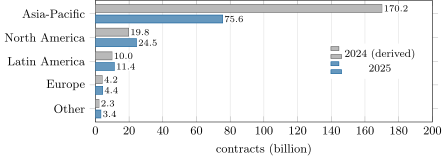
In 2024 more than four of every five futures and options contracts traded on the world’s exchanges changed hands in Asia-Pacific; a year later, under two in three, and the world total had fallen by four tenths while futures volume rose. No crisis had occurred. A regulator had decided that a contract which individuals were buying in enormous numbers was too small and expired too often, and rewrote its specification. Twelve years earlier another regulator had done the same thing to what was then the most traded option in the world, for the same reason. Options markets outside the United States are national, each with one dominant exchange, its own contract design, its own retail population and its own regulator’s view of both. This chapter gives the tools for comparing them, which begin with refusing to count contracts.
27.1 Three ways to measure a market
Definition 27.1 (Lot size, notional and premium turnover)
The lot size of a derivative is the number of units of underlying per contract: another name for the multiplier, used where contracts are specified in shares or index units per lot. Notional turnover is contracts times lot size times the underlying’s price. Premium turnover is, for options, contracts times lot size times the option’s price: the money that actually changed hands.
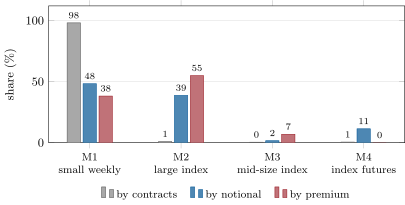
The three measures answer different questions. Contracts measure messages and exchange fees. Notional measures the exposure that changed hands, and overstates it for options, most of which are far out of the money. Premium measures the money at stake and the revenue pool available to market makers, whose spread is a fraction of the premium. Figure 27.1 ranks four invented markets, in realistic proportions, three ways.
27.2 Europe
European equity options are concentrated on two exchange groups, each the home of its national indices and shares, each clearing in its own house (Chapter 23). The flagship is the option on the euro-area blue-chip index: European-style, cash-settled, € 10 a point like its future, hedged with that future and quoted against it. Three features distinguish these markets from the American one. A large share of institutional volume is negotiated bilaterally and registered with the exchange as a block, so that the screen shows a fraction of the activity. Retail participation in listed options is small; individuals who want leverage buy bank-issued warrants and certificates, a parallel market with its own venues and its own market makers, the issuers themselves. And there is one order book per product, so that the routing and auction machinery of Chapter 24 has no equivalent: the structure is that of a futures exchange.
27.3 Korea
In the 2000s the most traded derivative in the world, by contracts, was the option on the Korean blue-chip index: a small contract, cheap out-of-the-money strikes, and a very large population of individual traders.
As of June 2012 — The multiplier, times five
On 14 June 2012 the contract size of the index option was raised from 100 000 to 500 000 won per point, on the home exchange and on the European exchange that listed a linked product.
The change multiplied the price of the cheapest lottery ticket by five. Contract counts must fall fivefold if activity is unchanged; how much activity itself falls is the question of exercise 3. It is the template for what followed elsewhere, and a standing warning for any firm whose business depends on one market’s retail flow: the contract specification is a policy instrument.
27.4 India
Definition 27.2 (Weekly expiry and position limit)
A weekly expiry is an option expiry listed each week on a fixed weekday, in addition to the monthly cycle. A position limit is a cap set by an exchange or regulator on the size of the position one participant or group may hold in a contract, measured on a stated basis (gross or net, in contracts, notional or delta-adjusted) and monitored at stated times.
By 2024 the Indian index options market was the largest in the world by contracts, by an order of magnitude: small lots, several indices each with a weekly expiry on a different weekday, so that some index expired every day, and millions of individuals trading options on their expiry day.
As of September 2026 — What the regulator found, and did
The study. The securities regulator’s study published on 23 September 2024 found that 93% of individual traders in equity derivatives lost money over the three financial years to March 2024, with aggregate losses above 1.8 trillion rupees. The measures. Its circular of 1 October 2024 set the contract value of index derivatives at 1.5 to 2 million rupees when reviewed (from 20 November 2024), allowed each exchange weekly expiries on only one benchmark index, required option premiums to be collected upfront from buyers, removed the margin benefit of calendar spreads on expiry day, added a 2% extreme-loss margin on short options on expiry day, and introduced intraday monitoring of position limits. The order. On 3 July 2025 the regulator issued an interim order against a foreign proprietary trading group, alleging manipulation of a bank index on expiry days between January 2023 and 2025, and impounded 48.4 billion rupees of alleged gains. The group deposited the amount on 14 July 2025 while reserving its right to contest the order. The matter was not decided at the time of writing.
27.5 The expiry-day case
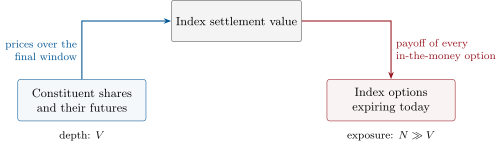
Set aside the question of what one firm did, which a tribunal will answer, and consider the structure that the order describes, because it is general. An index has a few dozen constituents whose cash and futures markets have a certain depth. Options on the index, expiring today, have a notional turnover many times that depth. The options settle on the index’s closing value, computed from the constituents’ prices over the final minutes. Then a participant large enough to move the constituents by a fraction of a percent changes the payoff of an options position many times larger than the shares traded.
Proposition 27.3 (Leverage of the settlement)
Let a participant hold index options with aggregate delta-one-equivalent exposure at expiry (the notional of the options that finish in the money), and let moving the index’s settlement value by a fraction cost in impact on the underlying shares. The payoff changes by . With the square-root rule, for the shares traded to produce , so for small the gain is linear and the cost cubic: whenever is large relative to the depth of the underlying, some is profitable.
Proof. Under Method 2.6, impact , so the quantity needed is and the cost of trading it, quantity times average impact, is proportional to . ∎
This is why settlement procedures use averages over a window, why regulators monitor expiry-day positions intraday, and why a firm’s compliance function must look at its cash and derivatives books together: trades that are each defensible as hedging or arbitrage can, in combination and with intent, constitute manipulation, and the pattern is visible afterwards in exactly the data the firm itself keeps. The distinction between moving a price as a by-product of legitimate trading and trading in order to move it is drawn by law, not by arithmetic, and differs by jurisdiction; One Quant Book 16 returns to it.
27.6 Other Asian markets
Elsewhere in Asia the picture is closer to Europe’s: one derivatives exchange per country, index options as the main product, European exercise and cash settlement, futures-style market structure. Japan’s and Hong Kong’s index options are dominated by institutions and by the hedging of structured products sold to individuals, whose issuers are structurally long or short volatility in ways that shape the local surface; Taiwan’s index options have a large retail share. For a trading firm the questions of Chapter 12 come first in each: who may trade, through whom, with what position limits, under what tax.
27.7 Tutorial: three rankings
Goal. Convert contract counts into notional and premium turnover in one currency, rank markets three ways, and compute what a lot-size change should do to a contract count. End state: the two data figures of this chapter.
One record per market.
@dataclass(frozen=True)
class MarketStats:
    name: str
    kind: str                       # 'option' or 'future'
    contracts: float                # contracts traded in the period
    multiplier: float               # units of underlying per contract (the lot size, for Indian contracts)
    underlying: float               # average level of the underlying, local currency
    avg_premium: float              # average option premium per unit of underlying, local currency (0 for futures)
    fx_to_usd: float                # US dollars per unit of local currency

    @property
    def notional_usd(self) -> float:
        return self.contracts * self.multiplier * self.underlying * self.fx_to_usd

    @property
    def premium_usd(self) -> float:
        """Money that actually changed hands for options. For futures there is no premium: None-like 0."""
        return self.contracts * self.multiplier * self.avg_premium * self.fx_to_usd

    @property
    def premium_to_notional_bp(self) -> float:
        return self.avg_premium / self.underlying * 1e4
Listing 27.1. Contracts, lot, underlying, premium, currency: three measures of turnover. code/firm/turnover/firm_turnover.py Lot changes. If notional activity is unchanged, tripling the lot divides the count by three; the count observed afterwards tells how much activity was lost.
def contracts_after_lot_change(contracts: float, old_lot: float, new_lot: float, activity_kept: float = 1.0) -> float:
    """Contracts one should expect after a lot-size change if traders keep `activity_kept` of their
    NOTIONAL activity: a tripled lot with unchanged activity divides the count by three."""
    return contracts * old_lot / new_lot * activity_kept


def activity_kept(contracts_before: float, contracts_after: float, old_lot: float, new_lot: float) -> float:
    """Inverse question: what happened to notional activity, given the counts before and after?"""
    return contracts_after * new_lot / (contracts_before * old_lot)
Listing 27.2. The arithmetic of a lot-size change, in both directions. code/firm/turnover/firm_turnover.py
What to change next. Replace the average premium by a distribution over strikes and estimate a market maker’s revenue pool as half the quoted spread times the premium turnover, by market.
27.8 Build: the turnover normaliser
Purpose. When the miniature firm’s strategy committee asks which market to enter next, the first slide must not be a league table of contracts.
Interface. MarketStats(name, kind, contracts, multiplier, underlying, avg_premium, fx_to_usd) with notional_usd, premium_usd, premium_to_notional_bp; shares(markets, measure); ranking(markets, measure); contracts_after_lot_change(…); activity_kept(…).
Rules. One currency for every comparison, with the exchange rate stored beside the data. Futures have no premium turnover and are excluded, with an error, from a premium ranking of futures alone. Ties are broken by name.
Acceptance tests. code/firm/turnover/tests/: units; three measures giving three rankings; the lot-change arithmetic both ways.
Stretch. Delta-adjusted notional for options, from a strike distribution of volume.
Sources and further reading
- Securities and Exchange Board of India, press release of 23 September 2024 on the updated study of individual traders in equity derivatives; circular SEBI/HO/MRD/TPD-1/P/CIR/2024/132 of 1 October 2024.
- Securities and Exchange Board of India, interim order of 3 July 2025 in the matter of index manipulation; commentary: “Jane Street and the Expiry Day Trap”, Oxford Business Law Blog, July 2025.
- Eurex, “Eurex and Korea Exchange further expand their link” (on the June 2012 change of contract size).
- FIA, ETD Volume — December 2025.
27.9 Exercises
Exercise 27.1 ★
An index option has a lot of 25, the index is at 22 000 rupees and the option costs 35 rupees per unit. With the rupee at $0.012, give the notional and the premium of one contract in dollars.
Solution
Solution of Exercise 27.1.
Notional ; premium .
Exercise 27.2 ★
Same for an index option with a multiplier of 100, the index at 5 600 dollars and a premium of 16. How many contracts of the previous exercise make the premium of one of these?
Solution
Solution of Exercise 27.2.
Notional $560 000; premium $1 600. One such contract carries the premium of 152 of the small ones, and the notional of 85.
Exercise 27.3 ★
A contract trades 90 billion times a year with a lot of 25. The lot is raised to 75. What count should be expected if notional activity is unchanged? The count turns out to be 24 billion. What happened to activity?
Solution
Solution of Exercise 27.3.
30 billion. With 24 billion observed, notional activity is of what it was: a fifth of the activity left with the smaller participants.
Exercise 27.4 ★★
From Figure 27.2 compute Asia-Pacific’s share of world contracts in 2024 and in 2025, and the world total in 2024. Check the total against the published fall of 42.2%.
Solution
Solution of Exercise 27.4.
2024: billion; Asia-Pacific 82%. 2025: . Check: .
Exercise 27.5 ★★
A market maker earns on average a quarter of the quoted spread, and spreads are 4% of premium in market M1 and 1.5% in M2. Using premium turnover of $945 billion and $1 360 billion, estimate the revenue pool in each. Which market would you enter, and what else would you need to know?
Solution
Solution of Exercise 27.5.
M1: billion. M2: billion. M1’s pool is larger despite its smaller premium turnover, because spreads are wide. Before entering: fees and taxes; who may trade and in what legal form; how much of the pool incumbents with better access already take; the adverse selection in each flow; and how long the contract specification will stay as it is.
Exercise 27.6 ★★
Give two reasons why a settlement value computed as an average over the last thirty minutes is harder to move than a last-trade price, and one cost of using it.
Solution
Solution of Exercise 27.6.
The mover must sustain the pressure for thirty minutes instead of one print, against arbitrageurs who have time to lean the other way; and each minute’s price counts for a thirtieth. Cost: nobody can trade at the settlement value, so hedgers who want to exit at settlement must execute a schedule over the window and bear tracking error against the average.
Exercise 27.7 ★★★
Coding. With the four markets of the tutorial, print the three tables of shares. Then change M1’s lot to 75 with activity_kept of 0.8 and print them again. Which shares move?
Solution
Solution of Exercise 27.7.
Before: contracts 98.1 / 0.9 / 0.4 / 0.5%; notional 48.3 / 38.7 / 1.6 / 11.4%; premium 38.2 / 54.9 / 6.9 / 0%. After (M1 at 24 billion contracts of lot 75): M1’s share of contracts falls to about 93%, still overwhelming, while its notional and premium, each 80% of before, give shares of about 43% and 33%. The contract table hardly notices a change that removed a fifth of the market’s activity.
Exercise 27.8 ★★★
Find the flaw. A desk head: “In the morning we bought bank stocks because they were cheap to futures. In the afternoon we sold them because our risk limit required it. Separately, our options desk was short the index. Each trade has its own rationale, so there is nothing to explain.” What is missing from this defence?
Solution
Solution of Exercise 27.8.
The combination. A regulator, and a court, will look at the firm as one entity: a large short index-options position whose payoff depends on the closing index, held while the same firm’s trades in the constituents move that index, first up while the options are being sold, then down into the settlement. Each leg’s local rationale does not answer the question of intent for the whole, and the firm’s own records show the whole. What is missing is a control that aggregates exposure to the settlement across desks, limits trading in the underlying by whoever benefits from its effect on a derivative, and documents the reasons before the trade.
27.10 Problem: Counting Contracts
Problem 27.1
Weekend problem — where is the money?
A firm compares two index option markets for a year. M1: 90 billion contracts, lot 25, index 22 000 rupees, average premium 35 rupees, rupee at $0.012, spreads 4% of premium, exchange and regulatory fees 0.05% of premium turnover, a transaction tax on option sales of 0.1% of premium. M2: 850 million contracts, multiplier 100, index $5 600, average premium $16, spreads 1.5% of premium, fees $0.50 a contract for a market maker.
Part I — Three measures.
- Give the ratio of contracts, M1 to M2.
- Give each market’s notional turnover in dollars.
- Give each market’s premium turnover in dollars.
- Give the premium turnover ratio, M2 to M1.
- Give premium as basis points of notional in each. What does the difference say about what is being traded?
Part II — A revenue pool.
- If market makers collectively earn a quarter of the spread on all premium, give each market’s gross pool.
- Give M1’s tax and fees on the makers’ side, assuming makers are on one side of every trade and sell half the time.
- Give M2’s fees for makers on one side of every trade.
- Give the net pools.
- What fraction of each pool could a new entrant realistically win, and what determines it?
Part III — Policy risk.
- M1’s regulator triples the lot and removes four of five weekly expiries. Contracts fall to 24 billion. Give the notional activity kept.
- Give the new premium turnover if the average premium per unit is unchanged.
- Recompute M1’s net pool.
- The firm had hired twelve people and rented co-location for M1. What is the lesson for the business plan?
Part IV — Judgement.
- Why did M1’s regulator act? Use Box 27.2.
- Who was on the other side of the individuals’ losses?
- Does that make market making in M1 illegitimate? Where is the line that Proposition 27.3 points to?
- A foreign firm entering M1 needs what, besides a strategy?
- State the named result: the premium turnover ratio, M2 to M1.
- In one sentence: what does a league table of contracts measure?
Solution
Solution of Problem 27.1.
1. to 1. 2. M1: trillion. M2: trillion. 3. M1: billion. M2: billion. 4. 1.44. 5. 15.9 and 28.6 basis points. M1’s options are cheaper relative to their underlying: shorter-dated and further out of the money, lottery tickets on the day’s move. 6. M1: billion. M2: billion. 7. Fees billion; tax on the half of premium that makers sell, billion: $0.94 billion. 8. billion. 9. $8.51 billion and $4.67 billion. 10. A small one at first. It depends on access (membership, co-location, market-maker status and its privileges), on speed and pricing quality relative to incumbents, and on which part of the flow it sees: the pool’s average spread is earned on benign flow that incumbents with entitlements see first. 11. . 12. billion. 13. billion, a fifth less; and the participants who left were the least informed, so spreads earned on the remainder are likely to be lower too. 14. A business built on one market’s retail flow has a policy risk that no model hedges: the regulator can change lot, expiries, margins or access in a quarter. Size fixed costs to the market that would survive such a change, and hold a second market. 15. Its study found 93% of individual traders losing money, in aggregate more than 1.8 trillion rupees in three years, much of it in expiry-day options. Larger contracts, fewer weekly expiries, upfront premium and extra expiry-day margin all raise the price of the cheapest bet. 16. Transaction costs, brokers and exchanges first; then the counterparties with better pricing and execution: proprietary firms and foreign investors, largely algorithmic. 17. No: quoting two-sided prices to willing buyers is the service. The line is crossed when a participant trades the underlying in order to move the settlement on which its options depend; the proposition shows that the temptation is structural wherever the options market dwarfs its underlying, which is why the surveillance is too. 18. A legal route (registration category, local entity or partner), a clearing member, tax structuring, position limits that fit the strategy, local compliance staff, and an understanding of how the regulator views foreign proprietary trading. 19. 1.44: the market with 1% of the contracts has 44% more premium turnover. 20. The number of times a matching engine printed a trade, which is the exchange’s revenue driver and nobody else’s.
27.11 Interview questions
Interview question 27.1 ★ trader, researcher
An exchange claims to be “the world’s largest derivatives exchange”. What do you ask?
Solution
Solution of Interview question 27.1.
By what measure: contracts, notional or premium? What is the lot size and how has it changed? How much is options against futures, index against single-stock, how much expires the same day? Who trades: the individual share, and the share of proprietary firms? And what would the ranking be in premium turnover, which is the money.
What the interviewer is looking for: the three measures without prompting.
Interview question 27.2 ★ trader, researcher, bank
How do listed options markets in Europe differ from those in the United States?
Solution
Solution of Interview question 27.2.
One exchange and one clearing house per product, not many exchanges on one clearing house: no fungibility across venues, no national best bid and offer, no price-improvement auctions. Index options are European-style and cash settled, hedged against the local index future. Much institutional size trades as negotiated blocks. Retail demand for leverage goes largely to bank-issued warrants and certificates, not to listed options.
What the interviewer is looking for: the clearing structure as the root difference.
Interview question 27.3 ★★ researcher, trader
A regulator triples the minimum contract size of index options. Predict the effects on volume, on participants and on market makers’ revenue.
Solution
Solution of Interview question 27.3.
Contracts fall by at least the factor of three mechanically. Notional and premium fall less, by however many participants are priced out: the smallest accounts, whose minimum ticket has tripled. Remaining flow is somewhat better capitalised and better informed; spreads in premium terms may tighten. Market makers lose the most benign flow; exchanges lose fee revenue per unit of notional if fees are per contract. Some activity migrates to other leveraged products.
What the interviewer is looking for: mechanical versus behavioural effects.
Interview question 27.4 ★★ trader, researcher
Why are cash-settled index derivatives vulnerable around their settlement, and how do exchanges defend against it?
Solution
Solution of Interview question 27.4.
Their payoff depends on a number computed from a few prices in a short window, in a market that may be far smaller than the derivative positions referencing it, so moving the underlying slightly can be worth more than it costs. Defences: settlement on an average over a window or on an auction with imbalance information and price collars; position limits monitored intraday on expiry day; higher margins on expiry day; surveillance that joins participants’ cash and derivatives activity; and spreading expiries away from single thin underlyings.
What the interviewer is looking for: the size mismatch and at least three defences.
Interview question 27.5 ★★ trader, bank
Your cash desk and your options desk are both active in the same index on expiry day. What controls do you want?
Solution
Solution of Interview question 27.5.
A firm-wide view, in real time, of exposure to the settlement value across all desks and entities. A rule that whoever benefits from the index moving may not trade the constituents aggressively in the settlement window, or only through a pre-approved schedule. Pre-trade documentation of the reason for large cash trades on expiry day. Limits on the firm’s share of volume in the constituents during the window. Independent review of expiry-day P&L attribution. And escalation when an exchange or regulator asks questions.
What the interviewer is looking for: aggregation across desks, and documentation before the trade.
Interview question 27.6 ★★★ researcher, trader
You are asked to evaluate entering a fast-growing retail options market abroad. Structure the analysis.
Solution
Solution of Interview question 27.6.
Size in money: premium turnover, spreads, hence the revenue pool; then fees and taxes. Flow: who trades, how informed, how concentrated in time (expiry days). Access: legal form, membership, co-location, market-maker programmes and their obligations, position limits. Competition: incumbents’ share and edge. Policy: the regulator’s stated concerns, recent and pending changes to lots, expiries and margins, attitude to foreign proprietary firms; scenario with the pool cut by half. Operations: clearing, collateral, currency, tax, staff. Exit: fixed costs recoverable if the rules change.
What the interviewer is looking for: policy risk as a first-class item, with a scenario.