Markets I: The Ecosystem and Exchange-Traded Markets · Markets
9US Equity Market Structure
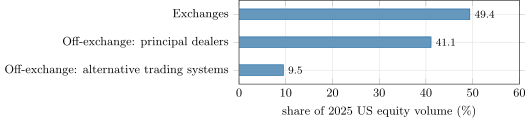
One hundred shares of a large American company can be bought, at this instant, on more than a dozen stock exchanges, in dozens of dark pools and from dealers who never show a quote to anyone. More than half of the 17.6 billion shares that changed hands on an average day of 2025 did so on none of the exchanges. For two decades a single regulation has tied these places together by decreeing which of their prices is “the” price and forbidding trades at worse ones; in June 2026 the regulator proposed to repeal that decree. This chapter describes the machine as it stands: the rules, the consolidated quote they create, the two speeds at which that quote can be known, the fee games played around it, and the half of the market that lives off-exchange.
9.1 Regulation NMS
The Securities and Exchange Commission adopted Regulation National Market System in 2005. Four of its rules shape every order.
Definition 9.1 (Protected quotation, trade-through, order protection rule)
A protected quotation is the best bid or best offer of an exchange that is displayed, automated and immediately accessible. A trade-through is the execution of a trade at a price inferior to a protected quotation displayed elsewhere: a purchase above another venue’s protected offer, or a sale below its protected bid. The order protection rule (Rule 611) requires every trading centre to have policies reasonably designed to prevent trade-throughs.
Definition 9.2 (Access fee cap)
The access fee cap (Rule 610(c)) limits what a venue may charge for executing against its protected quotation: $0.003 a share (“30 mils”) for stocks priced at a dollar or more. Without it a venue could display an attractive price that the protection rule forces others to route to, and charge whatever it liked for reaching it.
Rule 610 also forbids quotations that lock or cross the market (a bid equal to, or above, another venue’s offer). Rule 612, the sub-penny rule, fixes the minimum quoting increment at one cent for stocks at or above a dollar. Rule 603 governs the distribution of market data, to which we return below.
As of September 2026 — Regulation NMS in motion
In September 2024 the SEC adopted amendments creating a half-cent quoting increment for “tick-constrained” stocks and cutting the access fee cap to $0.001. Neither is in force: by an order of 11 June 2026 compliance with both is deferred to the first business day of November 2027. On the same day the SEC proposed to rescind Rule 611 and the ban on locked and crossed markets altogether, with a 60-day comment period. The rest of this chapter describes the rules in force; read the proposal’s current status before building anything that depends on them.
9.2 The national best bid and offer
Definition 9.3 (Round lot and odd lot)
A round lot is the standard trading unit that a quotation must reach to be protected; an odd lot is any smaller quantity.
As of September 2026 — Round lots by price
Since 3 November 2025 the round lot depends on the stock’s average closing price over the previous evaluation period: 100 shares up to $250.00; 40 shares from $250.01 to $1 000.00; 10 shares from $1 000.01 to $10 000.00; 1 share above. From the same date the consolidated tapes quote sizes in shares instead of lots. Until then a bid for 50 shares of a $3 000 stock, worth $150 000, was an odd lot: neither protected nor included in the NBBO.
Definition 9.4 (National best bid and offer)
The national best bid and offer (NBBO) of a stock is the highest protected bid and the lowest protected offer across all exchanges, with the total size displayed at each of those prices.
Example 9.5 (Three venues)
Venue X shows (300 by 500 shares), venue Y (200 by 100), venue Z (400 by 900). The NBBO is , 600 by 600: the bid from Y and Z, the offer from X and Y. A broker that fills a client’s market purchase at 10.03 while X and Y offer at 10.02 has traded through two protected quotations. If a fourth venue bids 10.015 for 60 shares, nothing changes: an odd lot is not protected. The NBBO is the benchmark of every execution-quality statistic of Chapter 10; it is also, as we now see, not a single thing.
9.3 One market, two clocks
Definition 9.6 (Securities information processor and direct feed)
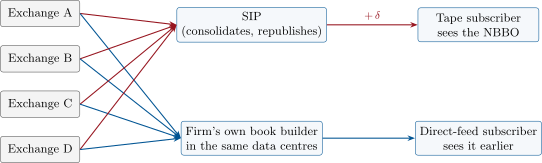
A securities information processor (SIP) collects the best quotes and the trades of every exchange, computes the NBBO, and publishes the consolidated tape. A direct feed is the proprietary data stream sold by an exchange, carrying its full order book, from which a subscriber can compute its own consolidated view.
Proposition 9.7 (How often the tape is wrong)
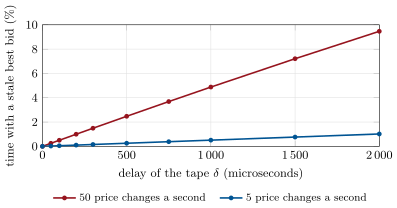
Suppose the best bid changes at the times of a Poisson process of rate , and the tape reports each change later than a direct-feed reader observes it. If , the fraction of time during which the two views differ is approximately .
Proof. Each change opens an interval of length during which the tape still shows the old bid. When these intervals overlap with negligible probability, and over a period they cover in expectation. ∎
Example 9.8 (Half a percent of the time, all of the trades that matter)
With five changes a second and millisecond, the tape is stale 0.5% of the time; in a burst of fifty changes a second, 5% (Figure 9.2). The fraction looks negligible and is not: these are precisely the moments when the price is moving, and an order priced off the stale view is filled because it is stale. A quote that has not yet followed a two-cent move can be bought one cent below the new fair value; in the tutorial’s simulated stock the slower venues offer 3 636 such opportunities in ten minutes. Who is allowed to take them, and how venues defend their slow participants, is the business of One Quant Book 11.
9.4 Exchange families and the fee game
Most exchanges belong to a few groups, each operating several venues with different fee schedules on nearly identical technology. The reason is the access fee cap: venues cannot compete on the displayed price, which the tick fixes at a cent, so they compete inside the cap, on who pays whom.
Definition 9.9 (Maker-taker pricing and inverted venue)
Under maker-taker pricing a venue charges the order that removes liquidity (the taker) a fee and pays the resting order it executed against (the maker) a smaller rebate, keeping the difference. An inverted venue does the opposite: it pays the taker and charges the maker.
Proposition 9.10 (Fees are a finer tick)
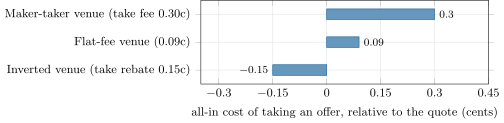
Let two venues display the same offer . A buyer taking liquidity pays on a venue with taker fee and on an inverted venue with taker rebate . A rational taker therefore hits the inverted venue first: a maker who posts there is at the front of a cross-venue queue, for a price, and receives with the inverted venue’s maker fee.
Proof. Immediate from the definitions; the ordering of venues by all-in price is strict although the displayed prices are equal. ∎
Example 9.11 (Buying priority)
With illustrative fees inside the cap: on a maker-taker venue a seller resting at 10.00 earns a rebate of 0.20 cent but waits behind everyone who arrived earlier; on an inverted venue it pays 0.18 cent and is executed ahead of every maker-taker venue, because takers collect 0.15 cent for going there first. The difference, 0.38 cent, is the price of jumping the queue in a market whose tick is one cent. A market maker chooses per stock and per moment: where the queue is long and the spread is one tick, priority is worth buying (Figure 9.3).
Definition 9.12 (Intermarket sweep order)
An intermarket sweep order (ISO) is a limit order marked so that the receiving venue may execute it at once without checking other venues’ protected quotations, because the sender has simultaneously routed orders to take out every better-priced protected quotation elsewhere. Compliance with the order protection rule moves from the venue to the sender.
The ISO is how every large or fast participant actually trades: it sends, in the same microsecond, one order per venue, sized to the displayed quantity, and so sweeps several price levels across the market before any venue can re-route anything. Without it an order for more than the size at the best price would have to crawl through the venues one routing decision at a time.
9.5 The off-exchange half
Definition 9.13 (Dark pool)
A dark pool is an alternative trading system (Definition 4.12) that displays no quotations: orders rest unseen and execute against each other at prices derived from the NBBO, most often its midpoint.
Trades that occur off-exchange are still public: they are reported within seconds to a trade reporting facility and appear on the tape without the name of the place. They come from two sources. Dark pools serve institutions that do not want to reveal a large order and are content to wait for a match at the midpoint. Principal dealers — wholesalers executing retail brokers’ orders against their own inventory (Chapter 10) and banks’ single-dealer platforms — trade as counterparty, not as venue.
As of September 2026 — Where US shares traded in 2025
Average daily volume in 2025 was 17.6 billion shares worth $1.1 trillion, up about 45% on 2024. The trade reporting facilities’ share of consolidated volume reached 50.6%, above one half for the first time over a full year; 81.3% of that off-exchange volume was executed by principal dealers and 18.7% on alternative trading systems, according to one exchange group’s annual review.
Remark 9.14 (Why the split worries regulators)
Off-exchange trades are priced from the NBBO and contribute nothing to it: they free-ride on displayed quotes. If the orders least dangerous to a market maker — retail orders — are executed away from exchanges, the orders that do reach exchanges are on average better informed, exchange spreads widen (Proposition 1.12), and the benchmark against which off-exchange “price improvement” is measured becomes easier to beat. Whether this loop is large in practice is one of the most contested empirical questions in market structure.
9.6 Speed bumps
If Proposition 9.7 describes a harm, a venue can sell protection from it. In 2016 the SEC approved as an exchange a venue, IEX, whose every inbound and outbound message passes through 38 miles of coiled optical fibre, a delay of 350 microseconds, while the venue’s own view of the market is not delayed. Resting orders pegged to the midpoint are therefore repriced by the venue before a fast trader who has seen the same move can reach them. The Commission held that a delay of this size is de minimis: the venue’s quotations remain “immediately accessible” and protected. The debate about who should bear the cost of speed is far from closed.
9.7 Tutorial: building an NBBO and timing the tape
Goal. Consolidate per-venue quotes into an NBBO, flag locked and crossed markets and trade-throughs, then measure how stale a delayed tape is. End state: the numbers of Example 9.5 and Figure 9.2.
The builder, as it runs inside the firm’s trading process: a fixed table of venues, no allocation, one pass per update.
    std::optional<Nbbo> nbbo() const {
        Nbbo n{0, 0, 0, 0, 0, 0};
        bool has_bid = false, has_ask = false;
        for (std::size_t v = 0; v < kMaxVenues; ++v) {
            const Quote& q = quotes_[v];
            if (!q.live) continue;
            if (q.bid_size >= round_lot_) {
                if (!has_bid || q.bid > n.bid) { n.bid = q.bid; n.bid_size = 0; n.bid_venues = 0; has_bid = true; }
                if (q.bid == n.bid) { n.bid_size += q.bid_size; n.bid_venues |= 1u << v; }
            }
            if (q.ask_size >= round_lot_) {
                if (!has_ask || q.ask < n.ask) { n.ask = q.ask; n.ask_size = 0; n.ask_venues = 0; has_ask = true; }
                if (q.ask == n.ask) { n.ask_size += q.ask_size; n.ask_venues |= 1u << v; }
            }
        }
        if (!has_bid || !has_ask) return std::nullopt;
        return n;
    }
Listing 9.1. Recomputing the NBBO from the venue table: protected sizes only, ties pooled. code/firm/nbbo/cpp/firm_nbbo.hpp - Check it on three venues. The acceptance tests replay Example 9.5: best bid 10.01 for 600 shares on two venues; an odd-lot bid of 10.015 ignored until it reaches a round lot; a purchase at 10.03 flagged as a trade-through.
Simulate two clocks. Jumps of one to three ticks arrive at Poisson times; each venue reprices after its own delay; the tape adds .
def venue_mid(times, level, delay_us, t):
    """Mid (in ticks) quoted by a venue at times t, given its repricing delay."""
    k = np.searchsorted(times + delay_us * 1e-6, t, side="right")
    return np.where(k > 0, level[np.maximum(k - 1, 0)], 0)


def best_bid(times, level, delays_us, t, extra_us=0.0):
    """Best bid across venues: each quotes mid - 1 tick."""
    return np.max([venue_mid(times, level, d + extra_us, t) for d in delays_us], axis=0) - 1


def stale_fraction(m: Market, sip_delay_us: float, seed: int = 9) -> float:
    """Fraction of time during which the tape's best bid differs from the direct-feed best bid."""
    times, level, _ = jumps(m, seed)
    cuts = np.sort(np.concatenate([times + (d + e) * 1e-6 for d in m.venue_delays_us for e in (0.0, sip_delay_us)]
                                  + [[0.0, m.seconds]]))
    cuts = cuts[(cuts >= 0.0) & (cuts <= m.seconds)]
    mids, widths = 0.5 * (cuts[1:] + cuts[:-1]), np.diff(cuts)
    direct = best_bid(times, level, m.venue_delays_us, mids)
    tape = best_bid(times, level, m.venue_delays_us, mids, extra_us=sip_delay_us)
    return float(widths[direct != tape].sum() / m.seconds)
Listing 9.2. Each venue’s quote as a step function of time, and the measure of the set where tape and direct view differ. code/markets-1/09-us-equity-market-structure/python/stale_tape.py - Compare with the proposition. At microseconds and per second the simulation gives 0.51% against a predicted 0.50%; at , 4.9% against 5%, the shortfall being the overlaps the proposition neglects.
What to change next. Give one venue a 350-microsecond speed bump on incoming orders only, and count how many of its stale quotes survive. Then add an inverted venue and route a taker by all-in price.
9.8 Build: the consolidated quote
Purpose. Every strategy, router and execution report of the miniature firm needs the best bid and offer across venues, computed by the firm itself from direct feeds (the feed handlers are built in One Quant Book 13).
Interface. NbboBuilder(round_lot); update(venue, bid, bid_size, ask, ask_size) returning the new NBBO if it changed; nbbo(); trades_through(side, price). The NBBO carries prices, pooled sizes, the set of venues at each price, and locked and crossed flags.
Rules. Integer prices. A quote smaller than the round lot is stored but not protected. A missing side means no NBBO. In C++ and Rust: a fixed venue table, no allocation and no locking on the update path; venues are small integers and the venue sets are bit masks.
Acceptance tests. code/firm/nbbo/tests/, cpp/ and rust/: the three-venue example; odd lots; change detection; locked and crossed; trade-through; rejection of malformed quotes.
Stretch. Per-symbol round lots from a reference table (Box 9.2); a second, fee-adjusted best bid and offer using each venue’s taker fee (Proposition 9.10).
Sources and further reading
- US Securities and Exchange Commission, Regulation NMS, Release 34-51808, Federal Register 70 (29 June 2005).
- US Securities and Exchange Commission, Fact Sheet: Regulation NMS Reforms (proposal of 11 June 2026, Release 34-105655); Release 34-105656, order granting temporary exemptive relief, 11 June 2026; press release 2024-137 (amendments of 18 September 2024).
- Cboe Global Markets, Regulation NMS Round Lots Enhancements FAQ, 28 October 2025; 2025 U.S. Equities Year in Review.
- US Securities and Exchange Commission, Release 34-78102, Commission Interpretation Regarding Automated Quotations Under Regulation NMS, June 2016; IEX, The speed bump.
- E. Budish, P. Cramton and J. Shim, “The high-frequency trading arms race”, Quarterly Journal of Economics 130 (2015).
- M. O’Hara, “High frequency market microstructure”, Journal of Financial Economics 116 (2015).
9.9 Exercises
Exercise 9.1 ★
Four venues quote a stock with a 100-share round lot: A (500 by 200), B (100 by 300), C (300 by 50), D (80 by 400). Give the NBBO with sizes and venues.
Solution
Solution of Exercise 9.1.
D’s bid (80 shares) and C’s offer (50 shares) are odd lots and are ignored. Best bid 25.11 for shares (B, C); best offer 25.13 for 300 shares (B): , 400 by 300.
Exercise 9.2 ★
Using Box 9.2, give the round lot of stocks priced at $48, $251, $999, $4 200 and $712 000, and the dollar value of one round lot of each.
Solution
Solution of Exercise 9.2.
100 shares ($4 800); 40 ($10 040); 40 ($39 960); 10 ($42 000); 1 ($712 000).
Exercise 9.3 ★
From Box 9.3, compute the average daily number of shares executed on exchanges, by principal dealers and on alternative trading systems, and the average price of a share traded.
Solution
Solution of Exercise 9.3.
Exchanges billion shares; principal dealers billion; alternative trading systems 1.7 billion. Average price .
Exercise 9.4 ★★
With the NBBO of exercise 1, a broker executes a client’s purchase of 200 shares at 25.14 on venue A. Which protected quotations were traded through? What should the broker have sent, and marked how, to buy 500 shares immediately and lawfully?
Solution
Solution of Exercise 9.4.
B’s protected offer of 25.13 for 300 shares was traded through. To buy 500 at once: intermarket sweep orders sent simultaneously for 300 at 25.13 to B and for 200 at 25.14 to A. (C’s 50 shares at 25.13 are unprotected; taking them too is good execution, not an obligation.)
Exercise 9.5 ★★
A maker-taker venue charges takers 0.30 cent and pays makers 0.25; an inverted venue pays takers 0.10 and charges makers 0.14. Both show an offer of 40.00. Give the all-in price paid by a taker and received by a maker on each, the venue’s revenue per share on each, and the price of priority.
Exercise 9.6 ★★
A stock’s best bid changes 12 times a second on average. Estimate the fraction of time a tape delayed by 600 microseconds shows a stale bid, and the number of seconds per 6.5-hour trading day. Why does the proposition overestimate slightly when changes cluster?
Solution
Solution of Exercise 9.6.
, that is 168 seconds a day. When changes cluster, several fall within one interval of length and the stale intervals overlap: their union is shorter than their sum.
Exercise 9.7 ★★★
Coding. With stale_tape, halve every venue’s repricing delay and recompute the stale fraction at microseconds and . Explain why the answer barely changes, and what quantity the venues’ delays do control.
Solution
Solution of Exercise 9.7.
0.255% in both cases. The tape’s staleness relative to a direct feed depends only on the extra delay : both views wait for the venues to reprice. The venues’ delays control something else — how long the quotes themselves lag the fair price, which is the window in which they can be sniped.
Exercise 9.8 ★★★
Find the flaw. A retail broker’s report states: “98% of our clients’ orders were executed at or better than the NBBO.” The broker computes the NBBO from the consolidated tape and timestamps each order on receipt at its own servers. Give two reasons why the statistic overstates execution quality, and one reason specific to high-priced stocks before November 2025.
Solution
Solution of Exercise 9.8.
(i) The benchmark is the tape’s NBBO, stale exactly when prices are moving: an execution “at the NBBO” during those intervals is worse than the true best price. (ii) Timestamping on receipt ignores the time the order then spent at the wholesaler or in routing; the fair comparison is with the NBBO at execution, and clock differences of a millisecond change the answer. (iii) In high-priced stocks the best prices were odd lots, excluded from the NBBO: the benchmark was wider than the real market, so “at or better” was easy. More generally, “at or better than” says nothing about size or about the midpoint, which is what the order could often have obtained.
9.10 Problem: A Stale Tape
Problem 9.1
Weekend problem — two views of one stock
A stock trades on four exchanges. Each quotes one tick (one cent) either side of its estimate of the fair price, for 300 shares a side. When the fair price jumps, the exchanges’ market makers reprice after 60, 150, 250 and 500 microseconds respectively. The consolidated tape reaches a subscriber 900 microseconds after a direct feed would. The fair price jumps 8 times a minute on average; 65% of jumps are of one tick, 25% of two ticks and 10% of three.
Part I — The tape.
- For what fraction of the time does the tape show a stale best bid?
- How many seconds is that in a 6.5-hour day?
- After an upward jump, which venue’s update moves the best bid on a direct feed, and after how long?
- After the same jump, when does the best offer move, and why is the answer different?
Part II — The snipe. A fast trader sees every direct feed and can reach any venue 40 microseconds after a jump.
- After an upward jump of ticks, which venues still show the old offer when the trader arrives?
- Buying at an old offer and valuing at the new fair price, what is the profit per share for ?
- Give the expected profit per share per jump, per stale venue.
- With 300 shares on each stale venue, give the expected profit per jump and per day if the trader wins every race.
- The trader pays a taker fee of 0.30 cent. Recompute the expected profit per share per jump per venue. Which jumps are still worth taking?
Part III — The defence.
- The slowest market maker loses what the trader wins. What does being sniped cost it per day, and per share it trades if it trades 400 000 shares a day?
- Its net capture before sniping was 0.35 cent a share. Is it still profitable?
- It can cut its delay to 30 microseconds for $2.5 million a year. Is the investment worth it, on 252 days?
- If all four market makers make that investment, what happens to the trader’s profit and to the market makers’ costs? What is this situation called?
- Alternatively the venue imposes a 350-microsecond delay on incoming orders. Which of its market makers’ quotes are now safe?
Part IV — The rule.
- A broker routes a client’s buy order using the tape. During a stale interval after an upward jump, where does it send the order, and what happens?
- Is the fill a trade-through under Rule 611? Explain with reference to what each venue displays at the time.
- The SEC’s 2024 amendments would cut the access fee cap to 0.10 cent. Redo question 9.
- Would rescinding Rule 611 remove the sniping opportunity?
- State the named result: the trader’s expected profit per share from a stale quote, per jump, net of the current taker fee, in cents.
- In one sentence, who pays for it in the end?
Solution
Solution of Problem 9.1.
1. . 2. 2.8 seconds. 3. The fastest venue’s, after 60 microseconds: a higher bid anywhere raises the best bid. 4. Only when the slowest venue reprices, after 500 microseconds: the best offer is the lowest, and the stale low offers remain the best until the last of them is gone. 5. All four: the fastest reprices at 60 microseconds and the trader arrives at 40. 6. Old offer , new fair value : profit ticks, that is 0, 1 and 2 cents. 7. cent. 8. per jump; with 3 120 jumps a day, $16 848. 9. cent: $12 917 a day. One-tick jumps lose the fee and are left alone; only jumps of two ticks or more are taken. 10. a day, 1.05 cent per share traded. 11. No: cent a share. It earns $1 400 a day and loses $4 212. 12. It would save $1.06 million a year for $2.5 million: not on these numbers. Its real choices are to quote wider, to quote smaller, or to stop. 13. Each would then again be slower than whoever invests next; the trader upgrades too, the sniping profit is unchanged or merely reallocated, and the industry has spent $10 million a year for nothing: an arms race, in which speed is valuable only relative to others. 14. A quote is safe if its market maker reprices before a delayed order can arrive, that is within microseconds: the three fastest. The slowest, at 500 microseconds, is still exposed. 15. To a venue still showing the old, lower offer; the order either arrives after the quote has been repriced or taken and is not filled, or executes against a fresh higher offer. The client chases the price. 16. No. Rule 611 compares the execution with protected quotations as displayed at the time; every venue’s displayed offer was at or above the price paid. The rule protects displayed prices, not fair ones, and says nothing about stale quotes. 17. cent: a lower fee cap makes sniping more profitable. 18. No: the opportunity comes from quotes lagging the fair price, not from routing obligations. Rescission would change who must route where, not the race to a stale quote. 19. 0.345 cent per share. 20. The investors who trade with the market makers, through the wider spreads and smaller sizes that pay for the losses of question 10.
9.11 Interview questions
Interview question 9.1 ★ trader, developer, researcher
What is the NBBO, who computes it, and why might two firms disagree about what it was at a given microsecond?
Solution
Solution of Interview question 9.1.
The highest protected bid and lowest protected offer across exchanges, with sizes. Officially the SIPs compute it; every serious firm computes its own from direct feeds. They disagree because each observer receives each venue’s update after a different delay and with a different clock: the NBBO is defined relative to a place and a time, and “the NBBO at 10:31:04.123456” has no unique answer.
What the interviewer is looking for: relativity of the consolidated view, not just “SIP is slow”.
Interview question 9.2 ★ trader, developer
What is an intermarket sweep order and why does it exist?
Solution
Solution of Interview question 9.2.
A limit order flagged to tell the receiving venue to execute without checking away markets, because the sender has simultaneously sent orders to clear every better-priced protected quote. It exists so that an order larger than the best displayed size can take several price levels on several venues in one instant instead of being rerouted level by level while the market moves away.
What the interviewer is looking for: responsibility for trade-through compliance shifting to the sender.
Interview question 9.3 ★★ trader, researcher
Why would anyone post liquidity on a venue that charges makers a fee when another venue pays them a rebate?
Solution
Solution of Interview question 9.3.
Takers hit the inverted venue first because it pays them, so a resting order there executes before the same price on any maker-taker venue: the fee buys time priority across venues. It is worth paying when the queue at the best price is long and the spread is pinned at one tick, so that priority, not price, decides who trades — and the fills obtained early, before the queue has been eaten, are also the less adversely selected ones.
What the interviewer is looking for: queue position as the thing being bought.
Interview question 9.4 ★★ developer
You must maintain the NBBO for 8 000 symbols from sixteen direct feeds with minimal latency. Describe your data structures and threading model.
Solution
Solution of Interview question 9.4.
Per symbol, a small fixed array of per-venue best quotes (prices as integers) plus the cached best bid and offer and venue bit masks; an update touches one slot and, only if it was at the best or improves it, a rescan of sixteen entries that fits in a cache line or two. Symbols in a dense array indexed by an integer identifier, not a hash of a string. One thread per feed decodes and writes; shard symbols across book-building threads so that each symbol has a single writer and no locks; publish to strategies through a sequence-locked snapshot or a ring buffer. Pin threads, pre-allocate everything, keep the hot structure contiguous.
What the interviewer is looking for: single-writer sharding and cache-aware layout.
Interview question 9.5 ★★ researcher, trader
More than half of US equity volume trades off-exchange. Is that a problem? For whom?
Solution
Solution of Interview question 9.5.
For retail investors mostly not: they get small price improvement and no commission. For institutions, dark pools reduce information leakage. The concern is for price formation: off-exchange trades use the NBBO without contributing to it, and if the least-informed flow is filtered away from exchanges, displayed spreads widen for everyone who must trade there, and the benchmark for “improvement” degrades. It is also a competition question: a few wholesalers see, and price, most retail flow.
What the interviewer is looking for: segmentation and adverse selection, with both sides.
Interview question 9.6 ★★★ researcher, trader
The regulator proposes to repeal the order protection rule. Predict three consequences for market structure and say how you would position a market-making firm for each.
Solution
Solution of Interview question 9.6.
(i) Venues need no longer route away or reject orders that would trade through: small exchanges that survive on protected-quote status lose flow, and volume concentrates; position connectivity and quoting capital on the venues likely to gain. (ii) Best execution becomes the broker’s judgement rather than a mechanical rule: brokers’ routers and their transaction-cost analysis matter more, so a market maker should expect more scrutiny of fill quality by venue and compete on it. (iii) Locked and crossed markets become legal: displayed prices across venues will overlap briefly, creating arbitrage for the fastest and new states that every quoting engine and risk check must handle. Also likely: more differentiated venue designs (delays, batch auctions) no longer constrained by protected-quote requirements.
What the interviewer is looking for: second-order effects and concrete firm actions, not a list of opinions.