Markets I: The Ecosystem and Exchange-Traded Markets · Markets
5Clearing and Settlement
At 5:11 on the morning of 28 January 2021 an automated notice arrived at a retail broker’s clearing arm. Overnight, the collateral that the US equity clearing house required from it had risen to about $3.7 billion. The firm had about $700 million on deposit; the remaining $3 billion was due by ten o’clock. Nothing had gone wrong with any trade. Its customers had bought enormous quantities of a few violently moving stocks, those purchases would not be paid for until two days later, and until then somebody had to stand behind them. That somebody is the subject of this chapter: what happens between the moment a trade is agreed and the moment it is final, who guarantees it meanwhile, and what that guarantee costs.
5.1 From trade to settlement
Definition 5.1 (Clearing and settlement)
Settlement is the final exchange of what was traded: securities move to the buyer, cash to the seller, and the trade can no longer be undone. Clearing is everything between execution and settlement: confirming the terms, computing who owes what to whom, netting, and managing the risk that a party fails before it has paid or delivered.
Definition 5.2 (Settlement cycle and settlement fail)
The settlement cycle is the standard delay between trade date and settlement date, written for business days. A settlement fail is an obligation not met on its settlement date, usually because the seller did not have the securities to deliver.
As of September 2026 — Settlement cycles
US securities have settled at since 28 May 2024. The European Union has legislated the same move for 11 October 2027 (the amendment to its central securities depositories regulation was published in October 2025); the United Kingdom and Switzerland have aligned on the same date. Until then most European securities settle at .
Definition 5.3 (Central securities depository and delivery versus payment)
A central securities depository (CSD) keeps the definitive record of who owns each security of a market and settles trades by book entry between its participants’ accounts. Delivery versus payment (DVP) is the rule that the securities leg and the cash leg of a settlement become final together or not at all, so that neither party can lose the full value of the trade.

5.2 The central counterparty
Definition 5.4 (Central counterparty and novation)
A central counterparty (CCP), or clearing house, interposes itself in every trade it accepts: by novation the contract between buyer and seller is replaced by two contracts, one between the buyer and the CCP and one between the CCP and the seller. Each member then has a single counterparty, whatever the number of firms it traded with.
Proposition 5.5 (What novation does to a network)
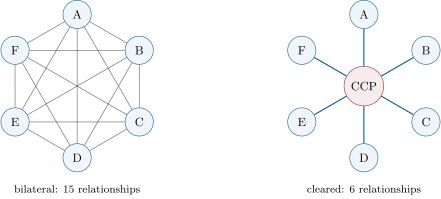
Among members trading bilaterally there can be counterparty relationships; through a CCP there are . After novation each member’s obligations in one security and one currency collapse to a single net position against the CCP, and these net positions sum to zero.
Proof. A pair of members is a set of two among : pairs. With a CCP every contract has the CCP on one side, giving one relationship per member. A member’s contracts with the CCP in one security are fungible and add to . Every trade adds to one member and to another, so the sum over members is zero. ∎
Example 5.6 (Netting one morning’s trades)
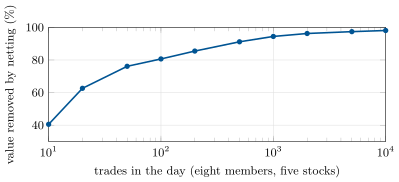
A buys 5 000 shares from B at $20.00, B buys 3 000 from C at $20.10, and C buys 4 000 from A at $19.95. Gross, 12 000 shares and $240 100 would move. Net, A receives 1 000 shares and pays $20 200; B delivers 2 000 and receives $39 700; C receives 1 000 and pays $19 500. Three deliveries totalling 2 000 shares and $39 700 settle instead: netting has removed 83% of the value. The tutorial shows the ratio rising towards 98% as activity grows, which is why a market of thousands of members can settle at all.
5.3 Margin and the default waterfall
A CCP that guarantees every trade must survive the default of a member. It does so with other people’s money, called in a fixed order.
Definition 5.7 (Variation margin and initial margin)
Variation margin is the daily (or intraday) payment of the change in value of a member’s open positions: losers pay, the CCP passes the cash to winners, and exposures restart from zero. Initial margin is collateral deposited against the loss the CCP could suffer on the member’s positions between its last variation-margin payment and the moment the CCP has finished closing them out, a delay called the margin period of risk.
Method 5.8 (A value-at-risk initial margin)
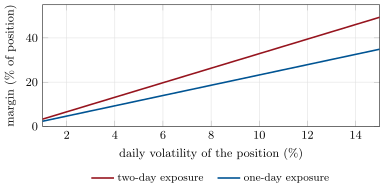
For a net position of value in an instrument of daily volatility , to be covered over days with confidence :
CCPs add charges for concentration, for illiquidity, for gaps between volatility regimes and — in the US equity clearing house — for a member whose requirement is large relative to its own capital. Real models are portfolio-based; Chapter 20 builds one.
Example 5.9 (Why the call came)
Apply the method to a broker whose customers bought, net, $1 billion of a stock: with , , , million. If the stock’s volatility jumps to 25% a day the same position requires $824 million, and doubling the position doubles it again. In January 2021 the volatility component of the retail broker’s requirement was about $1.3 billion, to which the clearing house’s formula added an “excess capital premium” of $2.2 billion because the requirement dwarfed the firm’s capital. The clearing house waived that premium the same morning, for this firm and others: $9.7 billion in total across its members that week, according to the congressional investigation. The broker restricted purchases in the stocks concerned — the only way it had to stop the requirement from growing — and set out the same week to raise $3.5 billion of new capital. Shortening the cycle to divides such a requirement by : that, not convenience, was the argument for it.
Definition 5.10 (Default fund and default waterfall)
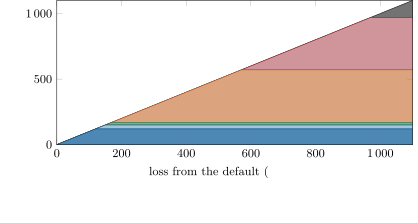
The default fund is a pool of collateral contributed by all members to absorb losses that exceed a defaulter’s own resources. The default waterfall is the order in which resources absorb the loss from a member’s default:
- the defaulter’s initial margin;
- the defaulter’s contribution to the default fund;
- a tranche of the CCP’s own capital (its “skin in the game”);
- the surviving members’ default-fund contributions;
- further assessments the CCP may call from survivors, up to a cap.
The design is “defaulter pays first, survivors pay next, together”: layers 1 and 2 make each member answer for its own risk; layer 3 gives the CCP’s owners a reason to set margins properly; layers 4 and 5 make every member a guarantor of every other — which is why members care who else is admitted and how much they are allowed to do.
5.4 When a member defaults
Method 5.11 (The default-management sequence)
- Declare the default and stop accepting the member’s trades.
- Port the defaulter’s clients, with their positions and margin, to other members where the account structure allows it.
- Hedge the defaulter’s house portfolio to neutralise its market risk within hours.
- Auction the hedged portfolio to the surviving members, who are obliged or strongly incentivised to bid.
- Allocate any loss down the waterfall; return what remains of the defaulter’s margin to its administrator.
Example 5.12 (September 2008)
When Lehman Brothers defaulted on Monday 15 September 2008, the London clearing house for interest-rate swaps held its portfolio: 66 390 trades with a notional value of $9 trillion in five currencies, against about $2 billion of initial margin. Traders seconded from member banks hedged the portfolio alongside the clearing house’s risk team; between 24 September and 3 October the hedged currency portfolios were auctioned. The clearing house reported that the default was managed well within the margin held and that its default fund was not used. The episode became the standard argument for the clearing mandates that followed.
Remark 5.13 (The risk has not disappeared)
A CCP does not remove counterparty risk; it replaces many small, opaque exposures with one large, collateralised and supervised one. Its margin calls are procyclical: they rise exactly when volatility is high and cash is scarce, so that the mechanism protecting the system can drain the liquidity of its members at the worst moment — the theme of Chapters 20 and 31. And the clearing house itself becomes a firm that cannot be allowed to fail.
5.5 Tutorial: netting a day of trades
Goal. Net a day of trades multilaterally and measure what netting removes. End state: the chart below, from 41% of value removed for ten trades to 98% for ten thousand.
Net. One pass over the trades accumulates, per member, shares per symbol and cash.
def net_obligations(trades: list[Trade]):
    """Per member: net shares to receive (+) or deliver (-) per symbol, and net cash (+ receives)."""
    shares: dict[str, dict[str, int]] = defaultdict(lambda: defaultdict(int))
    cash: dict[str, float] = defaultdict(float)
    for t in trades:
        shares[t.buyer][t.symbol] += t.quantity
        shares[t.seller][t.symbol] -= t.quantity
        cash[t.buyer] -= t.quantity * t.price
        cash[t.seller] += t.quantity * t.price
    return {m: dict(s) for m, s in shares.items()}, dict(cash)


def netting_efficiency(trades: list[Trade]) -> float:
    """1 - (value that settles after multilateral netting) / (gross value traded)."""
    gross = sum(t.quantity * t.price for t in trades)
    _, cash = net_obligations(trades)
    net = sum(c for c in cash.values() if c > 0)
    return 1.0 - net / gross
Listing 5.1. Multilateral netting and the share of value it removes. code/markets-1/05-clearing-and-settlement/python/clearing_demo.py - Check the invariants. Net cash sums to zero across members, and so do net shares in each symbol: the tests assert both. A netting engine that violates them has lost a trade.
- Measure. Generate random trades among eight members in five stocks and average the efficiency over twenty seeds.
Allocate a loss. The waterfall is six lines.
    def allocate(self, loss: float) -> dict[str, float]:
        out, left = {}, loss
        for name, size in self.layers():
            used = min(left, size)
            out[name] = used
            left -= used
        out["uncovered"] = left
        return out
Listing 5.2. Walking a loss down the waterfall. code/markets-1/05-clearing-and-settlement/python/clearing_demo.py
What to change next. Make one member a retail broker that only buys one stock: its own netting efficiency collapses, and with it the economy of margin that netting gives everyone else. Then give each member an initial margin from Method 5.8 on its net position and find the member whose requirement is largest relative to its size.
5.6 Build: the netting engine
Purpose. The miniature firm clears its own simulated market. At the end of each session it must know, per member, what settles.
Interface. NettingEngine.add(trade) during the session; close() returning an immutable SettlementInstructions: per member and symbol a signed share quantity, per member and currency a signed cash amount in ledger units (Chapter 1), and the list of trade identifiers netted into each.
Rules. Prices and cash are integers in ledger units: no floating point. A trade with buyer equal to seller, a non-positive quantity or a duplicate identifier is rejected. After close() no trade is accepted. The two zero-sum invariants are checked inside close() and their violation is a fatal error, not a warning.
Acceptance tests. code/firm/clearing/tests/: reproduces Example 5.6 exactly; invariants on ten thousand random trades; rejections; every trade identifier appears in exactly two members’ instructions.
Stretch. Add fail(member, symbol, quantity): a partial delivery, the resulting fail carried to the next day, and the buy-in that closes it.
Sources and further reading
- US House Committee on Financial Services, majority staff report, Game Stopped: How the Meme Stock Market Event Exposed Troubling Business Practices, Inadequate Risk Management, and the Need for Legislative and Regulatory Reform, June 2022.
- US Securities and Exchange Commission, Staff Report on Equity and Options Market Structure Conditions in Early 2021, October 2021.
- US Securities and Exchange Commission, press release 2024-62 on the settlement cycle; Euronext, T+1 programme; UK Financial Conduct Authority, About T+1 settlement.
- LCH.Clearnet, $9 trillion Lehman OTC interest rate swap default successfully resolved, press release, 8 October 2008.
- Committee on Payments and Market Infrastructures and IOSCO, Principles for financial market infrastructures, April 2012.
- J. Gregory, Central Counterparties, Wiley, 2014.
5.7 Exercises
Exercise 5.1 ★
How many bilateral relationships can exist among 40 members? How many with a CCP? By what factor does the count fall?
Solution
Solution of Exercise 5.1.
bilateral relationships against 40: a factor of 19.5, that is .
Exercise 5.2 ★
A sells 2 000 shares to B at $50.00; B sells 2 000 to C at $50.20; C sells 1 500 to A at $50.10. Give each member’s net shares and net cash, and the netting efficiency by value.
Solution
Solution of Exercise 5.2.
A: shares, cash . B: shares, . C: shares, . Gross value $275 550; net cash moving $25 250: efficiency 90.8%.
Exercise 5.3 ★
Compute the initial margin of Method 5.8 on a net position of $400 million with , , for a two-day and for a one-day period. What does the shorter cycle free up?
Solution
Solution of Exercise 5.3.
Two days: million. One day: $23.3 million. The shorter cycle frees $9.7 million, 29% of the requirement.
Exercise 5.4 ★★
With the waterfall of Figure 5.4, allocate losses of (a) $140 million, (b) $300 million, (c) $1 000 million. There are 25 surviving members with equal fund contributions: what does each lose in (b)?
Solution
Solution of Exercise 5.4.
(a) 120 from the margin, 20 from the defaulter’s fund share; nobody else pays. (b) from the survivors’ fund: $5.2 million per surviving member. (c) , and $30 million is uncovered: the clearing house is insolvent unless its rules allow further loss allocation.
Exercise 5.5 ★★
A broker’s customers hold a net unsettled long position of $600 million. Overnight the stock’s daily volatility is re-estimated from 3% to 18%. Compute the margin before and after (, two days). The broker’s capital is $500 million: comment.
Solution
Solution of Exercise 5.5.
Before: million. After: $356 million, six times more, for an unchanged position. The new requirement is 71% of the broker’s capital: it would be reasonable for the clearing house to doubt that the broker can fund a further rise, which is what a capital premium expresses, and rational for the broker to stop the position from growing.
Exercise 5.6 ★★
Without DVP, a seller delivers $10 million of shares in the morning and is to be paid in the afternoon. With DVP and a CCP, the trade is guaranteed at its price. If the buyer fails at noon after the stock has fallen 4%, what does the seller lose in each case?
Solution
Solution of Exercise 5.6.
Without DVP the seller has delivered and receives nothing: it loses $10 million and becomes a creditor in a bankruptcy. With DVP it still has its shares, now worth $9.6 million: a replacement loss of $400 000. With a CCP it loses nothing: the CCP performs at the original price and bears the $400 000 against the buyer’s margin.
Exercise 5.7 ★★★
Coding. Using random_trades(2000, 8, seed=1), compute the netting efficiency. Then append 400 trades in which member A buys 500 shares of S0 from a random other member, and recompute it for the whole set. Explain the sign of the change.
Solution
Solution of Exercise 5.7.
96.0% before; 94.3% after (the exact second figure depends on the random counterparties chosen). The 400 added trades are all in one direction for one member in one stock: nothing offsets them, so they add $4 million of gross value of which almost all must settle, and the ratio falls. One-directional flow is what netting cannot help — and what margin is charged on.
Exercise 5.8 ★★★
Find the flaw. “Our clearing house has never used its default fund, so its margins are clearly sufficient; we can reduce the fund and lower members’ costs.” Give two reasons why the premise does not support the conclusion, one statistical and one about behaviour.
Solution
Solution of Exercise 5.8.
Statistical: defaults of large members are rare events; “no use in years” is a sample with almost no observations of the event the fund exists for, and says nothing about a loss sized to the tail. Margins at 99% are designed to be exceeded one period in a hundred per member. Behavioural: the fund is also what makes members monitor one another and the clearing house’s admission and margin policy; shrink it and both the resources and the discipline fall, and margins were calibrated in the presence of that discipline. The relevant test is a stress scenario (the default of the two largest members in extreme conditions), not history.
5.8 Problem: The Default of Member C
Problem 5.1
Weekend problem — a clearing house on its worst Monday
A clearing house for equity index futures has 21 members. Member C, a proprietary firm, is long futures with a notional value of $2.4 billion. The clearing house holds from C an initial margin of $130 million and a default-fund contribution of $25 million. Its own capital tranche is $15 million; the other 20 members contribute $20 million each to the default fund and can each be assessed once more for the same amount.
Part I — Was the margin right?
- The index has a daily volatility of 1.3%. What margin does Method 5.8 give for days at 99% ()?
- The clearing house held $130 million. To what confidence level does that correspond?
- On Friday the index falls 3%. What variation margin is C called for?
- C pays it. What is the clearing house’s exposure to C on Friday evening?
Part II — The default.
- On Monday morning the index opens 6% lower and C does not pay. What does C owe?
- The clearing house declares C in default at 9:00. Hedging the portfolio takes until noon, during which the index falls another 2%. Compute the total loss on the position since Friday’s close.
- The auction of the hedged portfolio costs a further 0.4% of notional in concessions to the bidders. Give the total loss to be allocated.
- Allocate it down the waterfall, layer by layer.
- How much does each surviving member lose?
Part III — Counterfactuals.
- If the clearing house had hedged within one hour, before the further fall, what would the survivors have lost?
- What initial margin would have covered the whole loss of question 7? Express it as a multiple of daily volatility times notional.
- What is the largest loss the full waterfall can absorb?
- To what total index fall since Friday’s close does that correspond, with the same auction cost?
Part IV — Design.
- After the event the clearing house raises to 3 and the margin period to three days. Give the new margin on a $2.4 billion position.
- C’s position was 30% of the open interest. Propose a concentration add-on and justify its form.
- Why does the clearing house’s own capital sit before the survivors’ money and not after?
- A member argues that assessments should be uncapped “so that the clearing house can never fail”. Give the argument against.
- During the same Monday every other member received a large intraday margin call. Why is this a risk to the system, and what is it called?
- State the named result: the loss reaching the mutualised default fund, in millions of dollars.
- In one sentence: who, in the end, guarantees a cleared trade?
Solution
Solution of Problem 5.1.
1. million. 2. : 99.8%. 3. million. 4. Zero: the loss has been paid, and the position, now worth $2 328 million, is again covered by $130 million. 5. million. 6. The position is worth $2 188 million at the open; a further 2% costs $43.8 million: $183.4 million in total. 7. million; total $192.0 million. 8. 130 (C’s margin), 25 (C’s fund contribution), 15 (clearing house capital), 22.0 (survivors’ fund). 9. million each. 10. Loss million, less than C’s own $155 million: neither the clearing house’s capital nor the survivors would have been touched. Three hours cost them $37 million. 11. $192 million, that is 6.2 times — against 2.95 held. 12. million. 13. Solving gives . 14. million. 15. A charge increasing in the ratio of the position to the market’s capacity to absorb it, for instance proportional to notional times : the cost of liquidating grows like the square root of size (Method 2.6), and a member holding 30% of the open interest is the market it would be liquidated into. 16. So that the clearing house loses its own money before its members lose theirs: those who set the margin model must suffer from its errors first. 17. Unlimited assessments make every member’s liability to the clearing house unbounded and unquantifiable: their own capital requirements and risk limits cannot be set, the best-capitalised members leave, and in a crisis the assessments would propagate the default instead of containing it. 18. Margin calls rise for all members when volatility rises, draining cash exactly when it is scarcest and forcing sales that raise volatility further: procyclicality. 19. $22.0 million. 20. The other members, jointly, up to the limit of what they have committed — and beyond that limit, nobody.
5.9 Interview questions
Interview question 5.1 ★ trader, developer, bank
What is novation, and what risk does it remove for a trading firm?
Solution
Solution of Interview question 5.1.
Novation replaces the contract between the two trading parties by two contracts with the clearing house in the middle. A firm no longer bears the credit risk of whoever it happened to trade with on an anonymous order book, only that of the clearing house; and its positions against all counterparties net into one.
What the interviewer is looking for: counterparty risk and netting, both.
Interview question 5.2 ★ trader, researcher, bank
What is the difference between initial margin and variation margin? Which one do you get back?
Solution
Solution of Interview question 5.2.
Variation margin is the daily settlement of gains and losses in cash: it is paid away to whoever won, and is not returned. Initial margin is collateral against future loss during a close-out: it remains the member’s property and comes back when the position is closed.
What the interviewer is looking for: a payment versus a deposit.
Interview question 5.3 ★★ trader, researcher
In January 2021 several retail brokers stopped customers from buying certain stocks. Give the mechanical explanation.
Solution
Solution of Interview question 5.3.
Customers’ purchases are guaranteed by the clearing house from trade date to settlement, then two days later; the broker posts margin for them, proportional to net unsettled positions and to volatility. One-directional buying in stocks whose volatility had exploded multiplied the requirement in days, beyond the broker’s liquid capital. Blocking purchases (not sales) was the one action that stopped the requirement growing; the alternative was failing the margin call, that is, defaulting.
What the interviewer is looking for: margin net position volatility , and that sales reduce it.
Interview question 5.4 ★★ bank, researcher
Describe the default waterfall of a clearing house. Why is the order what it is?
Solution
Solution of Interview question 5.4.
Defaulter’s margin; defaulter’s default-fund contribution; a tranche of the clearing house’s capital; survivors’ default-fund contributions; capped assessments. Defaulter-pays first so that each member internalises its own risk; the clearing house next so that it has an incentive to margin properly; mutualised layers last, to cover the tail while giving members a reason to police admission and concentration.
What the interviewer is looking for: the incentive logic of the order, not just the list.
Interview question 5.5 ★★ developer
You are writing the end-of-day netting job. What invariants do you assert before publishing settlement instructions, and what do you do if one fails at 18:55 with a 19:00 deadline?
Solution
Solution of Interview question 5.5.
Assert: net shares per symbol sum to zero across members; net cash per currency sums to zero; every accepted trade appears in exactly two members’ instructions; counts and gross totals match the matching engine’s end-of-day figures. If one fails: do not publish; escalate at once to operations and the settlement agent to obtain the extension that exists for this case; find the missing or duplicated trade from the reconciliation difference. Publishing wrong instructions is far worse than publishing late.
What the interviewer is looking for: refusing to publish, and knowing that an escalation path must exist before the day it is needed.
Interview question 5.6 ★★★ researcher, bank
Central clearing was made mandatory for standard swaps after 2008. Does it reduce systemic risk? Argue both sides.
Solution
Solution of Interview question 5.6.
For: multilateral netting shrinks exposures; margin is collected from everyone under one transparent model; a default is managed by an organised auction instead of thousands of bilateral disputes, as in September 2008; supervisors see positions. Against: risk is concentrated in a few entities too important to fail; margin is procyclical and transmits stress through liquidity; members’ mutual guarantees link all large banks; netting across products is lost when clearing is split by asset class; and the products that remain uncleared are the hardest ones.
What the interviewer is looking for: concentration and procyclicality named on the “against” side.