Markets I: The Ecosystem and Exchange-Traded Markets · Markets
29Getting Access: Equity Markets
Three people have a strategy that works on paper, ten million dollars of their own and their investors’ money, and no way to send an order. No exchange will take an order from them: exchanges deal with members. No member will lend them its membership without controls, because the law makes the member answerable for every order that passes through it. Nobody will settle their trades until a clearing firm has agreed to stand behind them. The data they need to decide what to trade is licensed, and the licence for a machine that reads the data costs more than the one for a person. And the price of each share they trade, to the hundredth of a cent, will depend on how many they trade in a month. The first twenty-eight chapters described the market as a mechanism. This chapter and the next describe it as a set of contracts, which is how a firm meets it.
29.1 Member or client?
Definition 29.1 (Executing and clearing brokers)
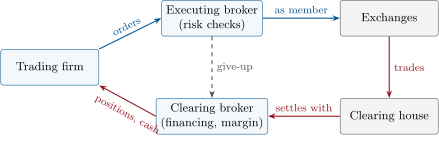
An executing broker is the member through which a firm’s orders reach a venue, in the broker’s name and under its pre-trade risk controls (Chapter 4). A clearing broker is the clearing-house member that settles the firm’s trades, carries its positions and finances them. A give-up is a trade executed by one broker and passed, by agreement, to another for clearing, so that a firm can execute with many brokers and hold everything at one.
There are three routes, in increasing order of cost, control and speed.
Client of a broker. The firm sends orders to a broker’s algorithms or smart router. No registration; the broker’s fees, tiers and latency.
Sponsored or direct market access. The firm’s orders go to the exchange through the broker’s membership and, by law, through risk checks that the broker controls; the firm chooses venue and order type itself, often from its own servers in the exchange’s data centre. It pays the broker per share and receives the broker’s exchange tier, in whole or in part.
Registration and membership. The firm becomes a broker-dealer and a member of each exchange it needs. It faces the exchange directly, earns its own tiers, may join liquidity-provider programmes, and takes on capital, reporting, supervision and examination.
As of September 2026 — What registration costs in capital
Under the net capital rule a broker-dealer that carries customer accounts must maintain net capital of at least $250 000; a dealer, which includes any firm making more than ten trades a year for its own investment account, at least $100 000; a broker that introduces its customers to a clearing firm, $50 000; one that never holds customer funds or securities, $5 000. A market maker needs $2 500 for each security in which it makes a market ($1 000 for those priced at $5 or less), up to $1 million. Aggregate indebtedness may not exceed 1 500% of net capital. These are floors; the binding constraint for a trading firm is the haircut on its positions.
29.2 The clearing arrangement
The clearing broker is the contract that matters most and the one new firms think about last. It decides how much leverage the firm has (its house margin, not the regulatory minimum), what it pays to finance longs and borrow shorts (Chapter 6, Chapter 16), whether positions are margined as a portfolio, what it charges per share or per ticket to clear, and the conditions under which it may raise margin or liquidate without notice. A clearing broker takes the firm’s credit risk overnight; it will want to see the strategy’s risk profile, the principals’ history, audited capital, and a minimum revenue commitment. A firm whose clearing broker gives thirty days’ notice has thirty days to find another or close.
29.3 Fee schedules and tiers
Definition 29.2 (Volume tier)
A volume tier is a line of an exchange’s fee schedule that grants a better rate to members whose monthly activity exceeds a threshold, usually expressed as average daily added volume in proportion to the total consolidated volume of the market. The rate of the tier reached applies to all of the month’s qualifying shares.
As of September 2026 — One exchange’s schedule
The equities fee schedule of one US maker-taker exchange effective 1 September 2026, for shares priced at $1 or more: removing liquidity costs $0.0030 a share; adding displayed liquidity earns $0.0016 at the standard rate, and under the add-volume tiers $0.0020 from 0.06% of total consolidated volume, $0.0023 from 0.20%, $0.0028 from 0.25% and, at the top tier quoted here, $0.0031 from 1.00%. Non-displayed orders earn from nothing to $0.0008. The schedule runs to many pages of further tiers, by tape, by order type and for combinations of activity across the group’s exchanges.
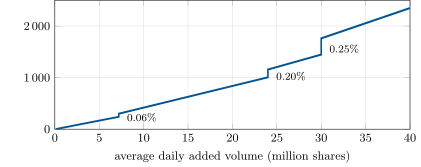
Three consequences follow. Scale is an edge: two firms with the same strategy earn different amounts per share, and the larger can quote where the smaller cannot. Aggregation is a business: a broker whose clients together reach a high tier can pass most of that rate to each of them and keep the rest, which is often a better deal for a small firm than its own membership. Volume near a threshold has a shadow price: late in the month a firm just under a tier will trade shares at a loss to get there, and its behaviour changes on the day it arrives.
Proposition 29.3 (When padding volume pays)
A member adds shares a day naturally, earning a rebate a share. The next tier, at , pays . Extra volume can be had at a loss of a share before rebates, . Padding up to is profitable if and only if
Proof. Padding changes the daily result by , which is positive exactly when . ∎
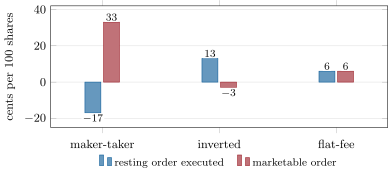
The sign of the fee decides where an order should rest. On the inverted venue a resting order pays, so the queue is short and fills come first; on the maker-taker venue it is paid, so the queue is long and the order is filled last, when the price is about to move through it. The difference in fees, three tenths of a cent, is the market’s price for queue priority, and a router that ignores it (Chapter 9) misprices every passive order.
29.4 Liquidity-provider programmes
Definition 29.4 (Designated market maker and supplemental liquidity provider)
A designated market maker is the member assigned to a listed security with obligations to maintain a fair and orderly market in it, including its opening and closing auctions, in return for information and allocation privileges. A supplemental liquidity provider is a member that commits to quoting assigned securities competitively for a minimum share of the day, in return for enhanced rebates, without the designated maker’s other duties.
As of September 2026 — A quoting requirement
On the New York Stock Exchange a supplemental liquidity provider must maintain a bid or an offer at the national best bid or offer in each assigned security for at least 10% of the trading day; it may be a proprietary trading unit of a member or a registered market maker, and the two are not aggregated for the requirement.
Programmes of this kind exist on every exchange under different names. They are contracts: obligations measured by the exchange (time at the inside, quoted size, spread), against rates not available otherwise. A firm already quoting at the inside most of the day should be in the programme; a firm that would have to change its behaviour to qualify is selling an option on its quotes for the rebate, and should price it.
29.5 Data licences
Definition 29.5 (Non-display fee)
A non-display fee is the charge an exchange makes for the use of its market data by a machine (an algorithm, a router, a risk system) as opposed to a person looking at a screen. It is levied per firm or per platform, by category of use, on top of the fee for receiving the data.
A trading firm’s data bill has four layers: access (the feed itself and the ports and cross-connects it arrives on), redistribution (if data goes to other entities, even affiliates), display (per user) and non-display (per category of automated use). Exchanges audit. The bill is per exchange, and a strategy that needs the direct feeds of a dozen exchanges (Chapter 28) pays a dozen of them before its first trade. Market data is a significant line of an exchange group’s revenue (Chapter 4) and, for a small firm, of its costs.
29.6 The negotiation
Nothing on a published exchange schedule is negotiable: exchange fees are filed with the regulator and apply to every member that meets their terms, which is why the schedules are long. Everything else is: the broker’s pass-through of its tier; the clearing fee per share and its minimum; financing spreads and borrow rates; the portion of the clearing broker’s stock-loan revenue on the firm’s longs that comes back; cross-connect and hosting prices at third-party data centres; vendors’ data and software. What the firm brings to each negotiation is volume, balances and the credible ability to go elsewhere. It should therefore know its own numbers better than the counterparty does: shares per day by venue and by add or remove; average balances, long and short; hard-to-borrow usage; messages per second. The builds of this book produce most of them.
29.7 Tutorial: net cost per share on three venues
Goal. Encode a tiered schedule, find a member’s tier, compute the month’s bill, measure the cliff at a threshold, and compare the all-in cost of a passive and an aggressive share on three kinds of venue. End state: the two data figures of this chapter.
A schedule is a base rate, a remove rate and a list of tiers.
@dataclass(frozen=True)
class Schedule:
    venue: str
    base_add_rate: float
    remove_rate: float
    tiers: tuple[Tier, ...] = ()

    def tier_for(self, adav: float, tcv: float) -> Tier | None:
        share = adav / tcv
        ok = [t for t in self.tiers if share >= t.min_adav_share]
        return min(ok, key=lambda t: t.add_rate) if ok else None

    def add_rate(self, adav: float, tcv: float) -> float:
        t = self.tier_for(adav, tcv)
        return t.add_rate if t else self.base_add_rate

    def daily_bill(self, added: float, removed: float, tcv: float) -> float:
        """Net exchange fees for an average day (negative = the exchange pays the member)."""
        return added * self.add_rate(added, tcv) + removed * self.remove_rate

    def next_tier(self, adav: float, tcv: float) -> Tier | None:
        current = self.add_rate(adav, tcv)
        better = [t for t in self.tiers if t.add_rate < current]
        return min(better, key=lambda t: t.min_adav_share) if better else None
Listing 29.1. Tier lookup and the daily bill. code/firm/feesched/firm_feesched.py Padding. The better rate applies to everything; the padded shares lose money before the rebate.
def extra_volume_worth_adding(s: Schedule, adav: float, tcv: float, loss_per_extra_share: float) -> tuple[float, float]:
    """To reach the next tier a member can add volume it would not otherwise trade, at a loss per
    share (before rebate). Returns (extra shares a day needed, daily gain from doing so); the gain
    counts the better rate on ALL added shares and the rebate earned on the extra ones."""
    nxt = s.next_tier(adav, tcv)
    if nxt is None:
        return 0.0, 0.0
    extra = max(0.0, nxt.min_adav_share * tcv - adav)
    now = -adav * s.add_rate(adav, tcv)
    then = -(adav + extra) * nxt.add_rate - extra * loss_per_extra_share
    return extra, then - now
Listing 29.2. Is it worth adding volume to reach the next tier? code/firm/feesched/firm_feesched.py - All-in. Exchange, clearing, regulatory.
What to change next. Add a second condition to a tier (a minimum share of volume removed as well) and a cross-exchange tier that counts activity on a sister exchange; then find the cheapest allocation of a fixed order flow across the group’s exchanges.
29.8 Build: the fee-schedule engine
Purpose. The miniature firm’s backtester (One Quant Book 7) and router (Book 11) need the marginal fee of every order, which depends on the month’s volume so far; its finance function needs the bill.
Interface. Tier(name, min_adav_share, add_rate); Schedule(venue, base_add_rate, remove_rate, tiers) with tier_for, add_rate, daily_bill, next_tier; extra_volume_worth_adding(schedule, adav, tcv, loss); breakeven_natural_volume(current, next, threshold, loss); all_in_per_share(…).
Rules. Rates per share, signed: positive is a cost. The best qualifying tier applies to all added shares of the period. Thresholds are shares of total consolidated volume, so the engine takes that volume as an input and a forecast of it for the current month. Schedules are data with an effective date, never code: they change monthly.
Acceptance tests. code/firm/feesched/tests/: tier lookup at and around thresholds; the cliff at 0.20%; padding that loses and padding that pays, with the closed-form break-even; all-in costs.
Stretch. Parse a real schedule’s tier table from its published page into the data format, with a diff against last month’s.
Sources and further reading
- Cboe BZX Equities, Fee Schedule, effective 1 September 2026.
- 17 CFR 240.15c3-1 (net capital requirements for brokers or dealers).
- New York Stock Exchange, Rule 107B (supplemental liquidity providers) as described in the exchange’s fee filings with the SEC.
29.9 Exercises
Exercise 29.1 ★
A member adds 9 million shares a day when total consolidated volume is 12 billion. Find its tier under Box 29.2, its daily rebate and its rebate for a 21-day month.
Solution
Solution of Exercise 29.1.
of consolidated volume: above 0.06%, below 0.20%: the first tier, $0.0020 a share. $18 000 a day; $378 000 for the month.
Exercise 29.2 ★
Compute the daily rebate at 23.9 and at 24.0 million shares added. What is the hundred-thousandth share worth?
Solution
Solution of Exercise 29.2.
; . The last hundred thousand shares are worth $7 400 a day, 7.4 cents a share against a rebate of 0.23 cent, and $155 400 over the month.
Exercise 29.3 ★
With clearing at 2 cents and regulatory fees at 1 cent per 100 shares, give the all-in cost per 100 shares of a passive and of an aggressive execution for the member of exercise 1, and of a round trip that enters passively and exits aggressively.
Solution
Solution of Exercise 29.3.
Passive: cents per 100 shares (income). Aggressive: . Round trip: a net cost of 16 cents per 100 shares, which a strategy entering passively and exiting aggressively must earn before it earns anything.
Exercise 29.4 ★★
A firm trades for its own account only and makes markets in 300 securities priced above $5. Using Box 29.1, give its minimum net capital. With $2 million of net capital, what is its maximum aggregate indebtedness? Why is neither number the one that limits its trading?
Solution
Solution of Exercise 29.4.
The larger of the dealer minimum, $100 000, and the market-maker amount, (under the $1 million cap): $750 000. Maximum aggregate indebtedness: million million. Neither binds in practice: net capital is computed after haircuts on the firm’s positions, so a book of a few tens of millions consumes the $2 million long before indebtedness does, and the clearing broker’s house margin is usually stricter still.
Exercise 29.5 ★★
A supplemental liquidity provider must be at the inside for 10% of the day in each assigned security. How many minutes is that? A firm is at the inside bid 6% of the day and at the inside offer 7%, never both at once. Does it qualify? What if the two always coincide?
Solution
Solution of Exercise 29.5.
minutes. With “a bid or an offer at the inside”, 6% and 7% that never coincide make 13% of the day with one side at the inside: qualified under that reading; if they always coincide, 7%: not qualified. If the exchange instead averages the bid and offer percentages, the first firm has 6.5% and fails. The measurement method is in the rule and must be read, since it decides how the quoting engine is tuned.
Exercise 29.6 ★★
On the inverted venue of Figure 29.3 a resting order costs 13 cents per 100 shares all-in, against an income of 17 on the maker-taker venue. Give two reasons why a market maker might still rest orders there.
Solution
Solution of Exercise 29.6.
Queue position: few participants rest orders where they must pay, so the queue is short and an order there is filled before the long queues on rebate-paying venues, when the fill is most valuable. Flow: marketable orders from fee-sensitive routers go to the inverted venue first, because it pays them, so the resting order meets a different, often less informed, counterparty. Both can be worth more than 30 cents per 100 shares.
Exercise 29.7 ★★★
Coding. With breakeven_natural_volume find the natural volume above which padding to the 0.20% tier pays, for a loss of 27 cents and of 25 cents per 100 padded shares. Check each with extra_volume_worth_adding just above and just below.
Solution
Solution of Exercise 29.7.
million shares a day at a loss of 27; million at 25. Just above each, padding gains a few dollars a day; just below, it loses them.
Exercise 29.8 ★★★
Find the flaw. A business plan: “Our passive strategy earns 10 cents per 100 shares before fees. The exchange pays 31 cents per 100 shares for adding liquidity. Net: 41 cents per 100 shares on 2 million shares a day.” Find two errors and recompute.
Solution
Solution of Exercise 29.8.
(i) The 31-cent rate is the top tier, for members adding 1% of consolidated volume, 120 million shares a day at 12 billion; at 2 million the firm is at the standard 16. (ii) Clearing and regulatory costs, about 3, are missing. Recomputed: cents per 100 shares, $96 600 a month, not $172 200. One should add that the 10 cents “before fees” was presumably measured on fills that a rebate-paying venue’s long queue would not give.
29.10 Problem: Reaching the Tier
Problem 29.1
Weekend problem — the last week of the month
A member adds 20 million shares a day naturally under the schedule of Box 29.2; total consolidated volume is 12 billion a day; the month has 21 days. Extra passive volume can be generated by quoting more aggressively, at a loss of 27 cents per 100 shares before rebates.
Part I — The cliff.
- Give the member’s tier and monthly rebate.
- Give the volume needed for the next tier and the extra volume a day.
- Give the daily gain or loss from padding up to it.
- Give the natural volume at which padding breaks even.
- The same for the 0.25% tier, starting from 24 million. Does padding from 24 to 30 million pay?
Part II — Member or client? A broker whose clients together reach the 0.25% tier offers to pass through 80% of its rebate. Membership costs the firm $25 000 a month in fixed fees (membership, ports, connectivity, compliance).
- Give the client’s effective rebate per share.
- At 20 million shares a day, compare the two routes per month.
- At 30 million, compare again.
- What else does the firm give up as a client?
- What else does it take on as a member?
Part III — The month as it happens.
- On day 15 the firm has averaged 23 million shares a day. What average does it need over the last six days to reach 24 million for the month?
- Total consolidated volume turns out to be 13 billion, not 12. What is the threshold now, and what does that do to the plan?
- How should the backtester charge fees to a strategy whose volume decides the firm’s tier?
- Why do exchanges design schedules with cliffs?
Part IV — Judgement.
- Is volume traded only to reach a tier harmful to anyone?
- A competitor ten times larger earns the top tier. Quantify its advantage per share and say where it shows up in the market.
- What would a regulator’s cap on rebates do to this chapter?
- List what the firm should measure before negotiating with a broker.
- State the named result: the natural volume at which the better tier pays for itself.
- In one sentence: what does a fee schedule reward?
Solution
Solution of Problem 29.1.
1. : first tier, $0.0020: $840 000 a month. 2. billion million: 4 million more a day. 3. (in millions of dollars) a day. 4. million shares a day. 5. From 24 to 30 million the padded shares lose 27 and earn the new rebate of 28: each pays for itself, so the break-even volume is zero. Padding gains a day. 6. . 7. Client: million . Member: . The client route is better by $125 800. 8. Member, at its own 0.25% tier: million . Client: $1 411 200. Membership is better by $327 800. 9. Direct connectivity on its own terms (the broker’s risk checks and ports are in the path), eligibility for liquidity-provider programmes, control over order types and sessions, and confidentiality: the broker sees its flow. 10. Registration, net capital, reporting, supervision, examinations, the exchange’s rulebook and market-access obligations of its own. 11. million a day. 12. billion million: the threshold has moved up by 2 million shares a day without the firm doing anything. Targets must be set on a forecast of consolidated volume and tracked daily. 13. At the marginal rate including the tier effect: a strategy whose volume takes the firm over a threshold is worth more to the firm than its own P&L shows, and the backtest should report both the stand-alone figure and the firm-level one. 14. Cliffs make volume sticky: a member near a threshold will concentrate its flow on that exchange to cross it, and a member just over it has a reason to stay. A smooth schedule would give up that pull. 15. It adds displayed liquidity, which is what the exchange pays for, but liquidity that exists for the fee and not for the price is the first to vanish; and it distorts routing statistics. Trades with no economic purpose other than the rebate, or arranged between related parties, cross into wash trading, which is prohibited. 16. cents per 100 shares. It can quote one tick tighter in some stocks where the smaller firm cannot, or hold the same quote with a fatter margin: in a business with a gross edge of 10 to 20 cents per 100 shares, that is most of it. 17. Rebates fund the spread that passive strategies earn; a cap lowers both the rebate and the access fee, compresses the differences between venue types, reduces the value of tiers and of scale, and shifts revenue from rebate-driven market making to strategies that earn the spread itself (see Chapter 9 for the state of that rule). 18. Shares per day by venue, added and removed; message rates; average long and short balances and hard-to-borrow usage; the tier it would reach alone; and its realistic alternative. 19. 13.7 million shares a day. 20. Volume, measured the way the exchange chose to measure it.
29.11 Interview questions
Interview question 29.1 ★ trader, developer, researcher
What is the difference between an executing broker and a clearing broker?
Solution
Solution of Interview question 29.1.
The executing broker is the member whose name and risk controls carry the firm’s orders to the venue. The clearing broker is the clearing-house member that settles the trades, holds the positions and cash, finances them and calls margin. They can be the same firm; with a give-up agreement a firm executes through several brokers and clears at one.
What the interviewer is looking for: who bears the credit risk: the clearing broker.
Interview question 29.2 ★ trader, researcher
What is a maker-taker fee schedule, and what is a volume tier?
Solution
Solution of Interview question 29.2.
The exchange pays a rebate to the order that was resting (the maker) and charges the order that traded against it (the taker), keeping the difference. A volume tier gives a better rebate or fee to members whose monthly volume passes a threshold, usually a share of consolidated volume, and applies it to the whole month.
What the interviewer is looking for: the retroactive application, hence cliffs.
Interview question 29.3 ★★ trader, researcher
Why would anyone rest an order on a venue that charges for adding liquidity?
Solution
Solution of Interview question 29.3.
For the queue. Where adding costs money few add, so a new order is near the front and trades first; and takers are paid there, so fee-sensitive routers hit that venue first. A faster, more certain fill against less informed flow can be worth more than the fee difference.
What the interviewer is looking for: queue priority as the thing being bought.
Interview question 29.4 ★★ researcher, mle
How should exchange fees enter a backtest?
Solution
Solution of Interview question 29.4.
Per fill, by venue, by add or remove, by order type, at the rate of the tier the firm actually has, with the schedule as of the trade date (schedules change monthly). Add clearing and regulatory fees. For capacity studies use the marginal tier the strategy’s own volume would reach. Never a flat “half a cent a share”.
What the interviewer is looking for: point-in-time schedules and tier awareness.
Interview question 29.5 ★★ trader, bank
You are starting a proprietary trading firm in US equities. Walk me through the decisions about access.
Solution
Solution of Interview question 29.5.
Start as the client of a broker offering direct access and good pass-through of its tier: days to set up, no registration. Choose the clearing broker first: margin method, financing and borrow rates, stability. Add co-location and direct feeds when latency starts to matter; budget data licences, including non-display. Register and take memberships when own-tier rebates, programme eligibility and control outweigh capital, compliance and fixed fees, typically at tens of millions of shares a day.
What the interviewer is looking for: clearing first; membership as a volume decision.
Interview question 29.6 ★★★ trader, researcher
It is the 25th of the month and you are 4% short of a tier. What do you do, and what do you not do?
Solution
Solution of Interview question 29.6.
Compute the shortfall in shares, given the latest forecast of consolidated volume, and the value of the tier on the whole month. Then: route more of the firm’s natural passive flow to that exchange; quote slightly more aggressively where the expected loss per share is below the threshold of Proposition 29.3; bring forward flow that would trade anyway. Not: trade with oneself or an affiliate, or enter orders with no purpose but the count. Decide a stop: if the shortfall cannot be closed at an acceptable loss by the 28th, stop padding.
What the interviewer is looking for: the shadow price, and the wash-trading boundary.