Coach
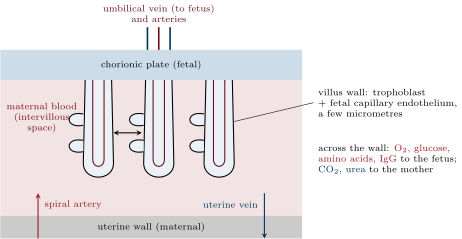
CoachFrom the implanted ball grow two constructions at once: the embryo itself, and its life-support interface — the placenta, a disc grown into the uterus wall where the mother’s blood and the embryo’s blood come intimately close without mixing. Across its vast thin surfaces — the specification of Proposition 47.1, built once more — nutrients and oxygen cross to the embryo, wastes and carbon dioxide cross back (Proposition 32.4’s cord runs between placenta and embryo). The placenta is lung, intestine and kidney to the passenger — all three borders in one organ.
Biology · Glossary
What is The placenta?
Also known as: placenta
The placenta is an organ made jointly by the embryo (the chorion, from the trophoblast) and the mother (the uterine lining). Finger-like chorionic villi, branched into a surface of some at term, hang in lakes of maternal blood delivered by the uterine arteries at half a litre a minute; inside each villus run fetal capillaries, joined to the fetus through the two arteries and one vein of the umbilical cord. The two bloods never mix: they are separated by the villus wall, a few micrometres of trophoblast and capillary endothelium, across which oxygen, , water, urea and fat-soluble molecules diffuse, glucose and amino acids are carried by transporters, and maternal antibodies (IgG) are ferried by receptor, giving the newborn its first months of immunity. The placenta is also a gland: from the first days the trophoblast secretes human chorionic gonadotropin (hCG), which keeps the corpus luteum making progesterone, and from the third month the placenta itself makes the progesterone and oestrogens that maintain the pregnancy (Chapter 9). It is, in effect, a lung, a gut, a kidney and an endocrine gland grown for nine months and discarded at birth.