Primary & Middle School Biology · Grades 1–9
32Human Reproduction
Every person you know — friends, teachers, the oldest person in your family — arrived the same way: as a baby, born after months of growing inside their mother. Humans are mammals (Proposition 21.4), and human reproduction runs on the mammal plan of Chapter 23 — with the numbers, dates and details of our own species, which this chapter sets out plainly.
32.1 The human version of the plan
Proposition 32.1 (Human reproduction is mammal reproduction)
Like all mammals, humans reproduce sexually (Definition 23.1):
- the mother’s body produces egg cells; the father’s produces sperm cells;
- fertilization — one sperm cell joining one egg cell — happens inside the mother’s body (Proposition 23.6);
- the fertilized egg cell — one single cell (Example 29.8) — settles in the mother’s womb and grows there;
- humans are viviparous (Definition 23.4): the baby is born alive, and is fed at first on milk.
Proof. Admitted at this level. ∎
Remark 32.2 (Reproduction needs grown-up bodies)
A child’s body cannot make babies: the reproductive organs only start working at puberty, the change of Definition 15.1’s adolescent stage, when the body rebuilds itself from a child’s into an adult’s. What puberty changes, and how, is the subject of a full chapter in the middle-school years of this book.
32.2 Nine months in the womb
Definition 32.3 (Pregnancy)
Pregnancy is the time the future baby spends growing in its mother’s womb: about nine months in humans. The growing baby is first called an embryo, then — once its body plan is laid out, after about two months — a fetus.
Proposition 32.4 (Fed through the cord)
Inside the womb, the baby floats in a pocket of liquid and cannot eat or breathe. Everything comes ready-made from the mother’s blood: nutrients and oxygen (Proposition 27.1) cross into the baby’s blood through the umbilical cord at its belly — and its wastes cross back the same way, for the mother’s body to deal with. Your navel is where your own cord was attached.
Proof. Admitted at this level. ∎
Example 32.5 (The nine-month timetable)
Month 1: a cluster of dividing cells, smaller than a grain of rice, but already growing fast. Month 2: an embryo with the sketch of a head, a beating heart, buds for arms and legs — still smaller than a thumb. Months 3–4: a fetus, complete in plan, that begins to move; the mother soon feels the kicks. Months 5–8: growing and ripening — hearing arrives, and a first coat of hair. Month 9: the baby, usually head-down and around , is ready.
Example 32.6 (Birth)
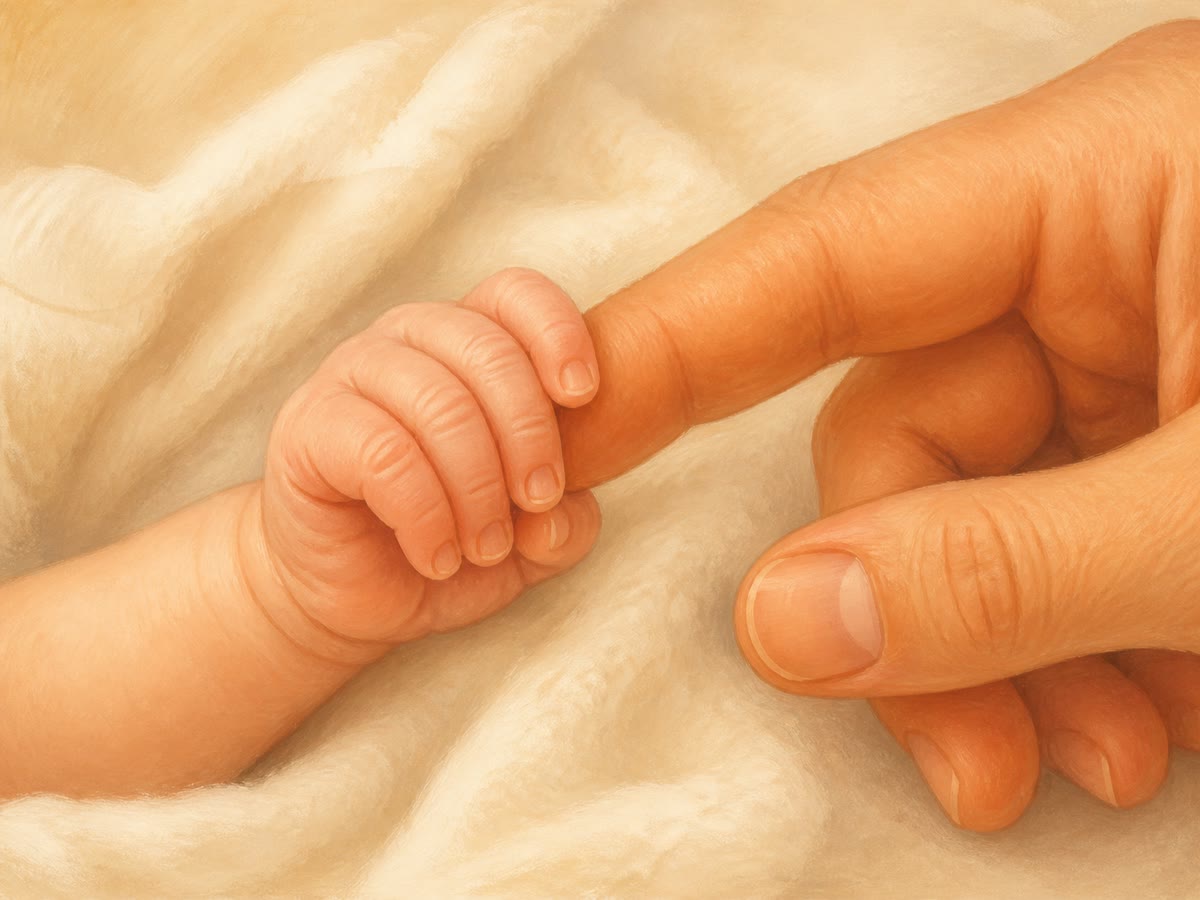
At birth, powerful muscles of the womb push the baby out into the world, usually head first. The first cry fills the lungs with air — they had never breathed before (Proposition 32.4) — the cord, no longer needed, is cut painlessly, and the mammal plan continues outside: milk, warmth and care (Example 23.9 would approve).
Remark 32.7 (Twins)
Sometimes two babies grow in the womb together. If one fertilized egg cell split into two embryos, the twins are identical — built from the same starting cell, alike as two copies. If two egg cells were fertilized by two sperm cells, the twins are no more alike than ordinary siblings — they only shared the womb. Two kinds of twins, told apart by their beginning.
32.3 Care before and after
Proposition 32.8 (The baby shares its mother’s supplies)
Everything reaching the baby travels through the mother’s blood — which is why an expecting mother eats well (Chapter 18), rests, is followed by doctors or midwives, and avoids what could harm the baby: tobacco smoke and alcohol pass through the cord too, and a fetus is far more fragile than an adult. Caring for the mother is caring for the baby.
Proof. Admitted at this level. ∎
Example 32.9 (A very cared-for species)
Even among mammals, humans push the few-and-cared-for strategy of Proposition 23.7 to the extreme: usually one baby at a time, helpless far longer than a foal or a kitten, and cared for — fed, taught, loved — for many years. Human childhood is one of the longest in the animal world; this book, a decade-long course, is itself a piece of that long care.
32.4 Exercises
Exercise 32.1 ★
Which cell comes from the mother, which from the father, and what is their joining called?
Solution
Solution of Exercise 32.1.
The egg cell from the mother, the sperm cell from the father; their joining is fertilization.
Exercise 32.2 ★
Where does the human baby grow, and for about how long?
Exercise 32.3 ★
What are the growing baby’s two names, in order, and roughly when does the first become the second?
Exercise 32.4 ★
The baby in the womb neither eats nor breathes. How does it get nutrients and oxygen, and where do its wastes go?
Solution
Solution of Exercise 32.4.
Through the umbilical cord: nutrients and oxygen cross from the mother’s blood into the baby’s, and the baby’s wastes cross back for the mother’s body to deal with.
Exercise 32.5 ★
What is your navel the mark of?
Solution
Solution of Exercise 32.5.
The place where your own umbilical cord was attached, before it was cut at birth.
Exercise 32.6 ★
What happens at the first cry, and why is it such a change for the baby’s body?
Solution
Solution of Exercise 32.6.
The first cry fills the lungs with air for the first time: until that moment they had never breathed — oxygen had always arrived through the cord.
Exercise 32.7 ★
Which features make human reproduction typically mammalian? Name three, citing Proposition 21.4 or Chapter 23.
Solution
Solution of Exercise 32.7.
Fertilization inside the mother’s body; a viviparous birth (the baby grows in the womb and is born alive); milk feeding afterward — the mammal class features exactly.
Exercise 32.8 ★
Why do doctors ask expecting mothers to avoid tobacco smoke and alcohol? Use Proposition 32.8.
Exercise 32.9 ★★
Explain the two kinds of twins by their beginnings. Which kind is alike “as two copies”, and why does that follow from Example 29.8?
Solution
Solution of Exercise 32.9.
Identical twins: one fertilized egg cell split into two embryos. Ordinary (fraternal) twins: two egg cells fertilized by two sperm cells, sharing only the womb. The identical pair are alike as copies because a body is built from its first cell — and they started from the same one.
Exercise 32.10 ★★
Place the human on the strategy line of Proposition 23.7, comparing with the codfish and the elephant: number of young, length of care, and what that long care contains for humans.
Solution
Solution of Exercise 32.10.
At the elephant’s end, and beyond it: usually one baby, years of helplessness, and care that includes not only feeding and protection but teaching — language, skills, school. The codfish’s millions-with-no-care is the opposite pole.
Exercise 32.11 ★★★
At birth, the cut cord ends the baby’s supply line at the very moment the lungs take their first breath. Using Proposition 32.4 and Proposition 26.5, explain what job switches, in that minute, from the mother’s body to the baby’s own lungs — and why the first cry is well timed.
Solution
Solution of Exercise 32.11.
The job of loading oxygen and unloading carbon dioxide: until birth the mother’s blood did it through the cord; from the first breath, the baby’s own lungs’ air pockets take it over. The cry is well timed because it comes at the exact minute the old supply line is cut — the lungs must start precisely when the cord stops.