Primary & Middle School Biology · Grades 1–9
25The Journey of Food
One bite of bread: chewed, swallowed — gone. Gone where? By tonight, part of that bread will be helping your legs run and your bones grow, which means it must somehow get out of the tube it was swallowed into and into the rest of the body. Follow the bite: its journey is one of the body’s best stories.
25.1 The digestive tract
Definition 25.1 (The digestive tract)
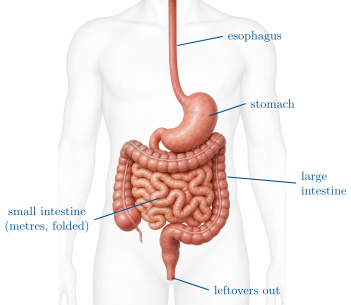
Food travels through the digestive tract, one long tube running right through the body:
- the mouth, where teeth grind (Chapter 12) and saliva moistens;
- the esophagus, the slide from throat to stomach;
- the stomach, a muscular pouch where food is churned and mixed with digestive juices for hours;
- the small intestine, a folded tube several metres long, where digestion finishes and the food’s goodness passes into the body;
- the large intestine, where water is reclaimed from what remains, before the leftovers leave the body.
Example 25.2 (Timing the journey)
The bite of bread spends seconds in the mouth, a couple of seconds sliding down the esophagus, some hours being churned in the stomach, several more working through the small intestine, and up to a day or more finishing in the large intestine. The whole journey commonly takes one to two days.
25.2 Digestion: from food to nutrients
Definition 25.3 (Digestion and nutrients)
Digestion is the transformation of food, along the tract, into components small and simple enough to enter the body: the nutrients. Teeth and the stomach’s churning break food up; digestive juices — saliva among them — dismantle it further, piece by piece, until what was bread is a liquid mix of nutrients.
Example 25.4 (The bread turns sweet)
Chew a piece of plain bread very long — a slow count of sixty — and a faint sweetness appears. Nothing was added: saliva is already dismantling the bread into simpler, sweeter pieces. You have tasted digestion beginning.
Proposition 25.5 (Crossing into the body)
The tract’s inside is still, in a sense, outside the body — like the hole of a doughnut. The crossing happens in the small intestine: through its thin, deeply folded walls, nutrients pass into the blood, which carries them to every part of the body (the delivery service that Chapter 27 explores). What cannot cross — fibres, husks — travels on, loses its water in the large intestine, and leaves as droppings.
Proof. Admitted at this level. ∎
Remark 25.6 (Why the folds and the metres)
Crossing takes wall surface, and the small intestine is built for it: metres of length, and walls folded and refolded inside. Stretched flat, the crossing surface would carpet a small room — packed into your middle. Big jobs, in the body, get big surfaces folded small.
25.3 Helping digestion do its work
Method 25.7 (Digestion-friendly habits)
- Chew properly: the stomach has no teeth — what the mouth skips, the stomach must struggle with;
- eat calmly, at regular mealtimes;
- drink water with meals;
- eat fibre-rich foods — vegetables, fruit, whole bread: fibre keeps the leftovers moving;
- leave hard play or swimming for after the meal has settled: a hard-working stomach and hard-working legs compete.
Example 25.8 (The stomach-ache detective)
Wolfed-down lunch, then a sprint: the classic afternoon stomach ache. The meal was swallowed half-chewed (rule 1 broken) and the digesting stomach was hurried into a race (rule 5). The fix is not medicine but manners — toward one’s own digestive tract.
25.4 Exercises
Exercise 25.1 ★
Name the parts of the digestive tract in order, mouth to exit.
Solution
Solution of Exercise 25.1.
Mouth, esophagus, stomach, small intestine, large intestine — then the leftovers leave the body.
Exercise 25.2 ★
What happens to food in the stomach, and roughly how long does it stay there?
Solution
Solution of Exercise 25.2.
It is churned by the stomach’s muscular walls and mixed with digestive juices — for some hours.
Exercise 25.3 ★
Exercise 25.4 ★
In which part do nutrients cross into the blood? What happens to what cannot cross?
Solution
Solution of Exercise 25.4.
In the small intestine, through its thin folded walls, into the blood. What cannot cross travels on to the large intestine, loses its water there, and leaves the body as droppings.
Exercise 25.5 ★
Why does long-chewed bread turn faintly sweet?
Exercise 25.6 ★
Why is the small intestine so long and so folded inside?
Solution
Solution of Exercise 25.6.
Because crossing into the blood takes wall surface: the metres of length and the deep inner folds pack an enormous crossing surface — flattened out, roughly a small room’s carpet — into the belly.
Exercise 25.7 ★
Give three digestion-friendly habits and the reason for each.
Exercise 25.8 ★
Try it (at table): time your next meal. How long does your food spend in your mouth — and how does that compare with the days ahead of it?
Solution
Solution of Exercise 25.8.
Open answer. Typically well under half an hour in the mouth — against one to two days for the rest of the journey. The mouth’s share is tiny in time and decisive in effect: it is the only stop with teeth.
Exercise 25.9 ★★
Diagnose Example 25.8’s stomach ache: which two habits were broken, and what would you change tomorrow?
Solution
Solution of Exercise 25.9.
Broken: chew properly (lunch was wolfed half-chewed) and rest after meals (a sprint straight after). Tomorrow: eat slowly, and let the meal settle before racing.
Exercise 25.10 ★★
“Food goes into the body the moment you swallow it.” Correct this with Proposition 25.5: where does food really enter the body, and what must happen to it first?
Solution
Solution of Exercise 25.10.
Swallowed food is still inside the tube — like the hole of a doughnut, not yet truly in the body. It must first be digested into nutrients; only in the small intestine do those cross the wall into the blood. Entering the mouth is not entering the body.
Exercise 25.11 ★★★
The cow’s grass is far tougher food than your bread — and the cow has four stomach chambers, chews its food twice, and hosts helpful living things in its gut to dismantle grass. Using Definition 25.3 and Proposition 10.4, explain why a grass-eater needs this heavier machinery.
Solution
Solution of Exercise 25.11.
Digestion must dismantle food into nutrients, and grass is far harder to dismantle than bread — tough fibres, little goodness per mouthful (Proposition 10.7). So the grass-eater brings heavier machinery: grinding molars used twice over (chewing the cud), four stomach chambers for long processing, and gut helpers that can break down what its own juices cannot. Tougher input, bigger factory.