Strategies I: Equities and Futures · Strategies
1Anatomy of a Stat-Arb Book
On an average day a book holds 452 stocks long and 495 short. Its median position is a quarter of one per cent of its capital, and no position is larger than one per cent. Over eight simulated years its best day makes 1.5 per cent and its worst loses 1.25, and its profit is the sum of 1.9 million position-days, none of which matters much alone. Remove one line of its construction (the neutrality to the style factors) and the same signals give a book whose best and worst days are nearly four times larger and whose daily profit and loss is, to 99.7 per cent of its variance, a bet on one factor. This part of the book is about strategies; its first chapter is about the vehicle most of the equity strategies ride in, the market-neutral stat-arb book: how it is built from Book 7’s pieces, what makes it neutral, how it is financed, and where each day’s P&L comes from. The build is firm.statbook.
1.1 Thousands of small bets
Definition 1.1 (Statistical arbitrage, stat-arb book)
Statistical arbitrage is the systematic trading of many small, individually unreliable relative mispricings among securities, each expected to earn a little, so that the book’s return comes from their number. A stat-arb book is a long–short portfolio of hundreds or thousands of stocks built this way, neutral to the market and usually to industries and styles, rebuilt daily or more often.
The fundamental law of active management (Book 7, chapter 15) is the stat-arb book’s business plan: an information ratio grows with the square root of breadth, so a skill too small to trade in one stock becomes a business across a thousand, rebuilt every day. The price is everything the law assumes away: the bets must be independent, which a book’s common exposures prevent, and cheap, which daily trading in a thousand names is not.
The chapter’s book lives on firm.synthmkt (Book 7, chapter 5), all of its listed names, years 3 to 10. Its signal is an equal blend of the two predictors Book 7 measured best: the one-day residual reversal and 12–1 month momentum, both point in time, smoothed with a half-life of two days to slow its trading. Each close, the signal is made neutral by regression on the risk model’s exposures, weighted to a gross exposure of three times capital (1.5 long, 1.5 short), capped at 1% of capital a name, and held over the next day at a cost of five basis points of the weight traded (Listing 1.1).
1.2 Neutrality: dollar, beta, sector, factor
Neutrality is a set of constraints on the book’s exposures (dollar, beta and factor neutrality are Book 7, chapter 25’s terms). Their purpose is that the book’s P&L should come from the stock-specific part of its signal and not from the market or a style. The chapter builds two versions of the same book. The first is neutral to the dollar, the market’s beta and the ten industries, which is what many descriptions of market-neutral books promise; the second also to the size, value and momentum styles.
| years 3 to 10, $1 billion of capital | neutral to beta and industries | also to the styles |
|---|---|---|
| return a year, after costs and financing | 23.6% | 22.5% |
| volatility | 23.6% | 4.5% |
| Sharpe ratio | 1.00 | 5.03 |
| share of the P&L variance from factors | 99.7% | 7.6% |
| best and worst day | , | , |
| one-way turnover a day | 42% | 91% |
| trading costs a year |
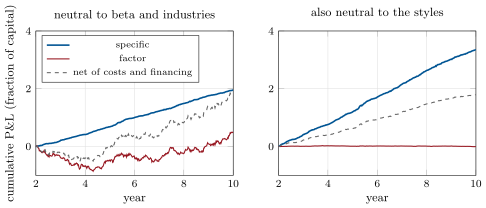
The first book is neutral to what it was asked to be neutral to and not to what it holds. Its momentum signal gives it a large exposure to the momentum style, and the momentum factor’s contribution alone has a volatility of 23.1% a year: the book’s specific P&L is swamped, and 99.7% of its variance is factor risk (Figure 1.1). Neutralised to the styles as well, the book keeps its specific return and loses the factor bet: its volatility falls to 4.5% and the factors explain 7.6% of its variance. The Sharpe ratio of 5 belongs to the simulation, which plants a strong reversal and a persistent drift (Book 7, chapter 5): a real book would earn a fraction of it, as the public record in section 4 shows. What carries over is the shape of the comparison. The neutral book pays for its neutrality in turnover, 91% of capital a day against 42%, because the style exposures move every day and must be traded away.
s1_statbook.run.1.3 Financing: cash, leverage, borrow and rebates
Definition 1.2 (Hard-to-borrow list)
A prime broker’s hard-to-borrow list names the stocks it cannot lend at the general-collateral fee: shorting them costs a higher borrow fee (Book 1, chapter 6), may be refused, and is exposed to recall.
A long–short book is a financing arrangement as much as a portfolio. The longs are paid for with the fund’s capital and, beyond it, with cash borrowed from the prime broker; the shorts are sold with borrowed stock, and the sale proceeds stay with the broker as collateral, earning the rebate rate (Book 1, chapter 6), the benchmark rate less the stock’s borrow fee. firm.statbook.financing (Listing 1.2) charges one day of each: a debit balance of 0.5 of capital (longs of 1.5 on capital of 1) at the benchmark rate of 4% plus a 0.5% spread, and short proceeds of 1.5 at 4% less the fee, with 95% of names at a general-collateral fee of 0.25% and 5%, the hard-to-borrow list, at fees drawn around 3%, not shorted by the book. For the neutral book the rebate brings 5.6% of capital a year and the long financing costs 2.2%; the borrow fees inside the rebate cost 0.4%. The net financing is , less than the 4% the capital would earn in cash, and the long financing and borrow fees together are 6.2% of the book’s gross alpha of 42.0%.
Gross exposure of three times capital is not allowed under the strategy-based margin rules of retail accounts; it is a professional book’s leverage, reached with risk-based margin (Box 1.1).
As of September 2026 — Margin for a long–short equity book
In the United States, Regulation T (12 CFR 220.12) requires margin of 50% of a long equity position’s value and 150% of a short sale’s value, of which the proceeds supply 100%: a book’s equity must be half its gross, so gross exposure is at most twice capital; the chapter’s book, at three times, would need equity of 1.5 times its capital. FINRA Rule 4210 lets members use portfolio margin instead, in which requirements come from a stress of each position (plus and minus 15% for an equity security) rather than fixed percentages; a book stressed at 15% on every position without netting needs 0.45 of capital for a gross of three. Strategy-based maintenance on a short stock priced at $5 or more is the greater of $5 a share and 30% of its value.
1.4 What public descriptions of such books say
The published record of stat-arb performance is thin and dated, and it says two things. Avellaneda and Lee, trading residuals against principal components and sector funds across the US market, reported Sharpe ratios after costs of 1.44 for 1997–2007, stronger before 2003 and 0.9 in 2003–2007, with the ETF version degrading similarly after 2002. Khandani and Lo documented the other side of the business: many books built this way held similar positions, and in August 2007 they lost together (Book 7, chapter 28). Pedersen’s book on hedge-fund strategies is the practitioner’s account to read alongside them. The chapters that follow take its ingredients one at a time: reversal (chapter 2), residuals (chapter 3), pairs (chapter 4), momentum (chapter 5) and the rest of Part I.
1.5 The daily cycle of a stat-arb book
Definition 1.3 (Daily P&L attribution)
Daily P&L attribution splits a book’s P&L for the day into the part explained by its factor exposures times the risk model’s factor returns, the specific part (its weights times the stocks’ specific returns), trading costs and financing, so that the parts add up to the P&L.
The book’s day has a fixed rhythm. After the close, the day’s data are checked and stored point in time; the risk model is updated; the signals are computed, blended and smoothed; the book is optimised under its neutralities and limits, and the trade list goes to execution for the next session; overnight the financing accrues; the next evening the day’s P&L is attributed and reconciled with the prime broker’s statement. Attribution is where a desk sees that a book is not what it thinks: with the risk model’s factor returns , exposures and specific returns , the day’s return holds exactly, so the split is an identity, and the checks of the chapter’s run confirm that the attributed parts add up to the P&L to within of capital.

1.6 Tutorial: three million small bets
Goal. Build the two books on firm.synthmkt, finance them and attribute their daily P&L. End state: the table and Figure 1.1.
The book: blend, smooth, neutralise, cap, avoid hard-to-borrow shorts.
    for t in range(START - 1, T - 1):
        ok = P.listed[t] & np.isfinite(E[t]) & np.isfinite(mom[t])
        raw = 0.5 * _z(-E[t], ok) + 0.5 * _z(mom[t], ok)
        s = lam * s + (1 - lam) * raw
        X = exposures(t + 1)
        cols = list(range(12)) + ([12, 13, 14] if neutral_styles else [])
        live = ok & P.listed[t + 1]
        x = np.where(live, s, 0.0)
        Xl = X[live][:, cols]
        x[live] = x[live] - Xl @ np.linalg.lstsq(Xl, x[live], rcond=None)[0]
        x = np.where((x < 0) & htb, 0.0, x)                                # hard to borrow: not shorted
        w = x * GROSS / np.abs(x).sum()
        for _ in range(5):                                                  # at most 1% of capital in a name
            w = np.clip(w, -CAP, CAP)
            w = w * GROSS / np.abs(w).sum()
        W[t] = np.clip(w, -CAP, CAP)
Listing 1.1. One close of the book’s construction. code/strategies-1/01-anatomy-of-a-stat-arb-book/python/s1_statbook.py Financing and attribution.
def financing(w, capital: float, rate: float, long_spread: float, fees):
    """One day's financing as fractions of capital, for weights w (fractions of capital). Cash left after buying the
    longs is L - 1 short of zero when L > 1 (a debit balance, charged rate + long_spread); short positions earn
    rebate = rate - fee on their proceeds, a cost where the fee exceeds the rate."""
    w, fees = np.asarray(w, float), np.asarray(fees, float)
    L = float(w[w > 0].sum())
    S = -w.clip(max=0)
    debit = max(L - 1.0, 0.0)
    long_cost = debit * (rate + long_spread) / DAYS
    rebate = float(S @ (rate - fees)) / DAYS
    borrow = float(S @ fees) / DAYS
    return {"debit": debit, "long_cost": long_cost, "short_rebate": rebate, "borrow_cost": borrow,
            "total": rebate - long_cost}


def attribution(w, X, f, e, cost: float = 0.0, fin: float = 0.0):
    """The day's P&L w'r with r = X f + e: factor part (X'w)'f by factor, specific w'e, minus trading costs, plus
    financing (fractions of capital)."""
    w, X, f, e = (np.asarray(a, float) for a in (w, X, f, e))
    x = X.T @ w
    by = x * f
    spec = float(np.nansum(w * e))
    out = {"factor": float(by.sum()), "by_factor": by, "specific": spec, "cost": -float(cost), "financing": float(fin)}
    out["total"] = out["factor"] + out["specific"] + out["cost"] + out["financing"]
    return out
Listing 1.2. A day’s financing, and the attribution that adds up. code/firm/statbook/firm_statbook.py - Run
s1_statbook.summaryfor both books,bets,margin_exampleandfig_statbook.py.
What to change next. Raise the borrow fees of the hard-to-borrow names and let the book short them; neutralise only the momentum style and see how much of the factor risk remains.
1.7 Build: stat-arb book accounting
Purpose. The accounting under every long–short strategy of the book: financing by name, margin, and a daily attribution that reconciles to the P&L.
Interface. borrow_fees(n, seed, htb_share, gc_fee, htb_median), hard_to_borrow(fees, threshold), reg_t_equity(long_mv, short_mv), stress_equity(w, capital, move), financing(w, capital, rate, long_spread, fees), attribution(w, X, f, e, cost, fin).
Rules. Financing is charged by name, every day; hard-to-borrow names are flagged before the optimiser sees them; the attribution must add up to the P&L, or the day is not closed.
Acceptance tests. code/firm/statbook/tests/: the fee distribution; Regulation T and the stress requirement by hand; a day’s financing by hand; an attribution that adds up to less costs plus financing.
Stretch. Locates and recalls day by day; margin under a portfolio-margin stress with netting; reconciliation against a broker statement.
Sources and further reading
- M. Avellaneda and J.-H. Lee, “Statistical arbitrage in the US equities market”, Quantitative Finance 10(7), 2010.
- A. E. Khandani and A. W. Lo, “What happened to the quants in August 2007?”, Journal of Financial Markets 14(1), 2011.
- L. H. Pedersen, Efficiently Inefficient, Princeton University Press, 2015.
- Regulation T, 12 CFR 220.12; FINRA Rule 4210.
1.8 Exercises
Exercise 1.1 ★
A book holds 946 positions and trades every day for a year; if each position-day were an independent bet with a standard deviation of 2% of the position, what would be the standard deviation, in units of one position, of the year’s summed P&L?
Solution
Solution of Exercise 1.1.
Independent bets add in variance: positions’ worth, against position-days. The edge adds linearly and the noise with the square root, which is the whole case for breadth.
Exercise 1.2 ★
The neutral book’s net financing is 3.42% a year. What does it cost relative to capital left in cash at the 4% benchmark?
Solution
Solution of Exercise 1.2.
: 0.58% of capital a year, the price of financing longs beyond capital and of the fees inside the rebate.
Exercise 1.3 ★
What equity does Regulation T require for a book long 1.5 and short 1.5 per unit of capital? What is the largest gross exposure it allows, and what a 15% stress without netting?
Solution
Solution of Exercise 1.3.
times capital, which the book does not have. Equity must be half the gross, so the gross is at most times capital; a requirement of 15% of the gross allows times.
Exercise 1.4 ★★
A book is long 1.5 and short 1.5, all shorts at the general-collateral fee of 0.25%, the benchmark at 4% and the long spread at 0.5%. Compute its financing for a year.
Solution
Solution of Exercise 1.4.
The rebate is , the long financing : , 3.37% of capital a year. The chapter’s book earns 3.42% because its capped longs sum to slightly less than 1.5 on some days.
Exercise 1.5 ★★
Why did neutralising the styles double the book’s turnover?
Solution
Solution of Exercise 1.5.
The signal’s exposure to the styles changes every day (momentum drifts, sizes and prices move), and each day’s neutralisation removes it again by trading. The book neutral only to beta and industries simply carries the style exposure and does not trade it.
Exercise 1.6 ★★
Show that the attribution is an identity when is the cross-sectional regression’s residual, and explain what would break it.
Solution
Solution of Exercise 1.6.
If is the cross-sectional regression’s coefficient and its residual, then by construction and . It breaks when the exposures used in the attribution differ from those of the regression (a different day’s, or a different model’s), when names missing from the regression are held, or when the book’s return is measured on different prices from the model’s.
Exercise 1.7 ★★★
Coding. Run s1_statbook.summary with a half-life of smoothing of one day and of five, and report the Sharpe ratio and the trading costs.
Solution
Solution of Exercise 1.7.
With a half-life of one day the book turns over 129% of capital a day, pays 32.5% a year in costs and returns 27.5% at a Sharpe ratio of 6.16; with five days 56%, 14.0%, 11.7% and 2.47. Here faster is better, because the simulated reversal is strong and short-lived and the cost of five basis points is low: slowing the book loses more signal than it saves in costs. At realistic costs the ranking can reverse (chapter 2).
Exercise 1.8 ★★★
Find the flaw. “Our book is market neutral: its beta is zero every day and it is dollar neutral, so its returns are pure alpha.”
Solution
Solution of Exercise 1.8.
Zero beta and zero dollar exposure leave every other factor free. The chapter’s book neutral to beta and industries had 99.7% of its variance from factors, nearly all momentum; its return was a style bet. Market neutral is not factor neutral, and alpha is what remains after all the factors the firm can buy cheaply.
1.9 Problem: Three Million Small Bets
Problem 1.1
Weekend problem — a book, taken apart
The chapter’s two books on firm.synthmkt.
Part I — The book.
- What is the signal, and how is it made into weights?
- How many names does the neutral book hold, and how large is its median position?
- Why does breadth matter, and what does the fundamental law assume that the book violates?
- How many position-days make its eight years?
Part II — Neutrality.
- Give the two books’ returns, volatilities and Sharpe ratios.
- What share of each book’s variance comes from factors, and from which factor in the first?
- What does the neutral book pay for its neutrality?
- Why is a Sharpe ratio of 5 a property of the simulation?
Part III — Financing.
- Break the neutral book’s financing into rebate, long financing and borrow fees.
- What does Regulation T allow, and how does a book reach a gross of three?
- How are hard-to-borrow names handled, and what do they cost?
Part IV — The verdict.
- State the named result: the share of the year’s P&L variance explained by factor exposures in the book that was not neutral to the styles, and the financing drag as a fraction of gross alpha.
- What did Avellaneda and Lee find, and what happened after 2002?
- What did August 2007 show about books built this way?
- Describe the daily cycle.
- Why must the attribution add up?
- What would you add to make the neutral book realistic?
- How would you tell a factor bet disguised as stat arb?
- What is the first question to ask about any market-neutral fund’s returns?
- In one sentence: what is a stat-arb book?
Solution
Solution of Problem 1.1.
- An equal blend of the z-scored one-day residual reversal and 12–1 month momentum, smoothed (half-life two days), neutralised by regression on the risk model’s exposures, scaled to gross three, capped at 1% a name, with no shorts in hard-to-borrow names.
- 452 long and 495 short on average; the median position is 0.25% of capital, the largest 1.0%.
- The information ratio grows with the square root of the number of independent bets; the law assumes independent bets and ignores costs, and the book’s common exposures and daily trading violate both.
- 1.9 million.
- 23.6%, 23.6% and 1.00 neutral to beta and industries; 22.5%, 4.5% and 5.03 also neutral to the styles.
- 99.7% in the first, almost all momentum (a momentum P&L of 9.0% a year with a volatility of 23.1%, and value ); 7.6% in the second.
- Turnover of 91% of capital a day against 42%, and trading costs of 22.9% a year against 10.6%.
- The simulation plants a strong reversal and a persistent drift at costs of five basis points; published stat-arb Sharpe ratios after costs are nearer 1.
- Rebate 5.6%, long financing , borrow fees (inside the rebate): net of capital a year.
- Equity of half the gross, so at most twice capital; a gross of three needs risk-based portfolio margin (a 15% stress without netting requires 0.45 of capital).
- They are flagged before optimisation and not shorted; had they been, their fees (median around 3%) would have cut the rebate and exposed the book to recall.
- Named result. 99.7% of the P&L variance of the book not neutral to the styles came from factor exposures; the financing drag (long financing and borrow fees) was 6.2% of the neutral book’s gross alpha of 42.0%.
- Sharpe ratios after costs of 1.44 for 1997–2007 for their PCA strategies, 0.9 in 2003–2007; the ETF version degraded similarly after 2002.
- Books built this way held similar positions and lost together when some of them were unwound.
- Data checked and stored, risk model updated, signals blended and smoothed, the book optimised, trades executed the next session, financing accrued, the P&L attributed and reconciled.
- Because a part that does not add up means a wrong position, price, exposure or charge: an unexplained residual is a defect, not a line in the report.
- Realistic costs with impact (Book 7, chapter 27), locates and recalls, a real risk model, and signals whose strength is estimated, not planted.
- Attribute its P&L: a large share of variance from factor returns, or a high correlation with style indices, means a factor bet.
- What share of its variance comes from factors it does not claim to hold.
- A long–short portfolio of many small, individually unreliable bets, neutral to what it does not want to hold, whose return comes from their number.
1.10 Interview questions
Interview question 1.1 ★ researcher, trader
What does it mean for a long–short equity book to be market neutral, and what is it still exposed to?
Solution
Solution of Interview question 1.1.
Zero net dollars and zero beta, so the market’s move does not move it. It is still exposed to industries, styles (momentum, value, size), crowding with similar books, and financing and borrow conditions.
Interview question 1.2 ★★ risk
How is a long–short equity book financed, and what can go wrong with the financing?
Solution
Solution of Interview question 1.2.
Longs with capital and a debit balance at the prime broker; shorts with borrowed stock, the proceeds held as collateral earning the benchmark rate less the fee. What goes wrong: fees rise or names are recalled, margin requirements rise in a stress, the broker cuts financing, and the book is forced to shrink at the worst time.
Interview question 1.3 ★★ researcher
Explain the fundamental law of active management and why it favours stat arb.
Solution
Solution of Interview question 1.3.
The information ratio is approximately the information coefficient times the square root of breadth. A small forecasting skill applied to many independent names and rebalanced often gives a high ratio, which is stat arb’s premise; its limits are the bets’ correlation and the costs of trading them.
Interview question 1.4 ★★ researcher, trader
Published stat-arb Sharpe ratios fell after the early 2000s. Why might that be?
Solution
Solution of Interview question 1.4.
More capital in the same signals (the edge is shared and the costs rise), tighter spreads and faster markets that removed some mispricings, and crowding that made the books similar enough to lose together.
Interview question 1.5 ★★ developer, risk
Design the daily P&L attribution for a book of a thousand names. What must reconcile?
Solution
Solution of Interview question 1.5.
Point-in-time positions, prices, the risk model’s exposures and factor returns; P&L split into factor (by factor), specific, costs (by trade) and financing (by name). It must reconcile with positions times returns and with the prime broker’s statement of cash, fees and rebates.
Interview question 1.6 ★★★ researcher
A book has gross exposure with equal positions, specific volatility per name and independent specific returns. Derive its specific volatility and the information ratio for a per-name edge ; how does it scale with ?
Solution
Solution of Interview question 1.6.
Each position is ; the specific variance is , so the volatility is . The expected return is , and the ratio is : it grows with at a fixed per-name edge, independent of .