Strategies I: Equities and Futures · Strategies
10Index Rebalancing
When a stock joins an index, every fund that tracks the index must buy it at the same close. Shleifer found in 1986 that stocks newly added to the S&P 500 earned a significant abnormal return at the announcement, related to how much index funds bought: demand curves for stocks slope down. Thirty years later Patel and Welch found the effect reverting in the 2000s: added and deleted stocks no longer see a permanent shift in demand. On the synthetic market, index funds tracking 15% of each member’s shares push an addition by 5.3% on average; a trader who buys at the announcement keeps 2.4% of it when predictors have taken half the move before the announcement, and 0.8% when they have taken four fifths. This chapter is about index rules, predicting what they will do, and trading an event that everyone sees coming. The build is firm.indexevent.
10.1 Index rules and the calendar
Definition 10.1 (Index fund, rank day)
An index fund holds the securities of an index in the index’s weights, so that its trades follow the index’s changes rather than any view of the securities. A rank day is the date on which a rules-based index measures the characteristics (capitalisation, float, liquidity) that decide its membership at the next reconstitution.
Index changes (Book 1, chapter 15) come in two kinds. Indices whose changes are decided case by case, such as the S&P 500 in the studies below, announce each change before it takes effect. Rules-based indices such as the Russell US indexes follow a published calendar, and anyone with the data can compute their changes.
As of September 2026 — The Russell reconstitution calendar
FTSE Russell reinstated a semi-annual reconstitution of the Russell US indexes in 2026. The June 2026 reconstitution used April 30 as its rank day, published preliminary lists on May 22 and took effect after the close on Friday, June 26. The December 2026 reconstitution has its rank day on Friday, October 30, preliminary additions and deletions after the close on November 13, a lockdown from November 30, and takes effect after the close on Friday, December 11. FTSE Russell reports about $12.2 trillion of investor assets benchmarked to or invested in products based on the Russell US indexes.
The synthetic index follows the same pattern. It holds the 300 largest of the synthetic market’s stocks, is rebuilt every 126 trading days (seventeen times over the sample), and bands membership: a non-member joins only if it ranks 285th or better on the rank day, and a member leaves only if it ranks worse than 315th. The band (the buffer rule of Book 1, chapter 15) keeps stocks near the cut-off from churning in and out. Preliminary lists come sixteen trading days after the rank day, and the changes take effect at the close forty trading days after it: 331 additions and 270 deletions in all.
10.2 Predicting additions and deletions
Definition 10.2 (Membership prediction)
Membership prediction estimates, before the rank day, the probability that each stock will be in the index after the reconstitution, by applying the index’s rules to the stock’s characteristics projected forward.
On the rank day itself a rules-based change is known exactly: applying the rule to that day’s capitalisations reproduces every addition and deletion. Before it, the capitalisations still have to move. firm.indexevent.predict simulates each stock’s capitalisation forward with its own volatility, two hundred times, and applies the rule to each draw; a stock is predicted to join if it joins in more than half the draws.
| predicted before the rank day | additions: precision | recall | deletions: precision | recall |
|---|---|---|---|---|
| on the rank day | 100% | 100% | 100% | 100% |
| 20 trading days before | 86% | 72% | 86% | 74% |
| 60 trading days before | 76% | 45% | 76% | 46% |
Twenty days out, 86% of the predicted additions happen and 72% of the actual additions were predicted; sixty days out, three quarters of the predictions still come true but fewer than half the additions are found. The trade-off is the chapter’s: the earlier the prediction, the less certain it is, and the more of the price move is still ahead of it.
10.3 Trading the event and the reversal
The synthetic event is planted on top of each stock’s market-adjusted return. Index funds track a share of each member’s shares and trade the changes at the effective close; their demand’s price effect is the square-root law of Book 7, chapter 27, , with the shares they must buy and the stock’s daily volume. A share of the effect (early) is taken before the announcement by traders who predicted the change; the rest accrues between the announcement and the effective close; half of it reverses over the twenty days after. With 15% of shares tracked, the average push is 5.3%.
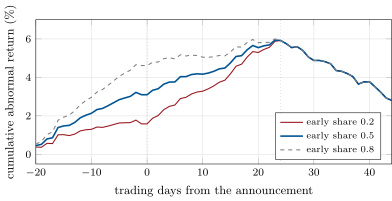
s1_index.path_for_figure.Three trades share the event. Predicting buys additions (and sells deletions) twenty days before the announcement and holds to it: with a perfect prediction it earns 3.75% per event at an early share of one half. Trading the announcement buys at the announcement’s close and sells at the effective close to the index funds: 2.40% per event after costs (standard error 0.4%). Providing liquidity at the effective close, selling to the index funds and buying back over the next twenty days, earns the reversal: 2.65%. The additions keep a small drift of their own, since stocks that have grown into an index are recent winners and the synthetic market plants momentum; Chen, Noronha and Singal found the real asymmetry the other way round, with a permanent rise for additions and no permanent fall for deletions, which they attributed partly to investor awareness.
10.4 How the trade decayed
| return from the announcement to the effective close | 5% of shares tracked | 15% | 30% |
|---|---|---|---|
| early share 0.2 | 2.2% | 4.0% | 5.7% |
| early share 0.5 | 1.3% | 2.4% | 3.5% |
| early share 0.8 | 0.4% | 0.8% | 1.3% |
| average push | 3.1% | 5.3% | 7.5% |
The event return rises with the demand and falls with the share taken early. More indexed money makes the push larger: from 3.1% at 5% of shares tracked to 7.5% at 30%. More arbitrage capital predicting the change moves it earlier, out of reach of anyone who waits for the announcement: at an early share of 0.8 the announcement trade keeps a fifth of what it keeps at 0.2. The predictors’ own return rises to 5.3% per event, but only with perfect foresight; twenty days out a predictor is wrong on one addition in seven and misses more than a quarter. This is the pattern the public record shows for the S&P 500: an effect first documented as a permanent shift in demand, and later as a temporary one that reverts, in a market where the event is known to all. The trade did not disappear; it moved earlier, to those who predict, and later, to those who provide liquidity at the close.
10.5 Strategy files
Strategy file 10.1 — Predicted additions
Who pays you, and why. Index funds that must buy at the effective close, whatever the price.
Instruments and venues. Stocks near the index cut-off; the closing auction on the effective date.
Signal. The probability of joining, from the index rules applied to projected characteristics.
Sizing and execution. Buy likely additions before the rank day or the announcement; sell into the index funds’ demand at the effective close.
Costs. Trading in stocks around the cut-off, often less liquid; wrong predictions.
How it dies. Competition moving the price earlier; index funds that trade over several days.
Horizon, capacity, infrastructure. Weeks; capacity limited by the event’s size; an index-rule engine and capitalisation data.
Backtest honestly. Rules as they were at each date; predictions from data before the rank day; the wrong predictions counted.
Sources. Shleifer (1986); this chapter’s simulation (3.75% per event with perfect prediction at an early share of one half).
Strategy file 10.2 — Predicted deletions
Who pays you, and why. Index funds that must sell at the effective close.
Instruments and venues. Members near the exit threshold.
Signal. The probability of leaving.
Sizing and execution. Short likely deletions (borrow permitting) and buy them back from the index funds’ selling at the close.
Costs. Borrow on falling, often small, stocks.
How it dies. As for additions; deleted stocks may not stay down.
Horizon, capacity, infrastructure. Weeks; borrow availability.
Backtest honestly. Borrow fees and availability; delisting of the weakest members.
Sources. Chen, Noronha and Singal (2004): no permanent decline for deletions.
Strategy file 10.3 — Effective-date close liquidity provision
Who pays you, and why. Index funds that trade at one close regardless of price.
Instruments and venues. The closing auction (Book 1, chapter 13) on the effective date.
Signal. The published imbalance of the closing auction and the known index demand.
Sizing and execution. Sell additions and buy deletions in the auction; unwind over the following weeks.
Costs. Holding risk over the reversal.
How it dies. When index funds spread their trading, or too much capital meets them at the close.
Horizon, capacity, infrastructure. Days to weeks; auction imbalance data.
Backtest honestly. Auction prices, not the day’s average; capacity against the auction’s size.
Sources. This chapter’s simulation (2.65% per event when half the push reverses); Patel and Welch (2017) on reversion in the 2000s.
Strategy file 10.4 — Post-event reversal
Who pays you, and why. As for liquidity provision: the part of the push that was pressure, not information.
Instruments and venues. Recently added and deleted stocks.
Signal. The size of the push relative to the stock’s volume.
Sizing and execution. Short additions and buy deletions after the effective date, hedged.
Costs. Borrow on additions; the momentum of recent winners.
How it dies. If index membership carries information (awareness, liquidity), the push does not revert.
Horizon, capacity, infrastructure. Weeks to months.
Backtest honestly. Separate additions from deletions; control for momentum.
Sources. Patel and Welch (2017); Chen, Noronha and Singal (2004).
10.6 Tutorial: everyone predicts it
Goal. Write a banded index rule, predict its changes, and trade the event at three moments. End state: the two tables and Figure 10.1.
The rule and its prediction: ranks, the band, and forward simulation of capitalisations.
def reconstitute(cap, members, size: int, band: int):
    cap, members = np.asarray(cap, float), np.asarray(members, bool)
    ok = np.isfinite(cap)
    order = np.argsort(-np.where(ok, cap, -np.inf), kind="stable")
    rank = np.empty(len(cap), int)
    rank[order] = np.arange(1, len(cap) + 1)
    rank[~ok] = len(cap) + 1
    add = ~members & (rank <= size - band) & ok
    drop = members & ((rank > size + band) | ~ok)
    return (members | add) & ~drop, add, drop


def predict(cap, vol, members, size: int, band: int, days: int, sims: int = 200, rng=None):
    """cap and vol (daily) as known today; each simulation moves every cap by an independent lognormal step."""
    rng = rng or np.random.default_rng(0)
    cap, vol = np.asarray(cap, float), np.asarray(vol, float)
    hits = np.zeros(len(cap))
    for _ in range(sims):
        c = cap * np.exp(vol * np.sqrt(days) * rng.standard_normal(len(cap)) - 0.5 * vol**2 * days)
        new, _, _ = reconstitute(c, members, size, band)
        hits += new
    return hits / sims
Listing 10.1. The banded reconstitution rule and its prediction. code/firm/indexevent/firm_indexevent.py The event: the planted path from prediction to reversal.
def event_path(push: float, early: float, revert: float, pre: int = 20, run: int = 24, post: int = 20):
    """Days -pre..-1 before the announcement: early x push accrues evenly (traders who predict the change); day 0: the
    announcement; days 1..run: the rest accrues evenly to the effective close; then revert x push over post days."""
    path = np.zeros(pre + 1 + run + post)
    path[:pre] = early * push * np.arange(1, pre + 1) / pre
    path[pre] = early * push
    path[pre + 1:pre + 1 + run] = early * push + (1 - early) * push * np.arange(1, run + 1) / run
    path[pre + 1 + run:] = push - revert * push * np.arange(1, post + 1) / post
    return path
Listing 10.2. The event’s price path. code/firm/indexevent/firm_indexevent.py - Run
accuracyat 0, 20 and 60 days,tradesover the grid, andfig_index.py.
What to change next. Trade only predictions above a probability of 0.8 and count the wrong ones; let index funds trade over three days; add a semi-annual and an annual calendar and compare the churn.
10.7 Build: index events
Purpose. Index rules, their prediction, and the price path of index-fund demand, to study index events with a known truth.
Interface. reconstitute(cap, members, size, band), predict(cap, vol, members, size, band, days, sims, rng), event_push(q, adv, sigma, eta), event_path(push, early, revert, pre, run, post).
Rules. Membership from rank-day data only; predictions from earlier data; the event path added to market-adjusted returns.
Acceptance tests. code/firm/indexevent/tests/: the band rule by hand; certain predictions far from the cut; the push and the path by hand.
Stretch. Float adjustment and liquidity screens; committee-style discretionary changes; index funds that trade over several days.
Sources and further reading
- A. Shleifer, “Do demand curves for stocks slope down?”, Journal of Finance 41(3), 1986.
- L. Harris and E. Gurel, “Price and volume effects associated with changes in the S&P 500 list”, Journal of Finance 41(4), 1986.
- H. Chen, G. Noronha and V. Singal, “The price response to S&P 500 index additions and deletions”, Journal of Finance 59(4), 2004.
- N. Patel and I. Welch, “Extended stock returns in response to S&P 500 index changes”, Review of Asset Pricing Studies 7(2), 2017.
- FTSE Russell (LSEG), Russell US indexes reconstitution announcements, 2026.
10.8 Exercises
Exercise 10.1 ★
An index of 300 stocks has a band of 15 ranks. At what rank does a non-member join, and at what rank does a member leave?
Solution
Solution of Exercise 10.1.
A non-member joins at rank 285 or better (); a member leaves beyond rank 315 ().
Exercise 10.2 ★
Index funds must buy 15% of a stock’s shares; it trades 0.6% of its shares a day with a daily volatility of 2%. What push does the square-root law give?
Solution
Solution of Exercise 10.2.
The funds must buy days of volume: .
Exercise 10.3 ★
With half of that push taken before the announcement and half of it reversing after the effective date, what do the announcement trade and the liquidity provider earn before costs?
Solution
Solution of Exercise 10.3.
The announcement trade earns the half not taken early, ; the liquidity provider earns the half that reverses, also 3.5%, before costs and before the stock’s own movements.
Exercise 10.4 ★★
Why does a band reduce turnover, and what does it do to the predictability of changes?
Solution
Solution of Exercise 10.4.
A stock near the cut-off must cross the band to change status, so small moves around the threshold do not flip it in and out: fewer changes, less trading by the index funds. Changes become rarer and involve stocks that moved further, which makes them easier to predict at the rank day but a band also makes the outcome depend on the stock’s current membership.
Exercise 10.5 ★★
Explain why the event return from the announcement falls as arbitrage capital grows, while the event itself does not shrink.
Solution
Solution of Exercise 10.5.
The index funds’ demand, and so the total push, is the same; arbitrage capital only changes when the price moves. The more capital predicts the change and buys early, the more of the push happens before the announcement and the less is left between the announcement and the effective close.
Exercise 10.6 ★★
Predictions sixty days before the rank day are right 76% of the time. What does that do to a predictor’s return, compared with a perfect predictor?
Solution
Solution of Exercise 10.6.
About a quarter of its positions are in stocks that do not join and earn no push (and may be hurt by the unwinding of others’ positions); it also misses more than half of the actual additions. Its return per position is well below the perfect predictor’s, and its risk higher.
Exercise 10.7 ★★★
Coding. Run trades(0.30, 0.2) and trades(0.05, 0.8). Explain the difference in the announcement trade’s return.
Solution
Solution of Exercise 10.7.
With 30% of shares tracked and only a fifth taken early, the announcement trade earns 5.7% per event; with 5% tracked and four fifths taken early, 0.4%. The first has a large push (7.5% on average) with most of it still to come; the second a small push (3.1%) mostly gone before the announcement.
Exercise 10.8 ★★★
Find the flaw. “Stocks added to the index rose 7% from the announcement to the effective date in our 1990s sample; we will buy all announced additions.”
Solution
Solution of Exercise 10.8.
The event has changed: more capital now predicts the changes, so more of the move happens before the announcement, and the part after it has shrunk; Patel and Welch find reversion in the 2000s. Measure the event on recent years, with costs and the stocks’ own drifts, and ask who else is buying.
10.9 Problem: Everyone Predicts It
Problem 10.1
Weekend problem — a known event, traded
The synthetic index and the public record.
Part I — The rules.
- Define an index fund, a rank day and membership prediction.
- Describe the Russell calendar in 2026.
- Describe the synthetic index’s rule and calendar, and the number of changes.
- What does a band do?
Part II — Prediction.
- How are changes predicted before the rank day?
- Give the precision and recall at 0, 20 and 60 days.
- Why does prediction get worse with horizon?
- What is the trade-off between early and certain?
Part III — The event.
- Describe the planted event path.
- Give the returns of predicting, trading the announcement and providing liquidity.
- What did Shleifer and Chen, Noronha and Singal find?
- Why do synthetic additions keep a small drift?
Part IV — The verdict.
- State the named result: the prediction accuracy of membership changes and the event return as index-tracking demand grows relative to arbitrage capital.
- What did Patel and Welch find?
- Where did the trade go?
- Which strategy file would you run with small capital, and which with large?
- What would you monitor on the effective date?
- How do semi-annual reconstitutions change the trade?
- What makes an index event different from a flow event of chapter 9?
- In one sentence: what is the index effect today?
Solution
Solution of Problem 10.1.
- A fund holding an index in its weights; the date on which a rules-based index measures membership criteria; the probability, before the rank day, that a stock will be a member after the reconstitution.
- Semi-annual from 2026: June (rank day April 30, effective after the close on June 26) and December (rank day October 30, effective after the close on December 11).
- The 300 largest stocks, reconstituted every 126 days with a band of 15 ranks; announcement 16 days and effective close 40 days after the rank day; 331 additions and 270 deletions over seventeen reconstitutions.
- It keeps stocks near the cut-off from churning in and out.
- By simulating each stock’s capitalisation forward with its own volatility and applying the rule to each draw.
- 100% on the rank day; 86% and 72% for additions 20 days before (deletions 86% and 74%); 76% and 45% sixty days before (76% and 46%).
- Capitalisations have more time to move.
- Early predictions leave more of the move ahead but are more often wrong.
- A share of the push before the announcement, the rest to the effective close, half of it reversing over the next 20 days.
- 3.75%, 2.40% and 2.65% per event at 15% tracked and an early share of one half.
- A significant abnormal return at the announcement of S&P 500 additions, related to index-fund buying; a permanent rise for additions but no permanent fall for deletions.
- Stocks that grow into an index are recent winners, and the synthetic market plants momentum.
- Named result. Membership changes are predicted with a precision of 86% and a recall of 72% twenty days before the rank day (76% and 45% sixty days before); the announcement trade earns 2.2% to 5.7% per event as the tracked share rises from 5% to 30% with a fifth taken early, and 0.4% to 1.3% with four fifths taken early.
- Reversion in the 2000s: no permanent demand shift for S&P 500 changes.
- Earlier, to predictors, and later, to liquidity providers at the effective close.
- Small capital: effective-close liquidity provision in a few names; large: predictions across the whole list.
- The closing-auction imbalances, the index funds’ expected demand, and the prices of the most crowded additions.
- Two smaller events a year instead of one: less demand per event, more events, and a busier calendar for predictors.
- Its date, size and direction are known in advance.
- A known, temporary push, most of which is traded before and after the date by those who predict it and those who meet it.
10.10 Interview questions
Interview question 10.1 ★ researcher, trader
Why does a stock’s price move when it is added to an index?
Solution
Solution of Interview question 10.1.
Index funds must buy it at once, and the other side of that demand is not perfectly elastic: the price rises until sellers are paid enough to supply the shares. Part of the rise can be information or awareness; the rest is pressure that tends to revert.
Interview question 10.2 ★★ trader
How would you trade the Russell reconstitution?
Solution
Solution of Interview question 10.2.
Predict the changes from the rules and capitalisations before the rank day, trade the likely additions and deletions ahead of the preliminary list, and provide liquidity at the effective close against the index funds’ demand; size by the expected demand relative to volume and by the confidence of the prediction.
Interview question 10.3 ★★ researcher, developer
Build a predictor of index additions a month before the rank day. What inputs and what uncertainty?
Solution
Solution of Interview question 10.3.
Capitalisation and float as of today, each stock’s volatility, the index rules including bands and screens, and the calendar; simulate capitalisations to the rank day to get a probability per stock. The uncertainty grows with the time to the rank day and is largest for stocks near the cut-off.
Interview question 10.4 ★★ risk
What can go wrong with a book of predicted index additions?
Solution
Solution of Interview question 10.4.
Wrong predictions; a crowded trade that has already priced the change; index funds that trade before or after the close; a market fall before the rank day that moves the cut-off; stocks near the cut-off that are small and illiquid.
Interview question 10.5 ★★ trader
The closing auction on reconstitution day shows a large buy imbalance in a stock. What do you do?
Solution
Solution of Interview question 10.5.
If the imbalance is mechanical index demand and the price already reflects heavy pre-positioning, sell into it and plan to buy back as the pressure reverts; size to the auction’s depth and to how much of the move has happened before the close.
Interview question 10.6 ★★★ researcher
Index demand meets arbitrage capital that buys before the announcement. In a model where the price push is proportional to the net demand the market must absorb at each stage, how does the return after the announcement depend on ?
Solution
Solution of Interview question 10.6.
If arbitrageurs buy before the announcement and index funds buy at the effective close, the market absorbs early and later, and sells back to the funds; with pushes proportional to net demand the early move is proportional to and the post-announcement move to , so the return after the announcement is proportional to and vanishes as arbitrage capital approaches the index demand.