Strategies I: Equities and Futures · Strategies
27Crypto Medium-Frequency Strategies
In 2021 the funding on Binance’s Bitcoin perpetual averaged 30.6% a year, paid by longs to shorts: a book long spot bitcoin and short the perpetual, with no view on the price, collected it. In November 2022 FTX.com, one of the largest venues on which such books were run, stopped paying withdrawals; at the petition its debtors located assets worth about a fifth of what customers were owed. Crypto’s medium-frequency strategies are carry, momentum and flows, like other markets’, with one addition: the venue itself can fail. On Binance’s data the carry book earned 25.3% on capital in 2021 and 3.3% in 2022; a book spread over four venues, each failing with a 5% chance a year and losing what FTX lost, gives up 20.2% of its capital when one fails. The build is firm.cryptomf.
27.1 Funding and basis carry
Definition 27.1 (Funding carry, basis carry)
Funding carry is the return of a position long spot and short a perpetual future of the same coin, which receives the perpetual’s funding payments when they are positive (longs pay shorts) and pays them when negative, with no net exposure to the price. Basis carry is the same trade with a dated future: long spot, short the future, earning the future’s premium over spot as it converges at expiry.
As of September 2026 — Perpetual funding on Binance
Binance’s funding rate for a perpetual is the average premium of the perpetual over its index plus a clamped interest term, paid every eight hours at 00:00, 08:00 and 16:00 UTC; for most contracts the interest term is 0.01% per interval. Book 3, chapter 17 describes the mechanism and its premium index.
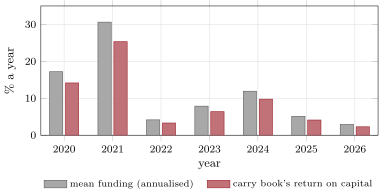
The carry book’s return on capital (Listing 27.1) is the year’s funding, less trading costs (0.2% a year, assumed), divided by the capital it ties up: the spot position plus the perpetual’s margin (20% of notional, assumed).
| year | 2020 | 2021 | 2022 | 2023 | 2024 | 2025 | 2026 |
|---|---|---|---|---|---|---|---|
| funding, mean annualised | 17.19% | 30.61% | 4.16% | 7.87% | 11.92% | 5.13% | 2.94% |
| share of negative rates | 14.3% | 7.3% | 22.1% | 10.1% | 8.4% | 12.9% | 26.1% |
| carry book, return on capital | 14.2% | 25.3% | 3.3% | 6.4% | 9.8% | 4.1% | 2.3% |
2026 runs to 24 September. The carry follows the market’s demand for leverage (Figure 27.1): high in the rising market of 2021, small after 2022’s crash, recovering in 2024. Schmeling, Schrimpf and Todorov found the same in dated futures’ basis, sometimes above 40% a year, and traced it to smaller, trend-chasing investors’ demand for leverage meeting arbitrage capital limited by regulatory and margin frictions. The carry is the price of that scarcity. In 2024 it was close to the interest term of 0.01% per interval ( a year); since then it has been below it.
s1_crypto.funding.27.2 Cross-sectional momentum in coins
Liu and Tsyvinski found that cryptocurrency returns are not exposed to the usual stock-market and macroeconomic factors but are predicted by factors specific to crypto: a strong time-series momentum effect and proxies for investor attention. Liu, Tsyvinski and Wu found that three factors, the crypto market, size and momentum, account for the cross-section of expected coin returns. firm.cryptomf simulates six years of 50 coins with a 60% market factor, 80% specific volatility with fat tails (a Student- with three degrees of freedom), and a planted persistent drift with a half-life of 60 days, and runs a weekly long–short book on past returns, top fifth against bottom fifth:
| lookback | 7 days | 28 days | 56 days |
|---|---|---|---|
| Sharpe ratio before costs | 0.85 | 1.56 | 1.29 |
| after 10 bp per unit traded | 0.42 | 1.35 | 1.13 |
| after 20 bp per unit traded | 1.13 | 0.97 |
A week of history is mostly noise at these volatilities; four weeks measure the drift better and trade less. Costs in crypto vary widely by venue and coin, and the small coins where momentum is strongest are the most expensive to trade.
27.3 On-chain data signals
Definition 27.2 (On-chain signal)
An on-chain signal is a trading signal built from a blockchain’s public records: flows of coins to and from exchanges’ known addresses, balances of large holders, activity of addresses, issuance and burning, available to anyone who reads the chain (Book 3, chapter 26).
The classic hypothesis: coins sent to exchanges are about to be sold. The chapter plants it: each coin’s net inflow, standardised, has a correlation of with the next day’s specific return. Measured as a rank IC across the 50 coins, the z-scored inflow (against its past 30 days) gives () over six years. The planted effect is recovered. In real data the mapping of addresses to exchanges is incomplete and changes, and flows between an exchange’s own wallets look like deposits; the scaffolding in firm.cryptomf is where such a signal is tested, not evidence that one works.
27.4 Venue and custody risk
Definition 27.3 (Venue risk)
Venue risk is the risk of losing assets held at a trading venue or custodian through its failure, fraud, hacking or freezing of withdrawals; in crypto it is borne by the customer, because exchanges often hold customers’ assets themselves.
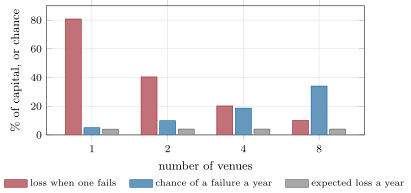
FTX.com’s debtors’ analysis gives the size of such a loss. At the petition, customer payables summed to about $11.2 billion and the located assets to about $2.2 billion: a shortfall of 80.8%. In the eleven days of November 2022 before the petition, customers withdrew $7.0 billion more than they deposited, $3.3 billion net on 7 November alone. Book 3, chapter 15 tells the story. For a carry book the lesson is arithmetic (Listing 27.2): with venues that fail independently with probability a year and lose a share of the assets on them, the expected loss is whatever the number of venues, and spreading assets only changes its distribution.
| venues (equal shares), , | 1 | 2 | 4 | 8 |
|---|---|---|---|---|
| loss when one venue fails (share of capital) | 80.8% | 40.4% | 20.2% | 10.1% |
| chance of at least one failure in a year | 5.0% | 9.9% | 18.7% | 34.0% |
| expected loss a year | 4.1% | 4.1% | 4.1% | 4.1% |
| 99th percentile of the yearly loss | 80.8% | 40.4% | 40.4% | 20.2% |
Against the carry, an expected loss of about 4% a year is decisive: 2021’s 25.3% would net 21.3%, 2022’s 3.3% would be a loss (Figure 27.2). Diversification across venues makes the bad year survivable; it does not make the strategy better. What lowers the expected loss is the choice of venues and custody: segregated custody, assets held off the exchange until needed, and the speed to withdraw when a venue weakens.
s1_crypto.venues.27.5 Strategy files
Strategy file 27.1 — Perpetual funding carry
Who pays you, and why. Leveraged longs who pay funding to hold perpetuals.
Instruments and venues. Spot coins and their perpetuals on the largest venues.
Signal. Positive expected funding; exit when it turns persistently negative.
Sizing and execution. Long spot, short perpetual in equal notional; margin kept above maintenance with a buffer.
Costs. Trading fees, borrowing if spot is financed, and venue risk.
How it dies. Arbitrage capital compresses funding; venue failure.
Horizon, capacity, infrastructure. Months; capacity limited by open interest; custody and margin monitoring.
Backtest honestly. Funding as paid, interval by interval; fees; the capital actually tied up; a venue-loss charge.
Sources. Binance funding data (Book 3); this chapter: 25.3% on capital in 2021, 3.3% in 2022, before venue risk.
Strategy file 27.2 — Dated-futures basis carry
Who pays you, and why. Investors wanting leveraged long exposure through futures.
Instruments and venues. Dated futures on regulated and crypto venues, against spot.
Signal. The annualised basis to expiry.
Sizing and execution. Long spot, short the future, held to expiry.
Costs. Fees; capital for margin; the roll into the next expiry.
How it dies. More arbitrage capital; regulation that eases it.
Horizon, capacity, infrastructure. Weeks to months.
Backtest honestly. Basis at executable prices; margin at the venue’s rules.
Sources. Schmeling, Schrimpf and Todorov: carry sometimes above 40% a year.
Strategy file 27.3 — Coin cross-sectional momentum
Who pays you, and why. Investors who underreact, then chase; attention flows.
Instruments and venues. Spot or perpetuals on liquid coins.
Signal. Past three- to eight-week returns, ranked.
Sizing and execution. Weekly long–short quintiles, volatility-scaled.
Costs. Large for small coins.
How it dies. Crashes and reversals; delistings.
Horizon, capacity, infrastructure. Weeks; clean price histories including dead coins.
Backtest honestly. Survivorship: include delisted coins; costs by coin.
Sources. Liu and Tsyvinski (2021); Liu, Tsyvinski and Wu (2022); this chapter: 1.35 after 10 bp at four weeks, synthetic.
Strategy file 27.4 — On-chain flow signal
Who pays you, and why. Holders about to sell, whose deposits to exchanges are public before their orders.
Instruments and venues. Coins with well-labelled exchange addresses.
Signal. Z-scored net inflows to exchanges.
Sizing and execution. Short-horizon tilts; small.
Costs. Data labelling; turnover.
How it dies. Internal transfers mistaken for deposits; wider use of the same data.
Horizon, capacity, infrastructure. Days; a node or a data provider and address labels.
Backtest honestly. Labels as they were known at the time; block times, not later-indexed times.
Sources. No performance figure verified; the chapter’s synthetic test.
Strategy file 27.5 — Funding-rate mean reversion
Who pays you, and why. Crowded leveraged positioning that unwinds.
Instruments and venues. Perpetuals.
Signal. Funding far above or below its recent range.
Sizing and execution. Fade extreme funding, sized small.
Costs. Funding paid while waiting; liquidation cascades.
How it dies. Trends that persist while funding stays extreme.
Horizon, capacity, infrastructure. Days.
Backtest honestly. Funding interval by interval; liquidation risk at the venue’s margin rules.
Sources. No performance figure verified.
Strategy file 27.6 — Venue-diversified carry
Who pays you, and why. As for funding carry.
Instruments and venues. The same trade on several venues.
Signal. Funding by venue, net of each venue’s risk.
Sizing and execution. Capital spread by venue quality; withdrawal limits and triggers.
Costs. Lower netting, more capital idle.
How it dies. Correlated failures when one venue’s collapse spreads.
Horizon, capacity, infrastructure. Months; treasury operations across venues.
Backtest honestly. A venue-failure charge; failures in the sample.
Sources. FTX debtors’ analysis (Doc 792-1); this chapter: 20.2% of capital lost when one of four venues fails.
27.6 Tutorial: until the exchange failed
Goal. Turn Binance’s funding statistics into a carry book’s yearly returns, measure FTX’s loss given failure from its debtors’ analysis, simulate coin momentum and exchange flows, and size a carry book across venues. End state: the tables and the two figures.
The real data: funding by year and the FTX balances and flows.
def funding():
    out = []
    for r in _rows("binance_btcusdt_funding_by_year.csv"):
        f = float(r["mean_annualised_pct"]) / 100
        out.append((int(r["year"]), f, float(carry_return(f, MARGIN, COST)), float(r["negative_share"])))
    return out


def ftx():
    bal = _rows("ftx_com_petition_balances.csv")
    pay = sum(float(b["customer_payables"]) for b in bal)
    loc = sum(float(b["located_assets"]) for b in bal)
    flows = _rows("ftx_com_daily_flows_nov2022.csv")
    net = sum(float(f["customer_deposits"]) - float(f["customer_withdrawals"]) for f in flows)
    worst = min(flows, key=lambda f: float(f["customer_deposits"]) - float(f["customer_withdrawals"]))
    return {"payables": pay, "located": loc, "lgd": 1 - loc / pay, "net_customer": net, "worst_day": worst["date"],
            "worst_net": float(worst["customer_deposits"]) - float(worst["customer_withdrawals"])}
Listing 27.1. Funding carry by year and the FTX shortfall. code/strategies-1/27-crypto-medium-frequency-strategies/python/s1_crypto.py Momentum, flows and venues.
def momentum_book(r, lookback: int = 21, hold: int = 7, q: float = 0.2, cost: float = 0.001):
    r = np.asarray(r, float)
    T, N = r.shape
    c = np.vstack([np.zeros((1, N)), np.cumsum(r, axis=0)])
    w = np.zeros((T, N))
    cur = np.zeros(N)
    for d in range(lookback, T):
        if (d - lookback) % hold == 0:
            past = c[d + 1] - c[d + 1 - lookback]
            k = max(1, int(q * N))
            order = np.argsort(past)
            cur = np.zeros(N)
            cur[order[-k:]], cur[order[:k]] = 0.5 / k, -0.5 / k
        w[d] = cur
    pnl = np.zeros(T)
    pnl[1:] = (w[:-1] * r[1:]).sum(1)
    pnl -= cost * np.abs(np.diff(w, axis=0, prepend=np.zeros((1, N)))).sum(1)
    return pnl


def flow_ic(flow, r, window: int = 30):
    flow, r = np.asarray(flow, float), np.asarray(r, float)
    ics = []
    for d in range(window, len(r) - 1):
        w = flow[d - window:d]
        z = (flow[d] - w.mean(0)) / w.std(0)
        a, b = np.argsort(np.argsort(z)), np.argsort(np.argsort(r[d + 1]))
        ics.append(np.corrcoef(a, b)[0, 1])
    v = np.array(ics)
    return float(v.mean()), float(v.mean() / v.std(ddof=1) * math.sqrt(len(v)))


def venue_losses(k: int, p: float, lgd: float, years: int = 100_000, rng=None):
    rng = rng or np.random.default_rng(28)
    fails = rng.random((years, k)) < p
    return fails.sum(1) * lgd / k
Listing 27.2. Coin momentum, flow IC and venue losses. code/firm/cryptomf/firm_cryptomf.py - Run
funding(),ftx(),momentum_table(),flows()andvenues(), andfig_crypto.py.
What to change next. Correlate venue failures (a failure raises the others’ probability); fetch funding interval by interval and compute drawdowns; add a delisting process to the coin universe and see momentum’s survivorship bias.
27.7 Build: crypto strategies
Purpose. Carry accounting, a coin universe with momentum and flows, and venue-failure losses.
Interface. carry_return(funding, margin, cost), basis_carry(fut, spot, days), CoinConfig(…), simulate_coins(cfg, rng), momentum_book(r, lookback, hold, q, cost), flow_ic(flow, r, window), venue_losses(k, p, lgd, years, rng).
Rules. Carry on the capital tied up; signals from past data; venue failures independent unless stated.
Acceptance tests. code/firm/cryptomf/tests/: carry and basis by hand, momentum and the flow IC on a planted universe, the mean and support of venue losses.
Stretch. Correlated failures; interval-level funding; delistings.
Sources and further reading
- Y. Liu and A. Tsyvinski, “Risks and returns of cryptocurrency”, Review of Financial Studies 34(6), 2021.
- Y. Liu, A. Tsyvinski and X. Wu, “Common risk factors in cryptocurrency”, Journal of Finance 77(2), 2022.
- M. Schmeling, A. Schrimpf and K. Todorov, “Crypto carry”, Management Science, 2026.
- FTX Debtors, Preliminary Analysis of Shortfalls, Doc 792-1, In re FTX Trading Ltd., 22-11068 (Bankr. D. Del.), March 2023.
- Binance, BTCUSDT perpetual funding rates (public endpoint) and funding-rate documentation.
27.8 Exercises
Exercise 27.1 ★
A funding rate of 0.01% per eight-hour interval, paid three times a day: what is it annualised? And 0.1%?
Solution
Solution of Exercise 27.1.
a year; at 0.1% per interval, 109.5%.
Exercise 27.2 ★
Funding averages 30.61% a year; costs are 0.2% a year; the perpetual’s margin is 20% of notional. What does the book earn on its capital?
Solution
Solution of Exercise 27.2.
on capital.
Exercise 27.3 ★
Why is a book long spot and short the perpetual not exposed to the coin’s price, and what is it exposed to?
Solution
Solution of Exercise 27.3.
A price move changes the spot position’s value and the short perpetual’s by opposite amounts. The book is exposed to funding (which can turn negative), to the basis between perpetual and spot, to margin calls on the short when the price rises (the gain sits in the spot, possibly on another venue), and to the venues and custodians holding both legs.
Exercise 27.4 ★★
Venues fail independently with a 5% chance a year and lose 80.8% of the assets on them. What is the expected yearly loss, and the chance of at least one failure among four venues? Among eight?
Solution
Solution of Exercise 27.4.
a year. At least one failure: among four venues, among eight (the simulation’s 18.7% and 34.0% are sampling noise around these).
Exercise 27.5 ★★
Net of an expected venue loss of 4.0% a year, what did the carry book earn in 2021 and in 2022?
Exercise 27.6 ★★
Why does the one-week momentum book lose after 20 basis points while the four-week book does not?
Solution
Solution of Exercise 27.6.
One week of returns at 80% specific volatility measures the planted drift with far more noise than four weeks, so its ranking changes more each week: the book trades more for a weaker signal, and at 20 basis points per unit traded the costs take everything.
Exercise 27.7 ★★★
Coding. Run venues_correlated(): in a year with a failure, each other venue also fails with probability 30%. Compare the expected loss and the 99th percentile with the independent case for four venues.
Solution
Solution of Exercise 27.7.
With contagion the expected loss rises from 4.1% to 7.4% a year and the 99th percentile from 40.4% to 60.6% of capital; the chance of a loss in a year stays about 18.7%, because contagion adds failures only in years that already have one. Spreading capital over venues helps least when failures travel together.
Exercise 27.8 ★★★
Find the flaw. “Our funding carry earned 18% a year for five years with a maximum drawdown of 2%: it is market-neutral and nearly riskless.”
Solution
Solution of Exercise 27.8.
Five years without a venue failure measure nothing about it: the book’s main risk is a loss of most of the assets on a venue, which a daily P&L history does not show until it happens. Charge the expected venue loss, stress the book with a failure, and count the funding years that were low or negative.
27.9 Problem: Until the Exchange Failed
Problem 27.1
Weekend problem — carry, momentum and the venue
Binance’s funding data, the FTX debtors’ analysis, the synthetic coins and the public record.
Part I — Carry.
- Define funding carry and basis carry.
- How is Binance’s funding rate set, and when is it paid?
- Give the carry book’s return on capital by year.
- What did Schmeling, Schrimpf and Todorov find about crypto carry?
Part II — Momentum and flows.
- What did Liu and Tsyvinski, and Liu, Tsyvinski and Wu find?
- Describe the synthetic coin universe.
- Give the momentum book’s Sharpe ratios by lookback and cost.
- Define an on-chain signal; what did the flow test find, and what does it not show?
Part III — Venues.
- Define venue risk.
- What do FTX.com’s petition-time balances and November flows show?
- Give the loss when one of venues fails and the chance of a failure a year.
- Why does diversification not change the expected loss?
Part IV — The verdict.
- State the named result: the funding carry’s yearly return and the venue-diversified book’s loss when one venue fails.
- What does lower the expected venue loss?
- How would you backtest funding carry honestly?
- Which strategy file carries the most venue risk?
- How does this chapter’s carry relate to chapter 20’s?
- What did the carry pay for in 2021?
- Why did funding fall after 2022?
- In one sentence: what is a crypto carry trader paid for?
Solution
Solution of Problem 27.1.
- Long spot and short a perpetual, collecting funding; long spot and short a dated future, collecting the basis.
- The average premium of the perpetual over its index plus a clamped interest term, paid every eight hours at 00:00, 08:00 and 16:00 UTC.
- 14.2%, 25.3%, 3.3%, 6.4%, 9.8%, 4.1% and 2.3% for 2020 to 2026.
- It can exceed 40% a year, varies strongly, and reflects leverage demand from trend-chasing investors against limited arbitrage capital.
- Crypto returns load on crypto-specific factors, with strong time-series momentum; market, size and momentum capture the cross-section.
- 50 coins, a 60% market factor, 80% fat-tailed specific volatility, a planted drift with a 60-day half-life.
- 0.85, 1.56 and 1.29 before costs at 7, 28 and 56 days; 0.42, 1.35 and 1.13 after 10 basis points; , 1.13 and 0.97 after 20.
- A signal from public blockchain records; a planted correlation recovered as an IC of ; not that real flows predict returns.
- The risk of losing assets held at a venue or custodian.
- Located assets of about a fifth of customer payables (a shortfall of 80.8%), and $7.0 billion of net customer withdrawals in eleven days.
- of capital; 5.0%, 9.9%, 18.7% and 34.0% for one to eight venues.
- The expected loss is on each unit of capital wherever it sits.
- Named result. The funding carry book earned 25.3% on capital in 2021 and 3.3% in 2022 (14.2% in 2020, 2.3% in 2026 to September); spread over four venues, it loses 20.2% of capital when one fails, with an expected venue loss of 4.1% a year.
- Choosing venues and custody, keeping assets off exchanges, and withdrawing early.
- Funding interval by interval, fees, the capital actually tied up, margin calls, and a venue-loss charge.
- Perpetual funding carry held on one venue.
- Both earn the price of holding an asset others pay to shed or to lever; here the payer is leveraged demand.
- Leveraged long demand in a rising market.
- Leverage demand fell after 2022’s losses; the chapter does not claim the cause.
- For supplying leverage and bearing venue risk.
27.10 Interview questions
Interview question 27.1 ★ researcher
What is a perpetual future’s funding rate, and why does it exist?
Solution
Solution of Interview question 27.1.
A periodic payment between longs and shorts of a perpetual future that has no expiry, set from the perpetual’s premium over its index; it pulls the perpetual’s price toward the spot index by making the crowded side pay.
Interview question 27.2 ★★ trader
Funding on a coin is 60% a year. Walk through the trade and its risks.
Solution
Solution of Interview question 27.2.
Buy spot and short the perpetual in equal notional; collect 60% a year while it lasts; risks are funding falling or turning negative, margin calls on the short if the price rises, liquidation if margin runs out, the basis moving, and the venue failing; size for the venue risk, not the funding.
Interview question 27.3 ★★ risk
How would you set limits on the assets a firm keeps on each crypto venue?
Solution
Solution of Interview question 27.3.
From the loss the firm can bear if the venue fails outright: a cap per venue scaled by its assessed quality (custody, audits, jurisdiction, history), a cap on total exposure to venues without segregated custody, and triggers to withdraw (withdrawal delays, spreads, rumours).
Interview question 27.4 ★★ developer
What does a system running a carry book across several venues need to monitor?
Solution
Solution of Interview question 27.4.
Positions and margin on each venue, funding received and paid, balances and withdrawal status, transfer times between venues, price and basis differences, and alerts when margin, funding or a venue’s behaviour moves outside limits.
Interview question 27.5 ★★ researcher
How would you test coin momentum without survivorship bias?
Solution
Solution of Interview question 27.5.
Build the universe as it was each week, including coins later delisted or dead, with their last tradeable prices; rank only coins tradeable at the time; charge costs by coin.
Interview question 27.6 ★★★ researcher
A book spreads its capital over venues, each failing independently with probability a year and losing a share . Derive the mean and variance of the yearly loss, and the probability that it is at least for an integer .
Solution
Solution of Interview question 27.6.
The number of failures is binomial and the loss is : mean , variance . The probability that the loss is at least is .