Strategies I: Equities and Futures · Strategies
12Share Classes, Holding Companies, Closed-End Funds and SPACs
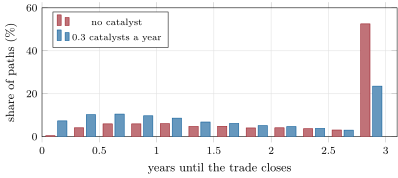
A closed-end fund holds $100 million of listed stocks and trades at $85 million. Its shares cannot be redeemed for the stocks, so nothing forces the two values together: the discount can last for years, narrow when sentiment turns, or widen. Buying the fund and selling its holdings locks in fifteen cents on the dollar only if something closes the gap. On the synthetic model of this chapter the trade earns 0.87% a year if the discount is left to drift back toward its average, with a median holding of three years and a two-in-five chance of losing; with catalysts (a tender, a liquidation, an activist) arriving at 0.3 a year it earns 5.0% a year and closes in a median 1.4 years. Structural relative value is the family of trades in which a contract or a structure ties two prices together: share classes, holding companies, closed-end funds and special-purpose acquisition companies. The build is firm.structrv.
12.1 Dual share classes
Share classes are the cleanest structural pair: the same company, the same dividends, a spread that should be small and stationary. They are the real counterpart of chapter 4’s planted twins, whose log price spread reverted with a ten-day time constant and a 2% standard deviation, and which the distance method found and traded at a Sharpe ratio of 5 after costs. The real spreads are driven by what differs between the classes: voting rights matter in takeover contests, one class may be in an index and the other not (chapter 10), and one may be far less liquid. A share-class book trades the spread against its own history and closes positions before events that could change the value of the vote.
12.2 Holding-company discounts
A holding company that owns listed stakes can be hedged exactly: buy the holding company, sell its stakes in proportion. What is left is the discount, which has reasons to exist (taxes on a sale of the stakes, the holding’s costs, governance) and few forces to close it; unlike a closed-end fund, a holding company rarely liquidates. The chapter’s holding company trades at 70 cents on the dollar with a discount reverting toward 80 cents over a half-life of three years and no catalyst: the hedged trade earns 0.94% a year, closes within three years in only 2% of the paths, and loses in 40%.
12.3 Closed-end fund discounts
The closed-end fund puzzle has two parts. Funds trade at discounts most of the time, and those discounts move. Lee, Shleifer and Thaler traced the movement to individual investors’ sentiment: discounts on different funds move together, new funds get started when seasoned ones sell near or above their asset value, and discounts narrow when small stocks do well. Pontiff found that deviations are larger where arbitrage is costlier: portfolios hard to replicate, small dividends, small funds and high interest rates, which together explained a quarter of the cross-section of mispricing.
| closed-end fund at 85 cents | holding company | |||
| catalysts a year | none | 0.1 | 0.3 | at 70 cents, none |
| mean return per trade; a year | 1.9%; 0.87% | 4.4%; 2.23% | 7.9%; 5.04% | 2.8%; 0.94% |
| median years held | 2.96 | 2.13 | 1.37 | 3.00 |
| closed within three years | 50% | 63% | 79% | 2% |
| closed by a catalyst | 0% | 19% | 46% | 0% |
| 5th percentile of return; share that lose | ; 40% | ; 30% | ; 17% | ; 40% |
The model (Listing 12.1) is a mean-reverting discount, in logs: the fund starts at 85 cents on the dollar () and reverts toward 90 cents () with a half-life of two years and a volatility of 8% a year. The trade buys the fund and shorts its portfolio, pays 1.3% a year in carry (the fund’s expenses and the hedge’s borrow), and closes when the discount reaches 5% or after three years. Without a catalyst, most of the expected narrowing is to the average discount, not to zero, and the carry eats much of it: the trade is a slow, uncertain 2% over three years. A catalyst changes the arithmetic: the discount closes to 2% at once, the capital is freed early, and the return per year rises nearly sixfold at 0.3 catalysts a year (Figure 12.1). This is why discount trades are so often activist trades: the investor who can force a tender or a liquidation owns the catalyst.
s1_structrv.fund.12.4 Blank-cheque companies and their trust value
The redemption right makes a SPAC share a floor plus an option: at the vote the holder can take the trust value or keep a share of the merged company. A share bought below the trust value has a guaranteed minimum return (if the trust is safe) and a free call on the merger. Bought at $9.80 with a trust of $10.00 earning 4% a year and the vote a year away, the floor is $10.41, a 6.2% return (Listing 12.2). What the call is worth depends on the merged company. Klausner, Ohlrogge and Ruan found that SPACs raising $10.00 a share held far less net cash per share at their mergers (a median of $5.70 for those merging from January 2019 to June 2020), and that shareholders who held through the merger suffered steep losses while sponsors profited. The chapter’s assumption follows that record: a merged value lognormal around $7 with a volatility of 60%. The arbitrageur who redeems when the merged value is below the trust (74% of the paths) earns 20.2% on average, the floor plus a call on a volatile outcome; a holder who never redeems loses 13.9% on average and 27.8% at the median.
12.5 Structural relative value, in general
The four trades share a shape. A structure ties a price to a value that can be observed or replicated (the other class, the stakes, the net asset value, the trust). The gap exists because no one can force it closed cheaply: votes, taxes, the inability to redeem, the time to a vote. The trade earns the gap’s narrowing and pays carry while it waits. Its risks are the gap widening (sentiment, as Lee, Shleifer and Thaler found for funds), the hedge failing (a portfolio that cannot be shorted exactly, as Pontiff found), and time. The practical question is always the same: what closes the gap, and when? With a catalyst the trade is an event; without one it is a slow, uncertain carry trade.
12.6 Strategy files
12.7 Tutorial: eighty-five cents on the dollar
Goal. Simulate a discount that reverts slowly and can be closed by a catalyst, trade it, and price a SPAC as a floor and a call. End state: the table and Figure 12.1.
The discount and the trade: an AR(1) in logs with Poisson catalysts; exit at a level, a catalyst or the horizon.
def simulate_discount(d0: float, mean: float, half_life: float, vol: float, days: int, catalyst_rate: float = 0.0,
                      catalyst_level: float = -0.02, paths: int = 10000, rng=None):
    rng = rng or np.random.default_rng(12)
    phi = 0.5 ** (1 / half_life)
    sd = vol / math.sqrt(252)
    D = np.empty((paths, days + 1))
    D[:, 0] = d0
    hit = rng.random((paths, days)) < catalyst_rate / 252
    cat = np.where(hit.any(axis=1), hit.argmax(axis=1) + 1, -1)
    for t in range(1, days + 1):
        D[:, t] = mean + phi * (D[:, t - 1] - mean) + sd * rng.standard_normal(paths)
        done = cat == t
        D[done, t] = catalyst_level
        after = (cat > 0) & (cat < t)
        D[after, t] = catalyst_level
    return D, cat


def discount_trade(paths, catalyst_day, close_level: float, carry: float, horizon: int):
    D = np.asarray(paths, float)
    reach = D[:, 1:horizon + 1] >= close_level
    first = np.where(reach.any(axis=1), reach.argmax(axis=1) + 1, horizon)
    cat = np.asarray(catalyst_day)
    exit_day = np.where((cat > 0) & (cat < first), cat, first)
    ret = D[np.arange(len(D)), exit_day] - D[:, 0] - carry * exit_day / 252
    return ret, exit_day
Listing 12.1. The discount’s paths and the hedged trade. code/firm/structrv/firm_structrv.py The SPAC: the trust floor and the merger option.
def spac_payoff(trust_at_vote: float, merged_value):
    return np.maximum(trust_at_vote, np.asarray(merged_value, float))


def spac_return(price: float, trust: float, rate: float, days: int, merged_value):
    return spac_payoff(trust * math.exp(rate * days / 252), merged_value) / price - 1
Listing 12.2. A SPAC share’s payoff at the vote. code/firm/structrv/firm_structrv.py - Run
fund(0.0),fund(0.1),fund(0.3),holding(),spac()andfig_structrv.py.
What to change next. Make the discounts of several funds move together (Lee, Shleifer and Thaler’s common sentiment) and size a book of them; add warrants to the SPAC; let the catalyst’s arrival depend on the discount’s width.
12.8 Build: structural relative value
Purpose. Discount dynamics with catalysts, the hedged discount trade, and the SPAC floor-plus-option payoff.
Interface. simulate_discount(d0, mean, half_life, vol, days, catalyst_rate, catalyst_level, paths, rng), discount_trade(paths, catalyst_day, close_level, carry, horizon), spac_payoff(trust_at_vote, merged_value), spac_return(price, trust, rate, days, merged_value).
Rules. Discounts in logs; carry charged for the time held; exits on the first of level, catalyst or horizon.
Acceptance tests. code/firm/structrv/tests/: deterministic reversion with zero volatility; catalysts that close the discount; the trade’s exit and return by hand; the SPAC payoff by hand.
Stretch. Correlated discounts across funds; activist campaigns with costs; the SPAC’s warrants and extension votes.
Sources and further reading
- C. M. C. Lee, A. Shleifer and R. H. Thaler, “Investor sentiment and the closed-end fund puzzle”, Journal of Finance 46(1), 1991.
- J. Pontiff, “Costly arbitrage: evidence from closed-end funds”, Quarterly Journal of Economics 111(4), 1996.
- M. Klausner, M. Ohlrogge and E. Ruan, “A sober look at SPACs”, Yale Journal on Regulation 39, 2022.
- US SEC, press release 2024-8, SPAC rules, January 2024.
12.9 Exercises
Exercise 12.1 ★
Express discounts of 85, 90 and 95 cents on the dollar in logs.
Exercise 12.2 ★
A trade bought at 85 cents closes at 95 cents after a year with carry of 1.3%. What is its log return?
Exercise 12.3 ★
A SPAC trades at $9.80 with a trust of $10.00 earning 4% a year and a vote a year away. What is the trust value at the vote and the floor return?
Exercise 12.4 ★★
With a half-life of two years, what fraction of the gap between today’s discount and its average remains after one year? Why is the no-catalyst trade so slow?
Exercise 12.5 ★★
Why is a closed-end fund discount harder to arbitrage than a share-class spread?
Exercise 12.6 ★★
Explain why a SPAC bought below its trust value is a floor plus a call, and what can make the floor fail.
Exercise 12.7 ★★★
Coding. Run fund(0.1) and compare the annual return and holding time with fund(0.0) and fund(0.3). How much would you pay a year for a catalyst arriving at 0.3 a year?
Exercise 12.8 ★★★
Find the flaw. “The fund trades at a 15% discount to its assets; buying it and shorting its portfolio locks in 15%.”
12.10 Problem: Eighty-Five Cents on the Dollar
Problem 12.1
Weekend problem — what closes the gap
The chapter’s simulated discounts and SPAC, and the public record.
Part I — Structures.
- Define a dual-class share, a holding-company discount and a closed-end fund discount.
- Why do these gaps exist, and why do they persist?
- Relate share classes to chapter 4’s twins.
- What did Lee, Shleifer and Thaler, and Pontiff, find?
Part II — The discount trade.
- Describe the model of the fund’s discount and the trade.
- Give the results without a catalyst.
- Give the results with catalysts at 0.1 and 0.3 a year.
- What does the holding company’s result show?
Part III — SPACs.
- Define a SPAC and its trust value.
- Compute the floor for the chapter’s SPAC.
- What did Klausner, Ohlrogge and Ruan find?
- What does the simulation say about redeeming and holding?
Part IV — The verdict.
- State the named result: the expected return and the time to close of a discount trade with and without a catalyst.
- What do the four structures have in common?
- Why are discount trades so often activist trades?
- What did the SEC’s 2024 rules change for SPACs?
- How would you hedge a fund whose portfolio you cannot short?
- Which strategy file would you run with patient capital?
- What is the main risk of a book of discount trades?
- In one sentence: what does structural relative value buy?
12.11 Interview questions
Interview question 12.1 ★ researcher, trader
Why can a closed-end fund trade below its net asset value for years?
Interview question 12.2 ★★ trader
How would you trade two share classes of the same company?
Interview question 12.3 ★★ researcher
How would you value a SPAC share before its merger vote?
Interview question 12.4 ★★ risk
What are the risks of a portfolio of hedged closed-end fund positions?
Interview question 12.5 ★★ trader, researcher
A holding company trades at 70% of its parts. What would make you buy it?
Interview question 12.6 ★★★ researcher
A discount follows an Ornstein–Uhlenbeck process toward with speed , and a catalyst closes it to at Poisson rate . Write the expected discount at time and the expected gain of a trade held to .