Derivatives and Volatility · Derivatives
21Convertibles and the Credit-Equity Link
A company whose shares trade at 30 issues a five-year bond that the holder may exchange for 2.5 shares at any time. With the share at 80 the bond is worth 202, barely more than the 200 its shares would fetch: it trades like the share. With the share at 10 it is worth 69, barely more than the 68 of a plain bond of the same company, and that plain bond has itself fallen, because a company whose share has collapsed is more likely to default. It trades on its credit. In between the convertible is both at once, and a convertible desk lives in that region. It holds the bond, sells the share against it, buys credit protection, and earns the convexity. This chapter describes the instrument and its bond floor, conversion value and convex middle. It then builds an equity-to-credit model on a finite-difference grid, derives what the desk hedges, and ends with what happened when the arbitrage’s financing disappeared.
21.1 The instrument
Definition 21.1 (Convertible bond)
A convertible bond is a bond that its holder may exchange for a fixed number of the issuer’s shares, at any time or during set periods, instead of receiving coupons and principal; it usually also gives the issuer the right to call it and sometimes the holder the right to put it.
Definition 21.2 (Conversion ratio)
The conversion ratio is the number of shares received per bond on conversion.
Definition 21.3 (Conversion price)
The conversion price is the face value divided by the conversion ratio: the share price at which converting is worth the face value.
Definition 21.4 (Conversion value)
The conversion value (parity) is the conversion ratio times the current share price, what the bond would be worth if converted now.
The chapter’s bond has a face of 100, five years to maturity, an annual coupon of 2%, and a conversion ratio of 2.5, so a conversion price of 40 against a share at 30. The issuer may call it at 100 from the end of year two, but only if the share is at or above 52, 130% of the conversion price. Rates are 3%, the dividend yield 1% and the share’s volatility 30%. The issuer’s credit spread is 300 basis points, a default intensity of 5% a year with 40% recovery of face.
Definition 21.6 (Soft call)
A soft call is an issuer’s right to redeem a convertible early that can be exercised only if the share price has traded above a trigger level (for instance 130% of the conversion price): a call forces holders to convert when conversion is worth more than the call price.
The issuer’s call is the holder’s cost. Calling forces conversion when the conversion value exceeds the call price. That caps the bond’s value near the trigger and removes the time value the holder would otherwise keep. In the model below the soft call is worth 3.9 at a share price of 40 and 4.7 at 52: 115.3 and 138.6 with the call, against 119.2 and 143.3 without it.
21.2 Bond floor, conversion value and the convex region
Definition 21.7 (Bond floor)
The bond floor of a convertible is the value of the same bond without the conversion right: its coupons and principal discounted for the issuer’s credit (Book 2, chapter 21).
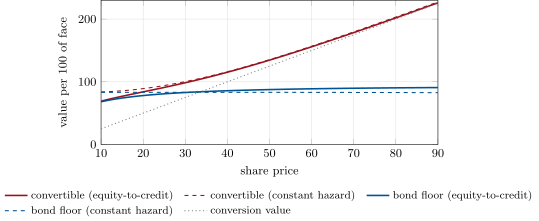
A convertible is worth at least its bond floor, because the holder can simply keep the bond, and at least its conversion value, because it can convert. It is worth more than both, by the value of the option to choose later. Far from the conversion price one bound dominates and the convertible behaves like it: a bond on the left, the shares on the right. Near the conversion price both matter. There the convertible is convex in the share, and that convexity is what the arbitrage buys (Figure 21.1).
Example 21.8 (The convertible across share prices)
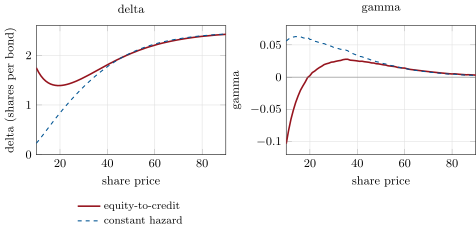
Under a constant 5% hazard, the convertible is worth 89.1, 100.2, 116.0, 156.7 and 203.2 at share prices of 20, 30, 40, 60 and 80. Its bond floor is 83.2 throughout. The conversion values are 50, 75, 100, 150 and 200, so the conversion premium falls from 78% at 20 to 34% at 30, 16% at 40, 4.5% at 60 and 1.6% at 80. The delta rises from 0.84 shares per bond at 20 to 2.39 at 80, approaching the conversion ratio of 2.5.
21.3 Equity-to-credit models
The constant-hazard picture has a flaw that matters most where the desk’s risk is largest. When a company’s share falls far, its credit usually deteriorates too, and the bond floor, on which the whole left side of the profile rests, falls with it. Models that tie default to the share price capture that.
Definition 21.9 (Equity-to-credit model)
An equity-to-credit model prices equity and credit instruments of one issuer together by making the default intensity a decreasing function of the share price, for instance . At default the share jumps to zero and bondholders recover a fraction of face.
Under the pricing measure the share must still earn the risk-free rate on average, so its drift is raised by to compensate for the jump to zero. The convertible’s value solves, in ,
between coupon dates, with the constraints for conversion, when the call is live, and on put dates. It is the Black–Scholes equation (chapter 3) with a killing rate and a recovery source. Ayache, Forsyth and Vetzal set out this single-equation formulation. Tsiveriotis and Fernandes had earlier split the convertible into a cash-only part discounted at the risky rate and an equity part discounted at the risk-free rate. The build solves the equation by Crank–Nicolson on a 500-point log-price grid (finite differences, One Quant Book 4, chapter 27, and chapter 22 of this book). It applies the constraints after each step, the same projection that priced American options in chapter 6. Andersen and Buffum showed that naive calibration of such models can bias prices significantly, and that the hazard function should be calibrated jointly to the issuer’s credit curve and to its options.
Example 21.10 (What the credit link changes)
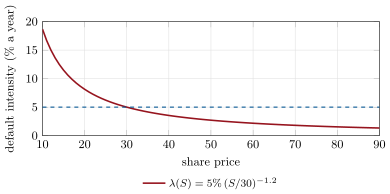
Take , the same 300-basis-point spread at today’s price. The hazard is 18.7% a year at a share price of 10 (Figure 21.2). The bond floor is now 78.1 at 20 and 90.4 at 80, where it was 83.2 at both. The convertible is worth 83.9 at 20 against 89.1 under the constant hazard, and 98.5 at 30 against 100.2. The delta is 1.55 shares per bond at 30 against 1.37, and 1.39 against 0.84 at 20. A falling share now also hurts the bond floor, so the convertible’s value falls faster. Below a share price of about 19 the gamma turns negative: at 15 and at 10. The convexity the desk thought it owned disappears where the credit takes over.
21.4 What a convertible desk hedges
The classic position is long the convertible and short delta shares. Hedged that way it profits from realised volatility above the implied volatility in its price (chapter 4), as a long option does. It keeps the credit risk of the bond floor and the risk of the model’s delta. Desks hedge the credit with a credit default swap (Book 2, chapter 23) sized to the convertible’s credit sensitivity, and they worry most about the combined scenario.
Definition 21.11 (Convertible arbitrage)
Convertible arbitrage is the strategy of buying convertible bonds that trade cheap to a model’s value, selling the issuer’s shares short in the model’s delta and often buying credit protection, to earn the convertible’s convexity, its coupon net of the short’s cost, and the convergence of its price to value.
Example 21.12 (The hedge book)
At a share price of 30 the equity-to-credit model’s delta is 1.55 shares per bond. A 1 basis point widening of the issuer’s spread, at a fixed share price, costs the convertible 0.0167 per bond (1.67 per 100 basis points), about half the 0.0296 of the bond floor, since the conversion right cushions it. With a five-year risky annuity of 4.12, credit protection on 40.6% of the face offsets that sensitivity.
Example 21.13 (Share down 20%, spread 300 basis points wider)
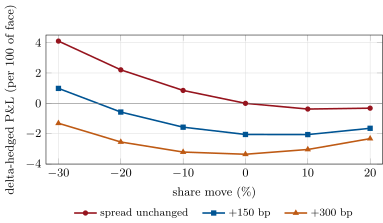
The share falls from 30 to 24, and the issuer’s spread at that price ends 300 basis points above today’s, a hazard of 10%. The convertible falls from 98.47 to 86.62, a loss of 11.84 per 100 of face. The short of 1.55 shares gains 9.30. The delta-hedged position loses 2.55 per 100 of face, 2.55 million on 100 million. Hedged with the constant-hazard model’s delta of 1.37 instead, it loses 4.38. The credit protection gains 4.47 in the same scenario and turns the loss into a gain of 1.93. The wider spread alone, with no move in the share, costs the delta-hedged position 3.35. The share move alone, with the spread held, earns it 2.21 of convexity (Figure 21.4).
The model’s choice of delta is itself a hedge decision. An equity-to-credit delta is larger, because it counts the credit channel through which a falling share lowers the bond floor, and so it protects more in the scenario that hurts. A desk running the constant-hazard delta is implicitly long credit through its equity hedge. It is also exposed to the jump to default, which a delta and a CDS sized for small moves hedge only in part (One Quant Book 6, chapter 13, and the structural models of chapter 14 there).
21.5 Convertible arbitrage and its crises
The arbitrage earns its return from the difference between a model’s value and a market price, and from the convexity it holds. It is financed: the fund borrows against the convertibles and lends the shares it sells through its prime broker. That financing is the arbitrage’s weak point. When many funds hold the same bonds and must sell at the same time, the prices fall together, away from any model’s value. The hedges then protect against the wrong risk.
Mitchell, Pedersen and Pulvino’s “Slow moving capital” (2007) and Mitchell and Pulvino’s study of 2008 (2012) examine what happens then. In their account, hedge funds held up to 75% of the convertible market; in early 2005 large investors began to withdraw capital from convertible-arbitrage funds, more than 20% of it in the first quarter (a figure they take from the Barclay Group), and the funds’ forced sales pushed convertibles below their fundamental values. For 2008, Mitchell and Pulvino describe the mechanism. The imminent failure of large prime brokers abruptly cut the leverage available to hedge funds, seemingly long-term financing became short-term, and relative-value funds could no longer hold similar assets at similar prices. For a model this means a scenario the stress example above does not contain: the convertible cheapens relative to its own model value while the share and credit barely move. No hedge in the share or the CDS covers it. Its protection is lower leverage and financing that cannot be withdrawn overnight.
21.6 Tutorial: a convertible on a grid
Goal. Price the chapter’s convertible under a constant and an equity-to-credit hazard, compute its delta, gamma and credit sensitivity, and stress the hedged position. End state: the four figures and the numbers of the weekend problem.
The operator: drift raised by the hazard, killing at , recovery as a source:
    drift = r - q + lam - 0.5 * vol * vol
    lo = 0.5 * vol * vol / dx ** 2 - 0.5 * drift / dx
    up = 0.5 * vol * vol / dx ** 2 + 0.5 * drift / dx
    mid = -vol * vol / dx ** 2 - (r + lam)
    src = lam * cb.recovery * cb.face
Listing 21.1. The convertible’s pricing operator. code/firm/convertible/firm_convertible.py The constraints after each step: coupons, puts, conversion and the soft call:
        if (n - 1) in coupon_idx and n - 1 > 0:
            v = v + cb.face * cb.coupon / cb.freq
            implicit_left = 2
        if (n - 1) in put_idx:
            v = np.maximum(v, put_idx[n - 1])
        v = np.maximum(v, conv)                                           # conversion at any time
        if t_new >= cb.call_start - 1e-12:
            callable_ = s >= cb.call_trigger
            v = np.where(callable_, np.minimum(v, np.maximum(cb.call_price, conv)), v)
Listing 21.2. Coupons, puts, conversion and the call. code/firm/convertible/firm_convertible.py - Run
dv_convertible.table(),credit_sensitivity(),stress(-0.20, 300),call_effect()andfig_convertible.py.
What to change next. Set and recompute the delta at 20; add an investor put at 100 in year three and see the bond floor move; price the call with a hard (unconditional) call from year two.
21.7 Build: the convertible pricer
Purpose. The miniature firm’s convertible-bond pricer and risk engine: value, delta, gamma and credit sensitivity of each bond in its convertible book, under a hazard that may depend on the share.
Interface. Convertible(face, maturity, coupon, freq, ratio, recovery, call_start, call_price, call_trigger, puts); power_hazard(lam0, s0, p, cap); price_grid(cb, r, q, vol, hazard, s_min, s_max, nx, steps_per_year) -> (spots, values); value_at; greeks(s0, grid) -> value, delta, gamma; bond_floor(cb, r, spread).
Rules. The hazard function is calibrated to the issuer’s credit curve before any convertible is priced; conversion, call and put are applied after every time step; credit sensitivity is reported with the equity delta, and the stress of share and spread together is run daily.
Acceptance tests. code/firm/convertible/tests/: without conversion and hazard the price is the bond; with a constant hazard, the closed form with recovery of face; the value exceeds floor and parity and rises with the share; the call lowers and a put raises the value; the credit link raises the delta at low share prices.
Stretch. The Tsiveriotis–Fernandes split; a hazard calibrated to a CDS curve and to the issuer’s options; dividends and call notice periods; the contingent convertibles of Book 2, chapter 26.
Sources and further reading
- K. Tsiveriotis and C. Fernandes, “Valuing convertible bonds with credit risk”, Journal of Fixed Income 8(2) (1998) 95–102.
- E. Ayache, P. A. Forsyth and K. R. Vetzal, “Valuation of convertible bonds with credit risk”, Journal of Derivatives 11(1) (2003) 9–29.
- L. Andersen and D. Buffum, “Calibration and implementation of convertible bond models”, Journal of Computational Finance 7 (2003) 1–34.
- M. Mitchell, L. H. Pedersen and T. Pulvino, “Slow moving capital”, American Economic Review 97(2) (2007) 215–220.
- M. Mitchell and T. Pulvino, “Arbitrage crashes and the speed of capital”, Journal of Financial Economics 104(3) (2012) 469–490.
21.8 Exercises
Exercise 21.1 ★
A convertible with face 100 and conversion ratio 2.5 trades at 110 with the share at 36. Give the conversion price, conversion value and conversion premium.
Exercise 21.2 ★
Why is a convertible worth at least its bond floor and at least its conversion value?
Solution
Solution of Exercise 21.2.
The holder can always keep the bond and receive its coupons and principal (worth the bond floor), or convert now (worth the conversion value); a right to choose later is worth at least each of the two, so the convertible is worth at least their maximum.
Exercise 21.3 ★
Why does the soft call lower the convertible’s value, and where is the effect largest?
Solution
Solution of Exercise 21.3.
When the conversion value exceeds the call price, the issuer can force conversion and so remove the holder’s remaining time value; the holder is short that call. The effect is largest where the time value is still large and the call can be exercised: near and above the trigger, here 4.7 at 52 against 3.9 at 40.
Exercise 21.4 ★★
Explain why the share’s drift under the pricing measure is in an equity-to-credit model.
Solution
Solution of Exercise 21.4.
Under the pricing measure the share must return on average. With intensity it jumps to zero, an expected loss of per unit time; the diffusion’s drift must add it back: .
Exercise 21.5 ★★
Why is the convertible’s credit sensitivity smaller than its bond floor’s?
Solution
Solution of Exercise 21.5.
A wider spread lowers the bond floor, but part of the convertible’s value comes from the conversion right, which is worth more than the floor’s loss in many scenarios (and gains from the higher share drift in the model); only the bond-like part carries the full sensitivity: 0.0167 per bp against 0.0296.
Exercise 21.6 ★★
Explain why the equity-to-credit delta is larger than the constant-hazard delta at low share prices, and what that means for a hedge.
Solution
Solution of Exercise 21.6.
In the equity-to-credit model a falling share raises the hazard and lowers the bond floor, so the convertible falls faster with the share: the delta adds a credit channel (1.39 against 0.84 at 20). Hedging with the constant-hazard delta leaves the desk under-hedged in exactly the falls that widen the credit, implicitly long credit.
Exercise 21.7 ★★★
Coding. Recompute the stress of Example 21.13 with the equity-to-credit exponent (same spread today). Does the delta-hedged loss grow or shrink?
Solution
Solution of Exercise 21.7.
With the delta at 30 is 1.65 and the delta-hedged loss shrinks to 1.25 per 100 of face (2.55 with ): the stronger link puts more of the credit move into the equity delta, which the short shares then hedge. The convertible is worth 97.32 today and 86.18 after the move.
Exercise 21.8 ★★★
Find the flaw. “Our convertible book is delta-hedged and CDS-hedged, so its only exposure is to volatility.”
Solution
Solution of Exercise 21.8.
The hedges are local and model-based: the delta depends on the model of the credit link, the CDS covers small spread moves but not the jump to default fully, and neither covers the convertible cheapening relative to its model value when financing is withdrawn and holders sell together (2008). The book is also short the combination of equity and credit moves in distress, where the gamma turns negative.
21.9 Problem: Equity Down, Credit Wider
Problem 21.1
Weekend problem — the scenario a convertible desk fears
A desk holds 100 million of face of the chapter’s convertible (share 30, conversion price 40, spread 300 basis points), short the equity-to-credit delta in shares.
Part I — The bond.
- Give the convertible’s value, bond floor, conversion value and conversion premium at 30 under the equity-to-credit model.
- Give the delta and the number of shares the desk is short.
- Give the value at a share price of 10 and the hazard there.
- What does the soft call cost the holder at a share price of 52?
- Why is the bond floor not flat in this model?
Part II — The hedges.
- Give the credit sensitivity per basis point, for the position.
- Size the CDS protection that offsets it.
- What does the position earn if the share falls 20% with the spread unchanged?
- What does it lose if the spread widens 300 basis points with the share unchanged?
- What would the constant-hazard model’s delta be, and how many fewer shares would the desk be short?
Part III — The scenario.
- The share falls 20% and the spread at the new price ends 300 basis points wider. Give the convertible’s new value and the delta-hedged loss.
- Give the loss with the constant-hazard delta.
- Give the result with the CDS hedge as well.
- Which part of the loss is credit and which is the model’s delta?
- What scenario is missing from this analysis?
Part IV — Judgement.
- Which delta would you trade, and why?
- How much CDS would you hold, given the jump to default?
- What limits would you set on the book?
- State the named result: the loss of the delta-hedged convertible-arbitrage position when the issuer’s credit spread widens by 300 basis points while its share falls 20%.
- In one sentence: what does a convertible arbitrageur own?
Solution
Solution of Problem 21.1.
1. 98.47; bond floor 82.91; conversion value 75; premium 31.3%. 2. 1.55 shares per bond: 1.55 million shares short for 100 million of face (one million bonds). 3. 69.07 at a share price of 10, where the hazard is 18.7% a year. 4. 4.65 per bond: 138.64 with the call against 143.29 without. 5. Because the hazard, and so the discounting of the bond’s cash flows, depends on the share price. 6. 0.0167 per basis point per bond: 16 700 per basis point for the position. 7. 40.6 million of protection (0.0167 per bond over a risky annuity of 4.12 per unit of spread). 8. 2.21 per 100 of face, 2.21 million: the convexity. 9. 3.35 million. 10. 1.37 shares per bond: 0.18 million fewer shares short. 11. 86.62; a loss of 2.55 million. 12. A loss of 4.38 million. 13. A gain of 1.93 million (the protection gains 4.47 million). 14. The spread widening alone costs 3.35 and the share fall alone earns 2.21 of convexity; the choice of delta is worth 1.83 (4.38 against 2.55). 15. The convertible cheapening relative to its model value as holders sell together (financing withdrawn), and the jump to default. 16. The equity-to-credit delta, calibrated to the issuer’s credit curve and options: it hedges the credit channel that the scenario exploits. 17. At least the credit sensitivity at the current price, more if the jump to default at the current recovery is large relative to the book; not more than the desk is willing to pay for in carry. 18. Limits on the joint equity-down, credit-wider stress, on concentration by issuer, on leverage and on the share of the book financed short-term. 19. 2.55 per 100 of face, 2.55 million on 100 million, with the equity-to-credit delta (4.38 million with the constant-hazard delta). 20. Convexity in the share, bought with credit risk and financed with borrowed money.
21.10 Interview questions
Interview question 21.1 ★ trader, researcher
Sketch a convertible’s value against the share price. Name the regions.
Solution
Solution of Interview question 21.1.
Left: close to the bond floor, which itself falls as the share falls when credit deteriorates (distressed region). Middle: convex, both bond and option (the hybrid region, where the arbitrage lives). Right: close to the conversion value, equity-like, capped near the call trigger by the issuer’s call.
What the interviewer is looking for: the three regions and the call’s cap.
Interview question 21.2 ★★ researcher
Write the pricing equation for a convertible with default risk. What are the boundary conditions and constraints?
Solution
Solution of Interview question 21.2.
In : . Terminal: . Constraints after each step: ; when callable; put price on put dates; coupons added at coupon dates. Boundaries: recovery at very low , conversion value at very high .
What the interviewer is looking for: the hazard terms, and the constraints as projections.
Interview question 21.3 ★★ trader
What does a convertible arbitrageur earn, and what are the risks?
Solution
Solution of Interview question 21.3.
The convexity (gamma trading against the short shares), the coupon net of the short’s borrow cost, and convergence of cheap bonds to value. Risks: credit (spread and default), the model’s delta, liquidity and financing (forced sales), the short squeeze or borrow recall on the shares, and issuer calls.
What the interviewer is looking for: sources of return and the risk list.
Interview question 21.4 ★★ developer
How would you implement the conversion, call and put features in a finite-difference pricer?
Solution
Solution of Interview question 21.4.
Step the PDE back in time (Crank–Nicolson, with implicit start-up steps after each discontinuity), then project: take the maximum with the conversion value, the minimum with the call price (or conversion) where the call is live and its trigger met, the maximum with the put price on put dates; add coupons at their dates. Handle soft-call triggers observed over days with an extra state or an approximation, and document it.
What the interviewer is looking for: projection after each step, and care at discontinuities.
Interview question 21.5 ★★ risk
Design a stress test for a convertible-arbitrage book.
Solution
Solution of Interview question 21.5.
Joint scenarios of share and credit: shares down 10–40% with spreads 100–500 basis points wider at the new price, jumps to default of the largest names, a volatility shock, a borrow recall, and a liquidity scenario in which convertibles cheapen by several points relative to model with no move in shares or credit.
What the interviewer is looking for: joint equity–credit moves plus liquidity.
Interview question 21.6 ★★★ trader, risk
Prime brokers cut the book’s leverage by half overnight. What happens to the positions and to their prices?
Solution
Solution of Interview question 21.6.
The book must sell about half its positions or find new financing. Sales of the same bonds by many funds push their prices below model values; the hedges (short shares, CDS) do not offset that cheapening; losses reduce capital and force further sales. Prices recover only as new capital arrives, slowly.
What the interviewer is looking for: forced sales, cheapening relative to model, and slow recovery.