Derivatives and Volatility · Derivatives
6American Options and Early Exercise
The share trades at 100.30 and goes ex-dividend tomorrow morning, when it will drop by about the dividend of 1.00. A deep in-the-money call struck at 80, expiring in a month, is on the book of thousands of holders. Exercised tonight, it delivers a share worth 100.30 with the dividend attached: 20.30. Held through the ex-date, it is a call on a share worth 99.30, and even with its month of remaining optionality it is worth about 19.56. The difference, 0.74 a share, goes to whoever is on the other side of the calls that are not exercised: the writers, who are assigned only by the holders who do exercise. Every quarter, before every dividend, the same decision is taken or forgotten across the listed market. This chapter works out when early exercise is optimal, what the boundary between exercising and holding looks like, how dividends and rates move it, how to price American options without a full tree, and what the decision looks like on a real expiry night.
6.1 Why and when to exercise early
An American option can be exercised at any time before expiry (One Quant Book 1, chapter 23). Its holder chooses a stopping time; the option’s value is the largest discounted expected payoff over all such choices, the optimal stopping problem of One Quant Book 4, chapter 10:
On the tree of chapter 2 this supremum is the backward induction that takes, at each node, the larger of exercising and holding.
Proposition 6.2 (When exercise can be optimal)
With : an American call on a share that pays no dividend before expiry is never exercised early, and its premium is zero; a call on a share that pays a dividend may be exercised only just before an ex-date; an American put may be exercised at any time when rates are positive, and its premium is strictly positive.
Proof. Call: , so the call is worth at least its exercise value alive (chapter 2). Between ex-dates the share has no dividend, so the argument holds up to the moment before each ex-date, where the share is about to lose and the bound becomes . Put: deep in the money the put is worth at most as a European, less than when ; exercising earns the interest on . ∎
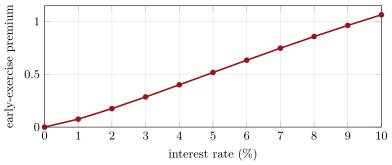
The call and the put give up different things by being exercised: the call gives up the interest on the strike it pays early and the insurance of its optionality, and gains only dividends; the put gives up its optionality and gains the interest on the strike it receives early. Figure 6.1 shows the put’s premium growing with the rate: zero at a zero rate, 0.52 at 5%, 1.06 at 10% for a one-year at-the-money put at 20 volatility.
6.2 The exercise boundary
Definition 6.3 (Exercise boundary)
The exercise boundary of an American option is the curve that separates the spots where exercising is optimal from those where holding is: for a put, exercise is optimal when . On the boundary the option equals its exercise value and, in the Black–Scholes model, meets it with the same slope (smooth pasting, One Quant Book 4, chapter 10).
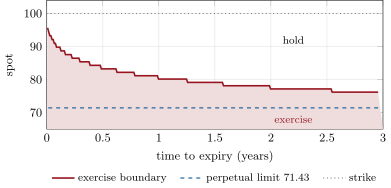
For a put without dividends the boundary rises towards the strike as expiry approaches (when ), and as the time to expiry grows it falls towards the boundary of the perpetual put. That limit has a closed form.
Proposition 6.4 (Perpetual American put)
In the Black–Scholes model with and no dividend, a put that never expires is worth for and below, with and .
Proof. With no time dependence the pricing equation is , solved by and ; a put that vanishes at infinity keeps only . Value matching and smooth pasting give . ∎
With and , and the perpetual boundary is 71.43; the boundary of a one-year put is 81.11 today, and of a three-year put about 76.2 (Figure 6.2).
6.3 Dividends and rates as triggers
For a call the only reason to exercise early is to capture a dividend, and the only moment is just before an ex-date. The holder compares two values the night before.
Method 6.5 (The call’s exercise decision before an ex-date)
With spot , strike , dividend and time left after the ex-date:
- exercise value: (the share, with its dividend);
- holding value: at least the European call on the ex-dividend share, ;
- exercise if the first exceeds the second. Since , exercise requires : the dividend must exceed the interest on the strike over the remaining life. For a deep in-the-money call, whose time value is little more than that interest, the threshold is close to it.
Example 6.6 (The night before the ex-date)
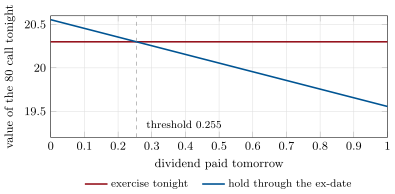
Spot 100.30, strike 80, 29 days left, , , dividend 1.00. Exercising is worth 20.30, holding 19.56. The interest on the strike over 29 days is 0.254, and the dividend above which exercising wins is 0.255: the put component of the call’s time value is worth a tenth of a cent. With a dividend of 1.00 the holder who does not exercise gives up 0.74 a share (Figure 6.3).
Puts move the other way around dividends: a dividend lowers the share after the ex-date and so raises the put, which makes holding a put through an ex-date more attractive and early exercise just before it less so. High rates and deep moneyness make early exercise of puts more likely; high volatility makes it less likely, since it raises the value of waiting, and so does a dividend yield or a borrow fee (chapter 5), which lowers the forward the put is waiting for. The same borrow fee works the other way on calls: a call holder who exercises owns a share that can be lent at the fee, and on a hard-to-borrow share that can justify exercising a call early with no dividend in sight.
6.4 Approximations and bounds
A tree prices one American option in milliseconds. A market maker who reprices tens of thousands on every tick needs something faster, and two closed-form approximations are standard.
Definition 6.7 (Quadratic approximation)
The quadratic approximation of Barone-Adesi and Whaley writes the American value as the European value plus a premium of the form , where the exponent solves the quadratic that the time-independent part of the pricing equation imposes, and the critical spot is found numerically from value matching and smooth pasting at . Beyond the option is worth its exercise value.
The approximation is exact for the perpetual option and for very short expiries, and good in between (see the table below). The Bjerksund–Stensland approximation is a different idea: it prices exactly the strategy that exercises at a flat trigger, which is feasible but not optimal, and so gives a lower bound that is close to the true value.
| spot | expiry | rate | yield | European | tree (2 001) | quadratic | error |
|---|---|---|---|---|---|---|---|
| 100 | 1 | 5% | 0 | 5.5735 | 6.0902 | 6.0976 | |
| 90 | 0.5 | 8% | 0 | 11.2671 | 12.1792 | 12.1151 | |
| 110 | 0.25 | 3% | 0 | 1.5070 | 1.5201 | 1.5229 | |
| 100 | 1 | 5% | 4% | 9.0396 | 9.2168 | 9.2444 |
Definition 6.8 (Bermudan exercise)
An option with Bermudan exercise can be exercised only on a finite set of dates before expiry. Its value lies between the European and the American values and increases with the set of exercise dates.
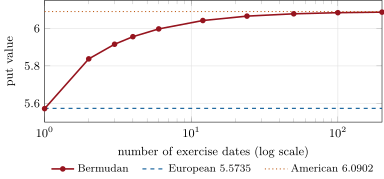
Bermudan exercise is the rule in callable bonds and in the Bermudan swaptions of One Quant Book 6, chapter 9, and it is what every numerical method actually prices: a tree with steps is a Bermudan with dates. The value converges to the American one as the dates multiply, quickly at first: a one-year put exercisable monthly is worth 6.04, already 90% of the way from the European 5.57 to the American 6.09 (Figure 6.4).
6.5 The practical exercise decision
The theory says when; the market decides whether. Exercise is an instruction sent by the holder, through the broker, to the clearing house before a cut-off; only options at least one cent in the money at expiry are exercised automatically (One Quant Book 1, chapter 23), and nothing is automatic before expiry. A holder who forgets to exercise a call the night before an ex-date loses the difference computed above, and the clearing house’s random assignment passes it to the writers who are not assigned.
As of September 2026 — Calls left unexercised before ex-dates
A study of US equity call options on shares paying quarterly dividends, January 1996 to April 2006, found that more than half of the long positions that should have been exercised on the day before an ex-dividend date were not, costing holders over USD 491 million over the period; market makers captured most of it through a dividend spread strategy (chapter 26). The one-cent automatic-exercise threshold at expiry is the options clearing house’s rule for equity and index options.
Three practical points follow. Desks value their short American calls assuming that holders exercise optimally, and book the gain when they do not; marking the writer’s position with an assumed failure rate is a model risk (chapter 27). Implied volatilities of American options are computed with an American pricer or after removing the early-exercise premium: inverting the European formula at the price of a deep in-the-money American put gives a volatility that is too high. And near-expiry decisions are made with the dividend and the borrow of the day, which move the thresholds as much as the spot does.
6.6 Tutorial: boundaries, approximations and a decision
Goal. Compute the put’s exercise boundary on a tree, compare the quadratic approximation with the tree, value Bermudan exercise, and solve the call’s decision before an ex-date. End state: the four figures of the chapter, the table and the numbers of Example 6.6.
The boundary: at each step of the tree, the highest node where exercise wins.
def put_boundary(strike: float, t: float, r: float, q: float, vol: float, n: int = 2000) -> list[tuple[float, float]]:
    """Exercise boundary of an American put from a Cox-Ross-Rubinstein tree: at each step, the highest
    node where exercising beats holding. Returns (time to expiry, boundary)."""
    dt = t / n
    u = math.exp(vol * math.sqrt(dt))
    d = 1 / u
    p = (math.exp((r - q) * dt) - d) / (u - d)
    disc = math.exp(-r * dt)
    j = np.arange(n + 1)
    s = strike * u ** (2 * j - n)
    v = np.maximum(strike - s, 0.0)
    out = []
    for step in range(n - 1, -1, -1):
        j = np.arange(step + 1)
        s = strike * u ** (2 * j - step)
        cont = disc * (p * v[1:] + (1 - p) * v[:-1])
        ex = strike - s
        v = np.maximum(cont, ex)
        mask = ex > cont + 1e-12
        if mask.any():
            out.append(((n - step) * dt, float(s[mask].max())))
    return out[::-1]
Listing 6.1. The put’s exercise boundary read off a Cox–Ross–Rubinstein tree. code/firm/american/firm_american.py The decision and its dividend threshold:
def exercise_decision(spot: float, strike: float, dividend: float, t_left: float, r: float, vol: float) -> dict:
    """The night before an ex-date: exercise a call (and keep the dividend) or hold it through the drop.
    Holding is valued as a European call on the ex-dividend share (a lower bound if further dividends
    follow)."""
    ex = spot - strike
    hold = bs(spot - dividend, strike, t_left, r, 0.0, vol, "C")
    return {"exercise": ex, "hold": hold, "exercise_now": ex > hold}


def dividend_threshold(spot: float, strike: float, t_left: float, r: float, vol: float) -> float:
    """Smallest dividend for which exercising the call the night before the ex-date is optimal
    (bisection on the dividend)."""
    lo, hi = 0.0, spot - strike
    for _ in range(200):
        mid = 0.5 * (lo + hi)
        if exercise_decision(spot, strike, mid, t_left, r, vol)["exercise_now"]:
            hi = mid
        else:
            lo = mid
    return 0.5 * (lo + hi)
Listing 6.2. Exercise or hold the night before an ex-date, and the threshold dividend. code/firm/american/firm_american.py - Run
dv_american.results(),accuracy_table(),hook()andfig_american.py.
What to change next. Add a second dividend two weeks after the first and find the dividend thresholds before each ex-date; then compute the put’s boundary with a 4% dividend yield and compare with the call’s.
6.7 Build: the American pricer and exercise helper
Purpose. The miniature firm’s listed-options desk prices its American options with the approximation in the quoting loop and with the tree for risk; on every ex-date eve it lists the calls, long and short, whose exercise is optimal.
Interface. baw(spot, strike, t, r, q, vol, right) -> (price, critical); put_boundary(strike, t, r, q, vol, n); bermudan_put(…, n_ex); exercise_decision(spot, strike, dividend, t_left, r, vol); dividend_threshold(…); the tree itself is firm.binomial.
Rules. The American call without dividends equals the European; the approximation returns the exercise value beyond its critical spot; the holding value in the decision is the European call on the ex-dividend share.
Acceptance tests. code/firm/american/tests/: the approximation within 0.07 of a 2 001-step tree on the four cases of the table; the perpetual limit of the boundary; the Bermudan value increasing in the number of dates, between European and American; the threshold dividend just above the interest on the strike.
Stretch. The Bjerksund–Stensland lower bound, and a dividend-aware decision that values holding with the American pricer when a further dividend follows.
Sources and further reading
- R. C. Merton, “Theory of rational option pricing”, Bell Journal of Economics and Management Science 4 (1973) 141–183.
- G. Barone-Adesi and R. E. Whaley, “Efficient analytic approximation of American option values”, Journal of Finance 42 (1987) 301–320.
- P. Bjerksund and G. Stensland, “Closed-form approximation of American options”, Scandinavian Journal of Management 9 (1993) 87–99.
- V. K. Pool, H. R. Stoll and R. E. Whaley, “Failure to exercise call options: an anomaly and a trading game”, Journal of Financial Markets 11 (2008).
6.8 Exercises
Exercise 6.1 ★
A one-year American put struck at 100 on a share at 100 (, ) is worth 6.0902 and the European 5.5735. Give the early-exercise premium, and its size relative to the European value.
Solution
Solution of Exercise 6.1.
, 9.3% of the European value.
Exercise 6.2 ★
Give the boundary and the value at spot 100 of a perpetual American put struck at 100 with and .
Solution
Solution of Exercise 6.2.
, ; at 100 the put is worth .
Exercise 6.3 ★
A call struck at 50 has 60 days left after tomorrow’s ex-date; . Below which dividend is its early exercise certainly not optimal?
Solution
Solution of Exercise 6.3.
Below the interest on the strike over the 60 days, : exercise then loses at least the interest.
Exercise 6.4 ★★
Why does high volatility make early exercise of a put less likely, and a high interest rate more likely? What does a borrow fee do?
Solution
Solution of Exercise 6.4.
Exercising kills the option’s remaining value, which grows with volatility, and earns the interest on the strike, which grows with the rate. A borrow fee acts like a dividend yield: it lowers the forward, raises the value of waiting with a put and so makes its early exercise less likely; on a call it can make early exercise worthwhile.
Exercise 6.5 ★★
Show that the Bermudan put with one exercise date at expiry is the European put, and that adding dates cannot lower its value.
Solution
Solution of Exercise 6.5.
With one date at expiry the holder has no choice, which is the European option. Adding a date adds a choice: the holder can always ignore it, so the value cannot fall (the new supremum is over a larger set of stopping times).
Exercise 6.6 ★★
From the table, which case does the quadratic approximation price worst, and why there?
Solution
Solution of Exercise 6.6.
The deep in-the-money put at 8%, error : there the premium is large and the option is exercised soon, while the approximation’s single power law is fitted to a perpetual shape and misprices the near boundary.
Exercise 6.7 ★★★
Coding. With dividend_threshold, find the threshold dividend for the call of Example 6.6 with 90 days left instead of 29, and compare it with the interest on the strike.
Solution
Solution of Exercise 6.7.
0.932, against an interest on the strike of 0.785: with 90 days left the call’s put component is worth 0.15, and the dividend must pay for it too.
Exercise 6.8 ★★★
Find the flaw. “The American put is quoted at 6.09. Inverting the European formula at 6.09 gives 21.4% volatility, against 20% for the European options. The American options are rich: sell them.”
Solution
Solution of Exercise 6.8.
The European formula has no early-exercise premium, so it needs a higher volatility (21.4%) to reach the American price. Priced with an American model the put is at 20%, like the European options. The “richness” is the premium, not volatility.
6.9 Problem: The Night Before the Ex-Date
Problem 6.1
Weekend problem — who collects the dividend
The share of the opening trades at 100.30 the evening before it goes ex-dividend by 1.00. The 80 call has 29 days left after tomorrow, , volatility 25%, and an open interest of 10 000 contracts (multiplier 100). Experience suggests that 45% of holders will not exercise tonight.
Part I — The decision.
- Give the exercise value tonight.
- Give the value of holding through the ex-date.
- Should a holder exercise? By how much per share?
- Give the interest on the strike over the remaining 29 days.
- Give the threshold dividend, and explain why it is so close to the interest.
Part II — Who pays.
- Give the loss of all holders if nobody exercised.
- Give the transfer to writers if 45% of holders fail to exercise.
- Which writers receive it, and how does random assignment decide?
- Why can a market maker who is short these calls not count on the transfer?
- What does a writer who is assigned tomorrow morning hold, and what does it owe?
Part III — Prices.
- Where should the call’s bid be tonight, relative to 20.30?
- Tomorrow, what is the call worth if the share opens at 99.30?
- A trader buys the share and sells the call tonight at 20.30. What does the trade earn if the call is not exercised against it?
- And if it is?
- How would you size such a trade given the uncertainty on the failure rate?
Part IV — Judgement.
- Why do retail holders fail to exercise?
- Should a broker exercise for its clients automatically?
- How should a desk mark its short calls tonight?
- State the named result: the threshold dividend and the value transferred to writers by the holders who fail to exercise.
- In one sentence: when is an American call worth more than a European one?
Solution
Solution of Problem 6.1.
1. 20.30. 2. 19.56. 3. Yes: 0.74 a share better. 4. . 5. 0.255: the call is so deep in the money that its time value is the interest on the strike plus a put worth a tenth of a cent. 6. : USD 744 600. 7. 45% of it: USD 335 000. 8. The writers who are not assigned: the clearing house assigns exercise notices randomly to clearing members, which assign them to their customers; a writer left unassigned keeps a call worth 19.56 that it sold on a share worth 20.30. 9. It does not know how many holders will exercise, nor which writers will be assigned: the transfer is an expectation, not a hedgeable cash flow. 10. It must deliver shares at 80; if it held shares as a hedge, it delivers them and receives 80 but does not receive the dividend on them. 11. At or slightly below 20.30: nobody should pay more than the exercise value, and holders who can exercise should not sell below it. 12. About 19.56. 13. Invested ; after the ex-date it holds the dividend 1.00, a share at 99.30 and a short call worth 19.56: . 14. Zero, less costs: the share is delivered at 80, the amount invested. 15. By the expected failure rate and its uncertainty, knowing that the gain is paid only on the calls not assigned, and that the whole market plays the same trade. 16. Inattention, holding through a broker without instructions, and the belief that options are exercised automatically before expiry. 17. Exercising on the client’s behalf needs the client’s consent and funding (the client must pay the strike); brokers alert rather than exercise. 18. As if every holder exercises optimally (the conservative value), releasing the gain on the calls that are not assigned. 19. A threshold dividend of 0.255; USD 335 000 transferred to writers. 20. When a dividend before expiry is worth more than the interest on the strike over the remaining life plus the call’s put component (or when a borrow fee makes owning the share valuable).
6.10 Interview questions
Interview question 6.1 ★ trader
Would you ever exercise an American call early? An American put?
Solution
Solution of Interview question 6.1.
A call: only just before an ex-date, when the dividend exceeds the interest on the strike plus the lost optionality (or on a hard-to-borrow share). A put: yes, when deep in the money with positive rates, since exercising earns the interest on the strike.
What the interviewer is looking for: the interest-on-strike argument both ways.
Interview question 6.2 ★ researcher
Why is an American option’s value a supremum over stopping times, and how does a tree compute it?
Solution
Solution of Interview question 6.2.
The holder chooses when to stop, using only information available at the time, and will choose the best rule: the value is the supremum over stopping times of the discounted expected payoff under the pricing measure. A tree computes it backwards, taking at each node the maximum of the exercise value and the discounted expected value of the next step (the Snell envelope, One Quant Book 4, chapter 10).
What the interviewer is looking for: optimal stopping, and backward induction as its algorithm.
Interview question 6.3 ★★ researcher
Derive the exercise boundary of a perpetual American put.
Solution
Solution of Interview question 6.3.
Time-independent pricing equation ; solutions and with ; the put keeps ; value matching and smooth pasting at give .
What the interviewer is looking for: the two boundary conditions.
Interview question 6.4 ★★ trader, risk
You are short deep in-the-money calls the day before a large dividend. What do you expect, and how do you hedge?
Solution
Solution of Interview question 6.4.
Holders should exercise tonight; some will not. Expect assignment on most but not all of the position, so the stock hedge must be sized for delivery (hold the shares) while the dividend on shares that are called away is lost; the calls not assigned become worth less than their exercise value tomorrow, a gain that should not be counted on.
What the interviewer is looking for: assignment uncertainty and its effect on the hedge.
Interview question 6.5 ★★ developer
You must price 50 000 American options per second. Tree, grid or approximation? What do you check?
Solution
Solution of Interview question 6.5.
A closed-form approximation (quadratic or Bjerksund–Stensland) or a precomputed grid in the quoting loop; a tree or a finite-difference grid, with dividends, for risk and end of day. Check the approximation against the accurate pricer on the whole range of moneyness, maturity and rates, especially deep in the money and near ex-dates, and fall back to the grid where it fails.
What the interviewer is looking for: speed where it is needed, accuracy where it matters, and a benchmark.
Interview question 6.6 ★★★ researcher, trader
How do you compute an implied volatility from an American option price, and what goes wrong if you use the European formula?
Solution
Solution of Interview question 6.6.
Invert the American pricer (tree or grid) with the dividends and borrow, or subtract an estimate of the early-exercise premium and invert the European formula. With the European formula the premium is read as volatility: deep in-the-money puts and calls before dividends show volatilities that are too high, a fake smile.
What the interviewer is looking for: the premium mistaken for volatility.