Derivatives and Volatility · Derivatives
27Managing an Exotic Book
A desk sells 100 million of a three-year worst-of autocallable to its private-bank clients at par. Its model values the notes at 98, so the sale looks like a profit of 2 million. Valuation control recognises 325 000 of it. It charges 621 000 at once for the cost of closing the hedges, and holds back 1 054 000 until two things it cannot observe become observable: which model of volatility is right for this payoff, and the correlation between the two indices. A year later the correlation trades, and 424 000 comes back. This chapter is about that arithmetic and the book behind it: what an exotic book owns, the reserves on its valuation, model risk as the desk meets it, stress and concentration, and the day-one P&L and its release.
27.1 What an exotic book owns
An exotic book is a large short position in structured products (chapters 18 and 19) and the hedges bought against it, vanillas, variance and the underlying. The net Greeks are small; what remains are the exposures nobody sells. For autocallables sold to investors, that is long volatility at long expiries, long skew and short correlation on worst-ofs, all concentrated where the notes’ barriers sit.
Accounting sorts those exposures by the inputs their valuation needs. IFRS 13 ranks inputs in three levels: quoted prices of identical instruments in active markets (Level 1); other inputs observable directly or indirectly, for substantially the full term of the instrument (Level 2); unobservable inputs (Level 3). A three-year correlation between two indices has no market: the worst-of note is a Level 3 instrument, and the rules on its day-one profit follow from that.
Example 27.1 (The note)
Worst-of Phoenix autocallable on two indices (volatilities 20% and 25%, correlation 0.5, rates 3%, dividends 2%), three annual observations, autocall at 100%, a coupon of 7.95% a year paid at or above 70% with memory, capital protected at maturity unless the worse index is below 60%. At that coupon the model values the note at 98.00 per 100. From the desk’s side, short the note, the book is long 0.533 and 0.693 of vega per volatility point in the two indices (per 100 of notional) and short 0.143 and 0.279 of delta per 1%, which the desk hedges by buying the indices.
27.2 Reserves and parameter bid–offer
The booked value is a mid. What the firm could exit at is worse, for three reasons, each a reserve.
Definition 27.2 (Valuation reserve)
A valuation reserve is an amount by which a firm lowers the booked value of a position below its model mid, for a specific source of uncertainty in what the position could be exited at; reserves are computed position by position, kept in the books, and reviewed at every valuation date.
Definition 27.3 (Bid–offer reserve)
A bid–offer reserve is the cost of closing a book’s net risk at the market’s bid or offer rather than at mid: the net exposure in each risk bucket times half the bid–offer spread of the instruments that would close it.
Definition 27.4 (Model reserve)
A model reserve covers the uncertainty from the choice of model: the booked model’s value less a prudent point of the values the position takes under a set of alternative models that market participants use.
Definition 27.5 (Parameter bid–offer)
The parameter bid–offer of a position is the reserve for an unobservable input: the booked value less a prudent point of the values over the input’s plausible range.
The EU’s prudent-valuation standard fixes the prudent point for regulatory capital: where a range of plausible values exists, the point where the firm is 90% confident it could exit at that value or better. The build uses the same rule for all three reserves.
Example 27.6 (Three reserves on the note)
Bid–offer. Closing the vega at half a point of spread and the delta at 2 basis points costs 0.266 and 0.346 for the two vegas and less than 0.01 for the deltas: 0.621 in all per 100. Model. Four models value the note at 98.00 (flat at-the-money volatilities, booked), 94.33 (flat at the knock-in strike’s volatility, three points higher), 98.62 (flat at the trigger’s, half a point lower) and 97.98 (uncertain volatility, ). The prudent point is the highest of these for a short position, 98.62: a reserve of 0.621. Correlation. Over a plausible range of 0.35 to 0.65 the note is worth 97.64 to 98.50, and the 90% point is 98.43: a reserve of 0.433 (Figures 27.1 and 27.2).
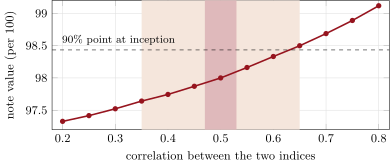
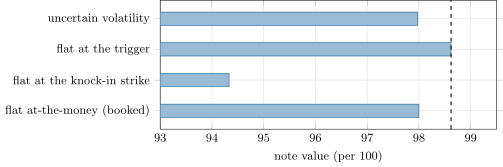
The reserves are not added naively for capital. The EU standard’s first aggregation method counts half of each position’s market-price, close-out and model-risk adjustments, for diversification across positions: 0.838 here.
27.3 Model risk on the desk
Book 6 treats model risk as a governance process. On the desk it has three faces. The first is the choice among models that all fit the vanillas and disagree on the exotic, the model reserve’s range: here almost four points of note value between the flat models at two strikes. The second is a model used outside its domain, such as a flat-volatility pricer for a knock-in whose value lives in the skew. The third is a calibration that moves the value without a market move (chapter 24’s recalibration P&L).
As of September 2026 — Model-risk guidance in the United States
On 17 April 2026 the Federal Reserve, the OCC and the FDIC replaced the 2011 model-risk guidance (SR 11-7) with revised guidance (Federal Reserve letter SR 26-2). It defines a model as “a complex quantitative method, system, or approach that applies statistical, economic, or financial theories to process input data into quantitative estimates”, and leaves generative and agentic AI models out of its scope.
A desk lives with model risk by pricing every exotic under at least two models, reserving the difference, and hedging what the models agree on. When the models disagree about the hedge (the delta of a worst-of under two correlation assumptions, the vega of a barrier under local and stochastic volatility), the desk hedges the part they agree on and limits the rest.
27.4 Stress and concentration
The Greeks describe small moves. A book of short autocallables has its risk in large ones: the knock-in barriers cluster, and the hedges that were right at inception turn over as the indices approach them.
Example 27.7 (A stress grid)
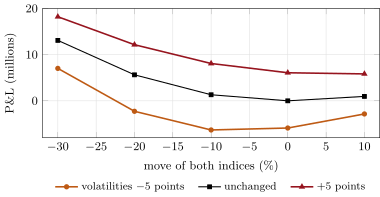
The firm’s P&L on the delta-hedged short note, in millions for 100 million of notional, under joint moves of both indices and of both volatilities:
| volatilities points | 7.02 | ||||
| unchanged | 13.09 | 5.63 | 1.31 | 0.00 | 0.96 |
| volatilities points | 18.21 | 12.15 | 8.08 | 6.08 | 5.83 |
The firm is long the investors’ knock-in put, so a crash with rising volatility is a gain. The loss is a moderate fall with falling volatility: million at and five points less volatility (Figure 27.3).
Concentration is the other face of size. The book’s vega in the second index, 693 000 per point, is a large position against the long-dated volatility that trades. At an assumed 100 000 per point a day and a participation of a tenth, closing it would take 69 days. The prudent-valuation standard asks for a concentration adjustment when the prudent exit period exceeds ten days. When many banks sell the same notes, the same exposure sits on every book, and the exit is crowded. Losses on such books are public when they are large. Natixis reported a non-recurring impact of € 259 million on Asian equity derivatives in the fourth quarter of 2018, after identifying a hedging strategy in Asia as deficient.
27.5 Day-one P&L and its release
Definition 27.8 (Day-one P&L)
The day-one P&L of a trade is the difference, at inception, between its transaction price and its fair value; under IFRS 9 it is recognised at once only if the fair value is evidenced by a Level 1 price or by a valuation using only observable data, and is otherwise deferred and recognised later only as a factor that market participants would price, including time, changes.
The rule does not say how to split a margin whose valuation uses some observable and some unobservable inputs. The build’s policy is one reading. The bid–offer reserve, on observable inputs, is part of fair value from the first day. The reserves on unobservable inputs, model and correlation, are deferred. What remains of the margin after both is recognised. A stricter policy defers the whole margin until the last unobservable input can be observed.
Example 27.9 (The deferred profit)
Per 100 million of notes sold at par: margin 2.000 million; bid–offer reserve 0.621; deferred 1.054 (model 0.621, correlation 0.433); recognised at inception 0.325. After one year, with both indices at 95% and the note alive, the correlation trades within 0.47–0.53 and the note has two years left. The correlation reserve falls to 0.071 and the model reserve to 0.559: 0.424 million is released, 0.362 of it from the correlation. After two years, with the indices still at 95%, another 0.336 comes back, and the last 0.295 at maturity (Figure 27.4).
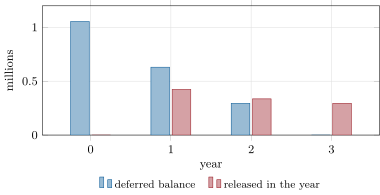
Deferral is not a loss. It moves profit from the year the note was sold to the years its uncertainty is resolved. It changes behaviour all the same: a desk paid on recognised P&L is less keen on trades whose margin lives in unobservable inputs.
27.6 Tutorial: reserving an autocallable
Goal. Price a worst-of autocallable, set its coupon for a 2% margin, compute its bid–offer, model and correlation reserves, split its day-one P&L and schedule its release, and run a stress grid. End state: the four figures, the stress table and the numbers of the weekend problem.
The prudent point and the model and parameter reserves:
def prudent_point(values: Sequence[float], confidence: float = 0.9, weights: Sequence[float] | None = None) -> float:
    """The point of a range of plausible values of the book at which the firm is `confidence` sure it could exit at that
    value or better: the (1 - confidence) quantile of the plausible values (weighted, by linear interpolation)."""
    v = np.asarray(values, float)
    w = np.full(len(v), 1.0 / len(v)) if weights is None else np.asarray(weights, float) / np.sum(weights)
    order = np.argsort(v)
    v, w = v[order], w[order]
    cum = np.cumsum(w) - 0.5 * w                                     # mid-point plotting positions
    return float(np.interp(1 - confidence, cum, v))


def model_reserve(values_by_model: Mapping[str, float], booked: str, confidence: float = 0.9) -> float:
    """Model reserve: booked model's value minus the prudent point of the values under the model set (at least 0)."""
    return max(values_by_model[booked] - prudent_point(list(values_by_model.values()), confidence), 0.0)


def parameter_reserve(value_of: Callable[[float], float], mid: float, lo: float, hi: float, confidence: float = 0.9,
                      n: int = 41) -> dict[str, float]:
    """Parameter bid-offer for one unobservable input spread uniformly over [lo, hi]: the book's value at the prudent
    point of the values over the range, against its value at the booked input `mid`."""
    grid = np.linspace(lo, hi, n)
    values = [value_of(x) for x in grid]
    prudent = prudent_point(values, confidence)
    booked = value_of(mid)
    return {"booked": booked, "prudent": prudent, "reserve": max(booked - prudent, 0.0),
            "worst": float(min(values)), "best": float(max(values))}
Listing 27.1. Prudent point, model reserve and parameter bid–offer. code/firm/reserves/firm_reserves.py The day-one split and the release schedule:
@dataclass(frozen=True)
class DayOne:
    margin: float          # transaction price minus the booked mid value (the trade's economic margin)
    charged: float         # observable reserves at inception (bid-offer): part of fair value, not a deferral
    deferred: float        # reserves on unobservable inputs (model, parameter): held back, released later
    recognised: float      # margin - charged - deferred


def day_one(price_received: float, booked_value_of_liability: float, observable_reserve: float,
            unobservable_reserve: float) -> DayOne:
    """Split a sale's margin: the part left after the observable reserves and the reserves on unobservable inputs is
    recognised at inception; the unobservable part is deferred."""
    margin = price_received - booked_value_of_liability
    recognised = margin - observable_reserve - unobservable_reserve
    return DayOne(margin, observable_reserve, unobservable_reserve, recognised)


def release_schedule(deferred_by_date: Sequence[tuple[float, float]]) -> list[tuple[float, float, float]]:
    """Release of a deferred amount as its reserve falls: from (time, deferred balance) pairs, the list of (time,
    balance, amount released since the previous date); a rise is a new deferral (negative release)."""
    out = []
    prev = None
    for t, bal in deferred_by_date:
        out.append((t, bal, 0.0 if prev is None else prev - bal))
        prev = bal
    return out
Listing 27.2. Day-one P&L and its release. code/firm/reserves/firm_reserves.py - Run
dv_reserves.fair_coupon(),reserves_at(0),day_one_study(),rho_curve(),stress()andfig_reserves.py.
What to change next. Add chapter 18’s local-volatility pricer to the model set; value the release with the indices at 80% after a year; set the correlation range from the dispersion of implied correlations of chapter 17.
27.7 Build: the reserve calculator
Purpose. The miniature firm’s reserve calculator: bid–offer by risk bucket, model reserves from a model set, parameter bid–offer on unobservable inputs, aggregation, the day-one split and its release, stress grids and concentration.
Interface. bid_offer_reserve(exposures, half_spreads); prudent_point(values, confidence, weights); model_reserve(values_by_model, booked); parameter_reserve(value_of, mid, lo, hi); aggregate(reserves, diversification); day_one(price, booked_liability, observable, unobservable) DayOne; release_schedule; stress_grid(value_of, spot_shocks, vol_shocks, hedge_delta); concentration_days.
Rules. Values are the book’s value to the firm and reserves are positive; the prudent point is the 90% point of the plausible range; unobservable reserves are deferred, observable ones are part of fair value; every reserve is recomputed at every valuation date.
Acceptance tests. code/firm/reserves/tests/: the prudent point of a uniform range; a model reserve of zero when the booked model is already the prudent one; the parameter reserve of a linear value on a uniform range; bid–offer, aggregation and day-one arithmetic; a release schedule that sums to the deferral; a stress grid on a linear book.
Stretch. Reserves across a book with netting of offsetting exposures; a concentration adjustment from the exit period; a model set from chapters 9, 10 and 18’s pricers through chapter 28’s library.
Sources and further reading
- Commission Regulation (EU) No 1255/2012 (IFRS 13 Fair Value Measurement), paragraphs 76–86.
- Commission Regulation (EU) 2016/2067 (IFRS 9 Financial Instruments), paragraph B5.1.2A.
- Commission Delegated Regulation (EU) 2016/101 (prudent valuation), Articles 9, 11 and 14 and Annex.
- Board of Governors of the Federal Reserve System, SR 26-2, “Revised guidance on model risk management” (17 April 2026); OCC Bulletin 2026-13.
- Natixis, 2018 fourth-quarter and annual results, press release, 12 February 2019.
27.8 Exercises
Exercise 27.1 ★
Why is the worst-of note a Level 3 instrument, and when could it become Level 2?
Solution
Solution of Exercise 27.1.
Its value depends materially on the correlation of the two indices over three years, an input no market quotes: an unobservable, Level 3 input. It could move to Level 2 if the correlation became observable for substantially the note’s remaining term (quoted correlation swaps or baskets on the pair), or if the correlation’s effect on the value became insignificant.
Exercise 27.2 ★
Why is the prudent point the highest of the model values for the firm, which is short the note?
Solution
Solution of Exercise 27.2.
The firm owes the note. The higher the note’s value, the lower the firm’s book value, so the prudent point, the value it is 90% sure it could exit at or better, is at the high end of the plausible note values. With four models and the 90% point below the first plotting position, it is the highest value: 98.62.
Exercise 27.3 ★
Check that the day-one split adds up, and compute it under a policy that defers the whole margin net of bid–offer.
Solution
Solution of Exercise 27.3.
million. Deferring everything net of bid–offer recognises nothing at inception and defers million.
Exercise 27.4 ★★
The model reserve (0.621) equals the vega bid–offer (0.621) to three decimals. Is this double counting?
Solution
Solution of Exercise 27.4.
Not by construction: the bid–offer reserve prices closing the vega that is known; the model reserve prices not knowing which volatility is the right one. They coincide because the alternative model here sits half a point of volatility away and the spread is half a point. A different model set, or a different spread, separates them. The EU standard asks that model risk not include what the market-price reserve already covers, so the check belongs in the reserve’s documentation.
Exercise 27.5 ★★
Why does higher correlation raise the value of a worst-of note?
Solution
Solution of Exercise 27.5.
The note pays off on the worse of the two indices. With higher correlation the indices move together, the worse one is less far below the other, and knock-in and missed coupons are less likely: the note is worth more to its holder.
Exercise 27.6 ★★
Explain why the stress grid’s worst cell is a moderate fall with falling volatility.
Solution
Solution of Exercise 27.6.
The firm is long vega: five points less volatility alone costs 5.89 million. A crash reaches the knock-in, where the firm’s long put pays and outweighs the volatility loss (7.02 million at ). A moderate fall gains little at unchanged volatility (1.31 million at ), and at lower volatility the knock-in is less likely still, so nothing offsets the vega loss: million at with five points less volatility.
Exercise 27.7 ★★★
Coding. Compute the correlation reserve with the plausible range 0.2–0.8 instead of 0.35–0.65. What does the day-one P&L become?
Solution
Solution of Exercise 27.7.
Over 0.2–0.8 the note is worth 97.33 to 99.12; the 90% point is 98.93 and the reserve 0.935. The deferred amount becomes and the recognised day-one P&L million: at that range, the sale at par does not cover its reserves.
Exercise 27.8 ★★★
Find the flaw. “Our reserves are conservative: we add all of them for every position, with no aggregation benefit, so capital is never understated.”
Solution
Solution of Exercise 27.8.
Adding every reserve at its 90% point assumes that every position is exited at its worst at once. That is not conservative by design; it is miscalibrated, and it makes the reserve useless as a measure of what the book could lose. The prudent-valuation standard’s aggregation (half of the sum under its first method) exists for that reason. Conversely, offsetting positions should be netted before reserving, or the calculation charges twice for one exposure.
27.9 Problem: The Deferred Profit
Problem 27.1
Weekend problem — how much of the margin is profit
The desk of the opening sells 100 million of the three-year worst-of autocallable at par; its model values the notes at 98.
Part I — The note.
- Give the coupon that makes the note worth 98, and say what the firm is long and short once it has sold the note.
- Which inputs of the valuation are observable, and which are not?
- At what level of the fair-value hierarchy is the note, and what does IFRS 9 say about its day-one gain?
- Give the vegas and deltas of the firm’s position.
- What does the firm hedge, and what can it not hedge?
Part II — Reserves.
- Compute the bid–offer reserve.
- Give the four models’ values and the model reserve.
- Give the note’s range of values over the correlation’s plausible range and the correlation reserve.
- What is the aggregated total under the EU standard’s first method?
- How long would it take to close the second index’s vega, and what follows?
Part III — Day one and after.
- Split the margin into charged, deferred and recognised.
- What changes after one year, and what is released?
- How much of the release comes from the correlation?
- What would a fall of the indices to 80% in the first year do to the release?
- How would the stress grid’s worst cell change the desk’s hedging?
Part IV — Judgement.
- Is deferring the margin conservative or just slow?
- How does deferral change the desk’s incentives?
- Who should own the model set and the plausible ranges?
- State the named result: the day-one P&L recognised at inception on a three-year worst-of autocallable, and the amount released after one year as the correlation input becomes observable.
- In one sentence: what is a reserve for?
Solution
Solution of Problem 27.1.
1. 7.95% a year. The firm is long the investors’ knock-in put (long vega, long skew) and short correlation. 2. Observable: the indices, rates, dividends, at-the-money volatilities. Not observable: the three-year correlation, and the choice of volatility for the knock-in. 3. Level 3. The day-one difference may be recognised only when fair value is evidenced by Level 1 prices or by observable data only; otherwise it is deferred. 4. Vegas and per point per 100; deltas and per 1% before hedging (the firm is short the note). 5. The deltas, and part of the vega with listed options; not the correlation, not the long-dated skew. 6. 0.266 and 0.346 for the vegas and 0.008 for the deltas: 0.621 million (after rounding). 7. 98.00, 94.33, 98.62, 97.98; model reserve 0.621 million. 8. 97.64 to 98.50; the 90% point 98.43; reserve 0.433 million. 9. Half of : 0.838 million. 10. 69 days at an assumed 100 000 per point a day and a tenth of the volume: more than ten, so a concentration adjustment is due. 11. Charged 0.621 (bid–offer), deferred 1.054, recognised 0.325 million. 12. The correlation becomes observable within 0.47–0.53 and the note has two years left: the correlation reserve falls to 0.071 and the model reserve to 0.559; 0.424 million is released. 13. 0.362 million. 14. With the indices at 80% the note is worth 86.99 and nearer its barrier: the model reserve rises to 0.649 and the correlation reserve is 0.202, so only 0.203 million is released. 15. It should protect a moderate fall with falling volatility: sell less of the upside hedge, or keep some short-dated vega as the indices fall, within the limits. 16. Slow in timing, conservative in amount: the profit comes back only when the uncertainty is resolved, and if the resolution goes badly, some of it never does. 17. It lowers the reward for margins that live in unobservable inputs, which is its purpose, and it pushes desks to trade structures whose inputs can be observed. 18. An independent valuation-control function, not the desk: the desk proposes, valuation control decides and documents. 19. Of a 2 million margin on 100 million of notes, 0.325 million is recognised at inception (0.621 charged, 1.054 deferred); 0.424 million is released after one year, 0.362 of it as the correlation becomes observable. 20. To value a position at what the firm could exit at, not at what its model says.
27.10 Interview questions
Interview question 27.1 ★ bank, risk
What is day-one P&L, and when can a bank recognise it?
Solution
Solution of Interview question 27.1.
The difference at inception between the transaction price and the fair value. Under IFRS 9 it is recognised at once only if the fair value is evidenced by a Level 1 price or by a valuation using observable data only; otherwise it is deferred and released as factors market participants would price change, including time.
What the interviewer is looking for: observability and deferral.
Interview question 27.2 ★★ risk
How would you compute a model reserve for an exotic?
Solution
Solution of Interview question 27.2.
Price the exotic under a set of models that fit the same vanillas (local, stochastic, local-stochastic volatility; alternative calibrations), take the range, and reserve the distance from the booked value to a prudent point (the 90% point in the EU standard). Document the set, review it as markets change, and avoid double counting with the market-price reserves.
What the interviewer is looking for: model set, prudent point, independence.
Interview question 27.3 ★★ bank, trader
What exposures does a bank that issues autocallables keep, and why are they hard to hedge?
Solution
Solution of Interview question 27.3.
Long volatility at long expiries, long skew, short correlation (worst-ofs), dividends, and large gamma near the barriers as they approach. They are hard to hedge because few market participants take the other side and the exposures are shared by every issuer.
What the interviewer is looking for: the vega and correlation positions and their one-way market.
Interview question 27.4 ★★ risk
Design a stress test for a book of short autocallables. Which scenario do you fear most?
Solution
Solution of Interview question 27.4.
A grid of index moves and volatility moves, with correlation and dividend shocks, full revaluation, and the hedges in place; plus the path scenarios where indices approach the barriers. The feared cell here is a moderate fall with falling volatility, where the hedges lose and the long vega does too, not the crash.
What the interviewer is looking for: full revaluation, joint shocks, the non-obvious worst case.
Interview question 27.5 ★★ developer, risk
What must a reserve calculation system store so that an auditor can reproduce a reserve a year later?
Solution
Solution of Interview question 27.5.
The market-data snapshot, the model and its version, the model set and plausible ranges with their justification, the positions, the code version, and the computed values at each step, so that the same inputs reproduce the same reserve.
What the interviewer is looking for: snapshot, versions, ranges and their rationale.
Interview question 27.6 ★★★ bank
An unobservable correlation becomes observable. What happens to the book’s P&L, and why?
Solution
Solution of Interview question 27.6.
The parameter reserve on it shrinks to the market’s bid–offer, and the deferred day-one profit tied to it is released; the mark moves to the observed value, which can be a gain or a loss against the booked mid.
What the interviewer is looking for: release of the deferral, and a mark-to-market effect.