University Biology — Year 2 · Bachelor Year 2
26The Living Soil
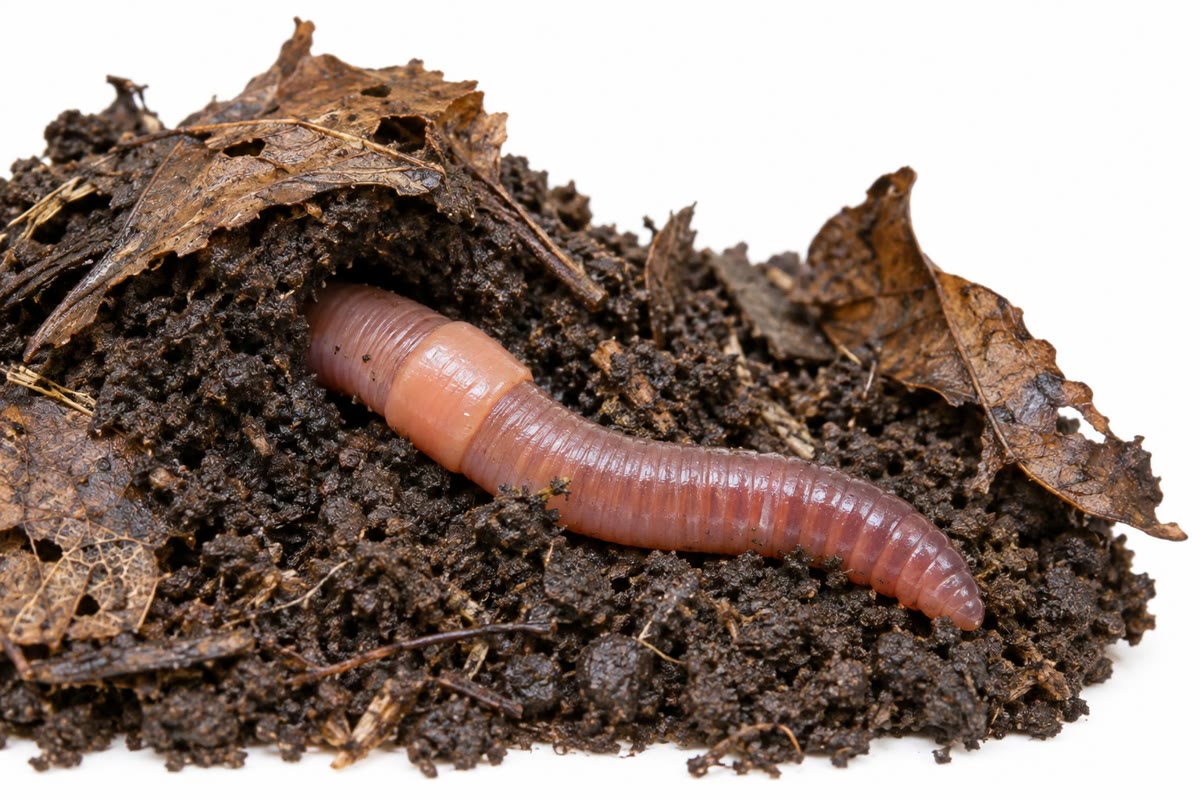
Charles Darwin’s last book, published the year before he died, was about earthworms. He had put a chalk marker on a field near his house in 1842 and dug it up in 1871: it lay eighteen centimetres down, buried by the castings the worms had brought to the surface at a rate he measured, weighed, and multiplied — ten tonnes of soil per acre per year passing through their bodies, so that “the whole of the superficial mould over any such expanse has passed, and will again pass, every few years through the bodies of worms.” The soil, in other words, is not a substrate on which living things stand but a thing living things make. This chapter is about that making: how rock becomes soil and how slowly, who lives in it and in what numbers, how dead matter is taken apart and what is left, how the roots of plants bargain with fungi and bacteria for what they cannot get alone, and how fast a soil that took ten thousand years to build can be lost.
26.1 What soil is
Definition 26.1 (Soil and its horizons)
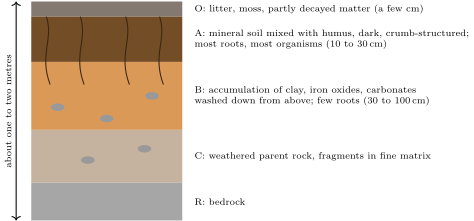
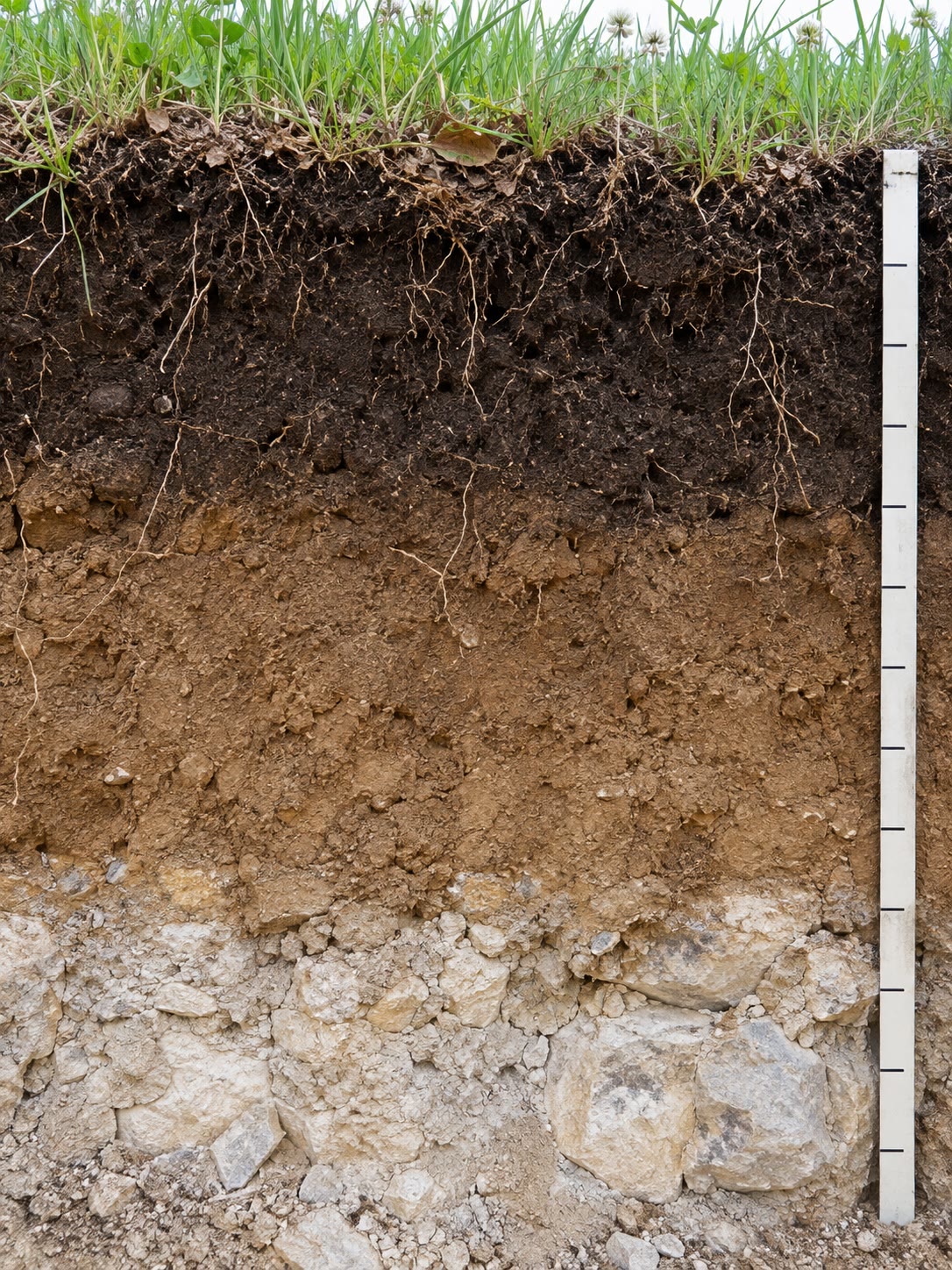
Soil is the layer of weathered mineral matter, organic matter, water, air and organisms that covers land and supports plants: about half its volume is pores, filled with water or air in changing proportion, and the solid half is mineral grains — sand (), silt () and clay (under ), whose proportions give the texture — with a few per cent of organic matter that governs most of its properties. A soil profile shows horizons: the O horizon of litter and partly decayed organic matter at the surface; the dark A horizon of mineral soil mixed with humus, the stable, dark, colloidal residue of decomposition; the B horizon below, into which clay, iron and dissolved matter are washed and where they accumulate; the C horizon of weathered parent rock; and the bedrock. A soil is made (pedogenesis) by five factors — parent material, climate, organisms, topography and time — and it is made slowly: weathering produces of the order of of soil a year, so a metre of soil is ten thousand years of work.
Proposition 26.2 (Why clay and humus matter)
Clay particles and humus carry negative charges on their surfaces and hold, by electrostatic attraction, a reserve of exchangeable cations — , , , — that plant roots draw on by exchanging for them. This cation exchange capacity is the soil’s nutrient bank; a sand has almost none (a few centimoles of charge per kilogram), a clay loam rich in humus fifty times more, and the fertility of the two differs accordingly. The same surfaces hold water: a sandy soil drains within a day to a field capacity of a tenth of its volume, a loam holds a third, and the difference is what a crop has between rains. And humus, together with fungal hyphae, root exudates and the mucus of worms, glues mineral grains into aggregates, the crumb structure whose pores let air, water and roots pass — the property that distinguishes a soil from a sediment and that is destroyed first by ploughing and compaction.
26.2 Who lives there
Proposition 26.3 (The soil community)
A gram of fertile topsoil holds about bacterial cells of some ten thousand species, a hundred metres of fungal hyphae, protists, a few dozen nematodes and a handful of mites and springtails; a square metre holds a few hundred earthworms and, below the visible animals, a living mass of several tonnes per hectare — comparable to the cattle the same hectare could carry. The community is a detrital food web: bacteria and fungi (the decomposers) eat dead matter and are eaten by protists and nematodes (the microbial grazers), which are eaten by mites and predatory nematodes, which feed centipedes and beetles; the detritivores — earthworms, millipedes, woodlice, termites, springtails — eat the litter itself with the microbes on it, fragmenting it a thousandfold and multiplying the surface the microbes attack. The grazers matter beyond their numbers: by eating bacteria they release the nitrogen locked in bacterial cells as ammonium, and a soil with protists and nematodes mineralises nitrogen faster than one with bacteria alone. Earthworms are the ecosystem engineers: their burrows are the soil’s macropores, their casts are the richest aggregates, and a grassland’s worms move a few tonnes of soil per hectare through their guts each year, as Darwin measured.
26.3 Decomposition
Theorem 26.4 (Litter decay and the carbon-to-nitrogen ratio)
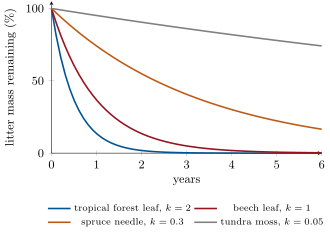
Litter decomposes at a rate proportional to what remains, , so with a decay constant of about 1 per year for grass and deciduous leaves in a temperate forest, for conifer needles, several per year in the wet tropics and in the tundra; a steady input per year builds a litter layer of . Decay is controlled by temperature, moisture, and the litter’s quality: nitrogen content, lignin content, and the ratio of carbon to nitrogen. Microbes have and retain about of the carbon they eat, so they need one nitrogen for every carbons of food: litter with below about 25 releases ammonium as it decays (mineralisation), while litter above it — straw at 80, wood at 400 — makes the microbes take up nitrogen from the soil (immobilisation), starving the plants until the carbon has been respired away and the ratio has fallen. That is why fresh straw ploughed in depresses a crop, why legume residue feeds it, and why a compost heap needs both.
Proof. For the ratio: microbes eating litter with carbons per nitrogen assimilate carbons and, to build biomass at , need nitrogens; the litter supplies 1. If there is nitrogen to spare, released as ammonium; if there is a deficit taken from the soil. The threshold 25 in practice reflects a retention efficiency somewhat below 0.4. For the litter layer: has steady state , approached with time constant ; the residence time of litter is , one year in a beech wood and twenty in the tundra. ∎
Evidence. Litter-bag experiments — known masses of leaves in mesh bags, buried and weighed at intervals — gave the exponential law and its constants across every biome (Olson, 1963), and showed with different mesh sizes that excluding the soil animals halves the rate: the microbes do the chemistry but the animals set the pace. Across a continent, the same leaf decays in a year in Georgia and in eight in Alaska, in proportion to actual evapotranspiration, the product of warmth and water. ∎
Proposition 26.5 (Humus and the soil carbon pool)
A few per cent of the litter’s carbon escapes complete oxidation and becomes humus: a dark, amorphous mixture of microbial residues, altered lignin and plant compounds, bound to clay and iron and locked in aggregates, that decays with residence times of decades to millennia. Humus is where the soil’s fertility lives — most of its nitrogen and cation exchange, half its water-holding — and it is the largest pool of organic carbon on land, in the top metre, twice the atmosphere’s. Its balance is input minus decay, : with per year a soil holds fifty years’ input, and any change — ploughing, which breaks the aggregates and aerates the humus; drainage of a peat, which admits oxygen; warming, which raises — shows up as a loss that continues for decades. The world’s cultivated soils have lost a third to a half of their humus since they were first broken, some , and a warming of would raise the decay of the rest by a third: soils are the largest uncertainty in the carbon budget of Chapter 27.
26.4 Partnerships below ground
Proposition 26.6 (Mycorrhizae and rhizobia)
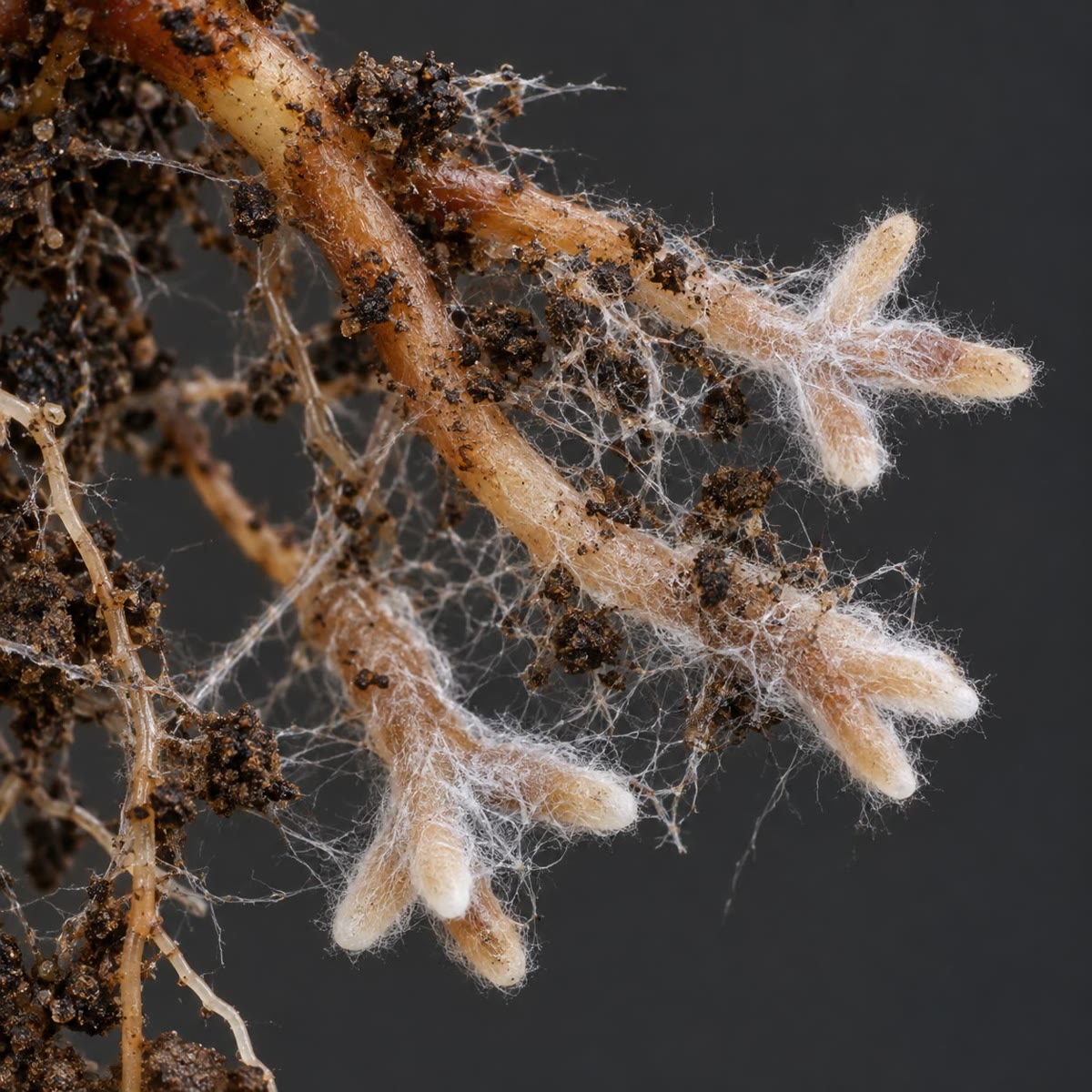
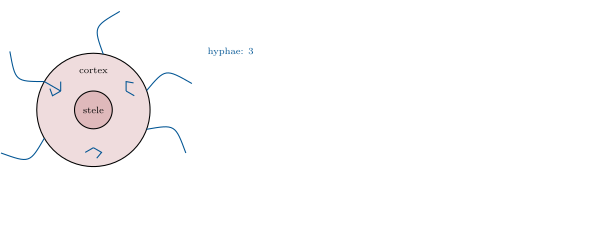
Nine plant species in ten have their roots colonised by fungi in a mycorrhiza: the plant gives sugar (a tenth to a fifth of its photosynthate) and the fungus gives phosphate, nitrogen, water and zinc, which its hyphae, a hundred times thinner than a root and extending a hundred times its length per unit of carbon, collect from a soil volume the root cannot reach — phosphate in particular, which diffuses so slowly through soil that a root exhausts its millimetre of neighbourhood within days. Arbuscular mycorrhizae, the older kind, enter the root cells and branch into arbuscules where the exchange takes place; ectomycorrhizae of forest trees sheath the root tip and grow between its cells. Legumes go further: rhizobia, attracted by the root’s flavonoids, enter through a root hair, and the root builds a nodule around them in which the bacteria, as bacteroids, fix nitrogen with nitrogenase — an enzyme so sensitive to oxygen that the nodule must be kept nearly anoxic by leghaemoglobin, a haemoglobin the plant makes, which gives the nodule its pink colour and delivers oxygen to the bacteroids at a concentration too low to poison the enzyme. Each partner polices the other: a plant cuts off sugar to nodules that fix nothing, and a fungus that delivers less phosphate receives less carbon.
Evidence. Kiers and colleagues (2011) grew a plant with two fungal partners on a divided root system and offered phosphate to one side only: the plant allocated more carbon to the fungus that supplied more phosphate, and the fungus allocated more phosphate to a root that gave more carbon — reciprocal rewards measured with isotopes. For rhizobia, nodules experimentally denied nitrogen (by replacing the air with argon and oxygen) received less oxygen and grew less than nodules on the same plant that could fix: the plant sanctions cheaters. Nitrogen-15 tracing shows that a clover–grass sward transfers a third of the clover’s fixed nitrogen to the grass within a season, through the soil and through shared fungal networks. ∎
26.5 Losing soil
Proposition 26.7 (Erosion, salt and the balance of a soil)
Soil forms at a year and, under natural vegetation, erodes at about the same rate. Bare ploughed land on a slope loses a year to water and wind — — ten to a hundred times the rate of formation: a soil built in ten thousand years is removed in a century, and with it the humus and the nutrients of the A horizon, the only part that matters. Cover crops, terraces, contour ploughing and no-till farming, which leaves the residue on the surface and the aggregates intact, bring the loss back near the rate of formation. Irrigation in dry climates brings the opposite failure: water evaporates and leaves its salts, a tonne per hectare per year from water that is only slightly saline, until the osmotic potential of the soil solution (Chapter 15) is lower than the roots can overcome — salinisation, which retired the fields of Sumer four thousand years ago and now affects a fifth of irrigated land. The state of a soil is a budget: humus in against humus out, formation against erosion, salt in against salt drained; each has a residence time, and each, once negative, is slow to reverse.
26.6 Exercises
Exercise 26.1 ★
Name the horizons of a soil profile from the surface down and say what happens in each.
Solution
Solution of Exercise 26.1.
O: litter and partly decayed organic matter, where decomposition begins. A: mineral soil mixed with humus, dark and crumb-structured, holding most roots, organisms, nutrients and water. B: the horizon of accumulation, where clay, iron oxides and carbonates leached from above are deposited. C: weathered parent material, rock fragments in a fine matrix, where new mineral soil is released. R: unweathered bedrock.
Exercise 26.2 ★
Explain what cation exchange capacity is, why a sandy soil has little, and what a farmer who limes an acid soil is doing to it.
Solution
Solution of Exercise 26.2.
The negative charges on clay and humus surfaces hold exchangeable cations that roots can take up in exchange for protons. Sand grains are quartz, uncharged and coarse, with little surface per gram and no humus to speak of. Liming adds calcium carbonate: the calcium displaces the hydrogen and aluminium ions that saturate the exchange sites of an acid soil, the carbonate neutralises the acidity, and the sites are refilled with a nutrient cation.
Exercise 26.3 ★
List the main groups of the soil food web from decomposers to top predators, with one organism each, and say what the grazers of bacteria do for the plants.
Solution
Solution of Exercise 26.3.
Decomposers: bacteria (Bacillus) and fungi (Trichoderma); microbial grazers: protists (amoebae) and bacterial-feeding nematodes; detritivores: earthworms, millipedes, springtails, woodlice; predators: mites, predatory nematodes, centipedes, ground beetles; and moles or shrews at the top. The grazers, with a higher than their bacterial prey, excrete the surplus nitrogen as ammonium: they mineralise the nitrogen the bacteria had locked up.
Exercise 26.4 ★
Distinguish arbuscular and ectomycorrhizae, and state what each partner gives and gets.
Solution
Solution of Exercise 26.4.
Arbuscular: the fungus (a glomeromycete) enters the root cortex cells and forms arbuscules; found in most herbs and crops and in tropical trees. Ectomycorrhizal: the fungus (basidiomycetes and ascomycetes, many of them mushrooms) sheathes the root tip and grows between the cells without entering them; found in temperate and boreal trees. In both, the plant gives sugar and the fungus gives phosphate, nitrogen, water, micronutrients and some protection from pathogens.
Exercise 26.5 ★★
A beech forest drops of leaves a year and its litter decays with per year. Compute the steady-state litter mass, the litter’s residence time, and the time for a year’s fall to lose of its mass.
Exercise 26.6 ★★
Wheat straw has and clover residue . For each, compute the nitrogen the microbes need per of carbon consumed (retention 0.4, microbial ) and whether the residue mineralises or immobilises, and how much.
Solution
Solution of Exercise 26.6.
Per of carbon eaten the microbes keep and need of nitrogen. Straw supplies : immobilisation of per of carbon. Clover supplies : mineralisation of .
Exercise 26.7 ★★
A hectare of grassland holds of earthworms that each process ten times their mass of soil a year. Compute the soil passed through worms per year and the time for the top (bulk density ) to pass through once. Compare with Darwin’s figure.
Solution
Solution of Exercise 26.7.
of soil a year through the worms. The top weighs : 130 years for one passage. Darwin’s ten tonnes per acre is , the same order — his “every few years” referred to the superficial mould, a few centimetres, not the whole topsoil.
Exercise 26.8 ★★
A gram of soil holds bacteria of mass each, and of hyphae of diameter and density . Compute the bacterial and fungal biomass per gram and per hectare (top , ).
Solution
Solution of Exercise 26.8.
Bacteria: per gram. Hyphae: volume , mass per gram. Per hectare ( g): of bacteria and of fungi.
Exercise 26.9 ★★
Soil humus decays with per year and receives of carbon a year. Compute the steady-state humus carbon. The field is ploughed and doubles: compute the new steady state, the carbon lost, and the time to lose half of it.
Solution
Solution of Exercise 26.9.
of carbon. Ploughed: ; loss , half of it gone after years.
Exercise 26.10 ★★★
Phosphate diffuses through soil with . Compute how far it travels in a growing season of days () and compare with the spacing of roots () and of hyphae (). What does this say about why mycorrhizae matter for phosphorus and less for nitrate ()?
Solution
Solution of Exercise 26.10.
Phosphate: in a season — a root from the next reaches an eighth of the soil between them, while hyphae apart reach all of it. Nitrate: , farther than the root spacing: it comes to the root by itself (and by mass flow with the water), so mycorrhizae add little for nitrate and much for phosphate.
Exercise 26.11 ★★★
A slope loses of soil a year to erosion while forming ; the A horizon is thick at and holds carbon. Compute the A horizon’s mass, its lifetime at this rate, and the carbon lost per year. Under no-till the loss falls to : recompute the lifetime.
Solution
Solution of Exercise 26.11.
Mass . Net loss a year: lifetime 170 years. Carbon lost a year. Under no-till the net loss is : 3250 years.
Exercise 26.12 ★★★
“The soil is the slowest organism on the farm.” Discuss with the residence times of litter, humus, mineral soil and salt, and say which changes a farmer can see within a career and which not.
Solution
Solution of Exercise 26.12.
Litter turns over in a year or two, humus in fifty, the mineral A horizon in thousands (its formation at a year), and salt accumulates in decades and is drained in decades if there is drainage. A farmer sees the litter and the crop respond within a season and the humus within a career (a decline of a third takes thirty years; a recovery as long); the erosion of the mineral soil is invisible in one lifetime and irreversible in ten; salt is visible in a generation and, without drainage, permanent. The soil’s slow variables are the ones no annual account records.
26.7 Problem: A Hectare of Soil
Problem 26.1
Weekend problem — one hectare of arable soil audited: its living mass counted, its litter and humus followed through their exponential budgets, the nitrogen released by a legume residue computed against a crop’s need, and the erosion and carbon accounts of two management regimes compared, ending on the soil’s carbon stock, its lifetime under the plough, and the nitrogen a legume supplies
The hectare: A horizon thick, bulk density , organic carbon; humus decay per year under the plough, under no-till; carbon input to the humus a year in both. Litter: a clover cover crop leaves of dry matter at carbon and nitrogen, decaying with per year. Erosion: a year ploughed, no-till; formation .
Part I — The stock.
- Compute the mass of the A horizon and its organic carbon.
- Compute the mass of nitrogen in the humus if its is 12.
- The soil holds bacteria per gram at each and of hyphae per gram at diameter, density 1.1. Compute the microbial biomass per hectare.
- Add of earthworms and of other animals, and give the total living mass per hectare. What is it as a fraction of the humus carbon?
- The microbes turn over their biomass twice a year and respire of what they eat. Estimate the carbon they consume per year, and the respired.
- Compare with the crop’s net primary production of about of carbon and comment.
Part II — The clover residue.
- Compute the carbon and nitrogen in the residue and its .
- With microbial and retention , does the residue mineralise or immobilise nitrogen? Compute the net nitrogen released as the whole residue decays.
- With , what fraction of the residue has decayed after 3 months? After a year?
- Compute the nitrogen released in the first 3 months.
- A wheat crop takes up of nitrogen per hectare, most of it in the two months after sowing. Comment on the timing.
- The same mass of wheat straw () is ploughed in instead. Compute the nitrogen immobilised and say what the farmer must do.
Part III — Humus.
- Compute the steady-state humus carbon under the plough and under no-till.
- The field, at the ploughed steady state, is converted to no-till. Write and compute the carbon gained after 10 and 50 years.
- Compute the rate of gain in the first year, in tonnes of carbon per hectare, and as tonnes of .
- If the world’s of cropland did the same, what would the first-year sink be, against fossil emissions of ? And in the fiftieth year?
- Why is the sink temporary and reversible?
- A warming of raises by a third. Compute the new no-till steady state and the carbon lost.
Part IV — Erosion.
- Compute the net loss of soil per year under each regime.
- Compute the lifetime of the A horizon under each.
- Compute the carbon and nitrogen carried off per year by erosion under the plough.
- Compare the erosion carbon loss with the humus decay loss at steady state under the plough.
- The eroded soil is deposited downstream. Is its carbon lost to the atmosphere? Discuss.
- Give the residence times of litter, humus and mineral soil on this hectare.
- State the result: the A horizon’s carbon stock, its lifetime under the plough and under no-till, and the nitrogen the clover residue supplies.
Solution
Solution of Problem 26.1.
1. ; carbon . 2. of nitrogen. 3. Bacteria , ; hyphae , : microbial biomass about . 4. About of living matter (fresh mass), some of the humus carbon — a few per cent of it as carbon, since organisms are mostly water. 5. Microbial carbon about half of , ; turning over twice a year with retained, they consume of carbon and respire of carbon, of (a crude estimate: the retention and turnover are rough). 6. Three times the crop’s net primary production of : the estimate is too high, as the assumptions (all the biomass turning over twice, none of it dormant) are generous; real soil respiration under a crop is of the order of the crop’s own production, several tonnes of carbon per hectare a year. The soil breathes as much as the plants above it. 7. Carbon ; nitrogen ; . 8. Mineralises: the microbes need of nitrogen and the residue holds 150, so is released net. 9. after 3 months; after a year. 10. . 11. The crop needs , most of it in its first two months; the residue gives in three months and in all — a supplement, not a supply. Its value is also in the nitrogen the clover fixed and holds in the residue’s own , most of which enters the humus and comes back over years. 12. Straw: carbon , nitrogen ; the microbes need , so is immobilised from the soil — more than half the crop’s need. The farmer must add nitrogen with the straw, or plough it in well before sowing, or leave it on the surface where it decays slowly. 13. Ploughed: ; no-till: . 14. : gain after 10 years, after 50. 15. of carbon in the first year, of . 16. in the first year, of fossil emissions; by the fiftieth year the rate has fallen to , . 17. The gain is the approach to a new steady state: it decays to zero as reaches , and the whole gain is returned to the air within decades if the field is ploughed again — a soil sink is a one-time, reversible transfer, not a permanent offset of continuing emissions. 18. : , a loss of , more than the first fifty years’ no-till gain: warming can undo the management. 19. Ploughed: a year; no-till: . 20. years; years. 21. Carbon ; nitrogen a year. 22. Humus decay at the ploughed steady state is a year; erosion adds a third as much again, but unlike decay it is not balanced by input — it drains the stock. 23. Partly. Eroded carbon buried in a sediment or a reservoir may be protected from decay for a long time (a burial sink); but the aggregates are broken in transport, much of the carbon is oxidised on the way, and the field’s lost fertility is replaced by fertiliser whose manufacture emits carbon. The global sign of erosion’s carbon effect is still debated. 24. Litter years; humus years under the plough and 67 under no-till; mineral soil years with respect to formation, and 220 years with respect to loss under the plough. 25. Carbon stock in the A horizon; lifetime 220 years under the plough, 3250 under no-till; the clover residue supplies about of mineral nitrogen, 15 of them in the first three months.