University Biology — Year 2 · Bachelor Year 2
7Asexual Reproduction and Cloning in Plants
In a valley in Utah stands a forest of forty-seven thousand aspen trunks that is one plant: every trunk has grown from the same root system, every cell carries the same genome, and the individual is some fourteen thousand years old and weighs six thousand tonnes. Every strawberry in a supermarket punnet of one variety is a piece of one plant multiplied by runners; every Cavendish banana on Earth is a cutting of a cutting of one plant. Plants, unlike most animals, can make new individuals without sex — from a stem, a root, a leaf, a single cell in a flask. This chapter examines how they do it, how growers exploit it, and what it costs a lineage to give up meiosis and fertilisation: the question of why sex exists at all.
7.1 Vegetative multiplication
Definition 7.1 (Clone, genet, ramet)
Asexual reproduction produces new individuals from one parent by mitosis alone, without meiosis or fertilisation: the offspring are a clone, genetically identical to the parent and to each other, apart from the somatic mutations that accumulate. In plants the usual form is vegetative multiplication, in which part of the body — stem, root, leaf — roots and becomes a separate plant. A genet is the genetic individual, everything that grew from one zygote; a ramet is one physiologically separate unit of it. A strawberry bed may hold a thousand ramets of one genet; the aspen forest is one genet. Vegetative multiplication is possible because plant cells keep the capacity to divide and form any organ — they are totipotent — and because plants grow from meristems that can be reawakened almost anywhere.
Proposition 7.2 (The organs of vegetative multiplication)
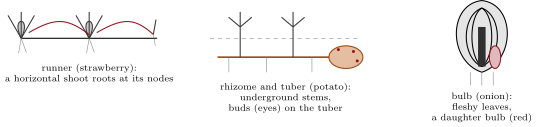
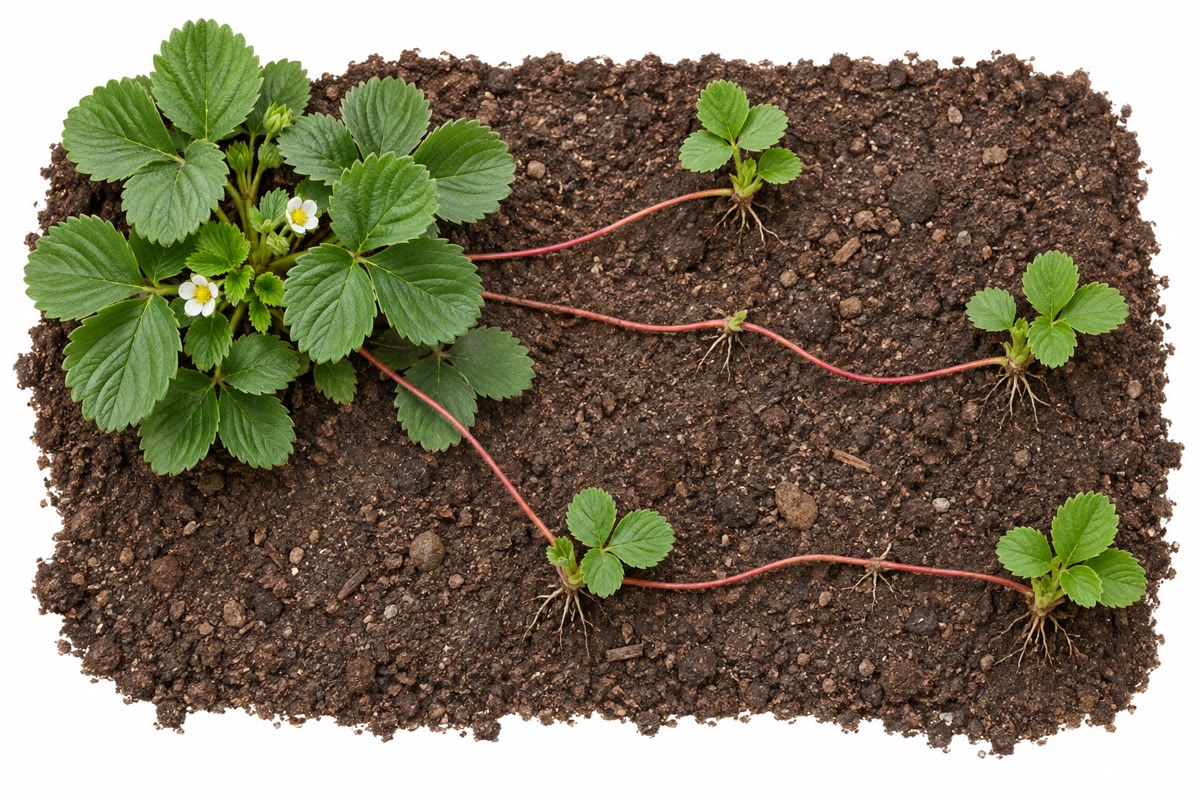
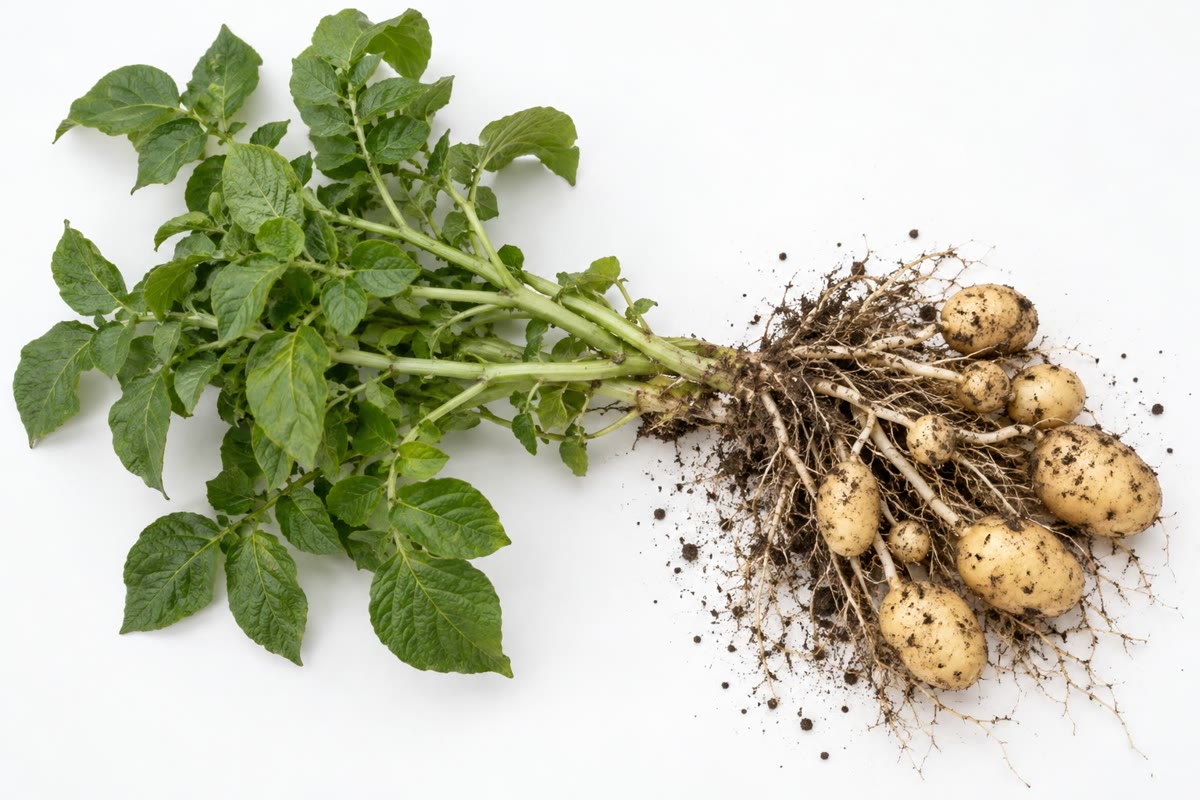
Plants have evolved the same trick from every organ. From stems: runners or stolons, horizontal shoots along the ground that root at their nodes (strawberry, creeping buttercup); rhizomes, horizontal underground stems that branch and fragment (couch grass, iris, ginger, bracken); tubers, swollen rhizome tips that store starch and carry buds, the “eyes” (potato); corms, swollen vertical stem bases (crocus); bulbils, small bulbs formed in the axils of leaves or in the flower head (garlic, some onions). From leaves: bulbs, buds wrapped in fleshy storage leaves that split into daughter bulbs (onion, tulip); plantlets along the leaf margin, complete with roots, that drop off (Kalanchoe). From roots: suckers, shoots that rise from horizontal roots (aspen, blackthorn, raspberry). By fragmentation: a piece of willow branch that floats away and roots, a duckweed frond that splits. In every case a storage organ or a meristem is carried a short distance, and the daughter starts life with a supply of food no seed can match.
Theorem 7.3 (The geometry of a spreading clone)
A genet whose every ramet produces rooted daughters a year, all surviving, grows in number as — exponential growth without any sex — until the ramets fill the space at their carrying density (ramets per unit area), after which the clone advances as a front. A clone that spreads its runners in a straight line at speed has, after years, a radius , and the number of ramets grows as : quadratically, not exponentially. A strawberry plant that sends runners a year has a radius of after ten years; the aspen clone of the opening paragraph, , has a radius of some and, at a net advance of a few centimetres a year, an age of order years — consistent with the age estimated from the retreat of the glaciers.
Proof. Each year every ramet is replaced by itself plus daughters, a factor ; years give . Once the interior is full, only the ramets on the edge find space, and the edge advances at the runner speed ; the area is and the number of ramets is the area times the density. ∎
Example 7.4 (The oldest organisms)
The aspen clone Pando (Utah) covers with about trunks that each live a century or so and are replaced by suckers from the same roots; the genet may be over ten thousand years old. A clone of the seagrass Posidonia in the Mediterranean stretches and may be a hundred thousand years old; a creosote bush ring in the Mojave has been dated to years, the central stems dying as the ring expands. In every case what is old is the genet; no cell in it is older than a few decades, and the genome has been copied thousands of times.
7.2 Seeds without sex, and animals without fathers
Definition 7.5 (Apomixis)
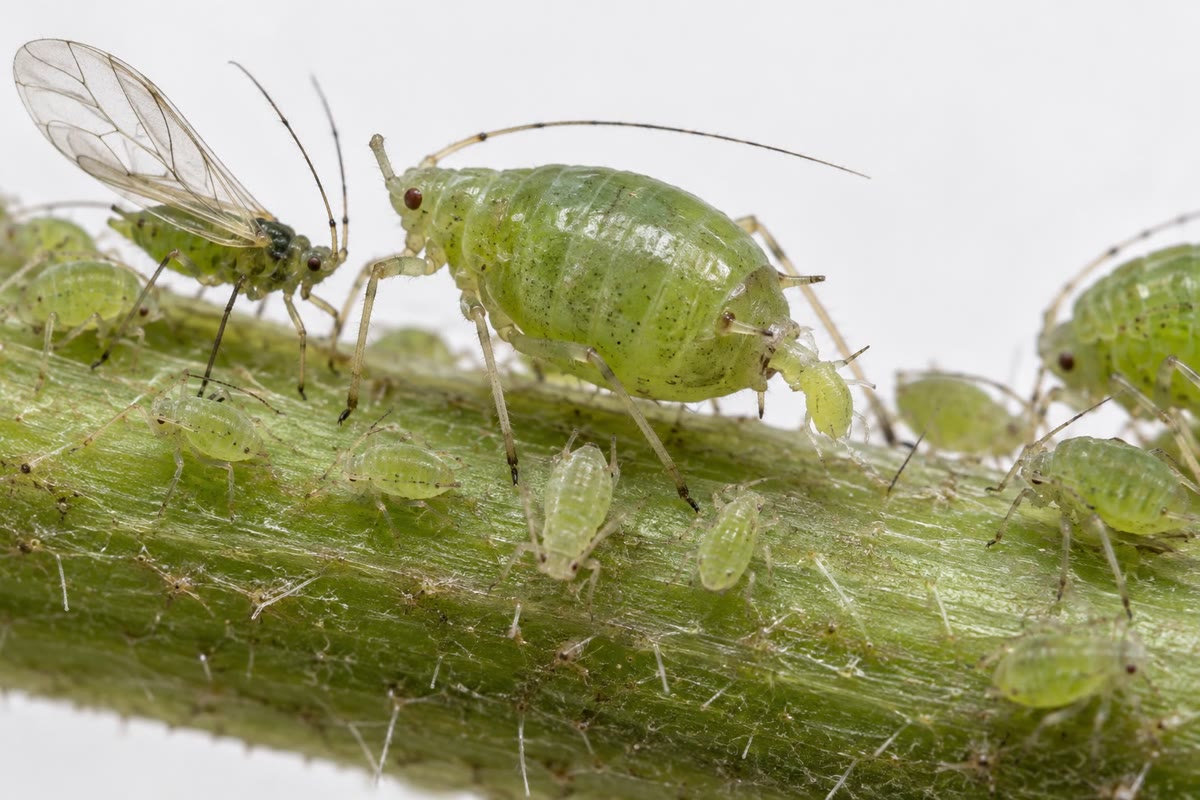
Apomixis is the production of seeds without fertilisation: an embryo develops from an unreduced egg cell (the megaspore mother cell skips meiosis) or directly from a cell of the nucellus, and the seed carries the mother’s genotype. Dandelions, hawkweeds, blackberries, Kentucky bluegrass and many citrus do this; the citrus seed often holds several embryos, one sexual and the rest nucellar copies of the mother. Apomixis keeps the seed — its dispersal, dormancy and coat — and drops the meiosis, so that a well-adapted genotype is broadcast unchanged; most apomicts are polyploids of hybrid origin whose meiosis would fail anyway. The animal counterpart is parthenogenesis, development from an unfertilised egg: obligate in some lizards and in bdelloid rotifers, which have had no males for tens of millions of years; cyclical in aphids and water fleas, which multiply parthenogenetically all summer, a female giving birth to live daughters that already carry their own embryos, and switch to a sexual generation in autumn that lays overwintering eggs.
Example 7.6 (An aphid summer)
A parthenogenetic aphid matures in about eight days and produces some five daughters a day for two weeks; the daughters are born already pregnant (the embryos begin developing inside the mother’s embryos). With a generation time near ten days and a net rate of increase of about per generation, a single founder in April could, unchecked, leave descendants within four months — more in mass than every animal now alive. Ladybirds, lacewings, parasitoid wasps, fungi and rain keep the number to a few thousand per plant, and the autumn sexual generation resets the clone into recombined eggs before winter.
7.3 Cloning by the grower
Proposition 7.7 (Cuttings, layering, grafting)
A cutting is a piece of stem, root or leaf induced to root: the cut end forms a callus of dividing cells from which root meristems arise, helped by auxin (the rooting hormone) and humidity. Layering roots a branch while it is still attached and cuts it afterward. Grafting joins a shoot of one plant (the scion) to the rooted stem of another (the rootstock): the two cambia are pressed together, callus bridges the wound, and new xylem and phloem connect across it within weeks. The graft is a chimera — the roots keep the rootstock’s genome, the fruiting shoot the scion’s — and it works only between related plants (species of one genus, sometimes of one family), because the tissues must recognise each other’s cells. Every apple, pear, cherry, citrus and grape variety is propagated by grafting: a named variety is one genet, kept alive for centuries by scions (the Reinette apples date from the sixteenth century), and the rootstock is chosen for the soil, the disease and the size of tree wanted — dwarfing rootstocks make the small trees of modern orchards.
Proposition 7.8 (Micropropagation and totipotency)
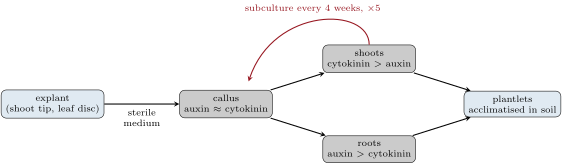
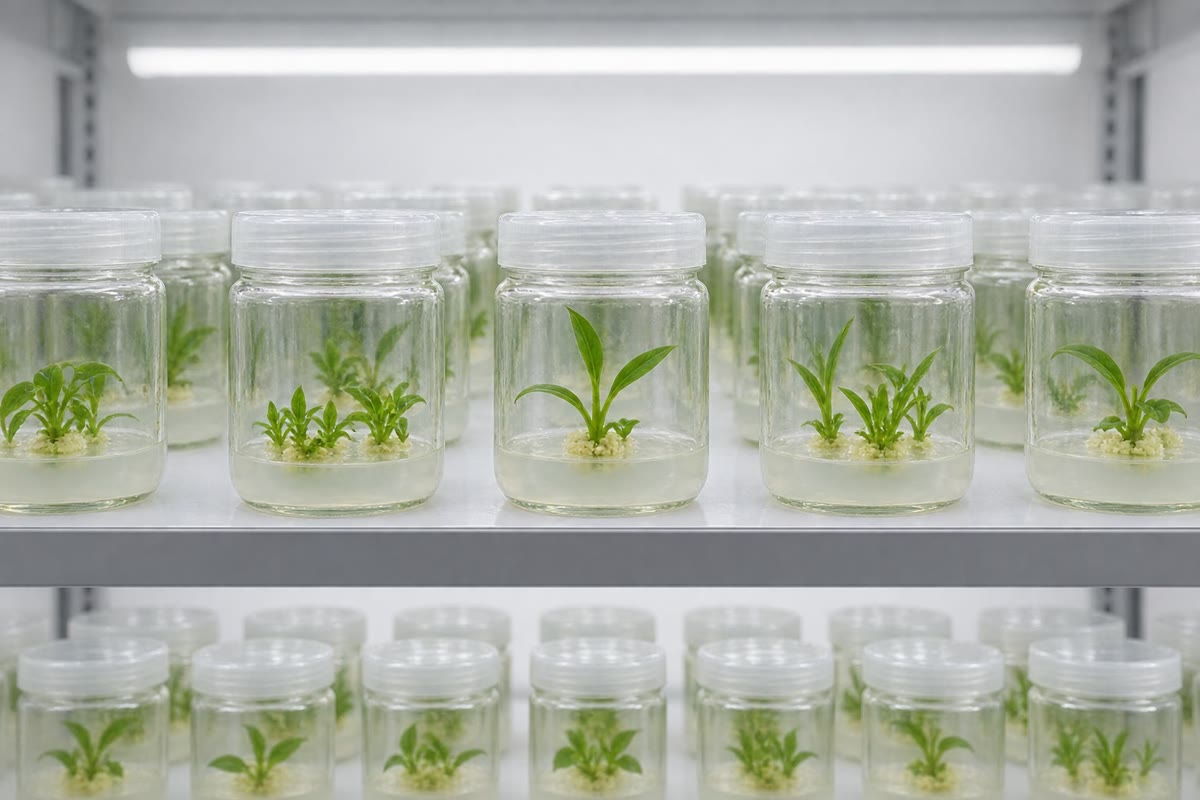
Any living plant cell with a nucleus can, in principle, regenerate a whole plant. In tissue culture a sterilised piece of tissue (an explant: a shoot tip, a leaf disc, an anther) is placed on an agar medium with sugar, minerals, vitamins and hormones. With auxin and cytokinin in balance the cells dedifferentiate into a callus, a mass of dividing unspecialised cells; with more cytokinin than auxin the callus forms shoots, with more auxin than cytokinin it forms roots, and in some species it forms somatic embryos — complete embryos without an egg. Shoots are cut and subcultured every few weeks, multiplying by a factor of three to ten each time, so that one meristem gives a million plantlets in a year. Because viruses lag behind the growing tip, a shoot meristem under a millimetre long is usually virus-free even in an infected plant: meristem culture is how potato, strawberry, banana and orchid stocks are cleaned. The method is the practical proof of totipotency, and the reason a plant variety can be sold by the million within a few years of its creation.
Evidence. Skoog and Miller (1957) grew tobacco pith callus on media with different ratios of auxin to the newly discovered cytokinin: high auxin gave roots, high cytokinin gave shoots, a balance gave only callus — organ formation was set by a ratio of two hormones, not by a specific organ-forming substance. Steward (1958) suspended single cells and small clumps from a carrot root in a rotating flask of coconut milk: some clumps formed embryo-like structures that grew into complete flowering carrots, showing that a differentiated cell of a mature organ still holds, and can use, the whole programme of development. ∎
7.4 The cost of sex and the cost of doing without
Theorem 7.9 (The twofold cost of sex)
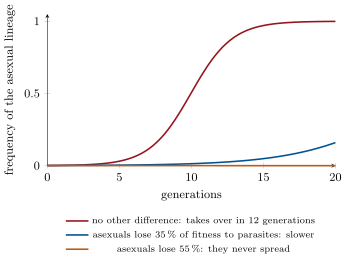
In a population where females make offspring each, of which half are sons, an asexual mutant female who makes daughters, all copies of herself, doubles her share of the next generation’s females. If the asexual lineage has frequency among females, then in the next generation
so that from one in a thousand it reaches half the population in ten generations and all of it soon after. Everything else being equal, sex halves the rate at which a lineage multiplies — the price of making males. Since sex is nevertheless nearly universal, everything else is not equal: sexual lineages must, on average, gain at least a factor two from recombination.
Proof. Asexual females number and leave daughters; sexual females number and leave daughters (the other half are sons, who make no eggs). The asexual share of the daughters is . Writing , the recursion becomes , so ; converting back gives . Setting gives , i.e. for . ∎
Proposition 7.10 (What sex is for)
Three benefits are large enough to matter. Muller’s ratchet: in a clone every harmful mutation is inherited by all descendants, and a mutation-free genome, once lost from a finite population by chance, can never be remade; the load ratchets upward, one click at a time, and small asexual populations decay. Recombination rebuilds clean genomes from two damaged ones. Adaptation: two useful mutations arising in different individuals of a clone compete and one is lost; in a sexual population they combine (Fisher and Muller, 1930s), so that sexual populations adapt faster when many genes must change. The Red Queen: parasites adapt to the commonest host genotype, and a clone, being one genotype, is the commonest of all; sexual parents make each offspring a new lock. Snails, fish and plants that have both sexual and clonal populations show the sexual ones prevailing where parasites are abundant. The asexual lineages that flourish — dandelions, bdelloid rotifers, most crop clones — are either young, or polyploid hybrids that carry variation of their own, or propped up by a grower who kills their parasites for them.
Example 7.11 (Monocultures of a clone)
In the 1840s most of the potato crop of Ireland was one clonal variety, the Lumper; the water mould Phytophthora infestans, arriving in 1845, met a country of genetically identical, uniformly susceptible plants and destroyed the crop in three successive years. The world’s export banana until the 1950s was a single clone, Gros Michel, wiped out of Central American plantations by a soil fungus; its replacement, Cavendish, is likewise a single clone and is now being lost, plantation by plantation, to a new strain of the same fungus, against which it has no variation to offer. A clone is the easiest target in nature, and the grower who plants one must supply the resistance that recombination would have supplied for free.
7.5 Exercises
Exercise 7.1 ★
Define clone, genet and ramet, and give three natural organs of vegetative multiplication with a plant for each.
Solution
Solution of Exercise 7.1.
Clone: the genetically identical descendants of one parent by mitosis. Genet: the genetic individual, all that grew from one zygote. Ramet: one physiologically independent unit of a genet. Organs: runners (strawberry), rhizomes (couch grass), tubers (potato), bulbs (onion), suckers (aspen), leaf plantlets (Kalanchoe).
Exercise 7.2 ★
In a graft, what tissues must meet for the union to succeed, and what does each partner contribute to the tree? Why is a grafted tree a chimera and not a hybrid?
Solution
Solution of Exercise 7.2.
The vascular cambia of scion and rootstock must be aligned and in contact; callus bridges the cut and differentiates xylem and phloem across it. The rootstock supplies roots (water, minerals, vigour, soil tolerance, size control), the scion the fruiting shoot (the variety). Each part keeps its own genome and the cells never fuse: two genotypes side by side, a chimera; a hybrid would carry a mixture of both genomes in every cell.
Exercise 7.3 ★
Distinguish apomixis from vegetative multiplication, and parthenogenesis from both. Which of the three keeps the seed?
Solution
Solution of Exercise 7.3.
Vegetative multiplication: a body part roots into a new plant. Apomixis: a seed forms without fertilisation, the embryo a clone of the mother. Parthenogenesis: an animal develops from an unfertilised egg. Only apomixis keeps the seed — with its coat, dormancy and dispersal.
Exercise 7.4 ★
List the steps of micropropagation from explant to plant in the field, naming the hormone conditions at each.
Solution
Solution of Exercise 7.4.
Sterilise the explant; place it on agar with sugar, minerals, vitamins and balanced auxin and cytokinin (callus); raise the cytokinin-to-auxin ratio to induce shoots; subculture the shoots every few weeks; transfer to an auxin-rich medium to root; wean the plantlets under high humidity and then in soil.
Exercise 7.5 ★★
A strawberry plant makes 8 runners a year, each rooting 3 plantlets, and every plantlet does the same the following year. How many plants after 4 years if none die? At per plant, what area would they need? What actually limits the clone?
Solution
Solution of Exercise 7.5.
Each plant is replaced by : after 4 years plants, needing , nearly four hectares. Space, light and nutrients, the short reach of a runner, and the death of plants under crowding stop the exponential phase within a couple of years; the clone then advances as a front.
Exercise 7.6 ★★
The aspen clone Pando has trunks on , each trunk living about years. If the genet is years old, how many generations of trunks has it had? Compute its mean radial advance in metres per year, treating it as a disc.
Solution
Solution of Exercise 7.6.
generations of trunks. Radius of a disc of : ; advance a year, under three centimetres.
Exercise 7.7 ★★
An asexual mutant arises at frequency in a sexual population, with the same fecundity. Compute its frequency after 5, 10 and 15 generations. How much must its fitness be reduced for it never to spread?
Solution
Solution of Exercise 7.7.
: : ; : ; : . It never spreads if its fitness is below half the sexual lineage’s: a relative fitness gives , which decays for .
Exercise 7.8 ★★
Predict what a tobacco callus does on media with auxin : cytokinin ratios of 10 : 1, 1 : 1 and 1 : 10, and explain why a shoot cutting is dipped in auxin, not cytokinin.
Solution
Solution of Exercise 7.8.
: roots; : undifferentiated callus; : shoots. A cutting already has a shoot and needs roots, which auxin induces at the cut base.
Exercise 7.9 ★★
Potatoes are planted as tubers. A planted kilogram yields , and a hectare needs of seed tubers. Starting from of a new variety, how many seasons until a hectare can be planted? Why does true seed give a faster multiplication but is not used?
Solution
Solution of Exercise 7.9.
1, 10, 100, , kg: after the third season only , after the fourth : four seasons. True seed gives thousands of seeds per plant but potato is a heterozygous tetraploid, so the seedlings segregate and none is the variety.
Exercise 7.10 ★★★
In a clonal population of individuals with harmful mutations per genome per generation, each costing a fraction of fitness, the fraction of mutation-free individuals at equilibrium is (derived in Chapter 22). With and , compute the number of mutation-free individuals for and , and explain, with Muller’s ratchet, why the small population is doomed and the large one is not — yet.
Solution
Solution of Exercise 7.10.
: 670 mutation-free individuals in the large population, about 7 in the small one. Seven individuals can all fail to leave offspring by chance within a few generations (the probability that none of them reproduces is of order per generation), after which the best class is gone for ever and the next-best becomes the best: a click of the ratchet, repeated until the load is unbearable. With 670 the loss is practically impossible — until a bottleneck shrinks or the mutation rate rises; the ratchet only ever turns one way.
Exercise 7.11 ★★★
A pathogen strain that overcomes the resistance of a given genotype arises once. Compare its fate in a field of one clone and in a sexual population where the resistance genes segregate at ten loci, each with two alleles at equal frequency, and explain the Irish potato famine in these terms.
Solution
Solution of Exercise 7.11.
In the clone every host is susceptible: the strain spreads unchecked at the rate the spores travel. In the sexual population the genotype it overcomes is one of combinations, present in about a thousandth of the plants, scattered among resistant neighbours, so the epidemic starves. The Lumper was one clone grown over most of a country; the blight found every plant open, and there was no variation to breed from until other varieties were imported.
Exercise 7.12 ★★★
“Sex costs a factor two and is everywhere; asexuality is cheap and rare.” Discuss the three explanations of the chapter, and say what the bdelloid rotifers — asexual for forty million years — imply for each.
Solution
Solution of Exercise 7.12.
Muller’s ratchet, the combining of favourable mutations, and the Red Queen each give sex a benefit that can exceed a factor two in a large, parasitised, changing world. Bdelloid rotifers are the awkward case: forty million years without males and no ratchet meltdown. They appear to escape by extreme desiccation resistance (which kills their parasites), by taking up foreign DNA and by unusually efficient DNA repair — exceptions that show what the rule normally requires.
7.6 Problem: A Strawberry Farm and an Old Clone
Problem 7.1
Weekend problem — the arithmetic of a clone, from a strawberry field filled by runners and a laboratory that multiplies a meristem, to the invasion of a sexual population by an apomict and the genetic decay of an ancient genet, ending on the time to fill the field, the plantlets from one meristem, and the equilibrium of apomicts and sexuals
A grower plants strawberry plants in a field of that can carry plants per square metre. Each plant makes runners a year, each rooting daughters, and all plants survive. A laboratory multiplies the same variety by tissue culture: each subculture, every weeks, multiplies the shoots by ; of plantlets survive weaning. Ordinary cuttings of the variety are virus-infected; meristem tips of carry the virus with probability . Aspen genome: base pairs; somatic mutation rate per base pair per cell division; meristem cell divisions per year in a growing shoot.
Part I — Filling the field.
- How many plants can the field hold?
- By what factor does the number of plants multiply each year?
- Compute the number of plants after 1, 2 and 3 years.
- Solve for the time at which the field is full.
- Once full, only the plants at the edge of a patch find room. If a patch advances a year, how many years would one plant take to cover the field by advance alone?
- Explain why the grower plants plants spread over the field rather than one.
Part II — The laboratory.
- How many subcultures are needed to go from one meristem to at least shoots? How many weeks?
- How many plants survive weaning?
- What is the probability that a meristem-derived line is virus-free? That all lines started from one plant are?
- The laboratory starts lines and discards infected ones after a test. Expected number of clean lines? Compare with cuttings.
- Explain why the meristem tip escapes the virus.
- The field could be planted from the laboratory’s output in the first year rather than filled by runners in three. Give one advantage and one risk of each route.
Part III — An apomict invades. A dandelion population is sexual; an apomictic (seed-cloning) mutant appears at frequency with the same seed output per plant. Half of the sexual plants’ reproductive effort goes into pollen.
- Justify the recursion for the apomict’s frequency among seed parents.
- Compute after 5 and 10 generations, and the generation at which it passes one half.
- A rust fungus specialises on the commonest genotype: the apomict’s seed output is reduced by a factor , with . Write the new recursion.
- Find the equilibrium frequency and check its stability from the sign of on either side.
- For what values of does the apomict take over completely?
- Compute the equilibrium for . Interpret: what must a parasite do to protect sex?
- The apomict is a triploid. Why can it not go back to sex, and why does this matter in the long run?
Part IV — The old clone.
- Compute the number of somatic mutations per cell division in aspen.
- Two trunks of the Pando clone are separated by years of growth on each side of their common ancestor. How many cell divisions separate them, and how many mutations distinguish their genomes?
- What fraction of the genome is that? If of the genome is coding, how many coding differences?
- A clone has no meiosis and no selection at the level of the organism to remove these mutations. What does remove them, and why is the sieve weaker than in a sexual lineage?
- Is Pando “genetically uniform”? Discuss in two sentences.
- State the result: the time to fill the field by runners, the plantlets one meristem gives in a year, and the equilibrium frequency of the apomict for .
Solution
Solution of Problem 7.1.
1. plants. 2. . 3. ; ; . 4. : years — full during the third year. 5. Radius of a hectare disc ; at a year, years. 6. A hundred scattered founders fill the field exponentially from a hundred fronts in two years; one founder would fill its neighbourhood in two years and then crawl for a century. 7. : , nine subcultures ( shoots), 36 weeks. 8. plants. 9. ; . 10. clean lines expected; from ten cuttings, one. 11. The virus travels through plasmodesmata and the phloem, and the apical dome has no vascular connection and divides faster than the virus spreads, so the outermost tenth of a millimetre is usually uninfected. 12. Laboratory: uniform, virus-free plants at once, but costly, and any mutation or contamination in the culture is multiplied a million times. Runners: free and on site, but three seasons lost and every virus in the mother plants carried along. 13. Apomicts number and give seeds each; sexuals give seeds each (half their effort is pollen, which makes no seeds); the apomict share of seeds is . 14. ; : it passes one half at generation 10. 15. . 16. when : . Below , and rises; above, it falls: stable. 17. when : the apomict takes over unless the parasite costs it more than half its output when common. 18. : . To keep sex in the population the parasite must, at high apomict frequency, cut the clone’s fitness by more than the twofold advantage — the Red Queen must run fast. 19. Three chromosome sets cannot pair in meiosis, so its gametes are unbalanced; it is locked out of recombination, and Muller’s ratchet and the parasites work on it unopposed — which is why apomictic dandelion lineages are young and keep being remade from sexual ancestors. 20. per division. 21. divisions; mutations. 22. of the genome; about coding differences. 23. Competition among cell lineages in the meristem (a slower-dividing mutant line is displaced) and among ramets (a trunk carrying a bad mutation suckers less). Weaker because most somatic mutations are heterozygous and masked, and nothing exposes them: no meiosis makes them homozygous and no single-cell zygote stage tests the whole genome in one cell. 24. Not uniform: its trunks differ at hundreds of thousands of sites. But the differences are mostly neutral and masked, so the clone is one genotype in effect — a mosaic of somatic variants of one genet. 25. Field full after 2.3 years; one meristem gives plants in nine months; with the apomict settles at , the sexuals keeping .