University Biology — Year 2 · Bachelor Year 2
6Sexual Reproduction of Flowering Plants
An apple orchard in May is white with blossom and loud with bees; in October the same trees are heavy with fruit, each apple holding ten seeds, each seed an embryo tree wrapped in a store of food. The whole of that transformation — the flower, the pollen carried by an insect, the tube that grows through the style, the double fertilisation that makes at once an embryo and its food supply, the ovary that swells into a fruit built to be eaten — is the invention that made the flowering plants, in a hundred million years, the dominant plants of the land. This chapter takes it from the flower to the dispersed seed.
6.1 The flower
Definition 6.1 (The parts of a flower)
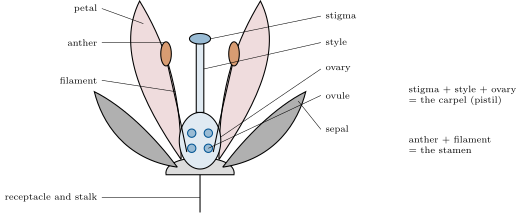
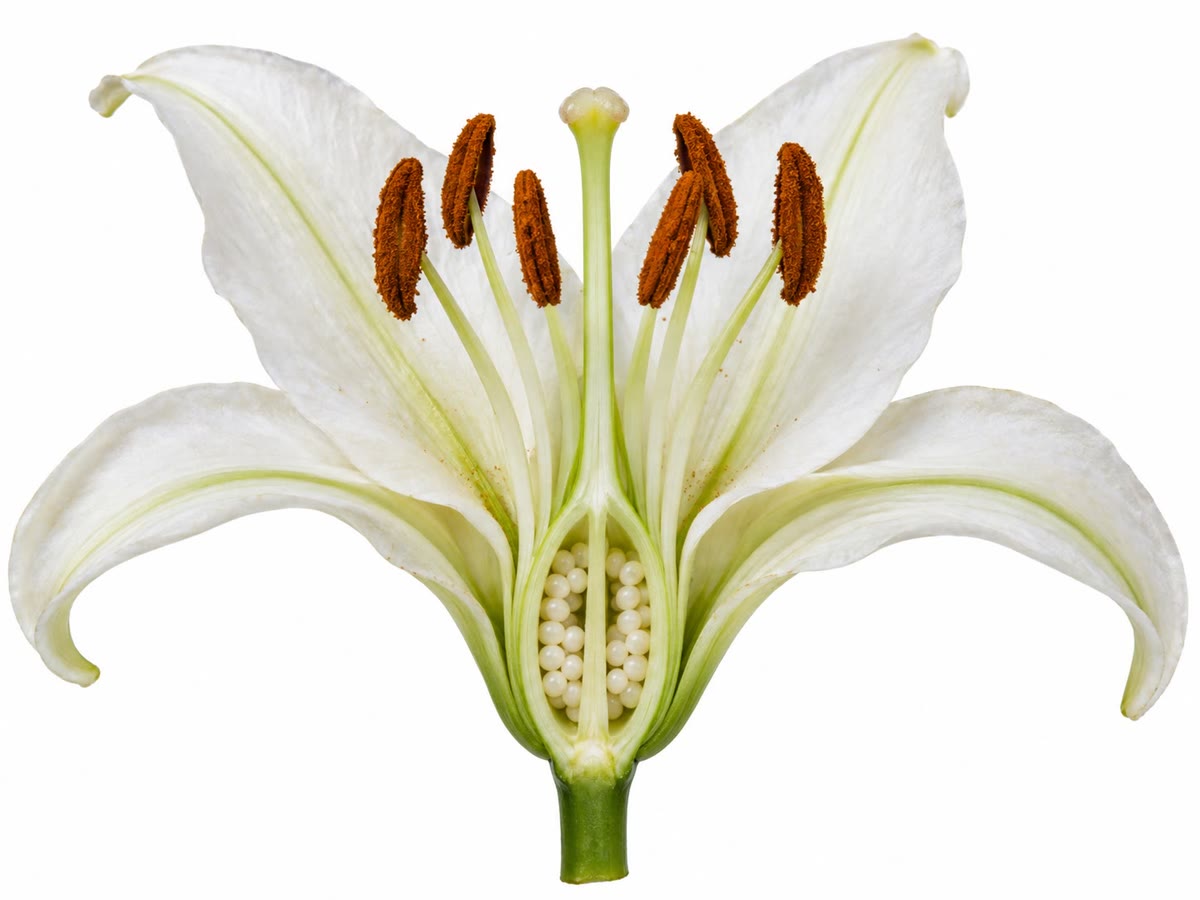
A flower is a short shoot whose leaves are transformed into four whorls. Outside, the sepals (together the calyx) protect the bud; then the petals (the corolla), which advertise; then the stamens, each a filament bearing an anther with four pollen sacs; and at the centre one or more carpels, each folded and sealed into a pistil with a receptive stigma, a style, and an ovary enclosing the ovules. A flower with both stamens and carpels is hermaphrodite (most species); monoecious plants bear separate male and female flowers on one individual (maize, oak, hazel), dioecious species on separate individuals (holly, willow, date palm). The whole point of the closed carpel — the character that names the angiosperms — is that the ovules are enclosed: pollen never reaches them directly, but must grow to them through the plant’s tissue, which lets the plant choose.
6.2 The two gametophytes
Proposition 6.2 (Pollen: the male gametophyte)
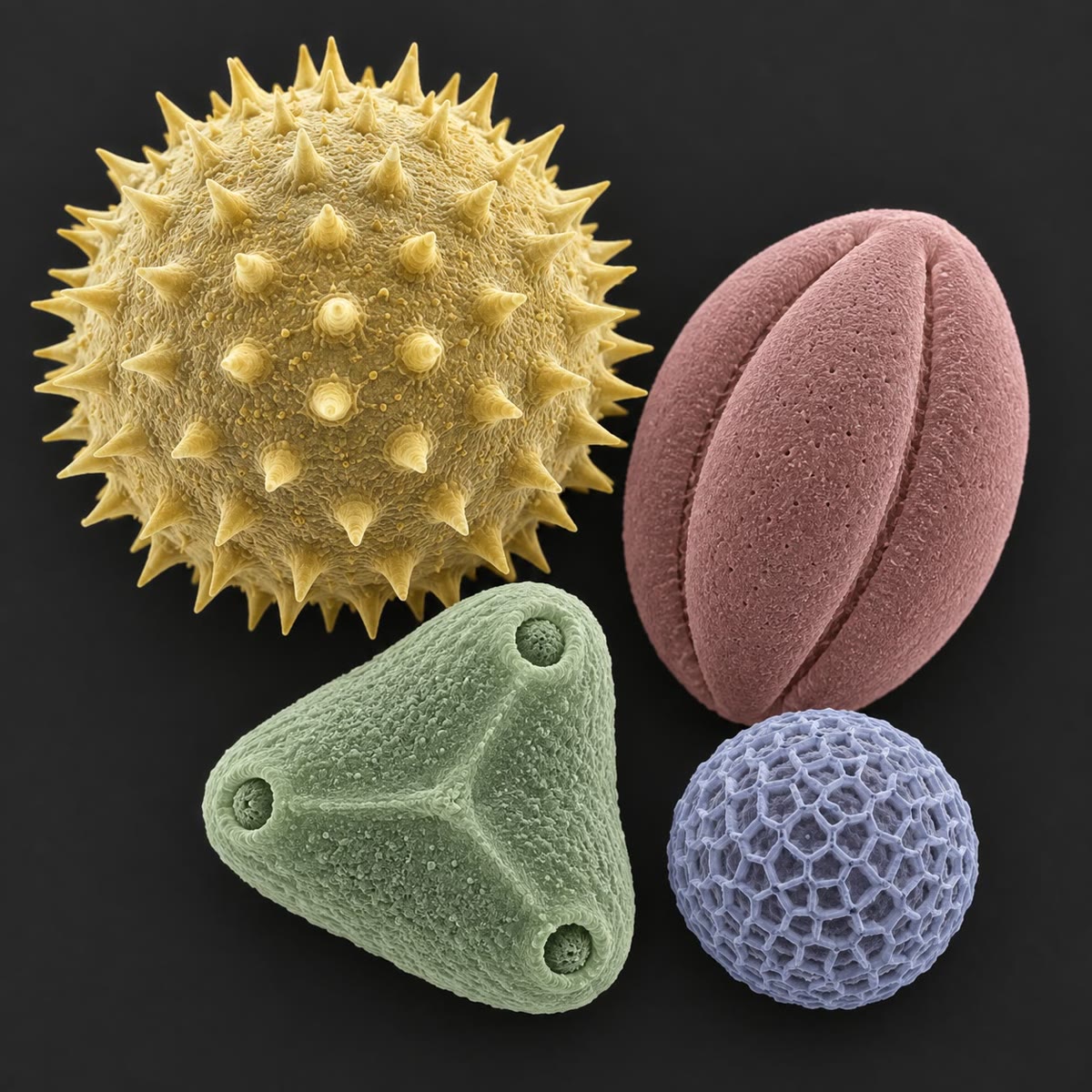
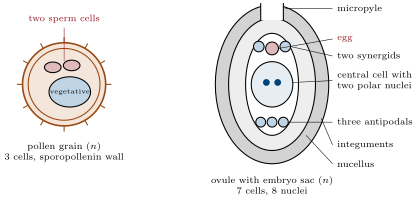
In each pollen sac, diploid mother cells undergo meiosis to give tetrads of microspores. Each microspore divides once, unequally, into a large vegetative cell and a small generative cell enclosed within it; the generative cell divides once more, before or after pollination, into two sperm cells. The mature pollen grain is thus a three-celled haploid organism — the whole male gametophyte — of , sealed in a wall whose outer layer of sporopollenin, the most resistant biological polymer known, is sculpted with spines, pores and furrows characteristic of the species, which is why pollen identifies plants in sediments tens of millions of years old. The grain is shed dehydrated, and survives hours (grasses) to weeks (some trees) until it reaches a stigma.
Proposition 6.3 (The embryo sac: the female gametophyte)
In each ovule, one diploid cell of the nucellus undergoes meiosis; three of the four megaspores degenerate and the fourth grows, by three mitoses without cell division, into an eight-nucleate, seven-celled embryo sac: at the micropylar end the egg flanked by two synergids; at the far end three antipodal cells; in the middle a large central cell containing two polar nuclei. This sac, wrapped in the nucellus and two integuments with a micropyle, is the entire female gametophyte — seven cells where a moss had a plant. The two polar nuclei are genetically identical to the egg, a fact that matters for the endosperm.
6.3 Pollination
Definition 6.4 (Pollination and its agents)
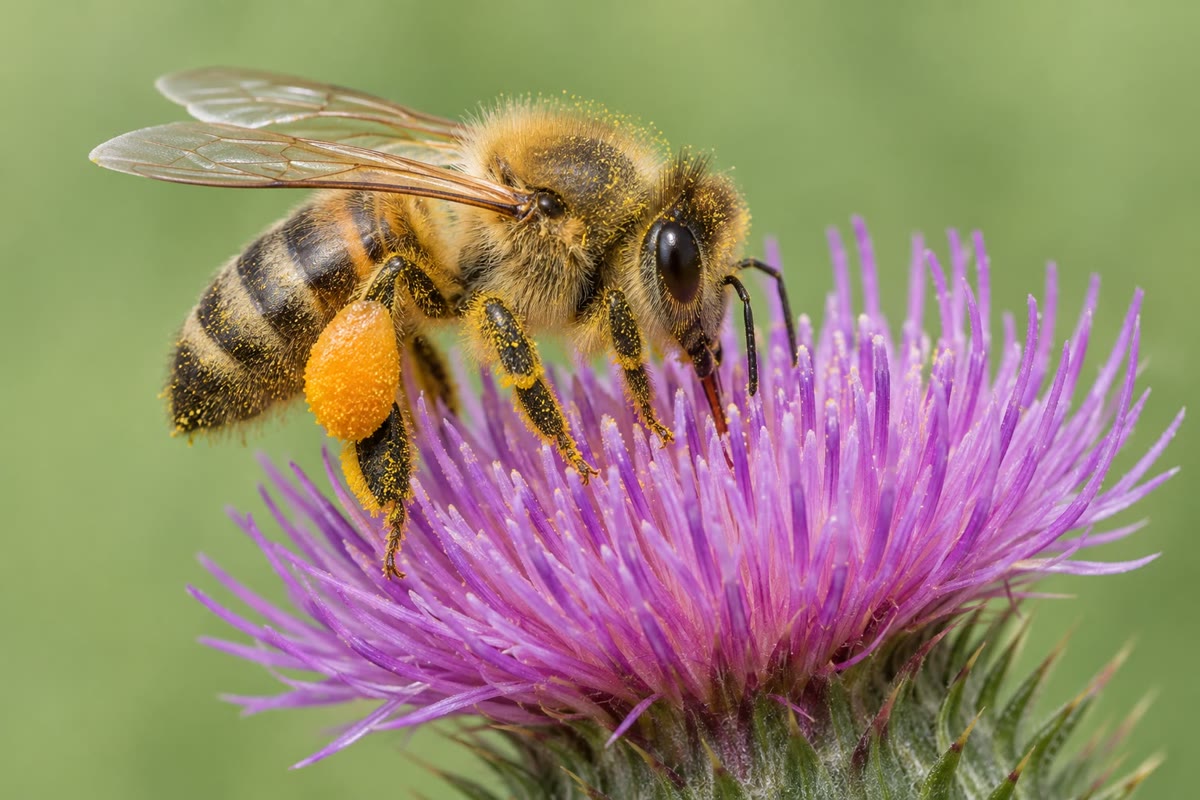
Pollination is the transfer of pollen from an anther to a stigma; self-pollination within one flower or plant, cross-pollination between plants. Wind-pollinated flowers (grasses, oaks, birches, plantains) are small, green, scentless, with large feathery stigmas and enormous quantities of smooth, dry pollen; their pollen-to-ovule ratio runs to a million. Animal-pollinated flowers pay their carrier: nectar (sugar solution from nectaries), pollen itself, oils, scent; and they advertise with colour, shape and smell tuned to the carrier’s senses — ultraviolet nectar guides for bees, which see ultraviolet and not red; red tubular flowers without scent for hummingbirds; white, heavily scented, night-opening flowers with deep tubes for moths; brown, foetid flowers for carrion flies; sturdy, pale, night flowers for bats. Each such set of traits is a pollination syndrome, and the fit between flower and pollinator is the textbook case of coevolution: Darwin predicted from a Madagascan orchid’s nectar spur a moth with a tongue, found forty years later.
Proposition 6.5 (Avoiding self-fertilisation)
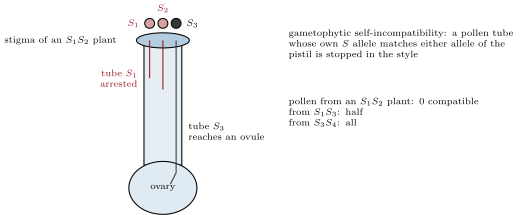
A hermaphrodite flower could fertilise itself, and many do (peas, wheat, tomatoes); but selfing exposes recessive deleterious alleles (inbreeding depression), and most species prevent it. In time: dichogamy, anthers and stigma maturing at different times (protandry in most umbellifers and composites). In space: herkogamy, anthers and stigma held apart, as in the heterostyly of primroses, whose pin flowers (long style, low anthers) and thrum flowers (short style, high anthers) place pollen on different parts of an insect. Biochemically: self-incompatibility, a recognition system in which pollen carrying an allele shared with the pistil is rejected. In gametophytic incompatibility (apples, cherries, petunias, grasses) the pollen’s own haploid allele decides: a pistil stops and tubes in the style, so that pollen from an plant is half compatible and from wholly. In sporophytic incompatibility (cabbages, sunflowers) the diploid genotype of the pollen’s parent decides, on the stigma surface. A rare allele is compatible with almost every partner, so selection keeps dozens of alleles in a population.
Evidence. Darwin (1862, 1877) crossed primroses by hand: pollen from a thrum flower on a pin stigma (a “legitimate” union) set full capsules; pin on pin or thrum on thrum (“illegitimate”) set few seeds or none, though the plants were healthy and the pollen alive. He concluded that the two forms were mutually adapted to cross and protected from selfing, and by counting seeds per capsule in thousands of crosses he measured the cost of self-fertilisation in dozens of species: selfed offspring were shorter, lighter and less fertile, generation after generation. ∎
6.4 Fertilisation
Theorem 6.6 (The pollen tube)
A pollen grain on a compatible stigma rehydrates and grows a pollen tube: the vegetative cell extends by tip growth, laying down new wall at the apex at a rate of , digesting its way through the transmitting tissue of the style and feeding on it. The tube carries the two sperm cells at its tip; it is guided the last distance by peptides secreted by the synergids, enters the ovule through the micropyle, bursts into one synergid, and releases the sperm. A tube crossing a style of length at speed takes : a few hours in a cherry, a full day in maize, whose “silks” are styles long. Pollen viability sets a clock: grass pollen dies in hours, so a stigma must be reached quickly.
Proof. The time is the length divided by the growth rate; for maize, at gives . The tube itself consists almost entirely of wall and a thin film of cytoplasm behind the tip, so that the vegetative cell’s reserves, plus what it absorbs from the style, suffice for a length a thousand times the grain’s diameter. ∎
Proposition 6.7 (Double fertilisation)
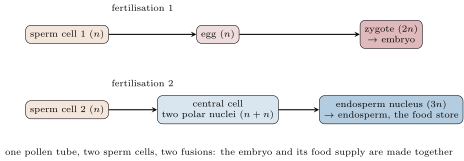
Of the two sperm cells delivered by the tube, one fuses with the egg to form the diploid zygote, from which the embryo grows; the other fuses with the central cell and its two polar nuclei to form a triploid nucleus (: two maternal genomes, one paternal), from which the endosperm grows — a nutritive tissue that fills the seed with starch, oil and protein. Both fertilisations happen within minutes of each other; neither succeeds without the other in most species, so that a plant provisions only those seeds that carry an embryo. The endosperm is the tissue that feeds humanity: the flour of wheat and rice, the meal of maize, the white of a coconut are triploid endosperm. In gymnosperms the seed’s food store is the female gametophyte, built before fertilisation whether or not an embryo follows; the angiosperm’s endosperm is made to order.
Evidence. Nawaschin (1898), following the pollen tube of a lily and a fritillary into the embryo sac under the microscope, saw both sperm nuclei leave the tube, one entering the egg and the other fusing with the polar nuclei; Guignard confirmed it the next year in other species. The triploidy of the endosperm followed from chromosome counts, and its genetic consequences — a kernel’s endosperm showing the pollen parent’s traits (xenia), in the ratio two maternal doses to one paternal — had been noticed by breeders of maize long before. ∎
6.5 Seed and fruit
Definition 6.8 (From ovule to seed, from ovary to fruit)
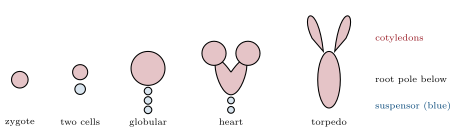
The zygote divides into a suspensor, which pushes the embryo into the endosperm, and an embryo proper that passes through globular, heart and torpedo stages as it lays down the root and shoot poles and one or two cotyledons (seed leaves) — the monocot–dicot distinction. In many dicots (beans, peas) the growing cotyledons absorb the endosperm and become the food store themselves; in cereals and most monocots the endosperm persists and the single cotyledon is a sucking organ. The integuments harden into the seed coat; the seed dehydrates to water, metabolism stops, and it enters dormancy, which ends only when a signal — water, cold, light, fire, the passage through a gut — says the season is right. Meanwhile the ovary wall grows into the fruit, whose form is a dispersal strategy: dry fruits that split (pods, capsules) or do not (grains, nuts, winged samaras), fleshy fruits that are eaten (berries, drupes with a stone, the apple, whose flesh is receptacle); the seed passes through the animal unharmed, its coat scarified, and is deposited with fertiliser kilometres away.
Evidence. The cereal grain shows how germination is controlled. The embryo, on imbibing water, secretes gibberellin into the surrounding endosperm; the outer layer of the endosperm, the aleurone, responds by making and secreting -amylase, which digests the starch into sugars the embryo absorbs. Half-grains without an embryo make no amylase; add gibberellin to them and they do (Paleg, Yomo, 1960); the hormone acts by switching on the amylase gene, one of the first cases in which a plant hormone was traced to a gene. Brewers have used the process for millennia: malting is barley made to germinate and then dried. ∎
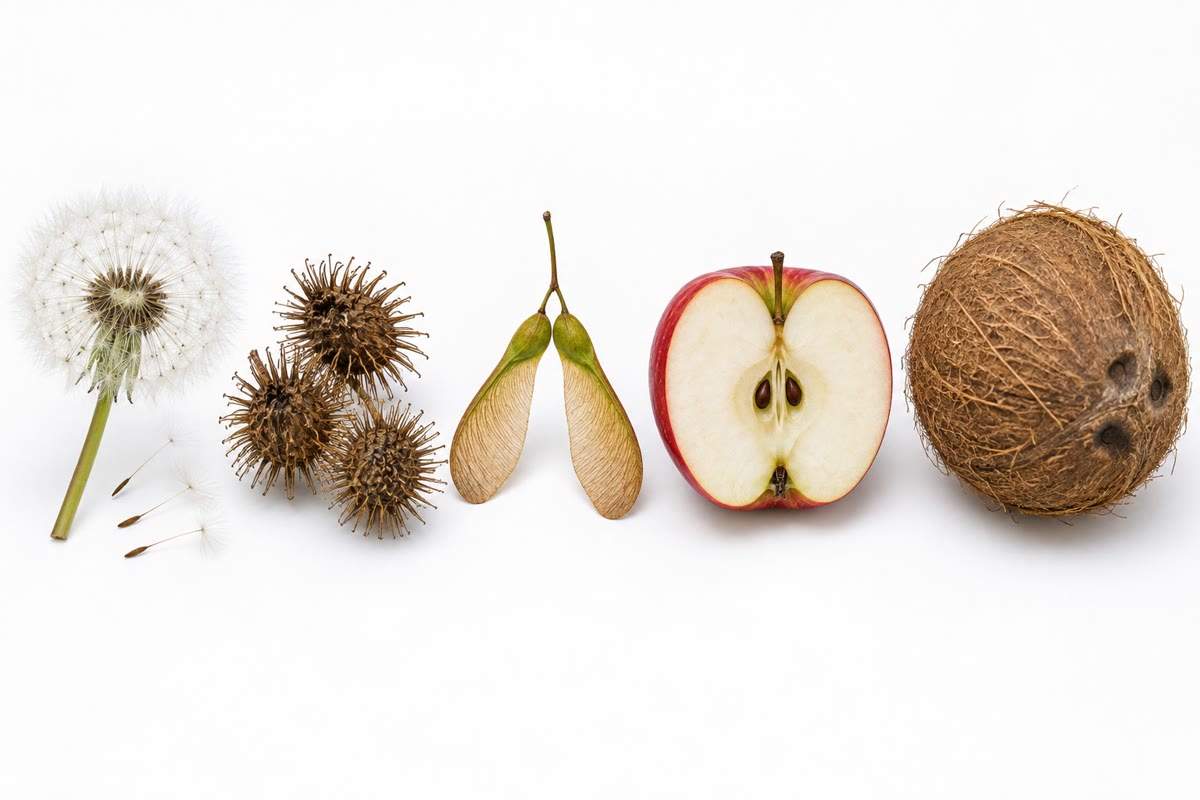
Example 6.9 (Dispersal distances)
A dandelion achene with its parachute descends at ; from in a wind it flies , and in a thermal, hundreds. A maple samara autorotates down at from : . A cherry stone dropped by a bird after a twenty-minute flight at : up to . An oak’s acorns fall at its foot unless a jay carries them, which it does by the thousand, a kilometre and more, and forgets a tenth of them: the oaks that recolonised Europe after the last ice age moved north at hundreds of metres a year, far faster than an acorn rolls, and it was the birds that moved them.
6.6 Exercises
Exercise 6.1 ★
Name the four whorls of a flower and the parts of a stamen and of a carpel. Which parts are diploid sporophyte, which are haploid gametophyte?
Solution
Solution of Exercise 6.1.
Sepals (calyx), petals (corolla), stamens (androecium), carpels (gynoecium). Stamen: filament and anther. Carpel: stigma, style, ovary with ovules. All these are diploid sporophyte; only the pollen grain (inside the anther) and the embryo sac (inside the ovule) are haploid gametophyte.
Exercise 6.2 ★
Give the ploidy of: a microspore, the vegetative cell, a sperm cell, the egg, a polar nucleus, the zygote, the endosperm, the seed coat, the fruit wall.
Solution
Solution of Exercise 6.2.
Microspore ; vegetative cell ; sperm ; egg ; polar nucleus ; zygote ; endosperm ; seed coat (maternal integuments); fruit wall (maternal ovary).
Exercise 6.3 ★
List five traits of a wind-pollinated flower and five of a bee-pollinated one, and give a plant for each.
Solution
Solution of Exercise 6.3.
Wind (grasses, oak, birch, hazel, plantain): small green flowers, no petals or scent or nectar, anthers dangling on long filaments, feathery stigmas, vast amounts of smooth dry pollen, flowering before the leaves. Bee (clover, sage, foxglove, lavender, apple): coloured petals often with ultraviolet guides, landing platform, scent, nectar, sticky sculptured pollen in moderate amounts, flowering in daylight.
Exercise 6.4 ★
What is double fertilisation, and what is made by each of the two fusions? Why can the endosperm be called “made to order”?
Solution
Solution of Exercise 6.4.
The two sperm cells of one pollen tube fuse, one with the egg (zygote, , the embryo) and one with the central cell (endosperm nucleus, , the food store). The endosperm begins to grow only after fertilisation, so the plant provisions only ovules that hold an embryo, unlike the gymnosperm, which builds its food store before.
Exercise 6.5 ★★
A maize silk is long and a pollen tube grows at . How long does fertilisation take after pollination? A tassel sheds pollen from day 0 to day 7 and the plant’s silks emerge from day 5 to day 12, one eighth of them each day; a silk catches pollen only while pollen is shed. What fraction of the silks is pollinated?
Solution
Solution of Exercise 6.5.
. Silks emerging on days 5, 6 and 7 meet pollen; those of days 8 to 12 do not: of the silks are pollinated, and the ear is five-eighths barren.
Exercise 6.6 ★★
Under gametophytic self-incompatibility, what fraction of pollen is compatible in the crosses , , (pistil listed first)? Give the genotypes of the offspring of the second cross.
Solution
Solution of Exercise 6.6.
: 0. : (only pollen grows). : all. Offspring of the second cross: eggs or , sperm : and , half each.
Exercise 6.7 ★★
In a population with equally frequent alleles, what fraction of random pollen is compatible with a given plant? Explain why a new allele arising by mutation spreads, and what this predicts for the number of alleles.
Solution
Solution of Exercise 6.7.
A plant carries 2 of the alleles and rejects pollen bearing either: compatible fraction . A new allele is rejected by no pistil, so its pollen sires more seeds than average and it spreads until it is as common as the rest; the same advantage protects every rare allele from loss. Selection therefore accumulates alleles, and natural populations of self-incompatible species carry dozens.
Exercise 6.8 ★★
A maize plant heterozygous (yellow endosperm dominant) is selfed. Give the endosperm genotypes of its kernels and their proportions, remembering that the two polar nuclei are identical. What fraction of kernels are yellow? What if the plant is pollinated by a plant?
Solution
Solution of Exercise 6.8.
The two polar nuclei are copies of one megaspore, so the central cell is or (half each); the sperm is or (half each): endosperm , , , at each; three quarters yellow. Pollinated by : and , half each — half the kernels yellow.
Exercise 6.9 ★★
Describe the aleurone experiment and explain what it shows about (a) the role of the embryo, (b) the role of gibberellin, (c) the site of amylase synthesis. Why is a half-grain without an embryo the essential control?
Solution
Solution of Exercise 6.9.
Barley grains are cut in half; the embryo-bearing halves digest their starch, the embryo-less halves do not, unless gibberellin is added, when they do. (a) The embryo is the source of the signal, not of the enzyme. (b) Gibberellin is the signal, sufficient by itself. (c) The amylase is made by the aleurone layer of the endosperm, which responds to the hormone. The embryo-less half separates signal from response: without it one could not tell whether the embryo digests the starch itself.
Exercise 6.10 ★★★
Compare the wind and animal strategies in cost: a wind-pollinated plant makes grains per ovule at each; an animal-pollinated plant makes grains per ovule at each plus of nectar sugar per flower of ten ovules. Compute the reproductive cost per ovule in each case (take pollen and sugar at the same energy per gram), and explain why wind pollination nevertheless persists.
Solution
Solution of Exercise 6.10.
Wind: per ovule. Animal: of pollen plus of sugar per ovule — about seven hundred times cheaper. Wind pollination needs no partner: it works in early spring before insects fly, in cold, windy and open places, at night and in rain, in dense stands of one species, and it cannot be cheated by nectar thieves or abandoned by a pollinator that goes extinct.
Exercise 6.11 ★★★
Explain, with the numbers of Example 6.9, why a fleshy fruit is worth its cost to a tree even though the animal digests the flesh and drops most seeds where they cannot grow.
Solution
Solution of Exercise 6.11.
Seeds falling at the foot of the parent land in its shade, among its roots, and where its specific seed predators and pathogens concentrate; almost all die. A bird carries a seed kilometres ( in twenty minutes) and drops it, with fertiliser, in a hedge or a clearing; even if only one seed in a hundred lands in a good site, that is more than all the seeds under the tree, and the population spreads at the speed of birds, not of falling fruit. The flesh is the price of the ticket.
Exercise 6.12 ★★★
“The closed carpel is the reason flowering plants dominate the land.” Discuss: what the enclosure of the ovule makes possible (choice of pollen, incompatibility, the fruit) and what it costs.
Solution
Solution of Exercise 6.12.
Enclosure makes the pollen grow through maternal tissue, which allows the pistil to test it (self-incompatibility, rejection of foreign species), to let many tubes compete so the fastest sires the seed, to protect ovules from drying and from herbivores, and to turn the ovary into a fruit that recruits animals for dispersal; double fertilisation then provisions only fertilised ovules. The costs: a pollen grain must reach a stigma rather than the ovule itself, so a style, a tube and its guidance are needed, and the fruit is a heavy investment. The balance favoured angiosperms so strongly that they went from nothing to nine tenths of plant species in a hundred million years.
6.7 Problem: An Orchard and a Field
Problem 6.1
Weekend problem — an apple orchard’s pollination planned around self-incompatibility, and a maize field’s fertilisation and yield computed from the pollen it makes, ending on the orchard’s fruit set and the field’s kernel count
Apple is gametophytically self-incompatible. An orchard has three varieties: A (), B (), C (). A flower has five carpels with two ovules each, and a fruit that sets fewer than five seeds is dropped by the tree. A bee visit deposits pollen grains on a stigma; each compatible grain has probability of fertilising an ovule not yet taken. A tree bears flowers and needs fruits for a full crop. Maize: a tassel sheds grains over days; the field holds plants per square metre; a plant bears one ear of silks; a silk presents to falling pollen; pollen settles at ; a kernel holds of endosperm.
Part I — Compatibility.
- For pollen of each variety on a pistil of A, give the compatible fraction .
- Same for pistils of B and of C.
- A bee arriving from a tree of B deposits 100 grains on an A stigma: how many are compatible, and how many ovules are expected to be fertilised (ignore saturation)?
- Same for a bee from C, and from another A.
- Which fruits are kept? What is the risk of planting an orchard of variety A alone?
- A block of A trees is surrounded by C trees; half the bee visits to A come from C. If each flower receives one visit, what fraction of A flowers set fruit, and how many fruits per tree? Is the crop full?
- Why do orchards interplant a crab-apple that flowers for weeks, and why must its alleles be checked?
Part II — Pollen over the maize field.
- Compute the pollen released per square metre of field per second, on average over the seven days.
- At steady state the flux of settling pollen equals the release rate. Compute the pollen concentration in the air (grains per cubic metre).
- Compute the number of grains landing on one silk per second, and the mean waiting time for the first grain.
- How many grains does a silk receive in a day? Why is only the first useful?
- A silk of is pollinated; the tube grows at . When is the ovule fertilised?
- A drought delays silk emergence by five days while the tassel sheds on schedule. Using the seven-day shedding period, estimate the fraction of the pollen season the silks catch, and the consequence for yield.
Part III — Double fertilisation and the kernel. The field is a variety with yellow endosperm (, dominant) next to a white () field; the wind blows from the white field.
- Give the genotypes of the embryo and the endosperm of a kernel of a plant fertilised by pollen.
- Is the kernel yellow or white? Explain the term xenia.
- A plant is pollinated by pollen: give the endosperm genotypes and their frequencies.
- The endosperm contains two maternal and one paternal genome. A gene with a dosage effect gives, per copy, 10 units of pigment: what pigment do the kernels , and (two paternal doses hypothetically) carry? Which of these can actually exist?
- Explain why the endosperm, not the embryo, is what we eat, and what fraction of the kernel’s mass it represents if the embryo weighs .
- Why is the endosperm’s “made to order” provisioning an advantage over the gymnosperm’s?
Part IV — Yield.
- If of silks are fertilised, compute the kernels per ear, per plant and per square metre, and the endosperm mass per square metre.
- Convert to tonnes per hectare.
- The crop fixes of carbon per square metre per season, of which half ends in the harvested grain. Check the consistency with the mass of question 20 (endosperm is carbon).
- How many pollen grains did the field shed per kernel harvested?
- Explain why a lone maize plant in a garden sets a poorly filled ear.
- State the result: the fruit set of the A block and the field’s yield in kernels per square metre and tonnes per hectare.
Solution
Solution of Problem 6.1.
1. On A (): pollen A ; B (, ) ; C (, ) . 2. On B (): A , B 0, C . On C (): A 1, B , C 0. 3. 50 compatible grains; ovules. 4. From C: 100 compatible, , i.e. all ten ovules; from A: none. 5. Fruits from C visits (10 seeds) are kept; from B (5 seeds) just kept; from A dropped. An orchard of A alone bears nothing. 6. Half the flowers set fruit (those visited from C): 2500 fruits per tree, ten times the 250 needed — a full crop, and the tree will drop the surplus. 7. It sheds compatible pollen over the whole flowering season of every variety; but if it shares both alleles with a variety it pollinates nothing on it. 8. grains per square metre per second. 9. grains per cubic metre. 10. per second: one grain every . 11. grains a day; the first tube to reach the ovule fertilises it, and the ovule is then closed to the rest. 12. after pollination. 13. Pollen on days 0–7, silks from day 5: only days 5, 6 and 7 overlap — of the silks, and those emerging after day 7 get nothing; the ear is largely barren. Drought at silking is the classic cause of a failed maize crop. 14. Embryo ; endosperm . 15. Yellow, since is dominant: the pollen parent’s trait shows in the seed on the mother plant — xenia. 16. Central cell or : endosperm (half) and (half). 17. : 20 units; : 10 units; a with the from the father is the same genotype , 10 units. Two paternal doses cannot exist: one sperm fertilises the central cell, and the endosperm is always two maternal genomes to one paternal. 18. It is the starch store; of the kernel. 19. The store is built only after fertilisation, so no resources go into ovules that carry no embryo; the gymnosperm’s gametophyte is built beforehand and wasted if pollination fails. 20. kernels per ear and per plant; per square metre; of endosperm per square metre. 21. . 22. Grain carbon ; endosperm carbon : consistent (the small remainder is embryo and coat). 23. grains per kernel. 24. Its own pollen cloud is thin and blown away, and its tassel sheds mostly before its own silks emerge, so many silks are never pollinated and the ear has gaps. 25. A block: half the flowers set fruit, 2500 per tree, a full crop. Field: 4320 kernels per square metre, .