University Biology — Year 3 · Bachelor Year 3
26Behavioural Ecology
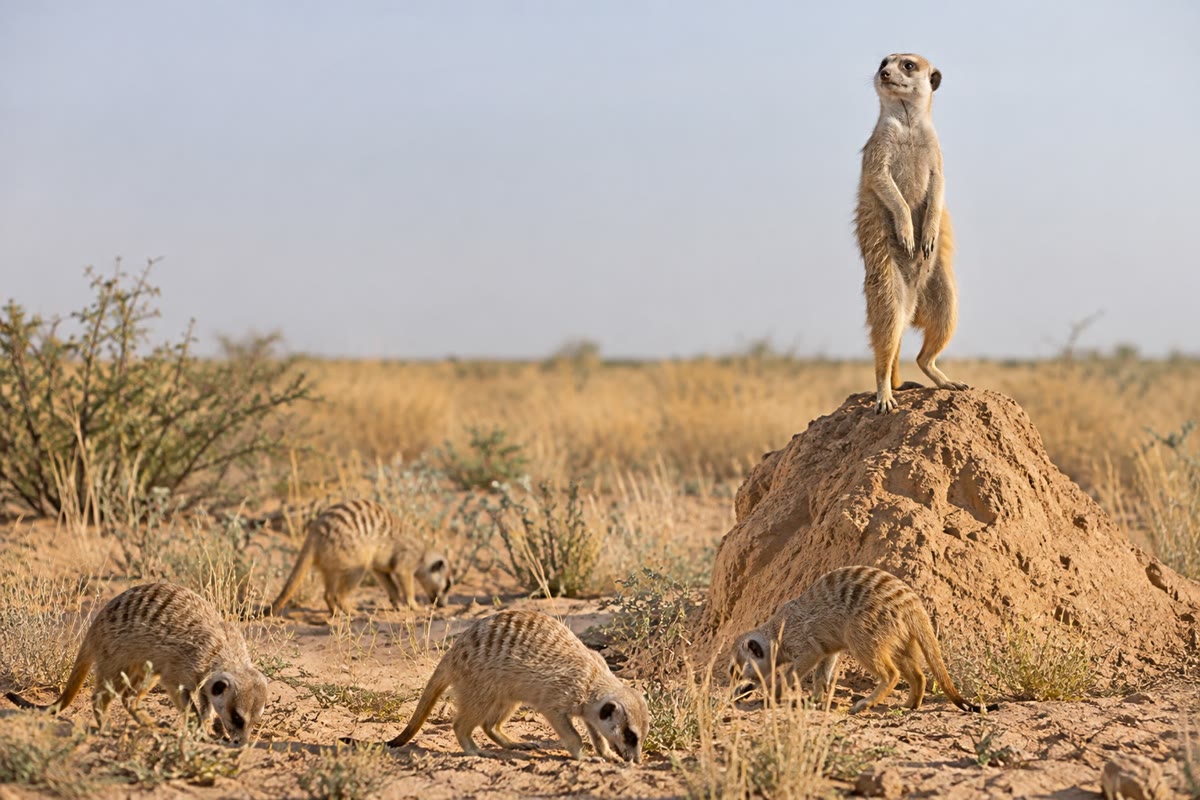
A meerkat stands on a termite mound while the rest of its group digs for food, and when a hawk appears it barks and the others bolt for their burrows. The sentinel has spent an hour not eating and has made itself the most conspicuous animal in the desert. Why? A peacock drags a tail that costs it a fifth of its energy budget and slows its escape from tigers. A honeybee returning from a field dances on a vertical comb, and the angle of her dance to the vertical is the angle of the food to the sun. A great tit hunting caterpillars in a patch of foliage leaves it while there are caterpillars still to be found. None of these animals has read this chapter, yet each behaves as if it had solved an optimisation, a game, or a problem in kinship accounting. Behavioural ecology is the study of behaviour as a set of evolved solutions: what a behaviour is for, in terms of the genes it propagates, and what its costs and benefits must be for natural selection to have produced it. Its tools are the ones an economist uses — optimisation, game theory, the accounting of relatedness — and its test is the field.
26.1 Four questions and the machinery of instinct
Definition 26.1 (Tinbergen’s questions)
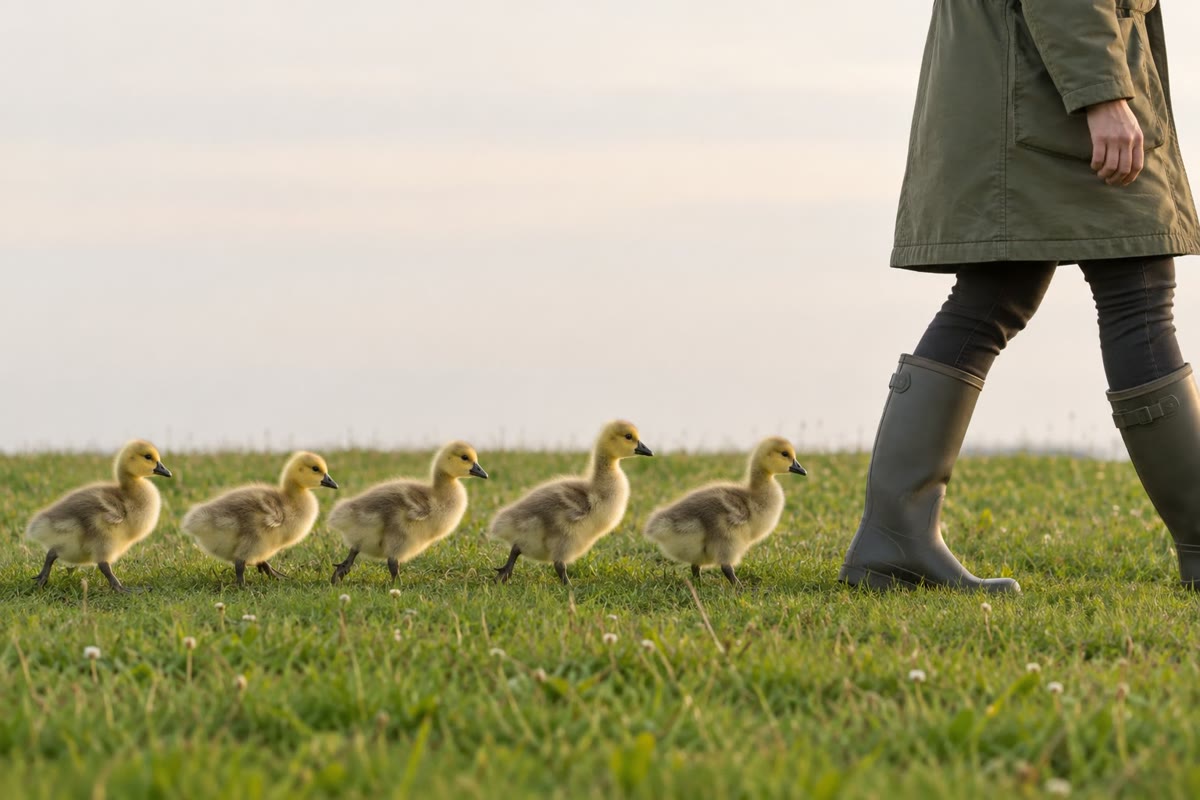
Tinbergen (1963) said a complete account of any behaviour must answer four questions: its mechanism (what stimuli and neural machinery produce it), its development (how it arises in the individual, from genes and experience), its function (how it contributes to survival and reproduction) and its evolutionary history (how it arose from ancestral behaviour). The ethologists who framed them had established the first two. Many behaviours are fixed action patterns: stereotyped sequences released by a simple sign stimulus and run to completion once begun — a greylag goose rolls a displaced egg back to the nest with its bill, and completes the motion even if the egg is removed halfway; a herring gull chick pecks at a red spot on any bill-shaped object, and pecks more at a stick with three red bands than at a real gull’s head; a male stickleback attacks anything red on its underside, including a passing mail van seen through the window. Others are learned within a window: imprinting, by which a gosling in its first day follows and thereafter treats as its parent whatever moves — a goose, Lorenz, a cardboard box — is fast, irreversible and confined to a critical period; song learning in birds, the Year 2 volume’s example, is the same shape. The dichotomy of innate and learned is false: a behaviour has a genetic programme that specifies what is to be learned, when, and from whom, and the programme is what evolves.
Evidence. Tinbergen’s field experiments set the method. Digger wasps (Philanthus) return to a nest hidden in sand; he moved a ring of pine cones he had placed around one entrance while the wasp was away, and she searched the centre of the displaced ring — she had learned the landmarks. Black-headed gulls remove eggshells from the nest after hatching; he laid out eggs beside painted shells, natural shells and other objects, and counted which the crows took: the white inner surface of a shell drew predators, and the removal that had looked like tidiness was camouflage. The gull-chick experiments quantified a sign stimulus by offering cardboard heads that varied one feature at a time. Lorenz’s imprinted geese followed him for life; ducks imprinted in the first day on a moving box and could not afterwards be made to follow a duck. ∎
26.2 Deciding: optimal foraging
Theorem 26.2 (The marginal value theorem)
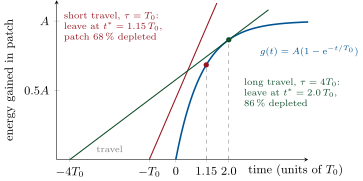
A forager visits patches of food separated by travel time . In a patch it gains energy after time , with increasing and concave (the patch depletes). If it leaves every patch after time , its long-run rate of gain is , and the residence time that maximises it satisfies
leave a patch when the instantaneous rate of gain in it has fallen to the average rate over the whole habitat, travel included (Charnov, 1976). Consequences: the longer the travel time, the longer the stay and the more thoroughly each patch is depleted; in a richer habitat (higher ) every patch is left sooner and less depleted; and all patches are left at the same marginal rate whatever their quality, so that a poor patch is left almost at once and a rich one only when it has been worked down to the habitat’s average. For the condition becomes , solved numerically: with , ; with , .
Proof. ; gives . Geometrically: plot against with the origin at ; is the slope of the line from to , maximal where that line is tangent to the curve — which is the condition. A larger moves the origin left and the tangent point right; a richer habitat steepens the tangent and moves it left. For the exponential, and ; equating and rearranging gives the stated equation, and substituting with : left , right . ∎
Evidence. Cowie (1977) let great tits hunt mealworms hidden in sawdust-filled cups in an aviary, with the travel time between cups manipulated by fitting lids that took longer or shorter to remove; the birds stayed longer in each cup when travel was slower, tracking the theorem’s prediction, and overshot it slightly in the direction that accounting for the energetic cost of travel explains. Starlings carrying leatherjackets to their nestlings (Kacelnik, 1984) took larger loads from feeders placed farther away, again as the rate-maximising solution to a loading curve requires. Neither test proves that birds compute tangents; both show that selection has produced rules of thumb whose outcome is close to the optimum. ∎
26.3 Contests: game theory
Proposition 26.3 (Hawk–Dove and the evolutionarily stable strategy)
When the best behaviour depends on what others do, there is no optimum, only a game. Two animals contest a resource worth ; a Hawk fights until injured (cost ) or victorious, a Dove displays and retreats if attacked. The average payoffs are
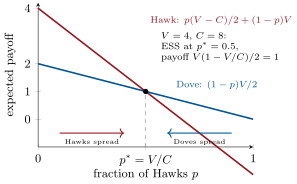
An evolutionarily stable strategy (Maynard Smith and Price, 1973) is one which, once common, cannot be invaded by any rare alternative. If , Hawk is the ESS: fighting pays even against fighters. If , neither pure strategy is stable — a population of Doves is invaded by Hawks, who win every contest, and a population of Hawks by Doves, who avoid the injuries — and the ESS is to play Hawk with probability
or, equivalently, a population in which that fraction are Hawks. At the ESS the two strategies do equally well, each averaging , less than the a population of Doves would have shared: the contest costs everyone, and no one can do better alone. Selection here is frequency-dependent: a strategy’s fitness falls as it becomes common, which is why animal contests are mostly display and occasionally war, and why the mix persists.
Proof. Let a fraction play Hawk. A Hawk’s expected payoff is ; a Dove’s is . , positive for and negative above: Hawks spread when rare and are culled when common, and the frequency settles where , at . That it is stable follows from the sign change: a perturbation of above favours Doves and is corrected, below it favours Hawks. If the difference is positive for all and Hawk fixes. The common payoff at : . ∎
Example 26.4 (Games in the field)
Male speckled wood butterflies contest sunspots on the forest floor: the resident almost always wins a brief spiral flight, and when two males are tricked into each believing themselves resident the fight lasts ten times longer — a convention (“resident wins”) that settles contests cheaply, itself an ESS when fighting is costly and the resource is not worth much. Male dung flies wait on cowpats for females and leave when the rate of arrivals falls to what a fresh pat would offer — the marginal value theorem again, in a game where the patch’s value depends on how many rivals sit on it. Fig wasps, side-blotched lizards with three male types that beat one another cyclically like rock–paper–scissors, and the “sneaker” males of salmon and bluegill sunfish, which fertilise eggs by darting past the territorial males they cannot fight, are all mixtures held at frequencies where the alternatives pay equally. The war of attrition — two animals displaying until one gives up, the ESS being to persist for a random time drawn from an exponential distribution — describes the staring contests of many species, and predicts, correctly, that the loser’s persistence gives away nothing about how long it would have gone on.
26.4 Kin: Hamilton’s rule
Theorem 26.5 (Hamilton’s rule)
An allele causing its bearer to perform an act that costs it offspring and gives a relative extra offspring spreads if
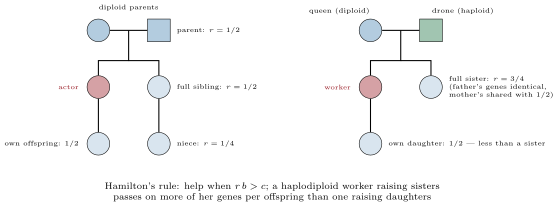
where is the coefficient of relatedness: the probability that a gene in the recipient is a copy, by descent, of the same gene in the actor — for parent and offspring or full siblings, for half-siblings, grandchildren, nieces and nephews, for first cousins. The quantity the allele maximises is its bearer’s inclusive fitness: its own reproduction plus its effects on the reproduction of relatives, each weighted by . Altruism — behaviour that lowers the actor’s reproduction and raises another’s — thus evolves toward kin, in proportion to relatedness, and the rule predicts where it should be found: in the alarm calls of female ground squirrels, who live among their sisters and daughters, and not of the males, who disperse; in the sentinel duty of meerkats, whose group is a family; in the helpers at the nest of birds that assist their parents to raise siblings when territories are full. In the haplodiploid Hymenoptera — males from unfertilised eggs with one set of chromosomes, females with two — full sisters share three quarters of their genes (), more than a mother shares with her daughters (), which Hamilton proposed as a reason the sterile worker castes of ants, bees and wasps arose there eleven times and elsewhere almost never.
Proof. Consider the allele’s copies. When the actor performs the act, its own copies lose in expected transmission; the recipient carries the allele with probability above the population average, so the recipient’s gain increases the allele’s transmission by on average. The allele increases in frequency when (Hamilton, 1964; the general derivation, from the covariance between an individual’s genotype and its fitness, is the Price equation, admitted here). Relatedness: a parent transmits each gene to an offspring with probability ; two full siblings each received a given gene from the same parent with probability , and it is the same copy with probability , and there are two parents: . Haplodiploid sisters: from their haploid father they receive identical genes (probability ); from their mother, identical copies with probability ; averaging over the two parents, . ∎
Evidence. Sherman (1977) watched Belding’s ground squirrels for three summers and recorded who gave alarm calls at approaching predators: females with kin nearby called far more often than females without, and than males, who had dispersed from their birthplace and had no relatives within earshot — the caller drew the predator’s attention, and paid for it, only when there were relatives to warn. Emlen’s white-fronted bee-eaters help at the nest in proportion to relatedness, choosing among available nests those of the closest kin. Clutton-Brock’s long-term study of meerkats found sentinels to be the well-fed individuals who had least to lose, and that the group’s survival — and so the sentinel’s relatives’ — rose with sentinel effort; the cost, though, proved smaller than the story supposed, since a sentinel on a mound is often the first to reach a burrow. ∎
26.5 Mates and messages
Definition 26.6 (Sexual selection)
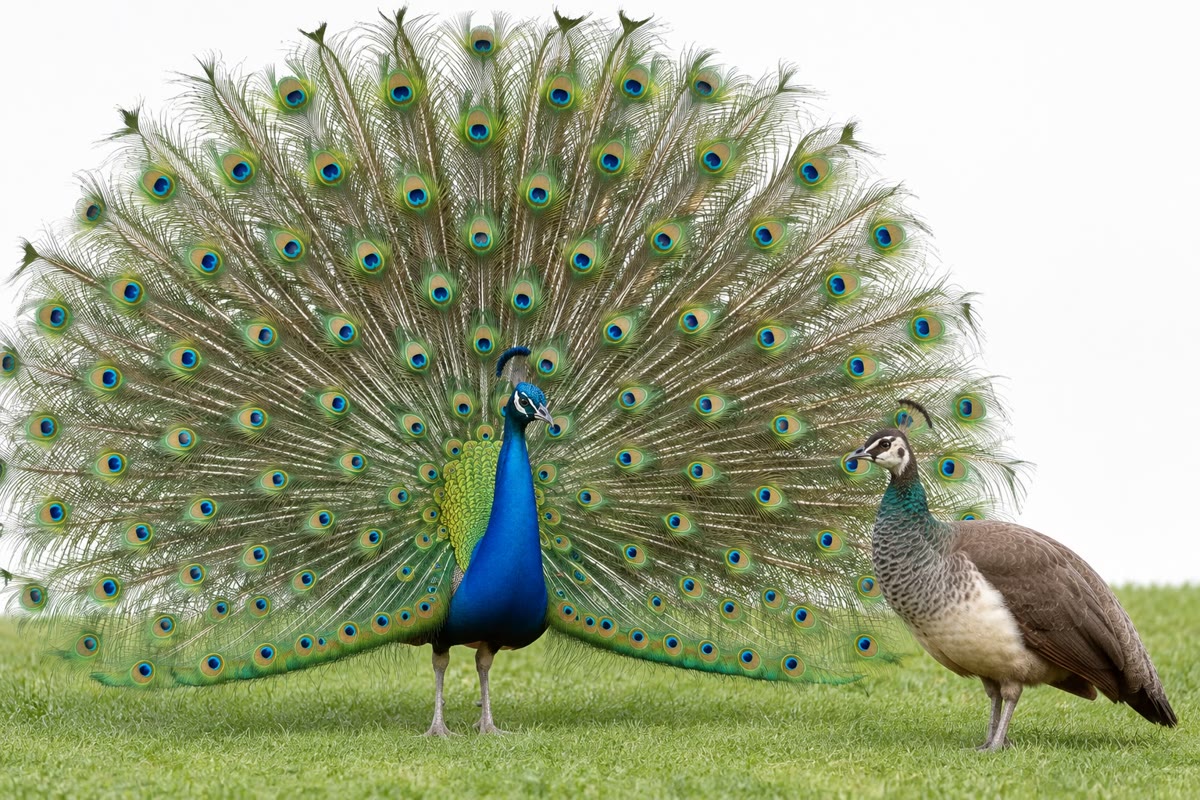
Darwin’s second mechanism: selection on traits that win mates rather than survival. Its root is anisogamy — a female’s reproduction is limited by the eggs she can make and provision, a male’s by the females he can fertilise — so that in most species a male’s fitness rises steeply with his number of matings and a female’s hardly at all (the Bateman gradient); males then compete for females and females choose among males. Competition gives horns, antlers, tusks, large size and the contests of the previous section. Choice gives ornaments, and three accounts of why females prefer them. Fisher’s runaway: a preference for a slightly longer tail and the longer tail spread together, each making the other advantageous, until the tail’s cost in survival balances its gain in matings. Zahavi’s handicap: an ornament that only a healthy male can afford to grow is an honest signal of his condition, precisely because it is costly — a peacock with a full train has, demonstrably, fewer parasites. Good genes and direct benefits: the female gains, through her offspring’s inheritance or through the territory and food the male provides. The two sexes’ interests differ, and sexual conflict — over mating frequency, over who cares for the young, over the fate of a previous mate’s sperm — is an arms race run within a species: the seminal fluid of male fruit flies shortens the female’s life and raises her egg-laying, and females evolve resistance.
Evidence. Andersson (1982) cut and glued the tail feathers of male long-tailed widowbirds in Kenya: males with tails lengthened to twice their natural length attracted four times as many new nests to their territories as males with shortened tails, while controls whose tails were cut and re-glued unchanged were unaffected — female preference for a longer tail than any male grows, the signature of a preference selected beyond the trait. Petrie (1994) found that peahens mated with the males whose trains carried the most eyespots, and that those males’ chicks survived better in the woods where they were released — a good-genes benefit measured. Bateman (1948) counted matings and offspring of fruit flies carrying marker mutations and found the gradient that bears his name: male reproductive success rose linearly with matings, female success plateaued after one. ∎
Proposition 26.7 (Honest signals)
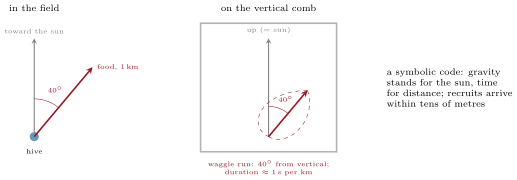
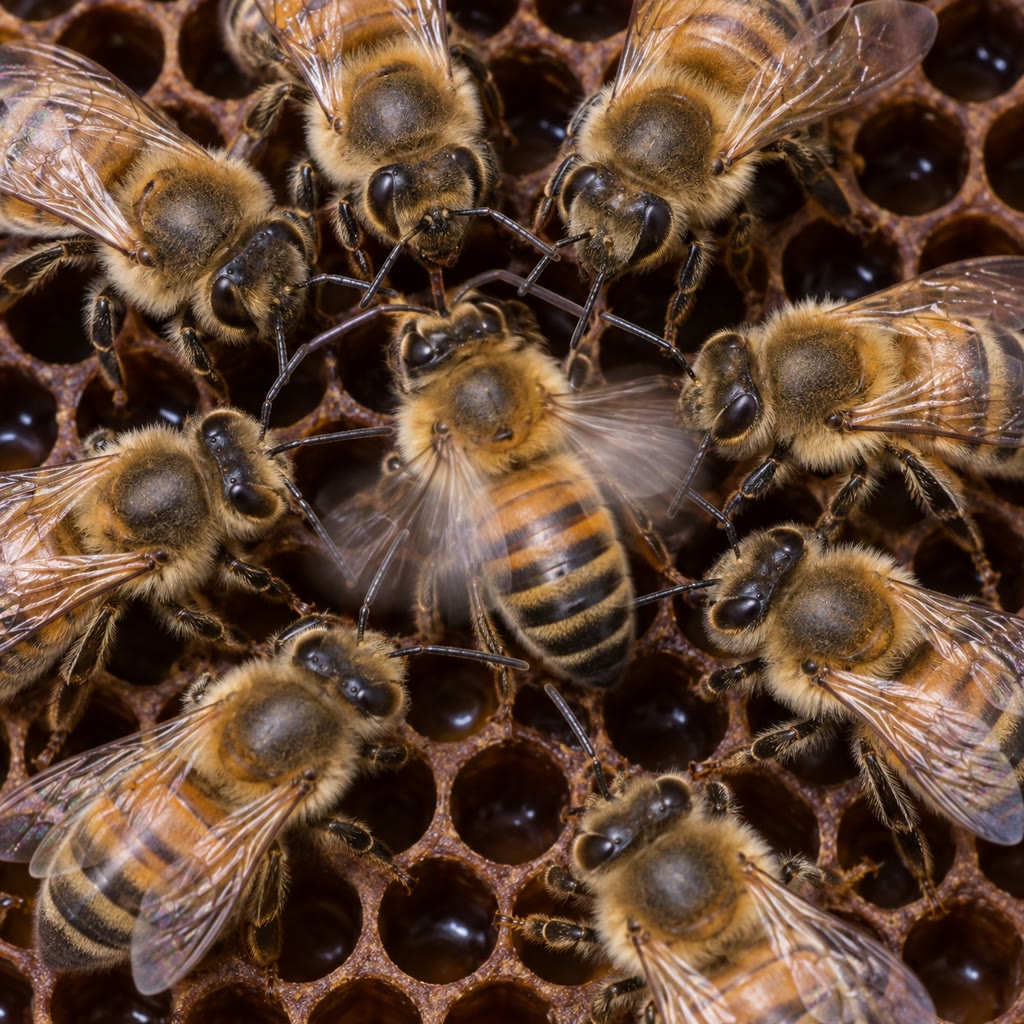
A signal is an act that changes a receiver’s behaviour and evolved to do so; it is stable only if it pays both parties, on average, to send and to respond. Where the two have common interests the signal can be cheap and precise: a forager honeybee’s waggle dance (von Frisch, 1940s) encodes the direction of a food source as the angle of the waggle run to the vertical — the angle of the source to the sun — and its distance as the run’s duration, about a second per kilometre, and recruits fly to within a few tens of metres of the target; vervet monkeys give distinct alarm calls for leopards, eagles and snakes, and listeners respond appropriately to each call played from a hidden speaker — referential signals. Where interests conflict, a signal must be costly or unfakeable to remain honest — the roar of a red deer stag, whose rate only a fit stag can sustain; the size of a toad’s croak, set by its body; the ornaments of the last paragraph — or it is exploited: fireflies of one genus mimic the females’ flashes of another to eat the males that come, and cuckoo chicks’ begging outbids the host’s own. Signalling theory thus predicts the form of a signal from the relation between the parties: cheap and informative among kin and mates whose interests coincide, expensive and ritualised between rivals, and an arms race between predator and prey.
Proof. Admitted at this level. ∎
Remark 26.8 (Why animals seem to calculate)
The great tit does not differentiate , the meerkat does not compute , and the peahen has never heard of a handicap. Each carries rules — leave when captures slow, call when the group is family, prefer the brightest — that selection has shaped because animals following them left more descendants; the mathematics is ours, a way of asking what the rules must achieve for that to be so, and of predicting behaviour in situations the animals have never met. When the predictions fail — the tit stays too long, the sentinel’s cost is smaller than supposed — the failure is informative: a currency was wrong, a constraint was missed, a relative was miscounted. The subject is a decade-by-decade conversation between a field notebook and a line of algebra, and the four questions Tinbergen posed remain the frame for both.
26.6 Exercises
Exercise 26.1 ★
State Tinbergen’s four questions and answer each, in a sentence, for the waggle dance.
Solution
Solution of Exercise 26.1.
Mechanism: the dancer transposes the angle between food and sun, measured on the flight, onto the angle to gravity on the comb, and encodes distance from the optic flow of the journey as the run’s duration. Development: largely innate — bees raised without seeing dances dance correctly, with small learned adjustments. Function: it recruits nestmates to a profitable source, raising the colony’s intake. History: derived from ritualised intention movements of departing for the food; dwarf honeybees still dance on a horizontal surface pointing directly at the source, the ancestral form.
Exercise 26.2 ★
What is a fixed action pattern and a sign stimulus? Give two examples and explain what the “supernormal” stick with three red bands showed.
Solution
Solution of Exercise 26.2.
A fixed action pattern is a stereotyped sequence released by a simple cue, the sign stimulus, and completed once begun: the goose’s egg rolling, released by an egg-shaped object; the gull chick’s pecking, released by a red spot on a bill-like shape. The stick with three red bands, pecked at more than a real head, showed that the releasing mechanism is a filter tuned to a feature — red contrast, elongation — not a recognition of the parent, and that exaggerating the feature exaggerates the response.
Exercise 26.3 ★
In words, what does the marginal value theorem say, and what does it predict about patch use when travel time doubles?
Solution
Solution of Exercise 26.3.
Leave a patch when the rate of gain in it has fallen to the average rate for the habitat as a whole, travel included. Doubling the travel time lowers that average, so the forager stays longer in every patch, depletes each more thoroughly, and ends with a lower overall rate.
Exercise 26.4 ★
Define an ESS. Why is a population of pure Doves not one, and why does the Hawk–Dove mixture cost everyone?
Solution
Solution of Exercise 26.4.
An ESS is a strategy that, once nearly everyone plays it, no rare alternative can outscore. All-Dove is not one: a lone Hawk wins every contest and earns against the Doves’ . In the mixture each strategy earns , less than the all-Dove would give, because a fraction of contests are fights that injure; no individual can improve on it alone, so everyone is stuck with the loss.
Exercise 26.5 ★★
Hawk–Dove with , : compute , the payoff to each strategy at the ESS, and the payoff a population of all Doves would have. Repeat for , .
Solution
Solution of Exercise 26.5.
, : ; payoff to each, against for all-Dove. : Hawk is the pure ESS, payoff , against for all-Dove — the contest destroys five sixths of the value.
Exercise 26.6 ★★
A gain function with . Find for and minutes (use the chapter’s values), the fraction of each patch consumed, and the long-run rate as a fraction of per minute.
Solution
Solution of Exercise 26.6.
: , fraction , per minute. : (more precisely ), fraction , per minute.
Exercise 26.7 ★★
Compute between: half-siblings; grandparent and grandchild; first cousins; a haplodiploid worker and her brother; a haplodiploid queen and her son. Explain the last two.
Solution
Solution of Exercise 26.7.
Half-siblings ; grandparent–grandchild ; first cousins . A haplodiploid worker and her brother: he is haploid and has only their mother’s genes; of the worker’s genes, half came from the mother and half of those are the copies he received, so from her point of view (from his it is : relatedness is not symmetric when ploidy differs). Queen to son: all his genes are hers, but only half of hers are in him: from her side, from his.
Exercise 26.8 ★★
An alarm call costs the caller a chance of death and saves each of nearby relatives from a chance. For which does Hamilton’s rule favour calling if the relatives are full siblings? Nieces? Unrelated?
Solution
Solution of Exercise 26.8.
with , : . Full siblings, : . Nieces, : . Unrelated: never — which is why dispersing males do not call.
Exercise 26.9 ★★
A widowbird’s tail is ; lengthened to it attracts twice the nests, shortened to half. If survival falls by for each added, which tail maximises the product of matings and survival, and why might the natural tail be shorter than that?
Solution
Solution of Exercise 26.9.
Matings double per , survival falls a fifth: : ; : ; : ; : ; : ; : . On these terms the product keeps rising far beyond the natural , so the model is missing costs: the survival penalty of a long tail in flight is steeper than linear, the female response saturates, growing the feathers costs energy, and Andersson’s doubling of nests was measured over one season, not a lifetime. The natural tail is where the real costs bite.
Exercise 26.10 ★★★
Add a third strategy, Retaliator, which displays like a Dove but fights back if attacked. Write its payoffs against Hawk, Dove and itself (against Hawk it fights: ; against Dove and Retaliator it shares: ). Show that a population of Retaliators cannot be invaded by Hawks when , and discuss whether Doves can drift in.
Solution
Solution of Exercise 26.10.
Retaliator: against Hawk , against Dove , against Retaliator . In an all-Retaliator population a rare Hawk meets Retaliators, who fight back, and earns : it cannot invade when . A rare Dove earns , exactly the Retaliators’ payoff, so Doves are neutral and can drift in; once common, they let Hawks in (a Hawk earns against a Dove), and the three-strategy game has no simple ESS — a first example of how adding an option can unsettle a stable mixture.
Exercise 26.11 ★★★
In a war of attrition, each contestant persists for a time drawn from a distribution; the ESS is exponential with mean (cost per unit time). Explain why a fixed persistence time cannot be an ESS, and why an exponential distribution makes the expected future persistence of a still-displaying opponent independent of how long it has already displayed.
Solution
Solution of Exercise 26.11.
If everyone persisted exactly , a mutant persisting would win every contest for a negligible extra cost, and a population of such mutants would be beaten by , and so on: no fixed time is stable, so the ESS must be a random one. With an exponential distribution the probability of persisting a further , given persistence so far of , is whatever is — the memoryless property — so an opponent still displaying gives away nothing about how much longer it will go on, and no strategy can exploit the elapsed time.
Exercise 26.12 ★★★
Hamilton’s argument for haplodiploidy predicts workers should prefer to raise sisters () over brothers (), while the queen values sons and daughters equally. Predict the sex ratio of the reproductives a colony should produce if the workers control it, and if the queen does; say what Trivers and Hare found, and what a queen who mates with several males does to the argument.
Solution
Solution of Exercise 26.12.
Workers value a sister at and a brother at , so under worker control the colony should invest three times as much in females as in males, a ratio by investment; the queen, equally related to both, prefers . Trivers and Hare (1976) found investment ratios near in ants with a single, singly mated queen: the workers win. Multiple mating lowers a worker’s average relatedness to her sisters toward to and pushes the workers’ optimum toward ; colonies of species with many-mated queens do invest more evenly, as the argument predicts.
26.7 Problem: The Sentinel’s Arithmetic
Problem 26.1
Weekend problem — a day in a meerkat group done as behavioural ecology: the patch times of the marginal value theorem, the contests of the Hawk–Dove game and its ESS, the kin accounting of sentinel duty and of a haplodiploid hive, and the cost of an ornament, ending on the patch residence time, the Hawk frequency and the sentinel’s Hamilton threshold
Data: foraging patches with , , ; travel between patches (dense habitat) or (sparse). Contests over a burrow: , (fitness units). Sentinel: an hour’s duty costs the sentinel offspring-equivalents (lost feeding, exposure); it lowers each groupmate’s predation risk, worth offspring-equivalents each; the group has members of average relatedness . Hive: a worker can rear either sisters or own daughters with the same effort. Ornament: tail length gives matings and survival , in cm.
Part I — Patches.
- Write the long-run rate and the marginal value condition for this .
- Show the condition reduces to , and solve it for (try ).
- Solve for (try ).
- For each case: residence time in minutes, energy per patch, fraction of the patch consumed, and rate in kJ/min.
- A rule of thumb: “leave after a fixed .” Compute for both habitats and compare with the optimum. Is the rule good enough?
- Another rule: “leave when pass without a capture.” Explain why this giving-up-time rule approximates the theorem, and in which direction it fails when patches differ in richness.
Part II — Contests.
- Write the payoff matrix and compute .
- Payoff to Hawk and to Dove when , and ; which strategy spreads in each case?
- Payoff at the ESS; compare with the all-Dove payoff. How much does the population lose per contest to the possibility of fighting?
- A drought raises to (burrows scarce). New ESS? What does this predict about fights in hard years?
- Bourgeois: “Hawk if resident, Dove if intruder,” each role half the time. Its payoff against itself is with no fights. Show Hawks cannot invade a Bourgeois population when , and explain the speckled wood butterfly.
- Explain in a sentence why frequency dependence, and not an optimum, governs this behaviour.
Part III — Kin.
- Hamilton’s rule for the sentinel: condition on . For what does duty pay?
- A group of full siblings (): does it pay? A group of 8 unrelated animals? A group of 8 half-siblings?
- The sentinel is well fed, so its falls to . Threshold now? Why does this predict that sentinels are the well-fed individuals?
- The hive: inclusive-fitness value of sisters against daughters. Which should a worker prefer, by what ratio?
- The queen has mated with three males equally: workers’ average relatedness to sisters? Does the preference survive?
- Explain why Hamilton’s rule does not require the actor to recognise kin, and what rule of thumb a ground squirrel might actually use.
Part IV — Ornaments.
- Fitness . Compute for , , , .
- Find the that maximises analytically, and there.
- Survival cost steepens to (a predator arrives). New optimum? In which direction, and why does this predict the tail’s evolution to track predation?
- Andersson’s experiment doubled tails to and doubled nests. Is the female preference for longer tails “beyond the optimum” consistent with the runaway account, the handicap account, or both?
- Why is a cheap ornament not an honest signal, and how does the cost in question 21 make it one?
- Bateman gradients: males gain offspring per extra mating, females . Explain in one paragraph how this asymmetry generates both the contests of Part II and the ornaments of Part IV.
- Summarise: in the dense habitat (question 4), (question 7), and the sentinel’s threshold (question 13).
Solution
Solution of Problem 26.1.
1. ; leave when : . 2. Multiply by : . With and : ; gives against . 3. : ; gives against ; , call it . 4. Dense: , , , . Sparse: , , , . 5. Five minutes: . Dense: ( of optimum); sparse: (). A crude rule loses a few per cent — good enough for selection to have settled for it. 6. The interval between captures lengthens as the patch depletes, so a fixed giving-up time is a fixed marginal capture rate — the theorem’s criterion, which is the same in every patch. It fails because the right threshold depends on the habitat: with a fixed the animal leaves too early where travel is long and too late where it is short, unless the giving-up time is itself adjusted to recent experience — which foragers do. 7. Hawk vs Hawk , Hawk vs Dove , Dove vs Hawk , Dove vs Dove ; . 8. , . : against , Hawks spread. : each, balance. : against , Doves spread. 9. at the ESS against for all-Dove: a third of the value of every contest is lost to the possibility of fighting. 10. : Hawk is the pure ESS; every contest is a fight. Hard years should see more fighting and more injuries — as they do. 11. A Hawk meeting a Bourgeois finds it resident half the time (a fight, ) and intruding half the time (a walkover, ): average . Bourgeois earns among its own. Hawk invades only if , i.e. . The butterfly’s “resident wins” is Bourgeois: a cheap convention, stable because fighting costs more than a sunspot is worth — and when both believe themselves resident, both play Hawk. 12. The best thing to do depends on what everyone else does, so the population settles where strategies pay equally rather than at any individual’s best. 13. : . 14. Eight full siblings: , duty pays. Eight strangers: , never. Eight half-siblings: , no. 15. : threshold — half-siblings and even a few full siblings now suffice. The individual with the smallest cost is the one for whom the rule is satisfied, so the well-fed stand guard while the hungry dig. 16. sisters are worth , daughters : prefer sisters, by . 17. A random sister is a full sister () with probability and a half-sister () with probability : . The preference reverses: daughters now beat sisters, so relatedness alone cannot explain sterile workers in polyandrous species — ecology and colony-level policing must be added. 18. The rule needs only that be higher on average among those helped than in the population; any cue correlated with kinship serves — staying near the natal burrow, helping those grown up with. A ground squirrel’s rule may be “call when near home,” which picks out kin without recognising any. 19. : : ; : ; : ; : . 20. : , . 21. : shorter. The optimum sits where the marginal mating gain equals the marginal survival loss, so a heavier predation cost pulls the tail in, and populations under different predation should differ in ornament — as guppies and swordtails do. 22. Both. Runaway predicts the preference outruns the trait, which stops at the survival optimum; handicap predicts females prefer longer because only a fit male carries it, again beyond what most can grow. The experiment shows a preference beyond the optimum and does not decide between the accounts. 23. If the tail were free, every male could grow the longest one, it would say nothing about his quality, and a preference for it would be exploited and decay. A cost that weighs more heavily on a poor-condition male makes the long tail affordable only to the fit, and the preference then picks fitness: the cost is what makes the signal honest. 24. With eight times the return per mating, a male’s fitness rises steeply with matings and a female’s barely at all; males are selected to compete for matings — the Hawk–Dove contests and their weapons — and females, whose few offspring each matter, are selected to choose, which makes male ornaments pay. One asymmetry in the gain per mating produces both the fighting and the finery. 25. in the dense habitat; ; sentinel duty pays when .