University Biology — Year 3 · Bachelor Year 3
24Stem Cells, Regeneration and Ageing
Cut off an axolotl’s leg and in two months it has grown a new one, bone, muscle, nerve and skin in the right places, and will do it again as often as you cut. Cut a planarian flatworm into twenty pieces and each becomes a whole worm within a fortnight, the piece that was a tail regrowing a head with eyes and a brain. Cut off a human finger above the last joint and it heals as a scar. Yet the human body is not without renewal: every second it makes two million red blood cells, the lining of the gut is replaced every five days, the skin every month, and all of it descends from small populations of cells that divide throughout life without exhausting themselves. This chapter is about those cells — what makes a stem cell, how its niche keeps it, how the whole hierarchy of blood or gut is built from it — about the animals that can regrow what we cannot and why, about the discovery that any cell can be pushed back to the embryonic state by four genes, and about what the arithmetic of cell division has to say about why we age.
24.1 What a stem cell is
Definition 24.1 (Stem cells and their hierarchy)
A stem cell has two defining properties: it can self-renew, producing daughters that are stem cells, and it can produce daughters that differentiate. It may do both at once, by asymmetric division, one daughter of each kind, with the fate decided by unequal inheritance of determinants or by which daughter stays in contact with the niche — the microenvironment of neighbouring cells, matrix and signals that keeps a cell a stem cell; or it may divide symmetrically, some divisions giving two stem cells and others two differentiating cells, with the population held constant on average. The differentiating daughters usually pass through progenitor or transit-amplifying stages, dividing several more times with narrowing potency before they mature: the hierarchy amplifies a few slow stem-cell divisions into a large output, and limits the number of divisions any stem cell must make. Adult stem cells are rare and slow — a haematopoietic stem cell divides perhaps once a year, an intestinal stem cell once a day — and multipotent, confined to the lineages of their tissue; embryonic stem cells, from the inner cell mass of the blastocyst, are pluripotent, able to make every tissue of the body but not the placenta.
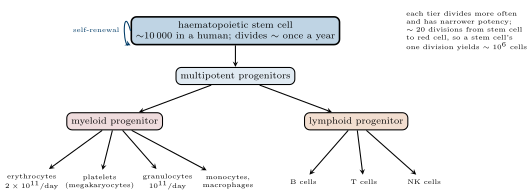
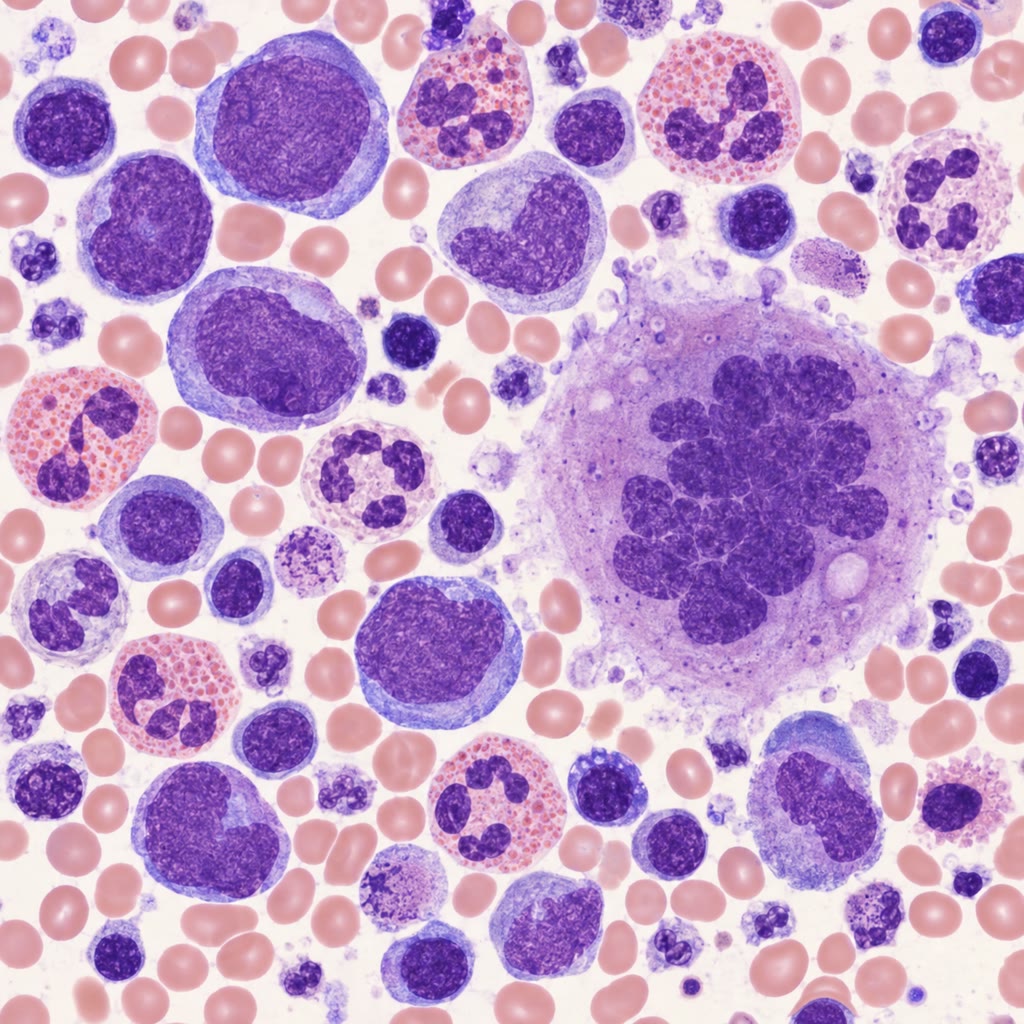
Evidence. Till and McCulloch (1961) injected marrow cells into lethally irradiated mice and counted the nodules that appeared on the spleen ten days later: each was a colony of blood cells of several lineages, their number proportional to the cells injected, and marking the donor cells’ chromosomes showed each colony to be a clone — a single cell had made red cells, granulocytes and platelets, and some colonies contained cells that could seed new colonies in a second mouse: self-renewal and multipotency in one cell, the operational definition of a stem cell, and the basis of bone-marrow transplantation. Barker and Clevers (2007) marked cells expressing the gene Lgr5 at the base of intestinal crypts with a heritable colour and watched, over weeks, the colour climb the crypt and fill whole villi: the marked cells were the stem cells of the gut, and one of them, cultured in a gel with the right three growth factors, grew into a miniature gut, an organoid, with crypts and villi of its own (Sato, 2009). ∎
Proposition 24.2 (The niche and the crypt)
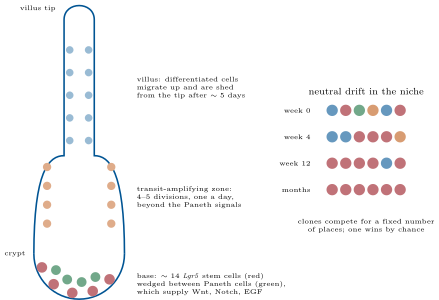
The intestinal crypt is the best-understood niche. At its base about fourteen Lgr5 stem cells sit wedged between Paneth cells, which secrete the Wnt and Notch signals and growth factors that keep them stem cells; a stem cell pushed up out of contact with the Paneth cells loses the signal within a few cell diameters and becomes a transit-amplifying cell, which divides four or five times in the crypt and then differentiates into the absorptive and secretory cells that migrate up the villus and are shed from its tip five days later. The stem cells divide symmetrically, about once a day, and compete for the limited niche space: by chance one clone expands and the others are lost, so that within a few months every crypt is descended from a single stem cell — neutral drift at the scale of a crypt, a random walk with absorbing boundaries. The niche, not the cell, holds the stemness: put a differentiated cell back in contact with Paneth signals after injury and it can revert; take the stem cell out and give it the signals in a dish and it makes an organoid. Bone marrow, hair follicles, testis and the neural stem-cell zones of the brain follow the same logic with different signals.
Evidence. Snippert and colleagues (2010) marked crypt stem cells with a “confetti” of four random colours; crypts were multicoloured at first and had become single-coloured by a few months, at a rate matching symmetric division and neutral competition among about fourteen cells — rather than asymmetric division, which would have kept every colour indefinitely. Removing Paneth cells shrinks the stem-cell pool; removing the Wnt signal empties the crypt within days. ∎
24.2 Pluripotency and reprogramming
Definition 24.3 (Embryonic, induced, and cultured)
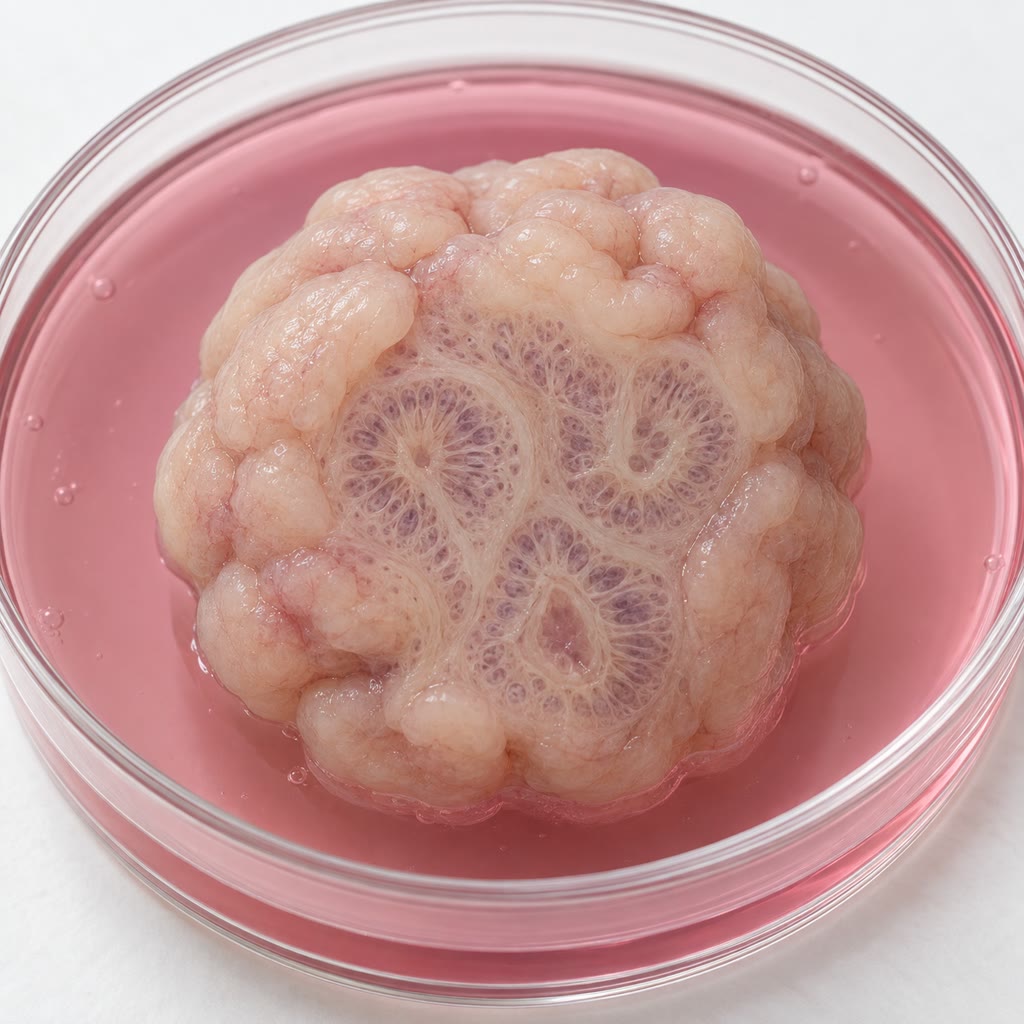
Embryonic stem cells (Evans, Kaufman, Martin, 1981, mouse; Thomson, 1998, human) are inner-cell-mass cells kept dividing in culture without differentiating, by signals (LIF, or FGF and activin) that maintain a core of transcription factors — Oct4, Sox2, Nanog — which activate one another and repress the genes of every lineage. Injected into a blastocyst they join the embryo and contribute to all its tissues, including the germ line, which is how the knockout mouse is made: alter a gene in the cells, make a mouse from them. The Year 2 volume’s nuclear transfer showed that a differentiated nucleus can be reset by egg cytoplasm; Takahashi and Yamanaka (2006) found what does the resetting. Of twenty-four candidate genes, four — Oct4, Sox2, Klf4, c-Myc — introduced together on viruses into skin fibroblasts, converted about one cell in a thousand over three weeks into an induced pluripotent stem cell indistinguishable from an embryonic one, able to form every tissue and a whole mouse. Reprogramming is slow and inefficient because the factors must open chromatin closed by years of differentiation, and the cells pass through a stochastic phase in which most stall; it is also, in principle, a route from a patient’s own cells to any tissue. Add the right signals in the right order and pluripotent cells in a dish recapitulate development: heart muscle that beats, dopamine neurons for transplant into a Parkinsonian brain, retinal cells, and organoids — self-organising three-dimensional tissues a few millimetres across, gut, kidney, liver and cerebral, with the architecture and cell types of the organ, in which human development and disease can be watched and drugs tested.
Method 24.4 (Lineage tracing)
To find which cells are the stem cells of a tissue: (1) choose a gene expressed by the candidate cells and put under its promoter an inducible recombinase (Cre-ER, active only when tamoxifen is given); (2) in the same animal, a reporter gene that becomes permanently active when the recombinase cuts a stop cassette out of it — a colour that is inherited by every descendant; (3) give one dose of tamoxifen to mark the candidate cells at one moment; (4) harvest tissue at intervals and score the marked clones: a clone that grows, persists for months and contains every cell type of the tissue came from a stem cell; a clone that is shed within a week came from a transit cell. (5) With a multicolour reporter, follow the competition between clones. (6) Test function directly by killing the marked cells with a toxin receptor expressed under the same promoter, and see whether the tissue fails to renew.
24.3 Regeneration
Definition 24.5 (How animals regrow)
Regeneration takes three routes. Hydra and the planarian rely on adult pluripotent stem cells: a planarian’s neoblasts, a fifth of its cells, are the only dividing cells it has, migrate to a wound, and rebuild any missing part guided by positional signals (a Wnt gradient tells the piece which end is the tail; block it and a tail piece grows a second head). Salamanders rebuild a limb from a blastema, a cap of dividing cells at the stump formed largely by dedifferentiation: muscle fibres fragment into mononucleate cells, cartilage and connective cells return to a progenitor state, each remembering its tissue of origin and its position along the limb, and the blastema re-runs the embryonic limb programme under the wound epidermis and the nerves, whose presence is required (denervate the stump and nothing grows). Zebrafish regrow fins and heart the same way, the heart’s surviving muscle cells dividing to replace a fifth of the ventricle in a month. Mammals do little of this: the liver regrows its mass after two thirds is removed, but by the remaining cells dividing in place (compensatory growth), not by rebuilding the lost lobes; a fingertip regenerates in children; the deer’s antlers grow anew each year from a stem-cell periosteum. Why not more is a question of trade-offs: the mammalian wound response — rapid clotting, inflammation, fibroblast scar — closes a wound fast against infection and blood loss, and the scar forecloses the blastema; and cells that can dedifferentiate and divide at will are cells that can become cancers, a risk a long-lived warm-blooded animal may not afford.
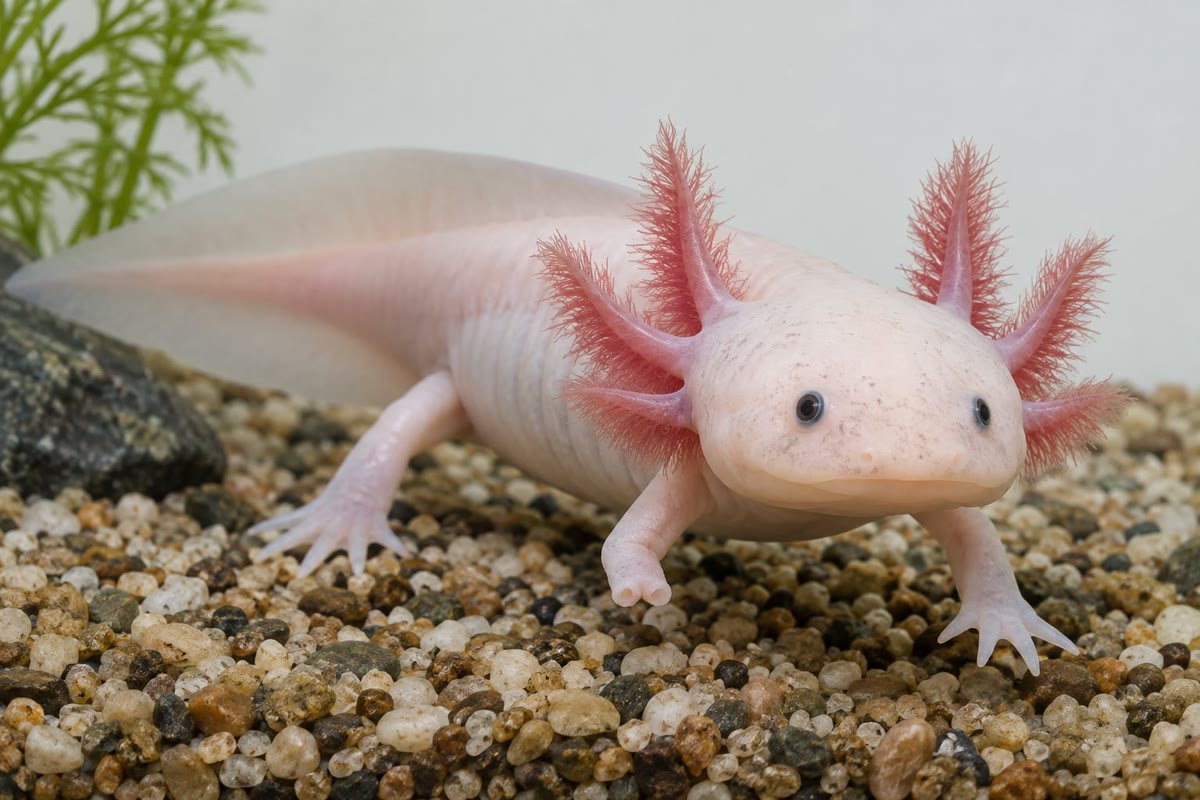
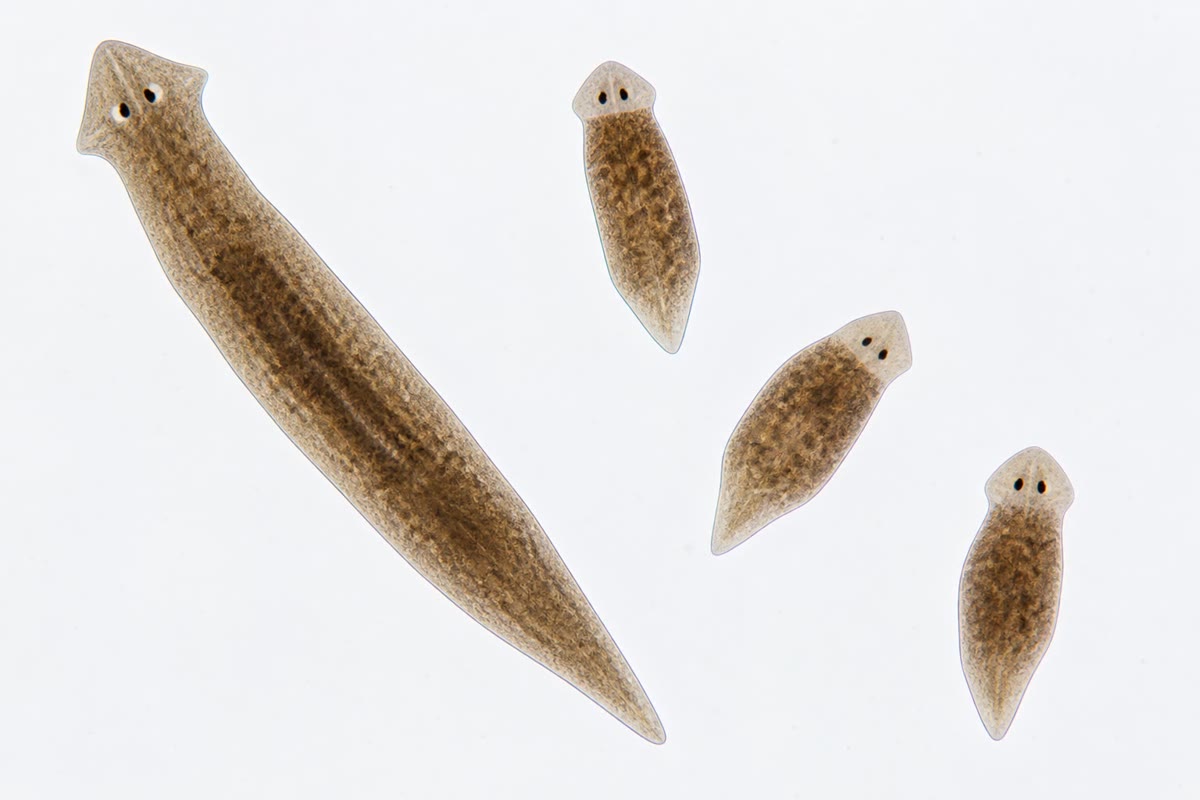
Evidence. Morgan (1898) cut planarians into 279 pieces and found each regrew a whole worm down to a limit of about a hundredth of the body; Reddien and colleagues (2011) transplanted a single neoblast into a lethally irradiated worm and restored it entirely — one cell, every tissue. Kragl and colleagues (2009) made axolotls whose tissues were labelled green one at a time and grafted them into unlabelled hosts: after amputation, green muscle gave rise only to muscle, green cartilage to cartilage — the blastema is not a pool of pluripotent cells but a collection of lineage-restricted progenitors, each dedifferentiated only as far as its own tissue’s progenitor. Singer (1952) showed a salamander limb regenerates only if a threshold number of nerve fibres reaches the stump, and that rerouting a nerve to a wound on the flank made a limb grow there. ∎
24.4 The arithmetic of ageing
Theorem 24.6 (Telomeres and the Hayflick limit)
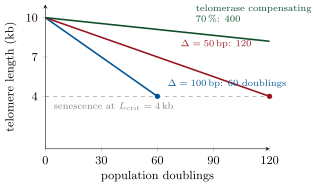
Each chromosome ends in a telomere, several kilobases of the repeat TTAGGG. Because DNA polymerase cannot complete the lagging strand’s last stretch (the end-replication problem), every division shortens each telomere by . Starting from and triggering replicative senescence — a permanent, p53-enforced arrest — when the shortest telomere reaches , a cell lineage can divide at most
times: the Hayflick limit, the fifty-odd population doublings that human fibroblasts complete in culture before stopping. The enzyme telomerase, an RNA-templated reverse transcriptase, re-extends the ends; it is active in the germ line, in embryonic and many adult stem cells, and in of cancers, which have escaped the limit by switching it back on. A stem cell that divides times a year with telomerase compensating a fraction of the loss has divisions, and a lifetime of years: with , , , some 330 years for a haematopoietic stem cell — but its progenitors, with telomerase off and twenty divisions to a red cell, spend a fifth of their reserve at every lineage, which is why old people’s blood cells have shorter telomeres than young people’s, by about a year.
Proof. The loss per division is a fixed length, so telomere length falls linearly with division number, , and reaches at ; with partial compensation the net loss per division is . Hayflick and Moorhead (1961) showed that normal human fibroblasts stop after about fifty doublings whatever the culture conditions, that cells frozen after twenty doublings and thawed complete only the remaining thirty — they count divisions, not time — and that the limit is lower for cells from old donors. Harley, Futcher and Greider (1990) measured telomeres shortening with doublings in culture and with donor age; Bodnar and colleagues (1998) put telomerase into normal cells and they divided past the limit indefinitely without becoming cancerous, which established the telomere as the clock. ∎
Proposition 24.7 (Gompertz’s law)
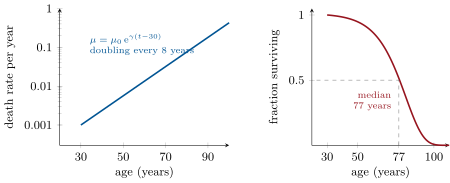
Above about thirty the human death rate — the probability of dying in the next year — doubles every eight years: with (Gompertz, 1825). The survival to age is then
a curve flat for decades and then falling steeply, with a median lifespan : for per year at thirty, about years. The same law, with different constants, holds for mice (doubling time three months), dogs, flies and worms: ageing is an exponential rise in vulnerability, not a clock that stops. The biology behind the exponent is a set of interacting hallmarks: accumulated DNA damage and epigenetic drift, telomere attrition, loss of proteostasis, mitochondrial decline, exhaustion of stem-cell pools, the accumulation of senescent cells that no longer divide but secrete inflammatory signals, and chronic inflammation; in mice, clearing senescent cells or restricting calories extends life, and in worms a single mutation in the insulin-like pathway doubles it. Whether the exponent can be lowered in humans, rather than the constant which medicine has reduced tenfold in a century, is the open question.
Proof. If is the hazard, , so . Setting : , whence the median; with and , , . The empirical law is Gompertz’s fit to English life tables; that it describes so many species with a shared form and species-specific constants is admitted here as the summary of a century of demography. ∎
Remark 24.8 (Renewal and its price)
A body that renews itself must keep cells that can divide indefinitely, and cells that can divide indefinitely are the material of cancer; a body that guards against cancer by counting divisions and enforcing senescence must, in time, run short of cells that can divide. The stem-cell hierarchy is one solution — few slow cells protected in niches, many fast cells that soon die — and the Hayflick limit another, and the exponential of Gompertz is the sum of their costs. The salamander pays differently: it tolerates cells that dedifferentiate and regrows a leg, and it is cold-blooded, slow and rarely lives long enough to pay the cancer bill. The cells you were born with are, for the most part, not the cells you have; the ones that made the replacements are the ones you have to keep.
24.5 Exercises
Exercise 24.1 ★
Define self-renewal, potency, niche and transit-amplifying cell, and give an example of each in the gut.
Solution
Solution of Exercise 24.1.
Self-renewal: a division that produces at least one daughter that is still a stem cell — the Lgr5 cells at the crypt base. Potency: the range of fates a cell can still adopt — the crypt stem cell is multipotent, making absorptive cells, goblet, enteroendocrine, Paneth and tuft cells. Niche: the Paneth cells and their Wnt, Notch and EGF signals, which hold stemness in place. Transit-amplifying cell: a committed daughter that divides four or five more times in the crypt before differentiating on its way up the villus.
Exercise 24.2 ★
What did the spleen-colony assay show, and which property of a stem cell required a second mouse to demonstrate?
Solution
Solution of Exercise 24.2.
Single marrow cells produced spleen colonies containing red cells, granulocytes and platelets: one cell, several lineages — multipotency, and the linear dose response showed each colony came from one cell. Self-renewal needed a second mouse: cells from a colony, injected into another irradiated recipient, made new colonies, so the founding cell had produced daughters with its own capacity.
Exercise 24.3 ★
Name the four Yamanaka factors and explain why reprogramming takes weeks and succeeds in a thousandth of cells.
Solution
Solution of Exercise 24.3.
Oct4, Sox2, Klf4, c-Myc. The fibroblast’s chromatin has closed the pluripotency genes behind heterochromatin and DNA methylation, so the factors find few accessible sites at first and must recruit remodelling enzymes over many cell cycles; the cell must also shut its own programme, escape senescence and pass through a stochastic intermediate state in which most cells stall or die. Only the rare cell in which every step succeeds emerges pluripotent, weeks later.
Exercise 24.4 ★
Contrast the planarian’s and the salamander’s routes to regeneration, and say what Kragl’s grafting experiments showed about the blastema.
Solution
Solution of Exercise 24.4.
The planarian keeps pluripotent adult stem cells, the neoblasts, which migrate to the wound and build whatever is missing. The salamander has no such pool: differentiated cells at the stump dedifferentiate into progenitors, which with resident tissue stem cells form a blastema that re-runs the limb programme. Kragl’s grafts of single labelled tissues showed that blastema cells stay true to their origin — muscle makes muscle, cartilage cartilage — so the blastema is a mixture of lineage-restricted progenitors, not a pluripotent mass.
Exercise 24.5 ★★
Telomeres start at , senescence at , loss per division. Hayflick limit? Cells from a 70-year-old donor have : remaining doublings? If telomerase compensates of the loss, limit?
Solution
Solution of Exercise 24.5.
doublings. From : . With compensation the net loss is : .
Exercise 24.6 ★★
A crypt holds 14 stem cells dividing once a day, feeding transit cells that divide 4 more times, and the crypt supplies cells a day to its villus. Check the arithmetic: how many stem-cell divisions a day produce differentiating daughters, and how many stem cells’ worth of divisions is that?
Solution
Solution of Exercise 24.6.
Fourteen stem-cell divisions a day yield 28 daughters; 14 must remain stem cells, so 14 commit — one committed daughter per stem cell per day. Each commits to cells: villus cells a day, the order of the observed (a fifth transit division gives ). The stem tier contributes fourteen cells’ worth of divisions, the transit tier the other .
Exercise 24.7 ★★
The body makes red cells a day, each the product of about 20 divisions from a stem cell. How many stem-cell divisions a day does that require, and, with stem cells, how often does each divide? Compare with the observed “about once a year” and explain the discrepancy.
Solution
Solution of Exercise 24.7.
committed daughters a day; with stem cells, 19 per stem cell per day — against one division a year. The count of twenty divisions is per lineage from stem cell to red cell, but the intermediate progenitors are not one-shot: multipotent and committed progenitor pools sustain themselves for weeks by their own divisions, so nearly all the division happens in the progenitor tiers and the stem cell is called on rarely.
Exercise 24.8 ★★
With and at thirty, compute the death rate at 50, 70 and 90, the survival to 70 and 90, and the median lifespan. What does halving do to the median? What does halving do?
Solution
Solution of Exercise 24.8.
; ; per year. With : , . Median: . Halving : , median 85 — one doubling time, eight years, gained. Halving to : , median 109: slowing the exponent gains four times more than halving the constant.
Exercise 24.9 ★★
Two thirds of a rat’s liver is removed. The remaining hepatocytes, all of which divide, restore the mass in ten days. How many divisions does each need? Why is this called compensatory growth and not regeneration, and what does the liver not rebuild?
Solution
Solution of Exercise 24.9.
The remaining third must triple: divisions per cell. Compensatory growth, because the existing lobes enlarge by division of cells in place; the removed lobes, with their ducts, vessels and architecture, are not rebuilt — the liver recovers its mass and function but not its shape.
Exercise 24.10 ★★★
Neutral drift: stem cells in a niche divide symmetrically; at each event one cell divides and one is lost at random, so the number of a given clone performs a random walk between and . Argue that the probability a clone of cells eventually takes over the niche is , and that with a single-cell clone has a chance. What does this predict for the fate of a stem cell carrying a new neutral mutation?
Solution
Solution of Exercise 24.10.
At each event the clone’s size goes to or with equal probability, so its expected size never changes; when the walk ends it is (take-over) or (loss), and the expectation gives . A single cell: . A neutral mutation in one stem cell fixes in its crypt with probability and is otherwise lost within months — drift purges thirteen of fourteen mutations.
Exercise 24.11 ★★★
A mutation gives a stem-cell clone a advantage in the competition of Exercise 24.10. Explain qualitatively why its take-over probability rises well above , why crypts and marrow of old people are increasingly dominated by a few clones (clonal haematopoiesis), and why this is a first step toward cancer without being cancer.
Solution
Solution of Exercise 24.11.
The walk is now biased: the clone gains a place more often than it loses one, so its expected size grows and the take-over probability rises toward certainty as grows — for a advantage in a niche of fourteen, roughly threefold above for a single cell, and higher still once the clone holds a few places. Over decades, stem cells with such mutations (DNMT3A, TET2 in marrow) take over their niches, and by seventy a fifth of people have a large share of their blood from one clone. It is not cancer: the cells still differentiate and obey their hierarchy. But the next mutation now has a clone of billions to arise in, and the risk of leukaemia is raised tenfold.
Exercise 24.12 ★★★
Suppose the Gompertz exponent reflects a rate of accumulating damage and the constant the environment. Medicine has cut tenfold since 1900 without changing . Compute the gain in median lifespan that tenfold reduction gives, and the further gain from another tenfold cut; explain why the returns diminish, and what a cut in would do instead.
Solution
Solution of Exercise 24.12.
Median : for , ; : 77; : . In the pure Gompertz form each tenfold cut adds the same years. The returns diminish in practice because the historical gains came from removing an age-independent term — infection, childbirth, accident, Makeham’s constant in — and once is small compared with the exponential at the ages that matter, cutting it further changes almost nothing; the intrinsic has moved much less. A cut in (to ) gives : nine years, gained at every age rather than by postponing a few causes of death.
24.6 Problem: The Cells You Were Born With
Problem 24.1
Weekend problem — a body’s renewal in numbers: the blood’s hierarchy and what it asks of its stem cells, the crypt’s drift, the telomere clock and how telomerase and progenitors spend it, the Gompertz curve of the population, and the trade-offs a regenerating animal accepts, ending on the Hayflick count, the stem cell’s lifetime reserve and the median lifespan
Data: red cells a day, granulocytes a day; divisions from stem cell to mature cell; haematopoietic stem cells. Telomeres: , , per division; telomerase in stem cells compensates ; none in progenitors. Crypt: stem cells, one division a day. Gompertz: per year at age 30, . Axolotl limb: regrown in ; blastema cells growing to .
Part I — The blood.
- Cells produced per day in total, and per second.
- Each mature cell is the end of divisions: how many cells result from one committed daughter of a stem cell? How many committed daughters a day are needed?
- With stem cells, how many differentiating divisions per stem cell per day does that imply? Per year?
- Measured stem-cell division is about once a year. Reconcile: what must the progenitors do that the calculation of question 3 assumed the stem cells did?
- Progenitors have no telomerase. From , what telomere length does a red cell precursor reach after its divisions? Does it matter that it is above ?
- A stem cell dividing once a year with : net loss per division, divisions to senescence, and years. Comment.
Part II — The crypt.
- Divisions per crypt per day at the stem-cell tier; if half the events replace a lost stem cell and half feed the transit zone, how many committed cells a day, and how many villus cells after transit divisions?
- A single-cell clone’s take-over probability is . Expected time to monoclonality is of order division events per cell; estimate it in days and compare with the confetti observations (months).
- A stem cell acquires a mutation. Probability it is eventually fixed in its crypt? In how many of the crypts of a colon would a mutation arising once per crypt become fixed?
- Why does a crypt’s drift protect against cancer more than a tissue in which every stem cell divides asymmetrically for life?
- After irradiation kills the stem cells, transit cells revert and refill the niche. What does this say about where stemness lives?
- Sketch the lineage-tracing experiment that distinguishes symmetric drift from asymmetric division, and the two outcomes.
Part III — The clock.
- Hayflick limit for a somatic lineage without telomerase.
- A fibroblast culture is frozen after doublings and thawed a decade later: doublings left? What does this show about what the cell counts?
- Leukocyte telomeres shorten by a year in adults. Starting from at twenty, when would they reach ? Compare with lifespan and comment.
- Telomerase added to normal fibroblasts lets them pass the limit without becoming cancerous. Telomerase is active in of cancers. Reconcile the two statements.
- Compute the Gompertz death rate at 40, 60, 80 and 100, and the survival to each.
- Median lifespan; and the age at which survive.
Part IV — Regrowing.
- Axolotl: mean regrowth rate in mm/day; doublings for the blastema to grow from to cells, and the mean doubling time over 60 days.
- If dedifferentiated cells divide like the blastema’s throughout life and a division carries a chance per cell of an oncogenic mutation, how many such mutations arise in one regeneration? Why is the axolotl nonetheless almost never cancerous, and why might a mammal not get away with it?
- Denervating the stump stops regeneration. Propose an experiment to show the nerve supplies a diffusible factor, and one possible identity of the factor.
- A planarian tail piece grows a second tail instead of a head when a Wnt inhibitor is knocked down. Explain with a gradient and the positional memory of the piece.
- Human liver after a two-thirds resection: fraction of hepatocytes that must divide once, twice, to restore the mass. Why is the result a working liver but the wrong shape?
- Why would a body that regenerated like an axolotl have a different Gompertz curve, and in which direction?
- Summarise: the Hayflick count (question 13), a telomerase-aided stem cell’s divisions and years (question 6), and the median lifespan (question 18).
Solution
Solution of Problem 24.1.
1. a day, a second. 2. cells per committed daughter; committed daughters a day. 3. per stem cell per day, a year. 4. The progenitor pools must sustain themselves: multipotent and committed progenitors divide for weeks and keep their own numbers, so almost every division of the twenty happens in tiers that renew themselves, and the stem cell contributes a committed daughter rarely — of the order of once a year. 5. : well above , and the red cell never divides again; the reserve matters only for progenitors that are re-used. 6. Net loss ; divisions; at one a year, years — far beyond a life, so telomeres do not limit the stem cell itself; other damage does. 7. divisions a day; replace lost stem cells and commit; villus cells a day. 8. events per cell at one a day: about , six to seven months — the time over which confetti crypts became single-coloured. 9. ; crypts. 10. Drift throws out thirteen of every fourteen mutations within months. Lifelong asymmetric division would keep every mutant stem cell for life, so mutations would accumulate in every lineage without ever being purged. 11. Stemness is a position in the niche and a set of signals, not a permanent property of a cell: any cell that reaches the Paneth signals can take the role. 12. Induce a multicolour label in the stem cells at one moment and follow the crypts. Symmetric drift: crypts become single-coloured within months. Asymmetric division: each crypt keeps all its colours indefinitely, each as a thin ribbon up the villus. 13. doublings. 14. About left: the cell counts divisions, not calendar time, since the decade in the freezer cost nothing. 15. years after twenty — age 153. Mean leukocyte telomere length does not itself limit life; the shortest telomeres, and the other hallmarks, matter more. 16. Telomerase removes one barrier, replicative senescence, and is therefore found in nearly every cancer, which needs unlimited division; but the fibroblasts given telomerase kept their checkpoints, contact inhibition and intact p53, so unlimited division alone did not make them cancers. Necessary, not sufficient. 17. , , , per year. : at 40, at 60, at 80, at 100. 18. Median . Ten per cent survive at : . 19. ; doublings in 60 days, one every six days. 20. About divisions, so oncogenic mutations per regeneration — one in ten limbs. Axolotls almost never develop tumours: cold-blooded and slow, with robust tumour suppression, and the blastema’s cells remain lineage-restricted and re-differentiate rather than continuing to divide; regenerating tissue even suppresses induced tumours. A mammal has more cells, a higher temperature and metabolic rate, and a longer life over which an escaped clone could grow. 21. Denervate the stump and implant a bead releasing the candidate protein, or graft nerve-conditioned tissue: regeneration restored means a diffusible factor. Candidates identified in newts and axolotls: the anterior-gradient protein nAG, neuregulin-1, and FGFs. 22. Wnt signalling is high at the tail and low at the head, and the wound at a piece’s anterior end normally makes a head because Wnt there is low; knocking down a Wnt inhibitor raises Wnt everywhere, both wounds read “posterior,” and two tails grow. The piece knows its own axis from the residual gradient in its muscle, and the wound re-establishes the gradient relative to it. 23. The remaining third must triple: every hepatocyte divides once (to two thirds) and half divide again — a mean of divisions. The surviving lobes swell to the original mass; the missing lobes and their ducts and vessels are not rebuilt. 24. Regeneration that replaces worn and damaged tissue would slow the accumulation the exponent measures, lowering and flattening the curve — axolotls show little senescence. The price would be a higher constant term from cancers in a warm, large, long-lived body. 25. Hayflick count about doublings; a telomerase-aided stem cell has some divisions, more than three centuries at one a year; median lifespan years.