University Physics — Year 3 · Bachelor Year 3
21Phase Transitions
Heat water by one degree, and nothing much happens — until, at one sharply defined temperature, the liquid tears itself into vapour. Cool iron through and, with no change of composition, it spontaneously magnetises. Nothing in a single molecule or a single spin announces these revolutions: they are collective — agents, each interacting with a few neighbours, conspiring to change their society’s phase all at once. The Year 1 volume catalogued the transitions; this chapter explains their mechanism with the tools of the last five: free-energy competition, order parameters, the breaking of symmetry, and the astonishing discovery that near a critical point the microscopic details cease to matter — a magnet and a boiling fluid share the same critical exponents. The ideas of this chapter now run from pressure cookers to superconductors to the Higgs field of Chapter 26.
21.1 Order parameters and free-energy competition
Definition 21.1 (Phases and order parameters)
A phase transition is a non-smooth change of a system’s equilibrium state as a control parameter (, , ) crosses a boundary. Its bookkeeper is the order parameter: a quantity zero in the disordered phase and nonzero in the ordered one — the magnetisation of a ferromagnet, the density difference of a fluid, the condensate fraction of Chapter 19. Transitions come in two kinds: first-order (order parameter jumps; latent heat; phases coexist — boiling, melting) and continuous (order parameter grows from zero; no latent heat; wild fluctuations — the Curie point, the critical point, superfluid helium). When the ordered state must choose among equivalent options — a magnet’s north has to point somewhere — the transition breaks a symmetry that the underlying laws respect: a theme that will return, at the highest stakes, with the Higgs mechanism. The engine behind every case is the free energy (Proposition 17.2): energy favours order, entropy favours disorder, and sets the exchange rate — phase boundaries are where the ledger ties.
21.2 The liquid–gas transition: van der Waals
Proposition 21.2 (Van der Waals isotherms)
The real-gas equation of the Year 1 volume,
encodes attraction () and hard cores (). Above a critical temperature its isotherms are monotonic: one fluid phase. Below it they develop a loop containing a mechanically unstable stretch (): the fluid there splits into coexisting liquid and gas, at the pressure fixed by equality of chemical potentials (Maxwell’s equal-area rule). The coexistence region closes at the critical point (), where liquid and gas become indistinguishable: approaching it, the density difference vanishes, the compressibility diverges, and density fluctuations grow to optical size — the critical opalescence of Problem 13.1.
Proof. Admitted at this level. ∎
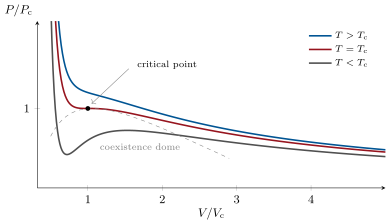
Proposition 21.3 (Clausius–Clapeyron)
Along any first-order coexistence line, equality of chemical potentials on both sides (Definition 18.2) forces the line’s slope to be
with the latent heat and the volume change per particle (or per kilogram, consistently). Everything about coexistence lines is in this one formula: water’s boiling line climbs at near (pressure cookers, altitude cooking — Problem 21.1); and water’s melting line tilts backwards (: ice floats), so pressure melts ice — a rarity among substances with consequences from glaciers to skating rinks.
Proof. On the line, ; move along it: (per particle, using ). Solve for and use . ∎
21.3 The ferromagnet: mean-field theory
Theorem 21.4 (Mean-field Ising transition)
Model a magnet as spins on a lattice, neighbours coupled by the exchange energy (Exercise 14.12), each spin having neighbours. Replace each spin’s neighbours by their average (the mean-field approximation): a spin then sits in the effective field , and Exercise 17.11 gives the self-consistency condition
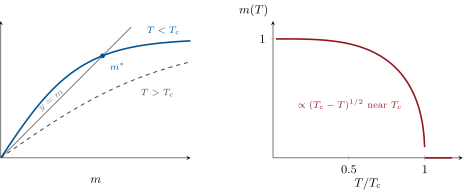
Above the only solution is ; below it two symmetric solutions appear and are the stable ones: the magnet must magnetise, choosing a direction at random — spontaneous symmetry breaking. Near , , and above it the susceptibility obeys the Curie–Weiss law : divergent at the transition — an infinitely obliging magnet.
Partial proof. A spin in field has ; demanding gives the stated equation. Graphically: the line cuts the curve only at the origin when the curve’s initial slope , and also at when . Expanding for small gives , the square-root growth; adding a small applied field and expanding likewise gives Curie–Weiss (Exercise 21.6). ∎
21.4 Landau’s viewpoint and universality
Proposition 21.5 (Landau theory)
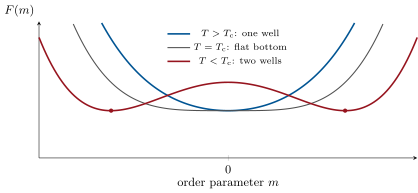
Near a continuous transition, expand the free energy in the small order parameter, keeping only what symmetry allows ( here):
Above : a single well at . Below: the origin becomes a summit and two symmetric wells appear at — the same square root as mean field, now from symmetry alone. This is why wildly different systems behave identically near their critical points: universality. Measured exponents (e.g. with for both fluids and uniaxial magnets) differ from the mean-field because near fluctuations rage on all scales — their taming, the renormalisation group (Wilson, Nobel 1982), showed that only dimensionality and symmetry, never microscopic details, decide the exponents. The double-well picture itself has a career beyond magnets: give the order parameter the role of a field filling space, and its symmetry-breaking well is the Higgs mechanism (Chapter 26).
Proof. Admitted at this level. ∎
Method 21.6 (Reading a transition)
(1) Identify the order parameter and whether it jumps (first-order: latent heat, coexistence, hysteresis, nucleation) or grows continuously (critical point: divergences, opalescence, universality). (2) First-order lines: Clausius–Clapeyron for the slope; -equality for coexistence. (3) Continuous: mean-field first ( or Landau) for the phase diagram’s shape; trust its topology, not its exponents. (4) Below , remember the choice: broken symmetry means domains, defects and history-dependence. (5) Estimates: (coupling per neighbour) (number of neighbours).
21.5 Exercises
Exercise 21.1 ★
Classify (first-order or continuous), naming the order parameter and the broken symmetry if any: (a) boiling at ; (b) the Curie point; (c) the superfluid point; (d) boiling exactly at the critical point.
Solution
Solution of Exercise 21.1.
(a) First-order: density jumps, latent heat flows; no symmetry differs between liquid and gas — which is why their line can end. (b) Continuous; order parameter ; the up–down (and rotational) symmetry breaks. (c) Continuous; the condensate’s macroscopic wave function (a phase angle breaks). (d) Continuous: at the critical point the jump has shrunk to zero — the one boiling with no latent heat.
Exercise 21.2 ★
Latent heats as entropy. (a) Water: at : compute per molecule in units of . (b) The same for melting ( at ). (c) Most liquids vaporise with – (Trouton’s rule): what does the number roughly count (the of what volume ratio)? (d) Why is melting’s entropy jump so much smaller than boiling’s?
Solution
Solution of Exercise 21.2.
(a) per molecule. (b) . (c) Roughly of the thousandfold volume gain per molecule () plus liberated orientations: the near-universal ten-ish of Trouton. (d) Melting frees orientation and position only slightly — the molecules stay packed; the big entropy purchase is the vapour’s volume.
Exercise 21.3 ★
Van der Waals critical constants (, , — accept). (a) Show , a universal number for the model; the measured values cluster near — comment. (b) For CO (, ): extract and . (c) From , estimate the molecular diameter. (d) Why does room-temperature CO liquefy under pressure while room-temperature N () never does?
Solution
Solution of Exercise 21.3.
(a) regardless of substance — the model’s law of corresponding states; real fluids’ shows vdW is a caricature near the critical point, where correlations rule. (b) ; . (c) — the molecular size, extracted from a steam table. (d) Liquefaction by pressure alone requires : true for CO at room temperature, false for N — hence CO cylinders hold liquid, nitrogen cylinders only compressed gas.
Exercise 21.4 ★
Order parameters, quickly: give one for (a) a ferromagnet; (b) the liquid–gas transition; (c) Bose–Einstein condensation; (d) an antiferromagnet (two sublattices — what quantity orders while the total magnetisation stays zero?).
Solution
Solution of Exercise 21.4.
(a) . (b) . (c) The condensate amplitude (with its phase). (d) The staggered magnetisation — the difference of the two sublattices’ moments.
Exercise 21.5 ★★
Mean field by hand. (a) Derive from a spin in the average field of its neighbours. (b) Show a nonzero solution exists exactly when . (c) Expand to third order and derive . (d) Iron: , : extract in eV and check the exchange scale of Exercise 14.12.
Solution
Solution of Exercise 21.5.
(a) One spin in : ; self-consistency closes the loop. (b) Nonzero crossing exists iff the initial slope . (c) gives near . (d) per bond — the electron-volt-class exchange of Exercise 14.12, shared over eight neighbours: electrostatics, not magnetism, heats iron’s Curie point to a thousand kelvin.
Exercise 21.6 ★★
Curie–Weiss. Add a small field: . (a) Linearise above and derive . (b) Compare with the free-spin Curie law: what does plotting against give in each case, and how does the intercept diagnose ferromagnetic coupling? (c) Nickel’s line hits zero at : interpret. (d) For an antiferromagnet the intercept is negative: what sign of does that betray?
Solution
Solution of Exercise 21.6.
(a) Linearising, : . (b) Both give straight lines; the free-spin line passes through the origin, the ferromagnet’s intercepts the axis at : the intercept is the coupling diagnosis. (c) Nickel orders at : its high-temperature susceptibility already announces the Curie point it will reach. (d) A negative intercept means : neighbours prefer anti-alignment — an antiferromagnet in waiting.
Exercise 21.7 ★★
Clausius–Clapeyron at work. (a) Water at (): compute . (b) Use to estimate the boiling temperature at (a summit). (c) Melting: with and , compute and the pressure to depress ice’s melting point by . (d) A skater on of blade: the pressure and its melting-point shift — does pressure-melting explain skating? (What does: friction and surface premelting.)
Solution
Solution of Exercise 21.7.
(a) . (b) : . (c) : five kelvin needs — almost seven hundred atmospheres. (d) The skater’s buys only K: pressure-melting fails on a cold rink; the lubricating film is made by friction heating and by ice’s intrinsic premelted surface layer.
Exercise 21.8 ★★
Landau computations. (a) Minimise below . (b) Compute at the minimum and show the heat capacity has a finite jump at the transition. (c) Sketch : mean-field step versus the measured near-logarithmic peak of helium’s point — what do real fluctuations add? (d) Add a field term : show the transition rounds off — symmetry must be exact for it to break.
Solution
Solution of Exercise 21.8.
(a) . (b) : jumps by at the transition. (c) Mean field: a clean step; helium’s measured -shaped, near-logarithmic peak is the fluctuations Landau ignores — the very shape gave the transition its name. (d) With the symmetry is pre-broken: is never exactly zero and every singularity is rounded — spontaneous breaking needs an unbiased choice.
Exercise 21.9 ★★
Nucleation. A droplet of radius in supersaturated vapour gains bulk free energy but pays surface tension . (a) Show the barrier peaks at . (b) Explain: why do clean supersaturated vapours and superheated liquids persist (metastability), and what do dust, ions and scratches provide? (c) Cloud chambers (Chapter 26’s ancestor detectors) and bubble chambers run on this physics: which role does the passing particle’s ion trail play? (d) Why are “boiling chips” put in laboratory flasks?
Solution
Solution of Exercise 21.9.
(a) of at . (b) Small embryos shrink (surface wins): a clean phase can wait, metastable, until a fluctuation crosses the barrier; dust, ions and scratches offer ready-made surfaces that slash it. (c) The ion trail seeds droplets (cloud chamber) or bubbles (bubble chamber) along the particle’s path: the track is a line of catalysed nucleation. (d) Their pores pre-seed bubbles, preventing superheating and the violent “bumping” of an unseeded flask.
Exercise 21.10 ★★★
No transition in one dimension. Consider a 1D Ising chain of spins, all up, and insert one “domain wall” (all spins beyond some bond flipped). (a) Energy cost of the wall: , independent of position. (b) Entropy gain: the wall can sit at any of bonds — . (c) Show for any at large : walls always proliferate, and long-range order is impossible — the 1D Ising model has . (d) In 2D, a wall is a line of length costing but with shapes: redo the estimate and show order survives below a finite — the Peierls argument behind Onsager’s exact .
Solution
Solution of Exercise 21.10.
(a) Only the one broken bond: , wherever it sits. (b) placements. (c) : at any positive temperature walls invade and order dies — . (d) A length- wall costs against entropy : for long walls are suppressed and order survives — the right magnitude beside Onsager’s exact .
Exercise 21.11 ★★★
Universality audited. Mean field predicts , (), ( at ). Measured, for both the liquid–gas critical point and three-dimensional uniaxial magnets: , , . (a) What justifies comparing a fluid with a magnet at all (what do their order parameters share — a single sign choice)? (b) Why does mean field fail near (what diverges, invalidating the neglect of fluctuations)? (c) Why does it fail less in higher dimensions (neighbour count versus fluctuation reach; mean field becomes exact above four dimensions)? (d) State the renormalisation-group moral in two sentences: what is being averaged scale by scale, and why only symmetry and dimension survive the averaging.
Solution
Solution of Exercise 21.11.
(a) Both order parameters are one real number choosing a sign (up/down; liquid/gas about the critical density): the same symmetry class. (b) The correlation length diverges: each spin’s “mean field” is precisely as fluctuating as itself, and replacing neighbours by averages becomes untenable. (c) More neighbours average better; above four dimensions the fluctuations’ reach grows slower than the averaging improves, and mean field becomes exact. (d) The renormalisation group averages out the shortest scales repeatedly, flowing every microscopic model of the same symmetry and dimension to one fixed point; exponents are properties of the fixed point — which is why steam and magnets share decimals.
Exercise 21.12 ★★★
From magnets to the Higgs. Promote the order parameter to a field with Landau energy density plus a gradient term. (a) Below the field sits at : small oscillations along the well have a restoring curvature — compute and interpret it, in field language, as a mass. (b) For a complex order parameter (a circle of minima — the “Mexican hat”), oscillations around the rim cost no potential energy: a massless mode — name the condensed-matter analogues (spin waves, superfluid phonons). (c) In the electroweak theory, the vacuum itself sits in such a broken-symmetry well; particles acquire mass from the field’s nonzero value, and the radial oscillation is the Higgs boson: map each element onto (a)–(b). (d) In one sentence: what did condensed-matter physics teach particle physics here (the export, via Anderson, of symmetry breaking)?
Solution
Solution of Exercise 21.12.
(a) With : — oscillations along the radial direction have a stiffness, i.e. (in field language) a mass that grows as the well deepens. (b) Around a circular rim the potential is flat: a zero-stiffness, massless mode — the Goldstone modes realised as spin waves in magnets and phonons in superfluids. (c) The vacuum’s is the condensate; particle masses are couplings to ; the radial oscillation is the Higgs boson, found at . (d) That broken symmetry, condensates and massive/massless modes were laboratory commonplaces first: particle physics imported a solid-state idea.
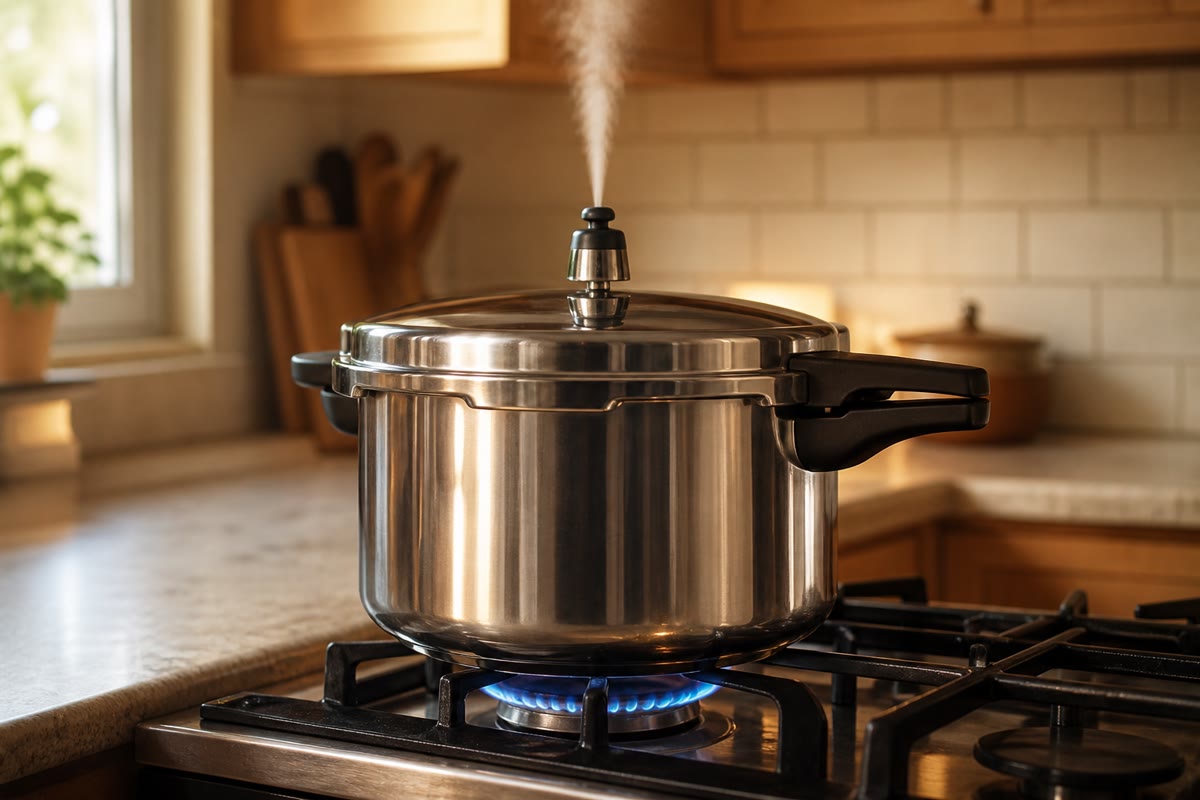
21.6 Problem: The kitchen phase diagram
Problem 21.1
Weekend problem — pressure cookers, mountain tea, and the end of boiling
Water’s phase diagram hangs, unnoticed, over every stove. This problem walks its three lines with Clausius–Clapeyron in hand — from why a pressure cooker halves cooking times, through why tea disappoints at altitude, to the strange world beyond the critical point where boiling itself ceases to exist. Data: , ; water vapour at , : ; melting: ; molecular mass ; critical point: , .
Part I — The boiling line.
- What defines “boiling” at a given pressure (which two chemical potentials tie)?
- Compute the slope of the vaporisation line at .
- A pressure cooker holds : integrate the slope (or use the exponential form with ) to find its boiling temperature.
- With the Arrhenius kitchen rule of Exercise 17.9 (rates double per ), estimate the speed-up over open-pot cooking.
- At La Paz (, ): boiling temperature, and why tea brews badly.
- Why does adding salt raise the boiling point (whose does the solute lower — recall Exercise 18.8)?
Part II — The melting line.
- Compute for melting and note the sign.
- Which everyday observation encodes (what does ice do in your glass), and why is that anomaly rare among substances?
- A glacier thick: the pressure at its base and the melting-point depression — does basal pressure-melting matter for glacier flow?
- Revisit the skater of Exercise 21.7(d): what actually lubricates the blade?
- If ice sank (positive slope, like almost every other solid), what would winter do to lakes and their fish — trace the consequence chain.
- The negative slope ends at high pressure where other ice crystal forms take over (ice III, V, VI): what does the existence of a dozen ices say about the free-energy landscape of one simple molecule?
Part III — The end of the line.
- The boiling line terminates at (): what happens to the latent heat and the density difference as the end is approached?
- Beyond the critical point one can carry water from “liquid-like” to “gas-like” with no transition at all: describe the path in the plane.
- Approaching the critical point, the fluid turns milky: connect this opalescence to Exercise 16.12 and Problem 13.1.
- Supercritical CO (, ) dissolves like a liquid and penetrates like a gas: name the industrial use that decaffeinates coffee, and why the solvent leaves no residue.
- Supercritical water (in power-plant boilers above ): why does eliminating boiling — bubbles, films, burnout — appeal to boiler engineers?
- Deep-ocean hydrothermal vents emit water at that does not boil: check against the local pressure ( at ) and the phase diagram.
Part IV — Reading the whole map.
- Sketch (in words) water’s diagram: the three lines, the triple point (, ), the critical point.
- Below , ice sublimes without melting: which appliance (freeze-drying) and which planet’s polar caps (Mars, CO and HO) live on this fact?
- Why was the triple point of water — exactly by definition until 2019 — such a good temperature standard (how many coexisting phases pin how many degrees of freedom)?
- Each line of the map is a first-order transition; only its endpoint is critical: restate the distinction with order parameters and latent heat.
- Humid air’s dew line is the same physics run backwards: explain dew, fog and the morning mist on a cold window with one -crossing sentence.
- Every pot lid is an experiment: droplets condense on it and rain back — identify the miniature water cycle’s two phase transitions and the latent-heat shuttle that makes a covered pot boil sooner.
- Summarise the named result: one slope formula, , explains the pressure cooker’s , the mountain’s tea, ice floating backwards up its melting line, and the supercritical kettle where boiling ends at .
Solution
Solution of Problem 21.1.
1. : boiling is coexistence, pressure by pressure. 2. . 3. : . 4. Twenty-one degrees at “double per ten”: about four times faster — the pressure cooker’s entire business case. 5. : — tea tannins extract poorly twelve degrees short. 6. Solute lowers the liquid’s (Exercise 18.8); matching the vapour then needs a higher temperature: boiling-point elevation. 7. : negative — pressure melts ice. 8. Ice floats: the solid is the less dense phase, the anomaly () that tilts the line backwards — rare because most solids pack tighter than their melts. 9. : only K — yet combined with geothermal heat it maintains basal meltwater, the lubricant of glacier surges. 10. Friction heating and the premelted surface film; the pressure myth persists because the sign of the slope is real — only its magnitude is too small. 11. Ice would sink and lakes freeze from the bottom up into solid blocks; no insulating lid, no liquid refuge, no freshwater overwintering life. 12. A dozen crystalline ices means a free-energy landscape with many nearly-tied packings: one bent molecule, many compromises — polymorphism as the rule. 13. Both shrink continuously to zero: at the endpoint the two phases merge and the first-order line dies as a continuous point. 14. Heat at to , then decompress: liquid to gas with never a meniscus — around the mountain instead of over it. 15. Compressibility diverges, so density fluctuations grow to optical scales and scatter light strongly: the fluid becomes its own cloud. 16. Supercritical CO pulls caffeine from beans; venting drops it below – and the “solvent” simply evaporates away entirely. 17. Above there is no liquid–vapour interface: no bubbles, no film boiling, no burnout crises — heat flows into one smooth fluid. 18. exceeds : at the vent water is supercritical — boiling is not suppressed, it is undefined. 19. Three lines meeting at the triple point (, ); the vaporisation line climbing to its end at (, ); the melting line leaning left; sublimation below the triple point. 20. Freeze-drying works below , where ice sublimes; Mars’s caps sublime seasonally for the same reason. 21. Three coexisting phases leave zero freedoms (Gibbs): the state is a single point — unreproducible thermometry’s dream, hence its long service defining the kelvin. 22. On a line the order parameter (density) jumps and latent heat flows; at the endpoint the jump has shrunk to zero and fluctuations replace it. 23. Where a cooling surface drags the local vapour’s above the liquid’s, water must condense: dew, fog and misted windows are -crossings made visible. 24. Evaporation (liquid vapour) at the surface, condensation (vapour liquid) on the lid: the latent heat carried up is repaid into the pot instead of the kitchen — the lid closes the heat loop. 25. : under two atmospheres, at La Paz, a melting line running backwards, and boiling itself expiring at (, ) — the kitchen, mapped.