University Physics — Year 3 · Bachelor Year 3
6Covariant Electromagnetism
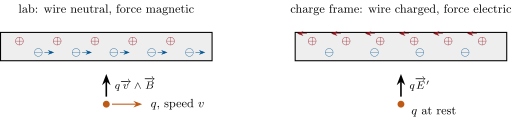
A copper wire carries ten amperes. Its electrons drift at a tenth of a millimetre per second — slower than a snail — and the wire is electrically neutral to fantastic precision. Yet a charge moving alongside feels a measurable pull. Viewed from that charge’s own frame, the “magnetic” explanation evaporates: the charge is at rest, and a resting charge feels no magnetic force at all. What pulls it, in that frame, is an electric field — conjured by relativity itself, because length contraction unbalances, by one part in , the two streams of charge in the wire. Magnetism is electricity seen from a moving seat. This chapter rewrites the electromagnetism of the Year 2 volume in the language of the previous three: four-vectors for charge and potential, one antisymmetric tensor holding and together, Maxwell’s four equations collapsing into two lines that read the same in every inertial frame. Beyond elegance, the payoff is working physics: how fields transform, why a fast charge’s field flattens into a pancake, and why the light of a relativistic electron sweeps forward like a headlight — the principle of the synchrotron light sources that X-ray proteins and batteries today.
6.1 Four-vectors for charge and current
Definition 6.1 (Four-vectors)
A four-vector is a quadruple , , whose components mix under a boost exactly as do:
for a boost at along . Any two four-vectors give the invariant scalar product , the same number in every frame — the pattern behind and . Position and four-momentum are the two we have; electromagnetism now supplies three more: current, potential, and wave-vector.
Proposition 6.2 (The four-current and charge conservation)
Charge density and current density form the four-current
a cloud of charge of proper density moving at has — density grows by because the cloud’s volume contracts, while the charge itself is invariant (a decisive experimental fact: atoms with fast inner electrons stay exactly neutral). Charge conservation is the invariant statement
the continuity equation of the Year 2 volume, now visibly the same law for all observers.
Partial proof. The moving cloud: a box of proper volume holds charge ; in the lab the box is contracted to , so , and by definition of a current density. That then transforms as a four-vector follows because it equals times the four-velocity , itself four-vector by construction. Invariance of charge is an experimental input. ∎
6.2 One tensor for both fields
Definition 6.3 (Four-potential and field tensor)
The potentials of the Year 2 volume assemble into the four-potential
and the measurable fields , are the six independent components of one antisymmetric array, the electromagnetic field tensor
and are not two fields but six faces of one object; which face an observer calls “electric” depends on the observer’s motion.
Theorem 6.4 (Maxwell, covariantly)
The four Maxwell equations of the Year 2 volume are the component form of two frame-independent statements: the sourced pair (Gauss and Ampère–Maxwell) is
and the sourceless pair (no monopoles, Faraday) is the identity guaranteeing that derives from a four-potential. The Lorentz force is — force law, magnetic included, in one line. Because both sides of each equation transform identically, Maxwell’s theory needs no correction to be relativistic: it was relativity’s first finished piece, born 1865.
Partial proof. Expand the component: , i.e. (using ). The component collects : the component of Ampère–Maxwell. The other components repeat the pattern; the sourceless pair is the equality of crossed second derivatives of (checked in Exercise 6.3). That transforms as a (two-index) tensor — each index like a four-vector — is admitted; its consequences are the next proposition. ∎
6.3 How the fields transform
Proposition 6.5 (Field transformation)
For a boost at velocity : the components along the motion are untouched, the transverse ones mix,
Compactly, transverse to the boost: and . A pure in one frame is and in another: the fields are one phenomenon.
Proof. Admitted at this level. ∎
Example 6.6 (Magnetism from a neutral wire)
A neutral wire carries current: positive lattice at rest, electrons drifting. For a test charge moving alongside, boost to its frame: the two charge streams contract differently (they have different velocities), the wire acquires the net line charge , and its radial electric field pulls the charge with exactly the force the lab called . Magnetism is what the second-order term of relativity looks like when elementary charges per metre conspire: each effect is fantastically small, but the wire is neutral to even greater precision, so the tiny imbalance is the whole story (Problem 6.1).
Example 6.7 (The pancaked field of a fast charge)
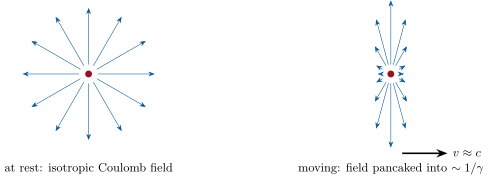
Transform the Coulomb field of a charge into the frame where it moves at : the longitudinal field is unchanged while the transverse one is multiplied by . The once-spherical field flattens into a disc of opening angle around the plane through the charge — accompanied, transverse to the motion, by a magnetic ring . To a stationary observer the passage of an LHC proton () is a sub-picosecond slap of nearly-crossed and : almost a pulse of light — the reason fast beams talk to matter the way photons do.
6.4 Invariants, light, and the headlight effect
Proposition 6.8 (The two field invariants)
From one can build exactly two independent scalars:
the same in every inertial frame. Consequences: if somewhere (with ), some frame sees a pure electric field there; if , some frame sees pure magnetic; and a plane light wave, with and , has both invariants zero — it is light in every frame: no boost can turn it into a static field, only redshift it. One cannot catch up with a light wave; Einstein’s teenage question answers itself in two invariants.
Partial proof. Check invariance under the standard boost by direct substitution of Proposition 6.5 (Exercise 6.6); that no third independent invariant exists is admitted. For the wave: and orthogonality give both zero; a frame with a static field would need a nonzero invariant. ∎
Proposition 6.9 (Four-wave-vector, Doppler and aberration)
A plane wave’s frequency and direction form the null four-vector , . Transforming it gives at once the relativistic Doppler formula of Chapter 4 and the aberration of directions:
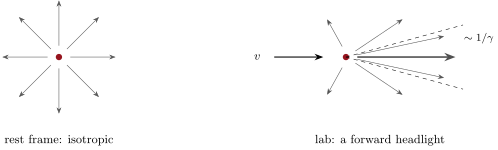
Read backwards, a source radiating isotropically in its rest frame beams, in the lab, half its light into the forward cone : the headlight effect. An electron circling at in a storage ring sweeps a searchlight of X-rays around the ring — the synchrotron light that fills protein-crystallography beamlines.
Partial proof. The phase counts wave crests passing events — an invariant — so must transform as a four-vector. Apply the boost to : the time component gives Doppler, the ratio of spatial components the aberration formula. Setting (the sideways ray of the source frame): , i.e. for — half the sphere folds into the forward cone. ∎
Method 6.10 (Working covariantly)
(1) Identify the four-vectors in play (, , , , ) and prefer their invariant products to components. (2) To transform fields, split into components along and transverse to the boost and apply Proposition 6.5. (3) Check the two invariants before and after — the fastest error detector in the subject. (4) When a magnetic problem looks mysterious, ride with the charge: in its frame only acts. (5) Trust Maxwell: the equations never need relativistic “corrections”, only relativistic reading.

6.5 Exercises
Exercise 6.1 ★
(a) Boost (units of some ) by : compute and check is unchanged. (b) Show that the sum of two four-vectors is a four-vector. (c) Is of a particle a four-vector? And ? (d) Why is “the electric field” alone not part of any four-vector?
Solution
Solution of Exercise 6.1.
(a) : , ; . (b) The transformation is linear, so it distributes over sums. (c) : no — its “time” component is the same for all particles while the mixing demands otherwise; : yes, a four-vector divided by the invariant . (d) ’s three components mix with ’s, not with any scalar: the fields fill a two-index tensor, not a four-vector.
Exercise 6.2 ★
A copper wire of section carries ; conduction-electron density . (a) Compute the drift speed. (b) Write for the electron fluid and for the lattice. (c) Check the continuity equation for each. (d) The wire is neutral: what is for the whole wire, and which component survives?
Solution
Solution of Exercise 6.2.
(a) . (b) Lattice: ; electrons: — their current density points against their drift, and that is the conventional current’s direction. (c) Both are static and uniform: every term vanishes. (d) Total: with — a pure current with no charge, the configuration that makes the wire’s relativity subtle.
Exercise 6.3 ★
(a) From the matrix of , read off which components give and . (b) Write for a pure uniform field , and for the field of a plane wave (, ). (c) Verify on components that reproduces for . (d) Why must be antisymmetric for the force to do no work in the particle’s own frame?
Solution
Solution of Exercise 6.3.
(a) : ; : . (b) For , only and ; for the wave, , (and antisymmetric partners). (c) : matches the matrix. (d) The particle’s rate of energy change is ; in the rest frame and antisymmetry makes : a force that can never work on a particle at rest — the defining property of the magnetic part.
Exercise 6.4 ★
A parallel-plate capacitor at rest holds , no . Give and in a frame moving (a) along (perpendicular to the plates); (b) along (parallel to the plates), and interpret the appearing as the field of the moving surface charges; (c) check the invariants in case (b); (d) in case (b), the plates also contract: which quantities (? ? the plate separation?) change, and consistently with what?
Solution
Solution of Exercise 6.4.
(a) Boost along the field: longitudinal components unchanged, , . (b) Boost along : , — the plates now stream as surface currents , and two opposite current sheets enclose exactly such a field. (c) ; : both preserved. (d) The plates contract along , so , consistent with ; the separation, transverse to the boost, is untouched.
Exercise 6.5 ★★
Motional EMF unified. A conducting rod slides at on rails across a uniform . (a) Lab account: which force drives the electrons along the rod, and what EMF results? (b) Rod-frame account: what field drives them, and where does it come from in Proposition 6.5? (c) Show the two EMFs agree at order . (d) Faraday’s flux rule of the Year 1 volume covered both “moving circuit” and “changing field” cases with one formula: what does relativity say about why that unification had to work?
Solution
Solution of Exercise 6.5.
(a) The magnetic force pushes electrons along the rod: EMF . (b) In the rod’s frame the rod is at rest — no magnetic force on stationary charges — but the transformation delivers : an honest electric field does the driving. (c) at order . (d) It had to work because “motional” and “transformer” EMFs are one phenomenon read in two frames: the flux rule is covariance wearing 1831 clothes — Einstein’s 1905 paper opens with exactly this magnet-and-conductor asymmetry.
Exercise 6.6 ★★
(a) Using Proposition 6.5, verify by direct computation that for a boost along . (b) Verify . (c) A region holds and perpendicular with : find the frame with a pure electric field (direction and speed). (d) Why can no frame make the field of a plane light wave purely electric or purely magnetic?
Solution
Solution of Exercise 6.6.
(a) The components are untouched; for the transverse ones, ; the cross terms cancel and the squares collect times the untransformed combination. (b) Same bookkeeping on . (c) : boost along at ; there and the surviving field is — which squares to the invariant, as it must. (d) A light wave has both invariants zero: any frame must reproduce , never a pure field.
Exercise 6.7 ★★
Crossed fields. In the lab, and with . (a) Show the frame moving at sees a pure magnetic field. (b) Describe the motion of a charge released at rest, seen from that frame and back in the lab (a cycloid drifting at ). (c) The velocity filter of the Year 1 volume passed particles of speed undeflected: re-derive that in one line from (a). (d) What happens, qualitatively, when — and why is the drift-frame trick then impossible?
Solution
Solution of Exercise 6.7.
(a) With : ; : pure, slightly weakened magnetic field. (b) There: a circle at ; back in the lab: that circle plus the uniform drift — a cycloid creeping at perpendicular to both fields, the trajectory of charges in a magnetron. (c) A particle moving at exactly is at rest in the drift frame, where the only field is magnetic and it feels nothing: undeflected. (d) For the required drift exceeds : no such frame; instead a pure- frame exists (previous exercise) and the charge is accelerated without bound along the field.
Exercise 6.8 ★★
The four-wave-vector . (a) Show that requiring the phase to be invariant forces to transform as a four-vector. (b) Derive the longitudinal Doppler formula from its time component. (c) Derive the aberration formula. (d) Starlight aberration: the Earth orbits at ; through what angle does a star’s apparent position sweep over a year? (Bradley measured in 1728 — the first direct proof that the Earth moves.)
Solution
Solution of Exercise 6.8.
(a) The phase counts crest-crossing events, an invariant number; it equals , and invariance of the product for all forces to transform four-vectorially. (b) with ; for , . (c) : the stated formula. (d) : ; over a year the apparent position sweeps an ellipse of that angular semi-axis — Bradley’s aberration.
Exercise 6.9 ★★
A charge moves at constant , . (a) By transforming Coulomb’s field, show that in the transverse plane through the charge the field is boosted to at distance , while straight ahead and behind it is crushed by . (b) Show a stationary observer at distance sees a field pulse of duration . (c) For an LHC proton passing at : peak field and pulse duration. (d) In what precise sense is this pulse “almost light”? (Check and the invariants.)
Solution
Solution of Exercise 6.9.
(a) In the rest frame, Coulomb; boosting multiplies transverse components by (at the transverse plane, ) while the field along the motion, evaluated ahead or behind at lab distance , maps to a rest-frame distance : reduced by . (b) The pancake of angular width sweeps past at : duration . (c) , lasting . (d) and both invariants are : locally indistinguishable from a light pulse — the basis of the “equivalent photon” description of fast-charge collisions.
Exercise 6.10 ★★★
Chasing a light wave. A plane wave has , . An observer chases it at . (a) Transform the fields: show and . (b) Show the frequency transforms by the same factor: the wave stays a wave, redshifted, with always. (c) What becomes of the wave’s energy density (proportional to ) and of the number of photons? (d) Conclude: what would “riding alongside a light beam” require, and which invariant forbids it?
Solution
Solution of Exercise 6.10.
(a) , and by the same algebra. (b) The phase transforms with the same Doppler factor: same null wave, redder and weaker. (c) Energy density falls as the Doppler factor squared; the photon number is unchanged — each photon’s carries the whole factor. (d) “Riding alongside” means the factor with : the wave never becomes static because its invariants are zero — there is no frame in which light stands still, which is where this book’s relativity began.
Exercise 6.11 ★★★
Synchrotron light and the death of circular electron machines. An ultrarelativistic charge on a circle of radius radiates the power (admitted — Larmor’s formula of the Year 2 volume, boosted). (a) Show the energy lost per turn is . (b) LEP: electrons at on : compute and per turn — what fraction of the beam energy is re-bought every lap? (c) LHC: protons at , same tunnel: compute per turn and compare. (d) Explain, with the factor, why the electrons’ successor is a linear collider or a much larger ring, and why proton rings survive.
Solution
Solution of Exercise 6.11.
(a) Per turn, : the stated result. (b) : per turn — three per cent of the beam energy re-injected every lap; LEP’s klystrons were the largest radio transmitter on Earth. (c) Protons: , smaller by : about per turn — negligible. (d) : at equal energy the electron radiates times more; hence linear colliders (radiate once, not per turn) or gigantic rings for electrons, while proton rings scale happily to .
Exercise 6.12 ★★★
The relativistic cyclotron. A charge in a uniform , at relativistic speed. (a) From with constant, show the orbit is a circle traversed at : the cyclotron frequency drops with energy. (b) A classical cyclotron pushes at fixed : show that after turns with growing linearly to its final value , the accumulated phase slip reaches a quarter RF period when ; for turns, what proton kinetic energy is that, and how does it compare with the historical ceiling of classical cyclotrons (some , bought with extra margin and voltage)? (c) Two cures exist: ramp the frequency (synchrocyclotron) or shape to grow as (isochronous cyclotron): explain each in one sentence. (d) The PSI isochronous cyclotron delivers protons: by what factor does its field at the rim exceed the central field?
Solution
Solution of Exercise 6.12.
(a) is constant (no work); turns at rate . (b) Slip per turn ; with growing linearly to , total slip ; a quarter period is : . For : , — the right scale; real machines stretched it to with high dee voltages (fewer turns). (c) Synchrocyclotron: sweep the RF downward during each pulse to follow . Isochronous cyclotron: let grow so the ratio never changes and the beam stays continuous. (d) : the rim field must exceed the central field by that factor.
6.6 Problem: Magnetism at a snail’s pace
Problem 6.1
Weekend problem — how a imbalance runs every motor
Electrons drift through a lamp cord more slowly than honey creeps, and for that drift is — yet the magnetic force it produces lifts cars in scrapyards. This problem does the full two-frame accounting for a straight wire and a moving charge, and finds relativity hiding in every electromagnet. Data: copper wire, section , current , conduction-electron density ; test charge at distance , moving parallel to the wire at (an ion-beam speed, to keep numbers visible); .
Part I — The lab-frame account.
- Compute the electrons’ drift speed , and .
- Model the wire as two superposed line charges: the lattice at rest and the electrons drifting at , with . Compute .
- Compute at the charge’s position and the magnetic force on it — direction included, for parallel to the conventional current (recall: parallel currents attract).
- Why is there no electric force in the lab?
- The same wire’s electric field if it carried a net charge of just one electron in excess per metre: compare the force it would exert on with the magnetic force of question 3, and conclude how precisely “neutral” must be measured before magnetism can be attributed.
- A charge at : is the force of question 3 measurable? (Compare with the weight of a grain of sand, .)
Part II — Changing seats. Boost to the frame of the test charge (speed along the wire).
- In that frame, what are the velocities of the lattice and of the electrons (which drift opposite to , hence gain speed in this boost — compose them properly)?
Integrated over the wire’s section, the four-current per unit length is with here. Transform it and show the wire’s line charge in the new frame is
- Evaluate , in coulombs per metre and in electron charges per metre. Which stream got denser, and why (contract each stream separately if you prefer)?
- Compute the electric field at the charge, and the electric force on it.
- Compare with the lab’s from Part I, and explain the residual factor (which four-vector’s transformation law relates the forces?).
- In this frame there is also a magnetic field (the wire still carries current): why does it exert no force here?
Part III — The moral of the numbers.
- The relative imbalance : compute it and write it as .
- How can an effect of order of the wire’s charge produce a macroscopic force? (What enormous number does it multiply?)
- Two parallel wires with each at : compute the force per metre, and check it against the definition-grade value newtons per metre.
- An electromagnet is ten thousand turns of this story: estimate the field of a -turn coil per metre carrying (solenoid formula of the Year 1 volume), and the force per square centimetre it exerts on iron ().
- If relativity were switched off ( in the transformation), what would remain of , of ’s force, of motors and scrapyard magnets?
- Why does the test charge at rest near the wire feel nothing, even though the electrons stream past it? (Which cancellation protects it, and to what accuracy?)
Part IV — Beyond the wire.
- The Year 2 volume derived magnetic fields from Ampère’s law with currents as given sources. What does this chapter add to that account — what is the magnetic field, seen from this problem?
- Iron magnets have no battery: what plays the role of the current in permanent magnetism (one sentence; the honest microscopic answer is quantum and waits five chapters)?
- A single electron beam in vacuum (no lattice): does a co-moving observer see it attract or repel itself more than a lab observer does? Reconcile the two frames’ accounts of a beam’s self-pinching.
- Make the last point quantitative: show that two parallel like-charged beams moving together at repel with a net force (electric repulsion minus magnetic attraction) reduced by exactly from its rest value — and say which frame’s account makes the factor obvious.
- The energy for a lamp arrives at nearly while its electrons drift a metre per hour: what actually carries the energy along the cord (recall the Poynting vector of the Year 2 volume)?
- Estimate for the electrons of this problem and a pedestrian test charge (): even there, the force is first-order measurable with a compass needle — who demonstrated current deflecting a compass, and in what year?
- Summarise the named result: a neutral wire, watched from a seat moving at , carries of relativistic charge — and that -order bookkeeping error of length contraction, multiplied by electrons, is the entire magnetic force of the lab.
Solution
Solution of Problem 6.1.
1. ; . 2. — fourteen kilocoulombs per metre in each stream. 3. ; , directed toward the wire (parallel currents attract). 4. The two line charges cancel exactly: , no field to zeroth order. 5. One excess electron per metre: , force — times smaller than the magnetic force. The wire could hide a hundred million stray electrons per metre before electrostatics rivalled magnetism: attributing the force to is safe. 6. is twenty sand-grain weights: easily measurable. 7. Lattice: . Electrons (drifting at opposite , i.e. opposite the boost): speed — faster than the lattice. 8. . 9. : about excess electrons per metre. The electron stream, faster in this frame, is the denser one — each stream contracts by its own . 10. , pointing at the wire; force , attractive. 11. Identical to up to the factor : exactly the transformation law of a transverse force (the four-force), . 12. The wire still carries a (larger) current, hence — but our charge is at rest here, and a magnetic field grips only moving charges. 13. . 14. It multiplies elementary charges per metre: electrons per metre — macroscopic. Matter is so enormously charged that its neutrality is a razor’s edge; relativity tips the razor. 15. — the formula that once defined the ampere. 16. ; magnetic pressure : whole cars hang on integrated relativity. 17. kills , and with it the force, the field’s magnetic part, motors, dynamos and scrapyard cranes: magnetism has no non-relativistic existence. 18. At rest the charge sees the lab’s neutral wire: the two streams cancel to whatever precision matter is neutral — known experimentally to fantastic accuracy — and no force acts. 19. That the “given sources” picture was one frame’s slice of a single tensor: is the piece of the electromagnetic field that a given observer’s motion assigns to currents rather than charges. 20. Electron spin: each electron is an elementary magnet (an intrinsic, quantum “current”), and iron is matter in which these align — Chapter 12 and Chapter 22 take this up. 21. In the beam’s rest frame the repulsion is pure Coulomb and maximal; in the lab, the parallel currents’ magnetic attraction nearly cancels it. No contradiction: the lab’s transverse force is the rest frame’s divided by , and slower dynamics (time dilation) completes the account. 22. Net lab force per the transformation; in the rest frame the factor is transparent: pure electrostatics, with the blow-up watched through dilated time. 23. The Poynting vector: energy streams through the fields around the conductors at nearly , the electrons merely marshalling it; the cord’s copper is a guide, not a pipe. 24. — and yet Ørsted saw his compass swing beside a wire in 1820: the multiplier of charges was already at work a century before anyone could name it. 25. A neutral wire, viewed from , carries : length contraction’s bookkeeping difference, multiplied by charges per metre, is the magnetic force — all of magnetism is relativity audited at a snail’s pace.