University Physics — Year 3 · Bachelor Year 3
19Quantum Statistics
Copper’s conduction electrons are a gas a thousand times denser than air — yet they add almost nothing to copper’s heat capacity, a scandal that haunted classical physics for fifty years. A cloud of rubidium atoms, cooled to a hundred billionths of a kelvin, suddenly collapses into a single quantum state ten thousand atoms deep. A dead star the mass of the Sun and the size of the Earth refuses to shrink further, held up by nothing but the exclusion principle. All three are the same chapter of physics: what happens to a gas when and the occupation formulas of Chapter 18 depart from Boltzmann. Fermions build seas — cold, rigid, pressurised; bosons build condensates — gregarious, coherent, superfluid. Between the Fermi sea’s silent majority and the condensate’s stampede lies most of modern condensed-matter and low-temperature physics, and the fate of the stars.
19.1 Gases of occupations
Proposition 19.1 (The quantum gas machinery)
For non-interacting particles in a box, sums over levels become integrals over the density of states of Proposition 7.5 (per spin state, ):
with the Fermi–Dirac or Bose–Einstein occupation. The first equation fixes ; the second delivers the thermodynamics. In the dilute limit both statistics collapse onto Boltzmann and the classical gas returns; the quantum regimes begin where the wave packets touch.
Proof. Admitted at this level. ∎
19.2 The Fermi sea
Theorem 19.2 (The degenerate Fermi gas)
At , fermions fill every level up to the Fermi energy
with mean energy per particle and the degeneracy pressure
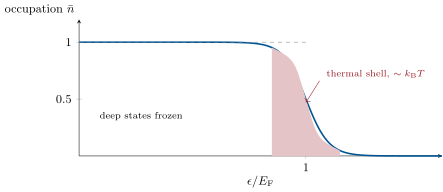
a pressure at absolute zero, of purely quantum origin — the stiffness of every metal’s electron gas and the support of dead stars. At , only the electrons within of the surface of this Fermi sea can respond to anything: the fraction is the master key to metallic behaviour.
Partial proof. Fill up to : inverting gives the stated (Exercise 7.8); by one more integral. Pressure: compressing the box raises every level as , so and — with , the stated law. ∎
Example 19.3 (The heat-capacity scandal, resolved)
Classically, copper’s free electron per atom should add to the heat capacity — on top of Dulong–Petit. Measured: about at room temperature. The sea explains: with , only the fraction of electrons can be thermally excited, each by :
(the exact Sommerfeld coefficient; Exercise 19.12). Linear in , it is buried under the lattice’s at ordinary temperatures but dominates below a few kelvin — exactly as calorimeters find, resolving in one stroke the puzzle of the electrons that carry current but not heat capacity.
Example 19.4 (Stars held up by exclusion)
A white dwarf (Exercise 14.11) balances gravity against electron degeneracy pressure. Since stiffens faster than gravity’s demands as the star shrinks, an equilibrium radius exists at any modest mass — with the eerie scaling : heavier dwarfs are smaller. Squeezed harder, the electrons turn relativistic, the pressure law softens to , and the balance fails at a unique mass, the Chandrasekhar limit (Problem 19.1) — beyond it, collapse to a neutron star: a Fermi sea of neutrons at nuclear density, the same physics at times the density.
19.3 The Bose stampede
Theorem 19.5 (Bose–Einstein condensation)
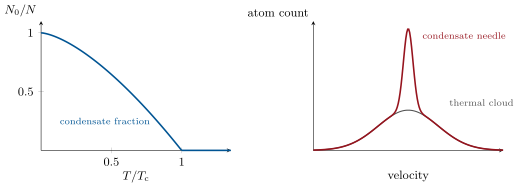
For a gas of conserved bosons, the excited states can hold at most particles (the integral of at its ceiling ). Below the critical temperature
the surplus has nowhere to go but the single ground state: a macroscopic population
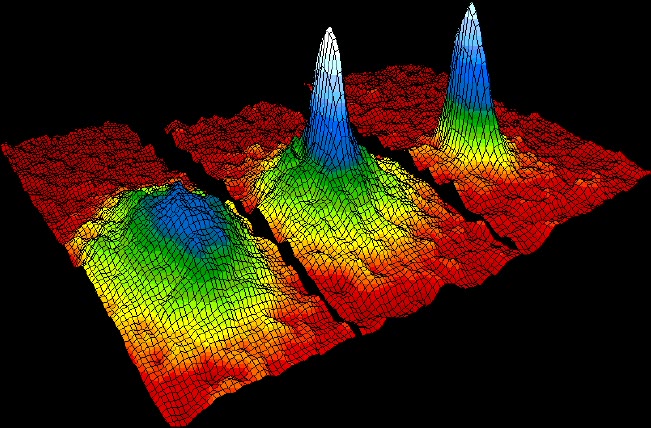
condenses into one quantum state — matter behaving as one giant wave function. Predicted by Einstein in 1925 from Bose’s photon statistics; realised in dilute rubidium in 1995 at (Nobel 2001), announced by the tell-tale bimodal velocity distribution: a thermal cloud with a needle of zero-velocity condensate rising from its centre.
Proof. Admitted at this level. ∎
Example 19.6 (Helium, the veteran superfluid)
Liquid He (bosonic) transforms at into a superfluid: zero viscosity through the finest capillaries, film flow over container walls, fountain effects, and circulation quantised in units of — a condensate’s macroscopic phase at work, shifted from the ideal-gas prediction ( for helium’s density) by interactions but unmistakably the same phenomenon. Fermionic He cannot condense alone: its atoms must first pair (like the electrons of a superconductor, Chapter 24) into composite bosons — and superfluidity duly arrives, but at , a thousand times colder: two isotopes, one lesson — statistics is destiny.
Method 19.7 (Which statistics, which regime)
(1) Compute first: means Boltzmann and chapter 17 suffices. (2) Degenerate fermions: think in and ; responses (heat capacity, susceptibility, scattering) carry the factor or sample only the Fermi surface. (3) Degenerate bosons: compare with ; below it, split the gas into condensate plus thermal cloud. (4) Pressures: fermionic stiffness (or relativistic) against whatever squeezes. (5) Composite particles: count constituent fermions to choose the statistics — and remember pairing can convert one statistics into the other.

19.4 Exercises
Exercise 19.1 ★
Compute and for (a) copper (); (b) sodium (); (c) liquid He (, ); (d) rank against room temperature and comment on who is degenerate when.
Solution
Solution of Exercise 19.1.
(a) , . (b) , . (c) With : , (ideal-gas value; interactions lower it). (d) Metal electrons: degenerate at every terrestrial temperature; He: only below a few kelvin; never touches a metal’s Fermi scale.
Exercise 19.2 ★
(a) Show at . (b) Compute the electrons’ r.m.s. speed in copper. (c) That speed corresponds classically to what temperature? (d) Why does a cold metal contain electrons moving at a hundredth of light speed without radiating that energy away?
Solution
Solution of Exercise 19.2.
(a) from . (b) ; r.m.s. . (c) : . (d) There is nowhere to go: every lower state is filled, so no photon can be emitted and no collision can slow them — speed without heat, by exclusion.
Exercise 19.3 ★
Degeneracy pressure of copper’s electrons: (a) evaluate in pascals and atmospheres. (b) Why does the metal not explode (what pulls back)? (c) This pressure resists compression: relate to metals’ low compressibility. (d) Estimate the bulk modulus and compare with copper’s measured .
Solution
Solution of Exercise 19.3.
(a) atmospheres. (b) The Coulomb attraction of the ion lattice: the metal is the truce between the two (Exercise 19.11). (c) Compressing raises steeply (): metals resist. (d) against the measured : half the stiffness of copper is pure exclusion.
Exercise 19.4 ★
BEC thresholds. (a) Compute for rubidium-87 () at . (b) For the same , what would hydrogen atoms have? (c) Why do experiments use dilute gases at nanokelvins rather than dense gases at millikelvins (what happens chemically at high density and low temperature)? (d) Check the consistency rule on your rubidium numbers.
Solution
Solution of Exercise 19.4.
(a) — the JILA condensate appeared at : same physics, slightly lower peak density. (b) : . (c) At high density and such cold, every gas but spin-polarised hydrogen solidifies; three-body collisions make molecules. The trick is a dilute, metastable gas cold enough that compensates the dilution. (d) : , as the rule requires.
Exercise 19.5 ★★
Two heat capacities. In a metal, (electrons; lattice). (a) Using Example 19.3 and the Debye-like lattice term , estimate the crossover temperature for copper (, ). (b) At , the electron share in percent. (c) At ? (d) Why do experimenters plot against , and what do the intercept and slope of that straight line deliver?
Solution
Solution of Exercise 19.5.
(a) at : for copper . (b) . (c) At the lattice term has collapsed as : electrons carry times more — calorimetry becomes electron spectroscopy. (d) is a straight line in : intercept measures the density of states at the Fermi level, slope the Debye temperature — two numbers per metal from one plot.
Exercise 19.6 ★★
A white dwarf of one solar mass () and Earth radius (), one electron per two nucleons. (a) Compute and (non-relativistic formula). (b) Compare with and with at the interior’s : justify “cold” and “nearly relativistic” simultaneously. (c) Compare the degeneracy pressure with the gravitational pressure estimate : same order? (d) What happens qualitatively to each side of the balance if grows?
Solution
Solution of Exercise 19.6.
(a) ; ; . (b) Half the electron’s rest energy (edge of relativistic), yet three hundred times (): white-hot and quantum-cold at once. (c) against : the same order — the star is exactly this balance. (d) More mass: gravity’s side grows as , and the star must shrink (), driving toward the relativistic softening.
Exercise 19.7 ★★
Neutron matter. A neutron star packs into . (a) Compute the neutron density and compare with nuclear density (). (b) Compute for the neutrons (non-relativistic; ) and check how relativistic they are. (c) Why did the star’s electrons disappear (inverse beta decay: — what made the electrons’ pay for it)? (d) One teaspoon of this matter weighs how much?
Solution
Solution of Exercise 19.7.
(a) : about twice nuclear density — a nucleus the size of a city. (b) : , a tenth of : relativity is knocking. (c) The electrons’ Fermi energy rose past the cost of : capture became profitable, and the star traded its electrons and protons for neutrons. (d) : a teaspoon outweighing a mountain range.
Exercise 19.8 ★★
Bosons without number. (a) Photons have always: why can they not undergo the condensation of Theorem 19.5 (what does the gas do instead when cooled)? (b) Which conservation law do rubidium atoms have that photons lack? (c) In 2010 a photon BEC was made, in a dye-filled cavity where photons thermalise and their number is effectively fixed: which ingredient did the dye cavity restore? (d) Phonons in a crystal: condensation or not, and why?
Solution
Solution of Exercise 19.8.
(a) Cooling a cavity simply removes photons (walls absorb them): with no number to conserve, stays pinned at zero and no surplus ever piles into the ground mode — the gas dims instead of condensing. (b) Atom number is conserved on every laboratory timescale. (c) The dye repeatedly absorbs and re-emits photons without losing them on the thermalisation timescale: an effectively conserved photon number (and an effective mass from the cavity) — and condensation duly appears. (d) Phonons: created and destroyed freely, : no condensation — a crystal’s “phonon gas” just freezes out.
Exercise 19.9 ★★
Helium’s two isotopes. (a) Compute the ideal-gas for liquid He (, ) and compare with . (b) Why is the agreement only rough (what does “ideal” ignore in a liquid)? (c) He at almost the same density stays normal down to millikelvins: state the obstacle and the workaround nature found. (d) Composite logic check: a He pair contains an even number of fermions — boson; Li holds fermions: classify it, and name the celebrated cold-gas experiments that exploit exactly this Li–Li contrast.
Solution
Solution of Exercise 19.9.
(a) against the measured . (b) Liquid helium is dense and strongly interacting: “ideal” drops the interactions that shift (and reshape) the transition. (c) He atoms are fermions: no condensation without pairing; attractive interactions bind Cooper-like pairs only below , and the paired liquid then superflows. (d) Nine fermions: Li is a fermion (while Li is a boson) — the pair of lithium isotopes lets one laboratory study a Fermi sea and a condensate in the same oven.
Exercise 19.10 ★★★
honestly. (a) Write at and reduce it, with , to . (b) Given , obtain the ceiling and . (c) Derive the condensate fraction . (d) Why does the same argument produce no condensation in a two-dimensional box (how does change, and what happens to the integral’s convergence)?
Solution
Solution of Exercise 19.10.
(a) Substitute and scale out . (b) The integral’s value gives ; setting defines . (c) Below , ; the remainder is . (d) In two dimensions is constant and diverges at the bottom: the excited states can always absorb everyone — no macroscopic ground-state population at any .
Exercise 19.11 ★★★
Why metals hold together. Model a metal as electrons of density (Fermi energy cost per electron) attracted to a neutralising ion background (Coulomb gain per electron ). (a) Write the energy per electron and show it has a minimum. (b) Show the equilibrium electron spacing is of order — metallic densities are not accidents. (c) Estimate the cohesive energy scale at the minimum, in eV. (d) What role does degeneracy pressure play in this bound state (what stops the Coulomb collapse)?
Solution
Solution of Exercise 19.11.
(a) at : a genuine minimum. (b) With and , the equilibrium spacing : metals are dense because the Bohr radius says so. (c) — electron-volt cohesion, as measured. (d) Degeneracy pressure is the repulsive half of the truce: without it the Coulomb term would crush the lattice to a point — matter’s bulk is Pauli’s.
Exercise 19.12 ★★★
Sommerfeld’s shell, quantified. (a) Argue: of electrons, only sit in the active shell, each holding extra energy : derive up to a constant. (b) With , recover (the exact constant is ). (c) The same shell logic gives Pauli’s temperature-independent spin susceptibility: only shell electrons can flip — but the shell grows as while each contribution falls as : show the cancellation. (d) State the general moral for degenerate fermions: every response is the classical one times or its surface-only analogue.
Solution
Solution of Exercise 19.12.
(a) Active electrons: ; energy each: ; differentiate . (b) gives — the exact replaces the 3. (c) Flippable spins ; each contributes alignment : the ’s cancel — Pauli’s susceptibility is flat where Curie’s (Exercise 17.11) falls as : a diagnostic of degeneracy. (d) Degenerate fermions respond only at their surface: multiply any classical answer by , or restrict it to the Fermi shell.
19.5 Problem: The heaviest possible white dwarf
Problem 19.1
Weekend problem — the Chandrasekhar limit, and the candles it lit
In 1930, aged nineteen, Subrahmanyan Chandrasekhar computed on the boat to England that electron degeneracy can support a dead star only up to a definite mass. The result — resisted bitterly by Eddington — underlies neutron stars, black holes and the supernova “standard candles” that revealed the accelerating universe. This problem builds it by scaling. Data: ; one electron per nucleons; ; ; .
Part I — Balance of two energies. For a star of mass , radius , treat the energies per unit mass by scaling.
- Gravitational energy: — recall its origin.
- Electron count and density : write the non-relativistic Fermi energy scale as a function of and .
- Show the total kinetic (degeneracy) energy scales as .
- Minimise over and show the equilibrium radius is .
- Read off the scaling : heavier dwarfs are smaller. Why does that already smell of trouble?
- Evaluate for and compare with Sirius B’s measured .
Part II — Relativity pulls the floor away.
- As shrinks, grows: estimate the density at which , and the corresponding dwarf mass region.
- In the ultrarelativistic regime each electron’s energy is : show the kinetic energy becomes .
- Both energies now scale as : conclude that equilibrium no longer selects a radius — compare the two coefficients instead.
Setting , derive the critical electron number and the mass
- Evaluate the dimensionless ratio — one of physics’ great pure numbers — and then in solar masses (the exact treatment gives ).
- Interpret the formula: which three constants conspire, and why does a quantum limit on a star carry ?
Part III — Beyond the limit.
- A dwarf pushed past (accretion from a companion): what supports it next, and at what radius scale (replace by and by 1 in Part I’s radius)?
- Show the neutron star’s own relativistic limit is of the same order — nature allows only a factor-two reprieve (observed maximum ). What waits beyond?
- During the collapse to a neutron star, of gravitational energy is released: evaluate it for , , and compare with the Sun’s entire output ().
- Almost all of it leaves as neutrinos in seconds: which 1987 observation confirmed this picture spectacularly?
- The collapsing core’s rebound and neutrino push blow off the envelope: a core-collapse supernova. Distinguish it, in one sentence each, from the thermonuclear (type Ia) supernova of a white dwarf igniting at the Chandrasekhar threshold.
- Why does detonation at a universal mass make type Ia supernovae nearly identical — and hence usable as standard candles?
Part IV — The candles and the cosmos.
- A standard candle’s apparent brightness gives its distance: state the inverse-square logic and why standard is the operative word.
- In 1998 two teams found distant type Ia supernovae fainter than expected: state the inference (expansion accelerating — dark energy) and why the candle’s reliability was the crux.
- List the chain of this problem in one line: Pauli degeneracy pressure uniform explosions cosmic acceleration.
- Eddington mocked the result (“a star committing absurdities”); Chandrasekhar received the Nobel Prize fifty-three years later: what does the episode teach about following equations past comfortable conclusions?
- Sirius B’s spectrum in 1915 implied a tonne per cubic centimetre — “nonsense” until Fowler, within months of Fermi’s statistics in 1926, explained the star as a degenerate gas: state why the puzzle was unsolvable one year and routine the next.
- Surveys of thousands of white dwarfs find masses clustering near with none above : which two predictions of this problem does that single histogram confirm?
- Summarise the named result: — three constants of nature setting the heaviest possible white dwarf, the trigger mass of the universe’s calibrated explosions.
Solution
Solution of Problem 19.1.
1. The energy released assembling the star from dispersed matter — negative, deeper for compactness. 2. . 3. . 4. Minimising gives : . 5. : — adding mass shrinks the star, so density and grow without bound: the non-relativistic support is living on credit. 6. : — the right order beside Sirius B’s (our scaling dropped factors of order a few). 7. at , i.e. –: the regime of the heaviest dwarfs. 8. Each electron: ; total: . 9. With both terms , radius drops out: stability is decided by whether the kinetic coefficient exceeds the gravitational one — a pure mass criterion. 10. Equate: , and : the stated formula. 11. ; — the exact computation sharpens the order-of-magnitude to . 12. (the pressure is quantum), (its relativistic softening), (the adversary): a star-sized number built from three microscopic constants — quantum mechanics legislating for objects of particles. 13. Neutron degeneracy, at radius smaller by (times the bookkeeping): kilometres — the neutron star. 14. The same three constants with throughout give the same mass scale: neutron stars top out near ; beyond, no pressure law wins — a black hole. 15. : several hundred times the Sun’s entire ten-billion-year output, released in seconds. 16. Supernova 1987A: two dozen neutrinos, arriving hours before the light brightened, carrying just the predicted energy — the collapse heard directly. 17. Core collapse: a massive star’s iron core implodes past every pressure floor; the envelope is blown off. Type Ia: a white dwarf fed to the threshold ignites its carbon in a thermonuclear flash that unbinds the entire star. 18. Same trigger mass, same fuel, same energy release: nearly identical light curves — calibrated bombs. 19. Knowing the absolute brightness, the observed brightness gives distance by the inverse square; without “standard” the ladder collapses. 20. Too faint means too far: the expansion has been speeding up — dark energy, resting evidentially on the candles’ uniformity (hence the care about their physics). 21. Exclusion principle degeneracy pressure a universal limiting mass standardised explosions the measured acceleration of the universe. 22. Follow the mathematics wherever it leads: the “absurd” behaviour of stars beyond the limit turned out to be neutron stars and black holes — both now catalogued by the thousand. 23. In 1915 no known physics allowed matter a tonne per cubic centimetre; in 1926 Fermi–Dirac statistics made it the default state of any cold dense gas: the observation waited for the statistics, not the reverse. 24. That dwarfs exist stably across a range of masses (the branch), and that the branch ends at : both are drawn in that histogram. 25. : three constants fix the heaviest white dwarf — and thereby the trigger mass of the standard candles that weighed the universe’s fate.