书籍暂未推出简体中文版——当前显示英文版。
High School Earth and Space Sciences · 10–12 年级
19The Continental Crust
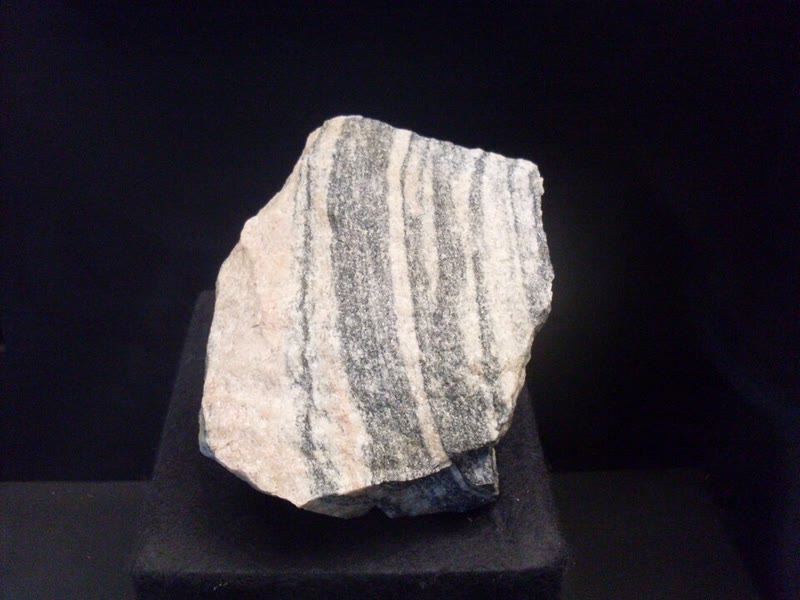
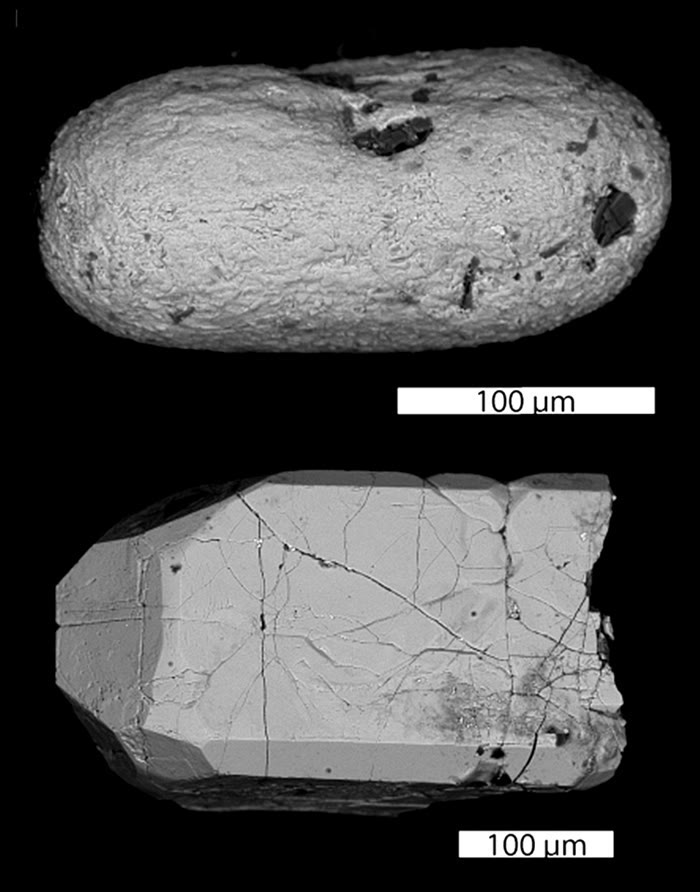
In northwestern Canada, near the Acasta River, crops out a grey rock streaked with pale and dark bands. It has been dated at 4.00 to 4.03 billion years: the Acasta gneiss, the oldest rock known. Older still are grains of the mineral zircon, each a fraction of a millimetre long, found in old sedimentary rocks of the Jack Hills of Western Australia. Worn from older rocks and carried by water before they were buried, they crystallised 4.4 billion years ago, and they show that a crust existed then. No ocean floor is even a twentieth as old. This chapter asks what the continents are made of, and why they last.
You already know
The crust ends at the Moho, below which lies the denser mantle (Chapter 11). The oceanic crust is about of basalt and gabbro made at the ridges (Chapter 14), and it is never older than about 190 million years (Chapter 10). The outer layers float on the asthenosphere: in Airy’s model, a region that stands a height higher has a crust thicker by (Chapter 12). Igneous rocks are named by their texture and their silica content: mafic from 45 to , intermediate from 55 to 65, felsic from 65 to 75 (Chapter 17). Radioactive elements decay at a steady rate, which gives rocks their ages (the physics books; Chapter 25).
19.1 What the continents are made of
Definition 19.1 (Continental crust)
The continental crust is the crust that forms the continents, including the parts of them under shallow seas. It is thick, of granitic composition on average in its upper part, light, and it can be very old.
The continents are larger than the land. The edges of the continental crust lie under the sea, on the continental shelves: mapped this way, the continental crust covers million , of the Earth’s surface, of which almost a third, , is submerged. Counted with its submerged parts, the mean height of the continental crust is only about above sea level.
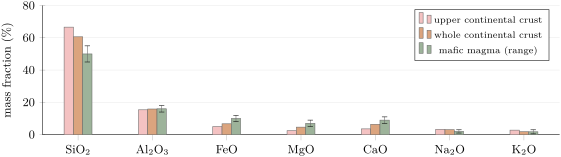
At the surface, the continents show every kind of rock — sediments, volcanic rocks, metamorphic rocks — but beneath the sedimentary cover the continental crust is made mostly of granitic rocks and of the metamorphic and plutonic rocks of old mountain roots. On average, the whole continental crust holds silica; its upper part is richer, , so its deeper part must be poorer.
19.2 A thick, light crust
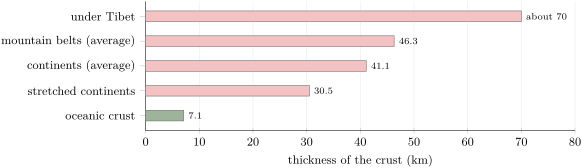
Seismic surveys find the Moho beneath the continents at very different depths. Averaged over all continents, weighted by area, the crust is about thick; it is thinner, about , where the crust has been stretched, and thicker, about on average, in mountain belts. Away from mountain belts it is commonly 35 to thick; under the highest ranges, 50 to , about under parts of Tibet. The oceanic crust is about thick: the continental crust is five to ten times thicker.
The continental crust is also light. Its mean density is about . The basalt and gabbro of the oceanic crust, rich in pyroxene and olivine, come to about (Chapter 16), and the mantle just beneath the Moho to about . A thick and light crust floats high: this is why the continents stand above the ocean floor, and why a continent cannot be dragged down at a subduction zone. Where a continent arrives at a trench, it is too light to sink; subduction stops, and the two continents collide (Chapter 20). Continental crust, once made, is hard to destroy.
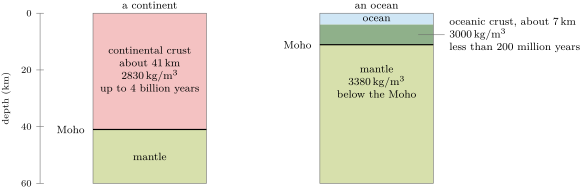
Method 19.2 (Comparing continental and oceanic crust)
To tell which kind of crust lies under a place, compare five properties:
- the thickness: about for oceanic crust, 30 to for continental crust;
- the rocks: basalt and gabbro, or granite, gneiss and their relatives, under a cover of sediments;
- the composition: about silica, or about 60 and more;
- the density: about , or about ;
- the age: less than 200 million years, or up to 4 billion years.
The elevation is a clue, not a test: most of the ocean floor lies kilometres deep, but the edges of the continents lie under shallow seas.
Example 19.3 (A shallow sea floor)
A survey ship finds a sea floor deep. Seismic profiles put the Moho below the sea floor; a drill core brings up, under the sediments, a coarse-grained rock of quartz, feldspar and mica. Which crust lies there?
Solution. Thickness about : continental, thinner than average, as where it has been stretched. A granite under the sediments: continental. The sea floor is a continental shelf, one of the submerged parts that make up almost a third of the continents.
How heavy is all this crust? A layer that is thin compared with the Earth’s radius has a simple mass.
Proposition 19.4 (The mass of a thin layer)
A layer of thickness and density covering a fraction of the surface of a planet of radius and mean density has a mass , and its share of the planet’s mass is
Proof. The surface of the planet is ; the layer covers and, being thin, has a volume close to that area times , so . The planet’s mass is . Dividing, . ∎
For the oceanic crust — the remaining of the surface, , about — with and , the share is : about a tenth of a percent of the Earth’s mass. The weekend problem does the same for the continents.
19.3 An old crust
The ocean floor is young everywhere: three quarters of it is younger than 100 million years, and almost none older than 190 million years. The continents are another matter. Their rocks span almost the whole history of the Earth, from the Acasta gneiss, 4.03 billion years old, to lavas erupted today, and grains of zircon carry the record back to 4.4 billion years.
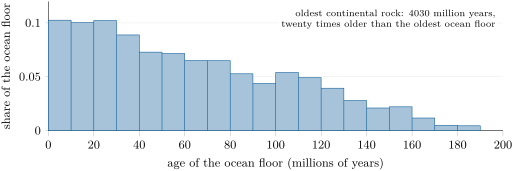
The oldest parts of the continents form their cores.
Definition 19.5 (Craton)
A craton is an old and stable core of a continent: continental crust formed and deformed more than a billion years ago, which has since cooled and no longer deforms. Its rocks are mostly metamorphic and plutonic rocks, the deep roots of former mountains.
Around the cratons lie belts of younger deformed rocks, the eroded roots of mountain ranges built later; the belts tend to be younger towards the edges of a continent. A continent has grown by mountain building that welded new crust to its edges, around an ancient core. In Canada, where the craton’s rocks lie at the surface, gneisses and granites 1 to 3 billion years old crop out, here on a lakeshore.
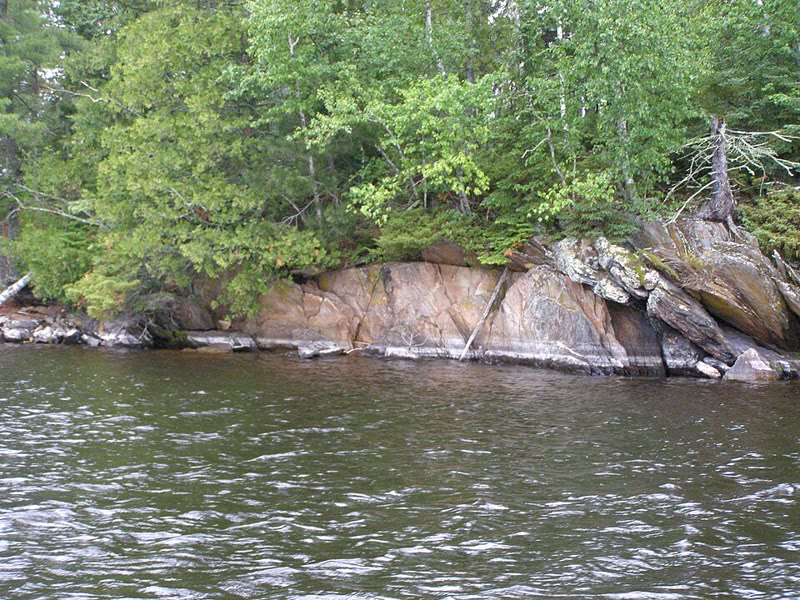
Why does the continental crust last, while the ocean floor is always young? The oceanic crust is dense: it sinks back into the mantle at subduction zones, and none of it survives much more than 200 million years. The continental crust is too light to sink; it can be worn down by erosion, stretched or crumpled, but it stays at the surface. The rocks of a continent are an archive of four billion years.
19.4 Mountain roots
The higher the mountains, the thicker the crust beneath them.
Definition 19.6 (Mountain root)
The root of a mountain range is the part of its thickened crust that reaches down into the mantle below the level of the Moho beneath the surrounding lowlands.
Airy’s model predicts the root: a range standing above its surroundings has a root , about five times its height with and (Proposition 12.5). Two kinds of measurements see the roots. Seismic surveys find the Moho deeper under ranges: 50 to under many mountain belts, about under parts of Tibet. Gravity is weaker over mountain ranges than their visible mass would suggest: the light root, standing in place of denser mantle, makes up a deficit of mass at depth, and the measured gravity anomalies follow the topography and the thickness of the crust found by seismology. The continents float, and their mountains float highest.
19.5 Exercises
Exercise 19.1 ★
Copy and complete for the continental and the oceanic crust: thickness; main rocks; silica content; density; greatest age.
Solution
Solution of Exercise 19.1.
Continental crust: 30 to , about on average; granitic rocks, gneisses and other metamorphic and plutonic rocks under a sedimentary cover; about silica on average; about ; up to 4.03 billion years (grains 4.4). Oceanic crust: about ; basalt and gabbro; about silica; about ; less than 200 million years.
Exercise 19.2 ★
The whole continental crust holds silica, its upper part . Using the silica classes of igneous rocks, is each mafic, intermediate or felsic? Name a plutonic rock of the same composition.
Exercise 19.3 ★
Why can the oceanic crust sink into the mantle at a subduction zone, and not the continental crust? Answer with densities.
Solution
Solution of Exercise 19.3.
The oceanic crust, about , sits on lithospheric mantle, and the old, cold oceanic lithosphere as a whole is dense enough to sink. The continental crust, about , far lighter than the mantle (about ), is too buoyant: a continent arriving at a trench stops subduction.
Exercise 19.4 ★
(1) What is a craton? (2) How old are the rocks of a craton at least? (3) Which kinds of rocks make it up?
Solution
Solution of Exercise 19.4.
(1) An old, stable core of a continent, which no longer deforms. (2) More than a billion years. (3) Metamorphic and plutonic rocks, the deep roots of former mountains.
Exercise 19.5 ★
The oldest ocean floor is about 190 million years old, the Acasta gneiss 4.03 billion years. How many times older is the gneiss? Why is there no ocean floor as old?
Solution
Solution of Exercise 19.5.
times. The ocean floor is made at the ridges and destroyed at subduction zones: none survives much more than 200 million years.
Exercise 19.6 ★★
The continental crust covers million , of which is under the sea. (1) What area of continental crust lies under the sea? (2) What area stands above it? (3) The Earth’s surface is with . What share of the surface does the continental crust cover?
Solution
Solution of Exercise 19.6.
(1) . (2) . (3) ; : .
Exercise 19.7 ★★
Compute the mass of a column of crust in cross-section, from the surface to the Moho: (1) through of continental crust at ; (2) through of oceanic crust at . (3) How many times heavier is the first?
Solution
Solution of Exercise 19.7.
(1) . (2) . (3) About 5.5 times.
Exercise 19.8 ★★
A range stands above lowlands whose crust is thick. With and , compute its root and the thickness of its crust. Is the result in the range measured under mountain belts?
Solution
Solution of Exercise 19.8.
Root: . The crust is thicker by : about in all, within the 50 to found under mountain belts.
Exercise 19.9 ★★
From the histogram of ocean-floor ages: (1) what share of the ocean floor is younger than 30 million years? (2) Which band of 10 million years holds the most floor? (3) Why does the share fall towards old ages?
Solution
Solution of Exercise 19.9.
(1) About : . (2) The youngest band, 0 to 10 million years (about ), almost tied with 20 to 30. (3) Old floor has been destroyed at subduction zones; the older the floor, the more of it has gone.
Exercise 19.10 ★★
Mapped with its submerged parts, the continental crust has a mean height of about . Suppose its submerged parts, of its area, lie on average below sea level. What is the mean height of its emerged part? Why do older estimates that counted only the land give a much higher mean height?
Solution
Solution of Exercise 19.10.
, so . Counting only the land leaves out the low, submerged edges of the continents, and the mean comes out far higher.
Exercise 19.11 ★★
A drill hole on an island far out in an ocean reaches, below a few hundred metres of lavas, a gabbro; seismic profiles put the Moho down. Another drill hole, under a broad, flat plain, reaches gneiss at , and the Moho lies down. Use the method to decide which crust lies under each.
Solution
Solution of Exercise 19.11.
The island: a gabbro under lavas and a Moho at , oceanic crust (the elevation of the island does not change that). The plain: gneiss and a Moho at , continental crust.
Exercise 19.12 ★★★
How good is the approximation of the proposition? (1) Compute the exact volume of a shell of thickness at the surface of a sphere of radius , , and the approximate one, . (2) What is the relative difference? Compare it with .
Solution
Solution of Exercise 19.12.
(1) Exact: ; approximate: . (2) The approximation is too large by about , close to : for a thin layer the error is negligible.
Exercise 19.13 ★★★
Suppose the upper third of the continental crust, by mass, holds silica, and the whole crust . (1) What is the silica content of the lower two thirds? (2) Which class of igneous rock does it match? (3) What does that say about the deep continental crust?
Solution
Solution of Exercise 19.13.
(1) , so . (2) Intermediate. (3) The deep continental crust is less rich in silica than the upper crust: more mafic minerals, richer in iron, magnesium and calcium.
Exercise 19.14 ★★★
Suppose that new oceanic crust forms at the ridges at about a year, and that the ocean floor covers about million . (1) How long would the ridges take to make an area equal to the whole ocean floor? (2) Compare with the ages of the ocean floor. (3) What must happen to the old floor?
Solution
Solution of Exercise 19.14.
(1) years, 100 million years. (2) The same order as the ages of the ocean floor: three quarters younger than 100 million years, none older than about 190. (3) It must be destroyed as fast as it is made: it sinks back into the mantle at subduction zones.
Exercise 19.15 ★★★
Suppose all the continental crust, , had formed at a steady rate since 4.0 billion years ago. (1) Compute the rate in cubic kilometres a year. (2) The zircons of the Jack Hills show that some crust already existed 4.4 billion years ago. Does a steady rate fit a world in which most of the crust might have formed early, or late? What could the oldest rocks tell, and what can they not, given that old crust can be eroded or recycled?
Solution
Solution of Exercise 19.15.
(1) a year. (2) A steady rate is only one possibility: the crust may have grown fast early and been recycled since, or grown late. The oldest rocks and grains prove that some crust existed early; they cannot tell how much, because old crust can be eroded or carried back into the mantle and leave few traces.
19.6 Problem: How Heavy Is the Continental Crust?
Problem 19.1
Weekend problem — the mass of the continents
The continental crust covers million (submerged parts included). Seismic surveys give it an average thickness of and a mean density of . The Earth has a mean radius of , a mass of and a mean density of .
Part I — The area.
- Compute the area of the Earth’s surface, , in .
- What share of it does the continental crust cover?
- of the continental crust lies under the sea. What area is that?
- What area of the Earth’s surface is left for the oceanic crust, assuming the rest is all oceanic?
- Why is the continental crust larger than the land?
Part II — Thickness and volume.
- Why can the volume be computed as area times thickness, though the crust lies on a sphere?
- Compute the volume of the continental crust in .
- Convert it to .
- Another estimate of the average thickness is . What volume does it give?
- By how much, in percent, do the two volumes differ?
Part III — Density and mass.
- Compute the mass of the continental crust with .
- Compute the mass of a column through the continental crust.
- Compute the mass of the oceanic crust: area from question 4, thickness , density .
- Which is heavier, and by how many times? Why, though it covers less area?
- Why is the continental crust less dense than the oceanic crust?
Part IV — Compared with the Earth.
- Divide the mass of question 11 by the Earth’s mass.
- Check the result with the proposition on thin layers.
- What share of the Earth’s mass is the oceanic crust?
- The continental crust holds the only rocks older than about 200 million years. What share of the Earth’s mass carries the record of almost all of its history?
- Conclude: what share of the Earth’s mass is the continental crust?
Solution
Solution of Problem 19.1.
1. .
2. : .
3. .
4. , .
5. The edges of the continents lie under shallow seas, on the continental shelves.
6. The thickness, , is very small compared with the radius, : the curvature changes the volume by less than one percent.
7. .
8. .
9. .
10. : .
11. .
12. .
13. , that is ; times 3000: about .
14. The continental crust, about 3.8 times heavier: it is almost six times thicker, which outweighs its smaller area and density.
15. It is made of granitic rocks, rich in quartz and feldspars, the lightest rock-forming minerals; the oceanic crust is made of basalt and gabbro, rich in pyroxene and olivine.
16. .
17. : the same.
18. : about a tenth of a percent.
19. About .
20. The continental crust is about of the Earth’s mass.