书籍暂未推出简体中文版——当前显示英文版。
High School Earth and Space Sciences · 10–12 年级
25Radiometric Dating and the Age of the Earth
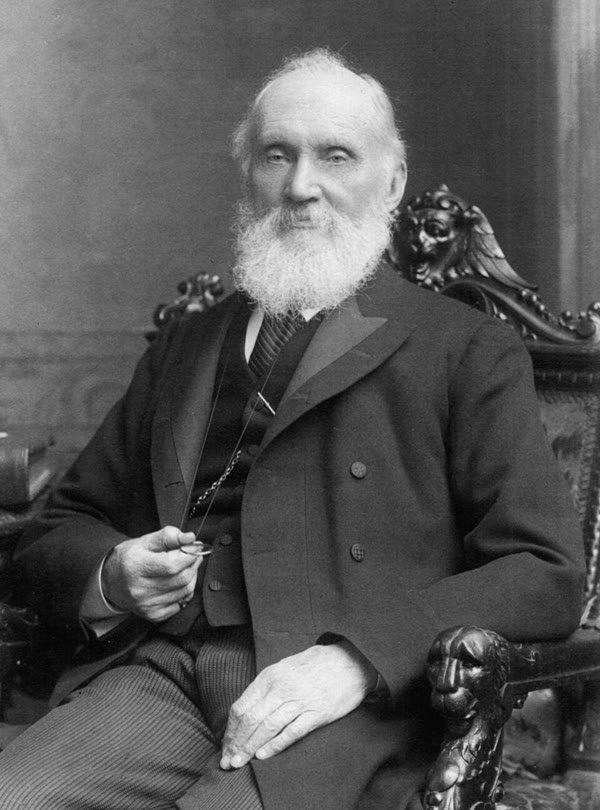
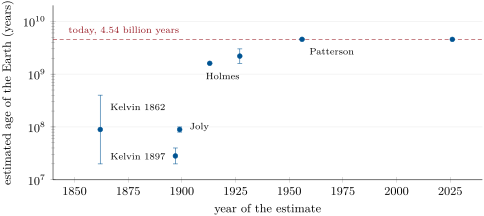
In 1862 the physicist William Thomson, later Lord Kelvin, worked out how old the Earth is from the way it cools. He supposed that it had formed molten and had been losing its heat ever since, and asked how long it would take for the temperature gradient near the surface to fall to its present value. His answer was 96 million years, somewhere between 20 and 400 million; by 1897 he had narrowed it to between 20 and 40 million. Geologists found this far too short for the history they read in the rocks. The answer came from radioactivity, which Kelvin did not know.
You already know
Relative dating puts rocks and events in order; an absolute age is a number of years (Book 1, grade 7). A radioactive isotope, the parent, decays into a daughter isotope at random: the number of parent atoms left falls as , where is the decay constant, and halves every half-life (the physics books). The oldest minerals known, zircons from Western Australia, are 4.4 billion years old (Chapter 19). The Earth also loses heat that radioactivity keeps making, and its mantle convects (Chapter 24).
25.1 A history of estimates
Before radioactivity, every estimate of the Earth’s age rested on a process whose rate was supposed known.
| who, when | method and what it assumes | estimate |
|---|---|---|
| Phillips, 1860 | thickness of the sedimentary layers divided by a rate of deposition; assumes a steady rate | 38 to 96 million years |
| Kelvin, 1862 | cooling of a molten Earth by conduction alone, with no source of heat inside | 20 to 400 million years |
| G. H. Darwin | time since the Moon separated from the Earth, from the slowing of their motions by the tides | at least 56 million years |
| Joly, 1899 | salt carried to the sea by rivers, divided by the yearly supply; assumes a steady supply and no salt removed | 80 to 100 million years |
History — Kelvin’s missing heat
In 1903 Pierre Curie and Albert Laborde showed that radium gives off heat, and several scientists soon argued that this heat overturned Kelvin’s conclusion. A year later Ernest Rutherford, lecturing with Kelvin in the audience, reminded him that he had limited the age of the Earth “provided no new source of heat was discovered”. Radioactivity seemed to be that source. Yet it was not Kelvin’s main error: what most lengthens the Earth’s cooling is mantle convection, which keeps the upper mantle hot and the gradient in the crust high for far longer than conduction alone would.
Radioactivity also gave a clock. In 1907 Bertram Boltwood showed that uranium minerals of the same age hold the same amount of lead for each gram of uranium: the lead is made by the uranium. By 1913 Arthur Holmes could write that the oldest rocks dated were million years old, and in 1927 he put the Earth’s age between 1.6 and 3.0 billion years. In 1956 Clair Patterson measured 4.55 billion years. Today’s value is 4.54 billion years, to within one per cent.
25.2 A radioactive clock
A radioactive clock works only if nothing has been added to it or taken away since it started.
Definition 25.1 (Closed system)
A rock or a mineral is a closed system for a parent isotope and its daughter if, since the moment its clock started, no atom of the parent or of the daughter has entered or left it, other than by the decay of the parent into the daughter.
For a mineral the clock starts when it crystallises from a magma, or more exactly when it has cooled enough for the atoms to stop moving in and out of it. Heating, a hot fluid or weathering can open the system again, and the age then measured is wrong, or dates that later event.
Counting the daughter atoms in a closed system gives the age, provided one knows how many were there at the start. Usually one does not. Rubidium-87 decays into strontium-87, but every mineral also took in some strontium-87 when it formed. The isochron method gets round this by measuring several minerals of one rock.
25.3 The isochron
Strontium has an isotope, strontium-86, that is stable and made by no decay: in a closed system its number stays the same, and it serves as a yardstick. The isotope ratios and are what a mass spectrometer measures.
Theorem 25.2 (The isochron equation)
In a mineral that has been a closed system for a time ,
where the index 0 marks the value when the clock started and is the decay constant of rubidium-87.
Proof. Let be the number of rubidium-87 atoms now and when the clock started. By the decay law , so , and the number of atoms that have decayed is . In a closed system each of them has become one atom of strontium-87, which is added to the atoms present at the start: . Dividing by the number of strontium-86 atoms, which has not changed, gives the equation. ∎
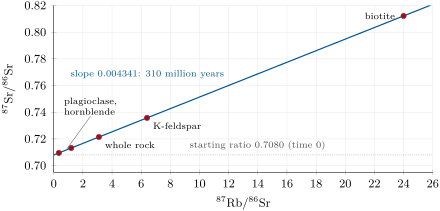
The minerals of a granite crystallised from one magma, so they all started with the same ratio . But they took in very different amounts of rubidium. All of them share the same and the same starting ratio, so the equation says that their points lie on one straight line.
Definition 25.3 (Isochron)
An isochron is the straight line on which lie the points of minerals or rocks that formed at the same time from the same source and have stayed closed systems since, when the ratio of daughter to stable isotope is plotted against the ratio of parent to stable isotope. Its slope gives their age, and the point where it meets the vertical axis gives their starting ratio.
Proposition 25.4 (Age from the slope)
If an isochron has slope , the age is
Proof. Comparing with the isochron equation, , so , , and . ∎
For rubidium-87, per year, a half-life of billion years: more than ten times the age of the Earth.
Method 25.5 (Dating a rock with an isochron)
- Separate several minerals of the rock (or take several samples of it) with different amounts of rubidium.
- Measure in each the ratios () and ().
- Plot against and check that the points lie on a straight line: if one does not, that sample was not a closed system.
- Take the slope of the line, and compute .
- Read the starting ratio where the line meets the vertical axis.
Example 25.6 (The Varden granite)
The granite of the Varden Hills, the series’ invented region, gives these ratios (exercise data):
| sample | ||
|---|---|---|
| plagioclase | 0.35 | 0.70952 |
| hornblende | 1.20 | 0.71321 |
| whole rock | 3.10 | 0.72146 |
| K-feldspar | 6.40 | 0.73578 |
| biotite | 24.0 | 0.81218 |
Through the plagioclase and the biotite, the slope is . Then years: the granite is 310 million years old. The line meets the vertical axis at , the starting ratio.
In the lab — Weighing atoms
The ratios are measured with a mass spectrometer. A few milligrams of a mineral are dissolved in acid, and the strontium is separated from the rubidium by chemistry, since the two isotopes of mass 87 would otherwise be counted together. The strontium, deposited on a metal filament and heated in a vacuum, gives off ions; an electric field speeds them up and a magnet bends their paths, the lighter ions more than the heavier ones, so that each isotope reaches its own collector. Their currents give the ratios.

The starting ratio is also a clue to where the magma came from. Rubidium prefers the melt when the mantle melts, so over the ages it has been concentrated in the continental crust, which has therefore made more strontium-87: crustal rocks have a higher than mantle rocks. A magma from melted crust inherits that high ratio.
25.4 The age of the Earth
No rock on Earth goes back to the Earth’s beginning: the oldest known rock, the Acasta gneiss, is 4.03 billion years old, and the oldest zircons 4.4 billion. The surface has been melted, eroded and recycled since. The dating of the Earth itself comes from meteorites, fragments of the small bodies that formed with the planets and some of which have stayed closed systems ever since.
Definition 25.7 (Age of the Earth)
The age of the Earth is the time since the Earth formed by the accretion of smaller bodies, at the birth of the Solar System. Measured from meteorites by radiometric dating, it is billion years, to within one per cent.
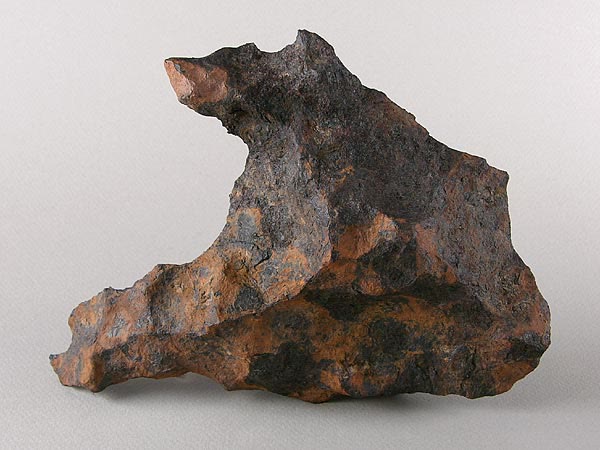
In 1956 Clair Patterson measured the isotopes of lead in three stony meteorites and two iron meteorites. Two isotopes of lead are made by the decay of uranium, lead-206 from uranium-238 and lead-207 from uranium-235, while lead-204 is made by no decay. Like strontium, the points of meteorites that formed at the same time lie on a straight line, when is plotted against . The iron meteorite of Canyon Diablo, in Arizona, holds almost no uranium: its lead has not changed since it formed, and marks the bottom end of the line, the lead the Solar System started with.
For lead the slope depends on the age through both uranium isotopes; the relation is admitted here. With the constants Patterson used,
which gives:
| age (billion years) | 4.40 | 4.45 | 4.50 | 4.55 | 4.60 | 4.65 |
| slope | 0.533 | 0.551 | 0.570 | 0.590 | 0.610 | 0.632 |
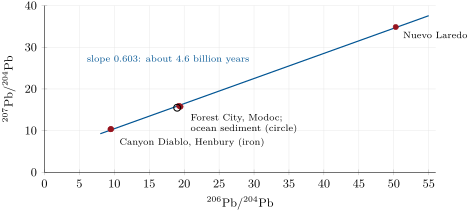
A line drawn through the five points has a slope of about 0.603, between the slopes for 4.55 and 4.60 billion years on the table. Patterson’s own result, allowing for the errors of the measurements and of the decay constants, was 4.55 billion years, give or take 0.07. He then measured lead from a modern ocean sediment, which mixes lead from a great mass of the Earth’s crust: it lies on the same line. The Earth’s lead has evolved like that of the meteorites, over the same time: the Earth is as old as they are.
Since then, hundreds of measurements have confirmed it. Meteorites give ages from 4.53 to 4.58 billion years, and the oldest solids of the Solar System, small inclusions rich in calcium and aluminium found in some meteorites, formed million years ago, give or take 0.16. The Earth formed later from such material, which is why its age, 4.54 billion years, is a little less than theirs.
25.5 Exercises
Exercise 25.1 ★
Give the word: (a) a mineral into and out of which no parent or daughter atom has moved since its clock started; (b) the straight line on which minerals of one age and one source plot; (c) the time since the Earth formed by accretion.
Exercise 25.2 ★
Using the table of the Varden granite, put its five samples in the order of their ratio of rubidium-87 to strontium-86, from the lowest. Which of them plots highest on the isochron, and why has it made the most strontium-87?
Solution
Solution of Exercise 25.2.
Plagioclase (0.35), hornblende (1.20), whole rock (3.10), K-feldspar (6.40), biotite (24.0). The biotite plots highest: it holds the most rubidium-87 for its strontium-86, so its rubidium has made the most strontium-87 since the granite formed.
Exercise 25.3 ★
Compute the half-life of rubidium-87 from its decay constant, per year. How many times the age of the Earth is it?
Exercise 25.4 ★
Compute for rubidium-87 for million years and million years.
Solution
Solution of Exercise 25.4.
, and . For 480 million years, and . Both are close to itself, since is small.
Exercise 25.5 ★
Put in order of date the estimates of Phillips, Holmes (1927), Joly, Kelvin (1862) and Patterson. How many times larger than the upper end of Joly’s estimate is today’s age of the Earth?
Solution
Solution of Exercise 25.5.
Phillips (1860), Kelvin (1862), Joly (1899), Holmes (1927), Patterson (1956). times.
Exercise 25.6 ★★
A mineral of the Varden granite (310 million years, starting ratio 0.7080) has . What is its today? What was it when the granite formed?
Solution
Solution of Exercise 25.6.
today; 0.7080 when the granite formed, like every mineral of the granite.
Exercise 25.7 ★★
Four samples of the Varden schist give = (0.90, 0.71806), (2.60, 0.72950), (5.10, 0.74632) and (9.40, 0.77525), with and . (1) From the first and last samples, compute the slope and the age. (2) Check that the two middle samples lie on the same line. (3) Is the result consistent with the granite’s 310 million years and the principle of cross-cutting relationships?
Solution
Solution of Exercise 25.7.
(1) ; years, 480 million years. (2) and : both on the line. (3) Yes: the granite cuts the schist, so it is younger, and 310 is less than 480 million years.
Exercise 25.8 ★★
Why does a rock in which all the minerals have the same ratio of rubidium to strontium give no isochron? Why does the biotite, in the Varden granite, fix the slope better than the other minerals?
Solution
Solution of Exercise 25.8.
All its points would fall at the same place: one point defines no line and no slope. The biotite lies far to the right of the others; a small error on any point then changes the slope of the line through it and the plagioclase much less than it would for two points close together.
Exercise 25.9 ★★
Long after the Varden granite formed, a hot fluid made its biotite lose part of its strontium-87. (1) Where does its point move on the isochron diagram? (2) What age would the biotite and the plagioclase alone then give: too old or too young? (3) How does the isochron method reveal the problem?
Solution
Solution of Exercise 25.9.
(1) Its rubidium is unchanged, so it keeps its ; it has less strontium-87, so its falls: the point moves straight down. (2) The line through it and the plagioclase is less steep, and gives an age too young. (3) The biotite no longer lies on the line through the other minerals: the points are not aligned, a sign that one sample has not been a closed system.
Exercise 25.10 ★★
(1) How many times longer than Kelvin’s 96 million years is the age of the Earth? (2) Joly assumed that the rivers bring salt to the sea at a steady rate and that none of it leaves the sea. Which of these assumptions makes his age too short if it is wrong, and why?
Solution
Solution of Exercise 25.10.
(1) times. (2) If some salt leaves the sea, for example buried in sediments, the sea holds less salt than the rivers brought in all: dividing the salt present by the yearly supply gives a time that is too short.
Exercise 25.11 ★★
Using Patterson’s values for Canyon Diablo (9.46, 10.34) and Nuevo Laredo (50.28, 34.86), compute the slope of the line through the two meteorites, and read the age from the table of slopes.
Solution
Solution of Exercise 25.11.
, between the slopes for 4.55 (0.590) and 4.60 billion years (0.610): about 4.58 billion years.
Exercise 25.12 ★★★
A basalt of the Varden region, also 310 million years old, has a starting ratio of 0.7035, against 0.7080 for the granite. (1) Which rock is more likely to come from melted mantle, and which from melted crust? (2) Explain why with what you know of rubidium. (3) Could the two have crystallised from one magma?
Solution
Solution of Exercise 25.12.
(1) The basalt, with the lower ratio, from the mantle; the granite, with the higher one, at least partly from melted crust. (2) Rubidium goes into the melt when the mantle melts, so it has been concentrated in the crust, which has made more strontium-87 over the ages. (3) No: minerals that crystallise from one magma share its starting ratio, and these two rocks do not.
Exercise 25.13 ★★★
(1) What fraction of the rubidium-87 present when the Earth formed is left today? And of the uranium-238 (half-life 4.47 billion years)? (2) What would be the slope of a rubidium–strontium isochron for a rock one million years old? Why is rubidium–strontium a poor clock for young rocks?
Solution
Solution of Exercise 25.13.
(1) Rubidium-87: , about left; uranium-238: , about half. (2) : even the biotite of the Varden granite () would rise by only above the starting ratio. So little strontium-87 has formed that the slope is hard to tell from zero: a slow clock suits old rocks.
Exercise 25.14 ★★★
The line through Patterson’s five meteorites is . (1) What does it predict for the ocean sediment, at ? Patterson measured 15.5: by what percentage do they differ? (2) What age does the slope 0.6026 give, from the table? Compare with Patterson’s billion years.
Solution
Solution of Exercise 25.14.
(1) ; is lower by , about : the sediment lies close to the line. (2) 0.6026 lies between 0.590 (4.55) and 0.610 (4.60): about 4.58 billion years, within Patterson’s range of 4.48 to 4.62 billion years.
Exercise 25.15 ★★★
Kelvin supposed that all the heat the Earth loses, today, is stored heat. (1) Radioactivity replaces about of it. By how much does that, alone, lengthen the time to lose a given store of heat? (2) Starting from 96 million years, is this enough to reach the true age? (3) What did Kelvin miss that matters more?
Solution
Solution of Exercise 25.15.
(1) The store then loses only net, so the same store lasts times longer. (2) million years, still more than twenty times too short. (3) Mantle convection, which carries heat up from deep inside and keeps the gradient near the surface high far longer than conduction alone.
Problem 25.1
Weekend problem — Dating the Varden granite
The granite of the Varden Hills, the series’ invented region, cuts the schist around it. A laboratory measured five of its samples (example above): plagioclase (0.35, 0.70952), hornblende (1.20, 0.71321), whole rock (3.10, 0.72146), K-feldspar (6.40, 0.73578) and biotite (24.0, 0.81218), each as . The decay constant of rubidium-87 is per year.
Part I — The samples.
- Which sample is the richest in rubidium relative to strontium?
- Why did all the minerals start with the same ?
- Why are the ratios taken to strontium-86?
- Which of the three isotopes has grown since the granite formed, and why?
- What did the five points look like on the diagram when the granite had just formed?
Part II — The isochron line.
- Compute the slope through the plagioclase and the biotite.
- Compute the slope through the plagioclase and the whole rock.
- Compare the two slopes. Which is the more reliable, and why?
- Find where the line of question 6 meets the vertical axis.
- Check that the K-feldspar lies on that line.
Part III — The slope and the age.
- Write the relation between the slope and .
- Compute .
- Compute the age .
- The schist has been dated at 480 million years. Is the order of the two ages what the field relations require?
- The Carboniferous runs from 358.9 to 298.9 million years ago. In which period did the granite form?
Part IV — The starting ratio and the source.
- What does the intercept, 0.7080, represent?
- A basalt of the region formed with a ratio of 0.7035. Which rock has the higher starting ratio?
- Why do crustal rocks have higher ratios than the mantle?
- What does the granite’s starting ratio suggest about the rock that melted to make it?
- Sum up: how old is the Varden granite?
Solution
Solution of Problem 25.1.
1. The biotite ().
2. They crystallised from one magma, and minerals that crystallise from one melt take in its strontium with its ratio of isotopes.
3. Strontium-86 is stable and made by no decay: in a closed system its number does not change, so it is a fixed yardstick.
4. Strontium-87, made by the decay of rubidium-87; rubidium-87 has decreased and strontium-86 has stayed the same.
5. A horizontal line at : same ratio, different .
6. .
7. .
8. They agree to within 1 in 4000. The first is the more reliable: its two points are far apart, so the rounding of the ratios matters less.
9. .
10. : exactly the measured value.
11. .
12. .
13. years.
14. Yes: the granite cuts the schist, so by the principle of cross-cutting relationships it is younger, and 310 is less than 480 million years.
15. 310 million years lies between 358.9 and 298.9 million years: the Carboniferous.
16. The ratio of the magma when the granite crystallised.
17. The granite: .
18. Rubidium goes into the melt when the mantle melts, so it has been concentrated in the crust; with more rubidium, the crust has made more strontium-87.
19. That the magma came, at least in part, from melted continental crust rather than from the mantle alone.
20. The Varden granite is 310 million years old.