High School Earth and Space Sciences · कक्षा 10–12
16Minerals
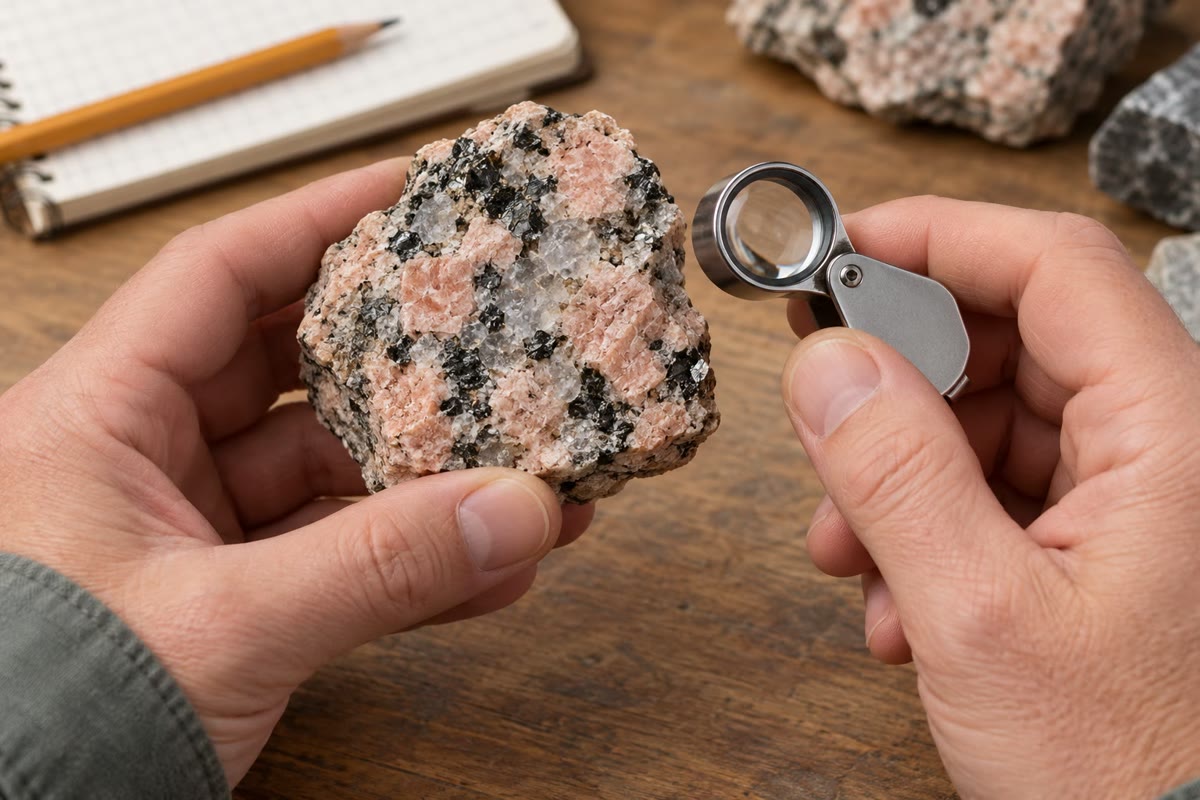
Pick up a granite pebble and look at it through a hand lens. It is not one substance but a mosaic of grains locked together: grey grains, glassy and almost transparent; pink grains, blocky, whose broken faces flash in the light when the pebble is turned; small black flakes that a knife tip lifts off in thin sheets. Each kind of grain is a mineral. This chapter shows how a geologist tells them apart, why almost all of them are built from silicon and oxygen, how they make the rocks met so far — granite, basalt, peridotite — and how a slice of rock thinner than a hair, seen in polarised light, shows them all at once.
You already know
A mineral is a natural solid substance, not made by living things, with a fixed make-up and its atoms arranged in a regular way; a rock is made of one or several minerals. Granite is made mostly of feldspar, quartz and mica. Rocks fall into three families, igneous, sedimentary and metamorphic. The hardness of a mineral is how well it resists being scratched, ranked from 1 (talc) to 10 (diamond) on the Mohs scale; orthoclase feldspar is 6 and quartz 7, while a glass plate is about 5.5 and a steel nail about 6.5 (Book 1, grade 6). The density of a body is its mass divided by its volume (physics). A compound is described by a formula that counts its atoms; in a solid made of ions, the positive and negative charges balance (chemistry). Peridotite makes the mantle; gabbro and basalt make the oceanic crust (Chapter 14).
16.1 Telling minerals apart
A mineral has a fixed make-up and a regular arrangement of atoms. Both show on the outside: in the shape of its crystals, the way it breaks, the way it reflects light, its hardness and its density. None of these properties is enough alone; together they identify the common minerals in a hand specimen, with no instrument but a lens, a steel nail and a glass plate.
Shape. A crystal that grew freely, in a cavity or in a liquid, takes a shape that reflects the arrangement of its atoms.
Definition 16.1 (Habit)
The habit of a mineral is the general shape its crystals take: cubic, tabular (flat, like a tablet), prismatic (elongated, like a prism), bladed, acicular (needle-like), and so on.
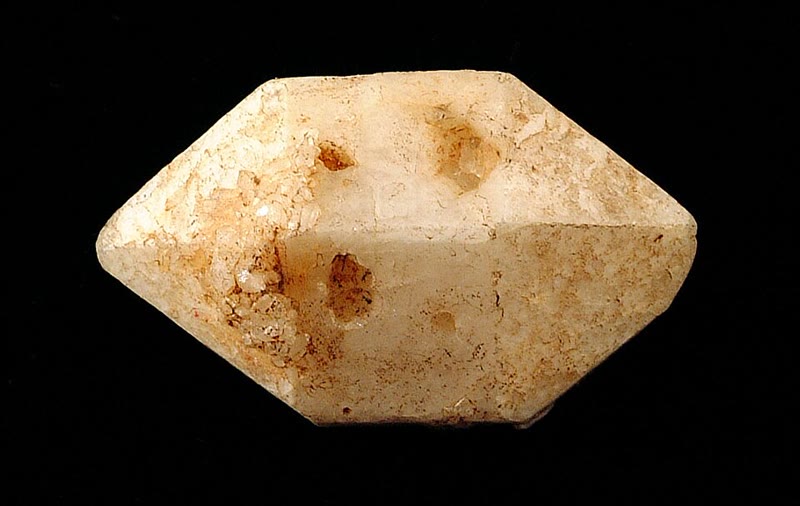
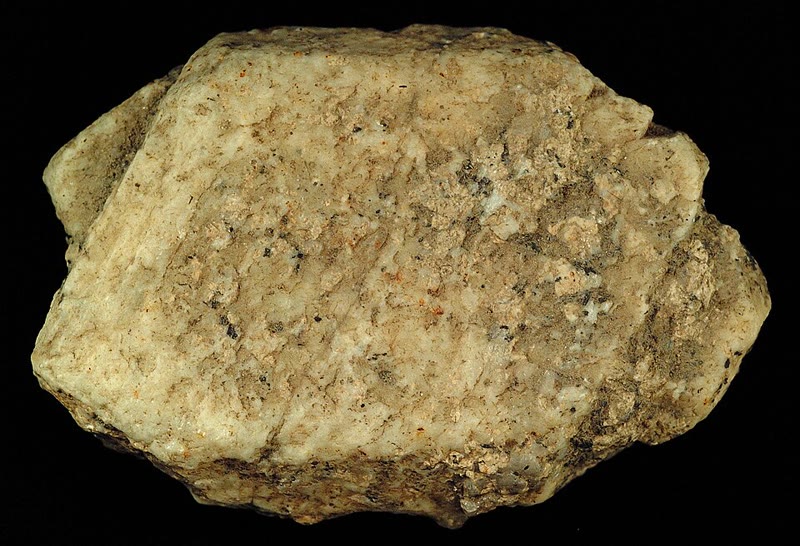
Quartz grows as six-sided prisms ending in points; biotite, as flat six-sided plates (photographs below). In most rocks, though, the grains grew against one another and have no faces of their own: habit then tells little, and the other properties take over.
Colour and lustre. Colour is the first thing one sees, and the least reliable. A trace of another element is enough to change it: quartz can be clear, white, black, pink, blue or purple. A few minerals, on the other hand, hardly vary: olivine is almost always green. How a mineral reflects light is a better guide.
Definition 16.2 (Lustre)
The lustre of a mineral is its appearance in reflected light. It is metallic when the mineral shines like a metal, and non-metallic otherwise: vitreous (glassy, like quartz), pearly, resinous, and so on.
The way it breaks. Strike a crystal and it breaks. Where the bonds between its atoms are weaker along certain planes, it splits along them, again and again, into flat shining surfaces; where no plane is weaker than another, it breaks along any surface.
Definition 16.3 (Cleavage; fracture)
Cleavage is the tendency of a mineral to break along flat planes, parallel to directions in which the bonds between its atoms are weaker. Fracture is breakage along irregular surfaces, in a mineral with no plane of weakness; a fracture with smooth curved surfaces, like broken glass, is called conchoidal.
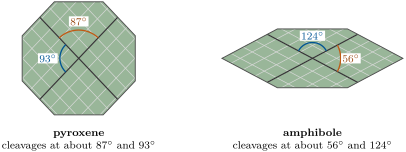
A mineral may have one cleavage, two, three or none. Micas have one, perfect: they peel into sheets. Feldspars have two. Quartz has none: it breaks with a conchoidal fracture, which tells it at once from a feldspar of the same grey or white colour. The angle between two cleavages is fixed by the arrangement of the atoms, and it can be measured on a broken grain or a section: the two cleavages of a pyroxene meet at about and , nearly a right angle; those of an amphibole at about and . Pyroxenes and amphiboles are often dark and alike; their cleavage angles tell them apart.
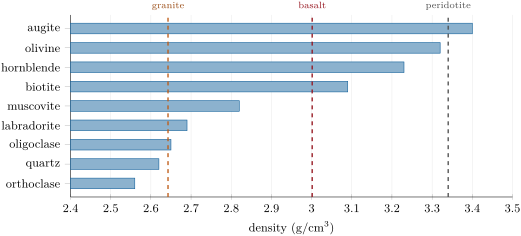
Hardness and density. Hardness, met in Book 1, separates minerals that look alike: quartz (7) scratches glass and is not scratched by a steel nail; a feldspar (6) also scratches glass, but the nail scratches it. Density is the last clue. In the hand, a grain cannot be weighed, but a specimen of one mineral can, and the common minerals of rocks span a narrow range, from about to about (chart below): the lightest are rich in silicon, aluminium, sodium and potassium, the densest in iron and magnesium.
Method 16.4 (Identifying a mineral in hand specimen)
- Look at the shape of the grain or crystal (habit), its colour — as a hint only — and its lustre.
- Look for cleavage: flat shining surfaces that catch the light together when the specimen is turned. Count the cleavage directions and estimate the angle between them; if there is none, describe the fracture.
- Test the hardness against reference objects: a glass plate (about 5.5) and a steel nail (about 6.5).
- If the specimen is a single mineral, compare its density with the densities of the candidates.
- Conclude by the combination of properties, never by one alone.
Example 16.5 (Quartz or feldspar?)
Two grey-white grains in a granite. The first shows no flat face, only smooth curved breaks, and the steel nail leaves no mark on it: conchoidal fracture and a hardness above 6.5, it is quartz (7). The second breaks into flat shining surfaces in two directions and is scratched by the nail, though it scratches glass: two cleavages and a hardness between 5.5 and 6.5, it is a feldspar (6).
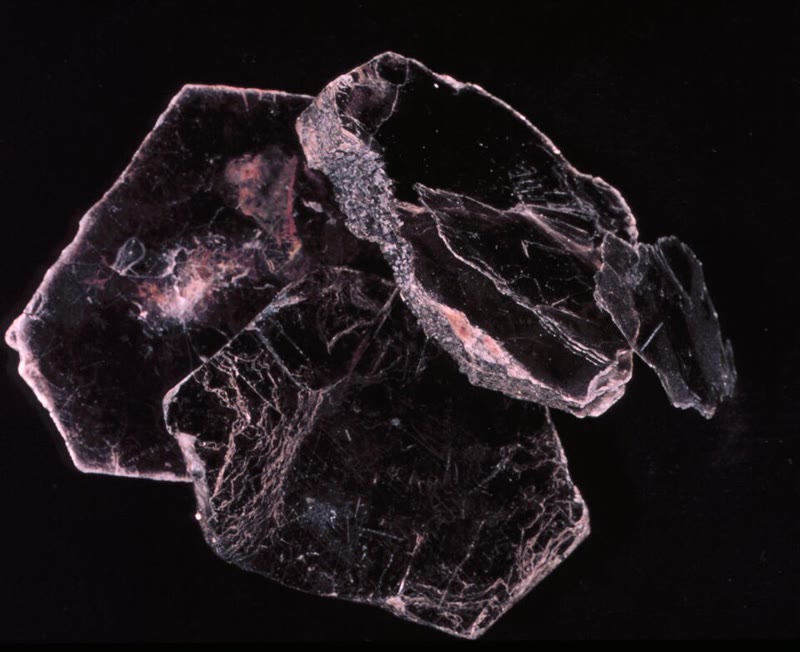
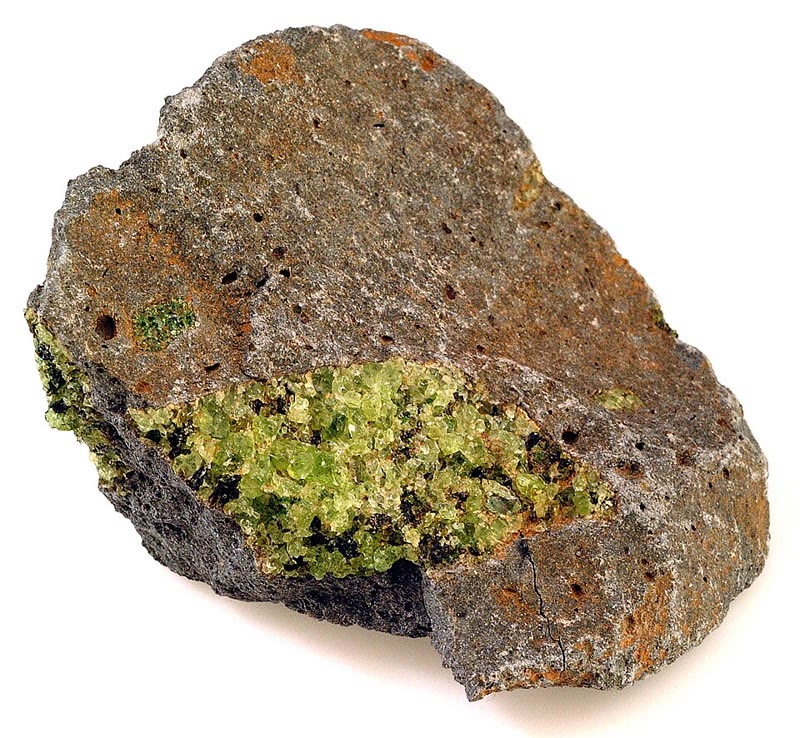
16.2 Silicates
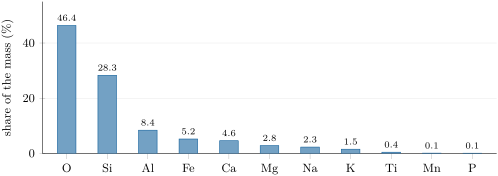
Two elements make the crust. The chemical composition of the continental crust is known from the analyses of many rocks, reported as percentages of oxides: about , , and so on. From these, and from the masses of the atoms, the mass of each element follows. Oxygen makes of the mass of the continental crust and silicon : two elements, about three quarters of the mass. With six metals — aluminium, iron, calcium, magnesium, sodium and potassium — they make more than of it.
The silicon–oxygen tetrahedron. A silicon atom is small, and four oxygen atoms fit around it, at the corners of a tetrahedron, a pyramid with four triangular faces. The group holds one silicon ion and four oxygen ions : it carries a charge of , which other ions — or other tetrahedra — must balance.
Definition 16.6 (Silicate; silicon–oxygen tetrahedron)
The silicon–oxygen tetrahedron is the group formed by one silicon atom and the four oxygen atoms around it, at the corners of a tetrahedron. A silicate is a mineral built from silicon–oxygen tetrahedra, alone or linked to one another by shared corners.
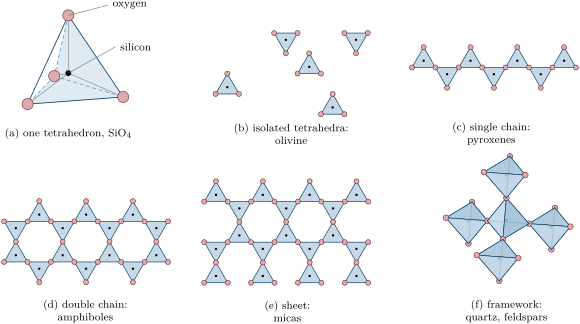
Tetrahedra link by sharing oxygens: the corner of one tetrahedron is the corner of the next. How many corners each tetrahedron shares sets the structure of the silicate, and its formula.
- Isolated tetrahedra, sharing no corner, held together by metal ions between them: olivine, .
- Single chains, each tetrahedron sharing two corners with its neighbours: the pyroxenes.
- Double chains, two single chains joined side by side, the tetrahedra sharing two or three corners in turn: the amphiboles.
- Sheets, each tetrahedron sharing three corners: the micas, and the clay minerals of soils (Chapter 7).
- Frameworks, each tetrahedron sharing all four corners, in all three directions of space: quartz, , and — with aluminium in place of some of the silicon — the feldspars.
Proposition 16.7 (Counting the oxygens)
In a silicate where each tetrahedron shares of its corners with other tetrahedra, there are oxygen atoms for each silicon atom. Isolated tetrahedra give , single chains , sheets and frameworks .
Proof. Each tetrahedron has one silicon and four corners. A corner that is not shared belongs to this tetrahedron alone and counts for one oxygen; a shared corner belongs to two tetrahedra and counts for half an oxygen in each. With shared corners, a tetrahedron owns oxygens. For , , and this gives , , and oxygens per silicon: , , and . ∎
The formulas of the minerals bear this out. The pyroxene augite contains , that is twice, and the mica biotite , four tetrahedra for ten oxygens, twice; in a feldspar, four tetrahedra hold eight oxygens, four times, exactly as in quartz. The charges, though, differ. Quartz is neutral: in a framework, each oxygen is shared, and the charges of silicon and oxygen balance. In the other structures the unshared oxygens carry spare negative charges, balanced by metal ions — magnesium and iron in olivine, potassium in orthoclase, where one aluminium ion in place of a silicon ion leaves one charge to be balanced.
Definition 16.8 (Rock-forming silicates)
The rock-forming silicates are the six groups of silicate minerals that make up most common igneous and metamorphic rocks: olivine, the pyroxenes, the amphiboles, the micas, the feldspars and quartz. The feldspars are of two kinds: potassium feldspar, such as orthoclase, and plagioclase, a series of feldspars containing sodium and calcium.
| group (example) | structure | formula | density |
| () | |||
| olivine | isolated tetrahedra | 3.32 | |
| pyroxene (augite) | single chains | 3.4 | |
| amphibole (hornblende) | double chains | 3.23 | |
| mica (biotite) | sheets | 3.09 | |
| mica (muscovite) | sheets | 2.82 | |
| potassium feldspar (orthoclase) | framework | 2.56 | |
| plagioclase (oligoclase) | framework | 2.65 | |
| quartz | framework | 2.62 |
The table holds a rule that runs through the rest of this book. The minerals with isolated tetrahedra and chains, rich in iron and magnesium, are the densest, above ; the frameworks, made of silicon, aluminium, sodium, potassium and calcium, are the lightest, about . The micas lie between. Olivine and pyroxene make the peridotite of the mantle; feldspars and quartz, the granite of the continents: the light rock floats on the dense one.
16.3 Minerals make rocks
A rock is described first by its minerals and their proportions. Three rocks met in earlier chapters show the range:
- granite: quartz, potassium feldspar and plagioclase, with a little biotite or muscovite — the rock of the continents;
- basalt and gabbro: plagioclase and pyroxene, often with olivine — the rocks of the oceanic crust, the first fine grained, the second coarse (Chapter 17);
- peridotite: mostly olivine, with pyroxene — the rock of the mantle.
The density of a rock follows from its minerals. Imagine a block of rock of volume , a fraction of it made of a first mineral, of a second, and so on.
Proposition 16.9 (The density of a rock from its minerals)
A rock without pores, made of minerals of densities occupying fractions of its volume (), has the density
the mean of the densities of its minerals, weighted by their volume fractions.
Proof. In a volume of rock, mineral occupies the volume and has the mass . With no pores, the mass of the rock is the sum of these masses, , and its density is . ∎
How are the volume fractions measured? On a flat cut face of the rock, or on a thin section (next section), a regular grid of points is laid out, and at each point the mineral beneath is noted. When the grains are scattered without order, the fraction of the points that fall on a mineral estimates the fraction of the area it covers, and that is also the fraction of the volume it fills: a thin slice is a fair sample of the whole block. This is a point count.
Example 16.10 (A granite light in quartz and potassium feldspar)
A point count gives quartz (), orthoclase () and oligoclase (). The density of the rock is
Measurements bear out this order of magnitude: of rock samples weighed from about two hundred bodies of granitic rock in the Sierra Nevada of California, the average is , and the granites richest in silica and potassium, like this one, are below .
16.4 Thin sections
A hand lens shows grains a millimetre across. To see finer grains, and to identify them with certainty, geologists look at rocks through a microscope — not at their surface, but through them.
Definition 16.11 (Thin section; polarising microscope)
A thin section is a slice of rock ground down to a thickness of and mounted on a glass slide: at this thickness light passes through most minerals. A polarising microscope is a microscope fitted with two polarising filters, one below the slide and one above it. The section is seen in plane-polarised light with the lower filter only, and between crossed polars when the upper filter is added with its direction perpendicular to that of the lower one.
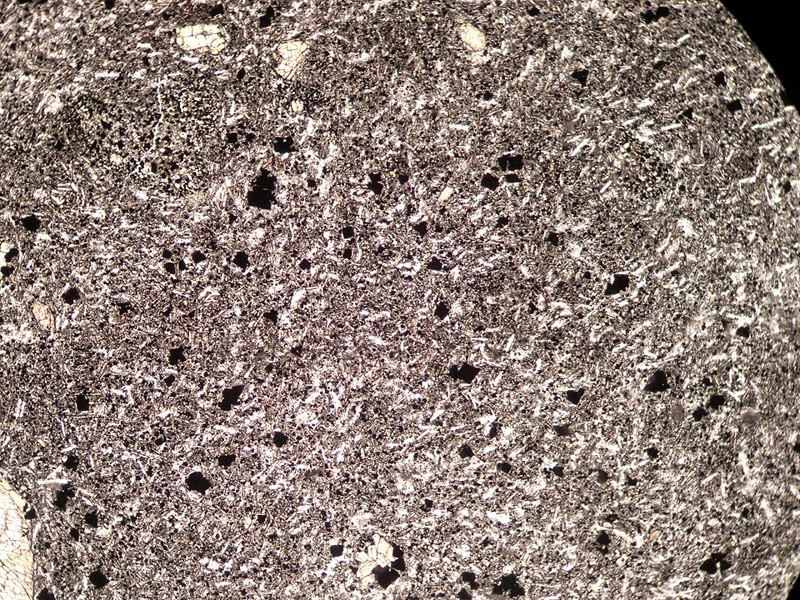
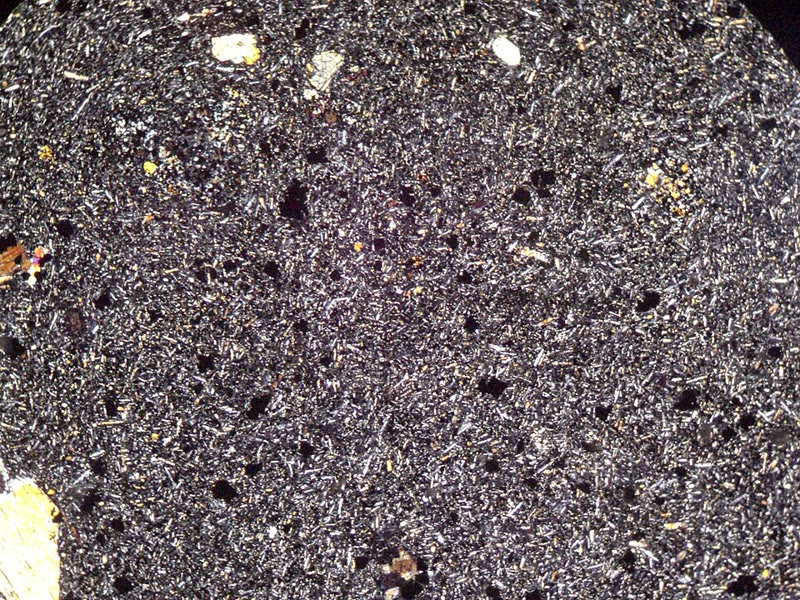
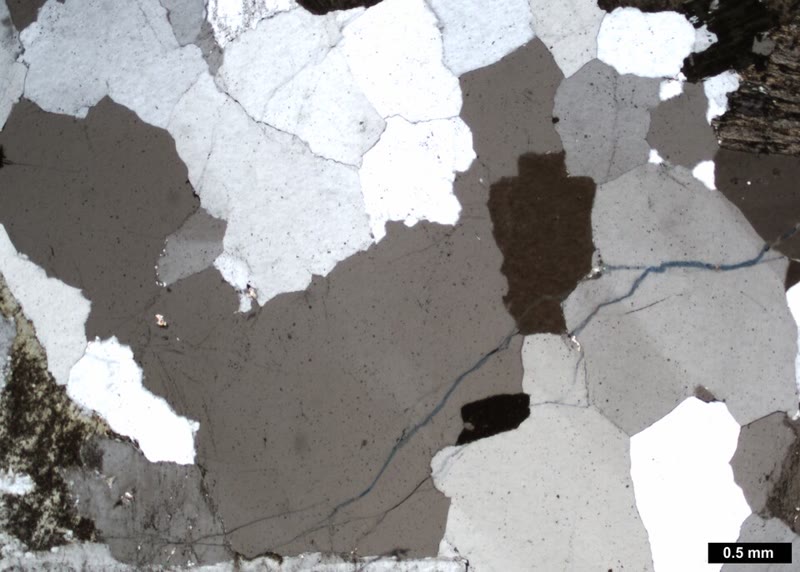
In plane-polarised light a thin section looks like a stained-glass window: most minerals are nearly colourless, some tinted, and the outlines of the grains, their cleavages and their habits show sharply. Between crossed polars the filters, set across each other, would let no light through on their own; most minerals alter the light that crosses them, and appear in shades of grey or in bright colours, which change as the slide is turned. Two grains of the same mineral can look different, because each is cut in its own direction: the quartz grains of the granite above are all quartz, in different shades. The colours, how they change, and what they reveal about each mineral are the subject of the first university year; here, the thin section is a picture of the rock, in which every grain can be seen, named and counted.
16.5 Exercises
Exercise 16.1 ★
Define cleavage and fracture. Which one does quartz show, and what do its broken surfaces look like? How many cleavages does a mica have?
Solution
Solution of Exercise 16.1.
Cleavage is the tendency of a mineral to break along flat planes, parallel to directions in which the bonds between its atoms are weaker; fracture is breakage along irregular surfaces, in a mineral with no plane of weakness. Quartz has no cleavage: it shows a conchoidal fracture, with smooth curved surfaces like broken glass. A mica has one cleavage, perfect: it peels into sheets.
Exercise 16.2 ★
Why is colour a poor guide to identifying quartz, but a fairly good one for olivine? Give two properties more reliable than colour.
Solution
Solution of Exercise 16.2.
A trace of another element is enough to change the colour of quartz, which can be clear, white, black, pink, blue or purple; olivine is almost always green. More reliable: the cleavage (or fracture), the hardness, the lustre, the habit of free crystals, the density.
Exercise 16.3 ★
Match each description to a mineral among quartz, orthoclase, biotite and olivine: (1) green grains in a basalt; (2) black flakes that peel into thin sheets; (3) pink blocky grains with two flat breakage planes, scratched by a steel nail; (4) glassy grey grains with curved breaks, not scratched by the nail.
Exercise 16.4 ★
(1) How many atoms does a silicon–oxygen tetrahedron contain, and where are they? (2) Using the charges of the ions and , find the charge of the group .
Solution
Solution of Exercise 16.4.
(1) Five atoms: one silicon at the centre and four oxygens at the corners of a tetrahedron. (2) : the group is .
Exercise 16.5 ★
Name the six groups of rock-forming silicates and give, for each, the way its tetrahedra are linked.
Solution
Solution of Exercise 16.5.
Olivine: isolated tetrahedra. Pyroxenes: single chains. Amphiboles: double chains. Micas: sheets. Feldspars and quartz: frameworks.
Exercise 16.6 ★★
The atomic masses of silicon and oxygen are and . (1) Compute the share of oxygen in the mass of quartz, . (2) Do the same for forsterite, the magnesium olivine (magnesium: ). (3) Compare with the share of oxygen in the continental crust, about .
Solution
Solution of Exercise 16.6.
(1) ; oxygen: . (2) ; oxygen: . (3) The crust, at , is of the same order: it is made almost entirely of oxygen-rich minerals, the silicates.
Exercise 16.7 ★★
A white grain in a granite scratches a glass plate (about 5.5) but is scratched by a steel nail (about 6.5); it breaks along flat planes in two directions. A second, grey grain is not scratched by the nail and breaks along curved surfaces. Identify both, giving the reasons.
Exercise 16.8 ★★
In the pyroxene augite, each tetrahedron shares two corners. (1) Using the proposition on counting the oxygens, how many oxygens are there for each silicon? (2) Check that the part of the formula of augite agrees.
Solution
Solution of Exercise 16.8.
(1) oxygens per silicon: . (2) holds two silicon (or aluminium) atoms for six oxygens, three per silicon: it is twice.
Exercise 16.9 ★★
A basalt is made of labradorite (), augite () and olivine (), by volume. Compute its density, then the mass of a cube of this basalt on a side.
Solution
Solution of Exercise 16.9.
. The cube has a volume of , so a mass of about .
Exercise 16.10 ★★
A peridotite of the mantle is made of olivine () and augite (). (1) Compute its density. (2) By what percentage is it denser than the basalt of the previous exercise, at about ? (3) Why does the oceanic crust stay on top of the mantle?
Solution
Solution of Exercise 16.10.
(1) . (2) : about denser. (3) The basalt and gabbro of the oceanic crust are lighter than the peridotite of the mantle: they stay on top of it.
Exercise 16.11 ★★
On a thin section of a rock, a grid of 400 points falls 168 times on plagioclase, 132 times on pyroxene, 60 times on olivine and 40 times on holes left by gas bubbles. (1) Compute the fraction of each. (2) Why can the proposition on the density of a rock not be applied directly to the whole section? (3) Compute the density of the solid part, with , and , then that of the rock with its holes.
Solution
Solution of Exercise 16.11.
(1) Plagioclase , pyroxene , olivine , holes . (2) The proposition holds for a rock without pores; here a tenth of the volume is empty. (3) In the solid part, the fractions are , and : . With its holes, which add volume and no mass, the rock has the density , that is .
Exercise 16.12 ★★★
In of continental crust there are about of oxygen, of silicon, of aluminium, of iron, of calcium, of magnesium, of sodium and of potassium. The atomic masses are , , , , , , and . (1) Compute the number of moles of each element. (2) What fraction of the atoms of the crust are oxygen atoms? (3) Why is the crust sometimes described as a packing of oxygen ions, with the other elements in the spaces between them?
Solution
Solution of Exercise 16.12.
(1) Oxygen mol; silicon ; aluminium ; iron ; calcium ; magnesium ; sodium ; potassium . (2) In all about mol of atoms, of which : almost two atoms out of three are oxygen. (3) Large oxygen ions make up most of the atoms, and even more of the volume: the crust is, at the scale of atoms, a packing of oxygen ions, with small silicon and metal ions in the spaces between them.
Exercise 16.13 ★★★
In an amphibole double chain, half of the tetrahedra share two corners and half share three. (1) How many oxygens are there for each silicon? (2) Write the result for four silicons. (3) In the formula of hornblende, , aluminium takes the place of silicon in one tetrahedron out of eight. Check that the formula agrees.
Solution
Solution of Exercise 16.13.
(1) The mean number of shared corners is , so there are oxygens per silicon. (2) Four silicons for eleven oxygens: . (3) holds eight tetrahedra (seven silicon, one aluminium) for 22 oxygens, that is per tetrahedron, or twice. The two groups are not part of the tetrahedra.
Exercise 16.14 ★★★
Over the Sierra Nevada of California, granitic rock samples have an average density of ; it is above in the west, and below where the granite is richest in silica and potassium. Compute the density of a rock of quartz (), orthoclase (), oligoclase (), biotite () and hornblende (). Compare with the granite of the example of this chapter, and explain the contrast between the two parts of the Sierra Nevada.
Solution
Solution of Exercise 16.14.
, above ; the granite of the example, richer in quartz and potassium feldspar, is about , below . The rocks of the west are denser because they hold more plagioclase and more biotite and hornblende, rich in iron and magnesium; the high-silica granites hold more quartz and potassium feldspar, the lightest rock-forming minerals.
Exercise 16.15 ★★★
The upper continental crust contains about by mass, the continental crust as a whole . (1) Using the share of silicon in (), compute the share of silicon held in in each. (2) Which minerals would you expect to be more common in the upper crust than lower down? (3) What does this imply for the density of the upper crust compared with the deeper crust?
Solution
Solution of Exercise 16.15.
(1) Upper crust: silicon; whole crust: . (2) The upper crust, richer in silica, should contain more quartz and feldspars, and fewer minerals rich in iron and magnesium; the deeper crust, the reverse. (3) Quartz and feldspars are the lightest rock-forming minerals: the upper crust should be lighter than the deeper crust.
16.6 Problem: The Density of a Granite
Problem 16.1
Weekend problem — from a point count to a density
A block of pink granite is cut and polished. Its minerals are identified, counted on a grid, and the density of the rock is computed, then checked by weighing.
Part I — Identifying the minerals.
- Grains A are grey and glassy, show no flat breakage surface, only curved ones, and are not scratched by a steel nail. Which mineral are they?
- Grains B are pink and blocky, break along flat shining planes in two directions, scratch glass but are scratched by the nail. Which mineral are they, and what is their hardness on the Mohs scale?
- Grains C have the same hardness and cleavages as grains B but are white; an analysis finds sodium and calcium in them, and no potassium. Which kind of feldspar are they?
- Grains D are black flakes, grains E silvery flakes; both peel into thin sheets. Which minerals are they, and which feature of their structure explains the sheets?
- Which of the minerals A to E are framework silicates? Which contain iron and magnesium?
Part II — The point count.
- A grid of 500 points falls 150 times on quartz, 175 times on orthoclase, 125 times on oligoclase, 30 times on biotite and 20 times on muscovite. Compute the fraction of each mineral.
- Why does the fraction of points estimate the fraction of the volume of the rock?
- What percentage of the rock is feldspar?
- If one point is wrongly counted, by how much does a fraction change?
- Is this rock a granite in the sense of Book 1?
Part III — The density.
- State the formula giving the density of a rock without pores from its minerals.
- With the densities quartz , orthoclase , oligoclase , biotite and muscovite , compute the contribution of each mineral.
- Add them up: what is the density of the granite?
- Which mineral contributes most to the sum? Which two minerals, though they make only a tenth of the rock, raise its density?
- Convert the density to , and give the mass of of this granite.
Part IV — Checking by weighing.
- A block of is cut from the granite. What mass do you expect it to have?
- Hung in water, a body is pushed up by the weight of the water it displaces (physics). What mass does the balance read when the block hangs fully immersed in water, of density ?
- Laboratories compute the density of a rock sample as . Check that your two masses give back the density of question 13.
- Granitic rocks of the Sierra Nevada average , and those richest in silica and potassium lie below . Where does this granite lie, and which minerals would make a granite denser?
- Conclude: what is the density of the granite?
Solution
Solution of Problem 16.1.
1. Quartz: no cleavage, conchoidal fracture, glassy lustre, harder than the nail (7).
2. Orthoclase, a potassium feldspar: two cleavages, hardness 6 on the Mohs scale.
3. Plagioclase (here oligoclase), the feldspar with sodium and calcium.
4. D is biotite, E muscovite: two micas. Their tetrahedra form sheets, and the bonds between the sheets are weak: they split along this one perfect cleavage.
5. Quartz and the two feldspars (A, B, C) are frameworks; biotite (D) contains iron and magnesium.
6. Quartz ; orthoclase ; oligoclase ; biotite ; muscovite .
7. When the grains are scattered without order, the share of points on a mineral estimates the share of the area it covers on the face, and that equals the share of the volume it fills.
8. : feldspar.
9. By , that is .
10. Yes: feldspar, quartz and mica.
11. , with .
12. Quartz ; orthoclase ; oligoclase ; biotite ; muscovite (all in ).
13. .
14. Orthoclase, at , because it is the most abundant. Biotite and muscovite, at and , are denser than the other minerals and raise the density of the rock above that of quartz and feldspar alone.
15. : of the granite has a mass of about .
16. .
17. The block displaces of water, of mass : the balance reads .
18. .
19. Between the two: lighter than the average of , above the of the granites richest in silica and potassium. More plagioclase and more biotite or hornblende, and less quartz and potassium feldspar, would make a granite denser.
20. The density of the granite is about .