书籍暂未推出简体中文版——当前显示英文版。
High School Earth and Space Sciences · 10–12 年级
21Metamorphic Rocks
A layer of mud settles on a sea floor and hardens into shale. Bury it a few kilometres and squeeze it, and it becomes a slate, a rock that splits into the thin, flat sheets of a roof. Bury it deeper and hotter, and its tiny flakes grow into glittering micas, among which red garnets swell: a schist. Deeper and hotter still, its minerals sort themselves into light and dark bands: a gneiss. Nothing melted along the way. The same mud, with the same chemical elements, simply rebuilt its minerals to suit the place where it was. Read the other way, the minerals of a metamorphic rock record how deep and how hot that place was, and this chapter learns to read them.
You already know
Rocks fall into three families — igneous, sedimentary, metamorphic — and the rock cycle turns one into another; marble is made from limestone and slate from shale, without melting (Book 1, grade 6). A mineral is a natural solid with a definite chemical composition and an ordered arrangement of atoms; most minerals of the crust are silicates (Chapter 16). A geotherm is the curve of temperature against depth beneath a place; near the surface the temperature rises by 25 to per kilometre (Chapter 12). In a subduction zone, oceanic crust carried down while it stays cold turns into blueschist, then into eclogite (Chapter 15). Pressure is a force divided by the area it presses on; it is measured in pascals, = .
21.1 Transformed in the solid state
Definition 21.1 (Metamorphism)
Metamorphism is the transformation of the minerals and the texture of a rock, in the solid state, when it is brought to a temperature and a pressure different from those under which it formed. The rock it becomes is a metamorphic rock.
The rock that metamorphism starts from is its parent rock, the same words as for the rock beneath a soil (Chapter 7). Metamorphism begins at about ; below that, the slow changes of a buried sediment belong to its hardening into rock. It ends where the rock starts to melt: from then on, what happens is igneous. Between these limits, each mineral is stable only over a certain range of temperature and pressure. Most clay minerals, for instance, last only up to about 150 or ; above that, they turn into micas. When the conditions change, the atoms of the unstable minerals rearrange themselves, grain by grain, into minerals that are stable in the new conditions.
Four things control the outcome. The parent rock provides the chemical elements: a limestone made only of calcite can only become a marble made of calcite. The temperature and the pressure decide which minerals are stable. And water, present in small amounts between the grains, carries dissolved ions from one grain to the next and speeds up the reactions. Metamorphism is slow: new minerals grow by about a millimetre in a million years. The tectonic events that bury rocks are slow too, so the reactions usually have time to run.
21.1.1 The weight of the rocks above
A rock buried at a depth carries the weight of all the rock above it.
Definition 21.2 (Lithostatic pressure)
The lithostatic pressure at a depth is the pressure exerted on a rock by the weight of the column of rock above it. It is the same in all directions.
Proposition 21.3 (Lithostatic pressure)
Beneath a column of rock of uniform density , the lithostatic pressure at depth is
where is the acceleration due to gravity; the pressure of the atmosphere, about , is neglected.
Proof. Take a vertical column of rock of horizontal cross-section , from the surface down to the depth . Its volume is , its mass , and its weight . This weight rests on the area at the bottom of the column, so the pressure there is . ∎
With the mean density of the continental crust, , and , the pressure rises by per metre, that is about per kilometre. At the base of a crust thick it reaches
about : nearly ten thousand times the pressure of the atmosphere at sea level. Pressures are often read the other way round, as depths: is reached down.
The weight of the rocks presses equally from all sides. In a mountain belt, the plates add a push in one direction: the rock is squeezed harder from the sides than from above. This directed pressure does not change which minerals are stable, but it changes how they are arranged, as Section 21.3 shows.
21.2 Index minerals and grade
21.2.1 Three minerals of one formula
Definition 21.4 (Polymorph)
Two minerals are polymorphs when they have the same chemical composition but different crystal structures: the same atoms, arranged differently.
Three minerals share the formula : kyanite, andalusite and sillimanite. Each is stable over its own range of temperature and pressure, measured in the laboratory by holding crystals at a chosen temperature and pressure and watching which polymorph grows at the expense of the other. Kyanite is the densest of the three, against for sillimanite and for andalusite: its atoms are packed more tightly, and it is the one that high pressures favour.
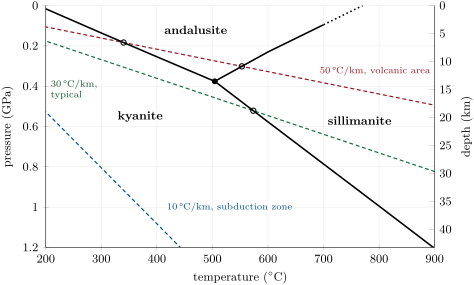
The diagram is a map of stability. Each point is a temperature and a pressure; each field is the polymorph that is stable there. Kyanite holds the high pressures, andalusite the low pressures and moderate temperatures, sillimanite the high temperatures. Along a boundary, two polymorphs are equally stable, and at the triple point, all three. The boundaries are not known exactly: the triple point is uncertain by about and , and traces of iron in the crystals shift the andalusite–sillimanite line by up to .
Method 21.5 (Reading a pressure–temperature diagram)
- Place the point of the rock: its temperature on the horizontal axis, its pressure on the vertical one.
- Read the field it falls in: the mineral stable there.
- Turn the pressure into a depth with , or read it on the depth scale.
- For a mineral found in a rock, read the other way: the rock was in that mineral’s field when it crystallised. Two minerals that formed together, or a mineral that is missing, narrow the range further.
Example 21.6 (The kyanite–sillimanite boundary)
At , kyanite turns into sillimanite at about . That pressure is reached at . Between 600 and the boundary climbs by , that is of depth: a rock deeper must be about hotter to turn into sillimanite. A schist that holds kyanite but no sillimanite and crystallised at was therefore colder than about .
21.2.2 Index minerals and isograds
In a belt of rocks that all started as the same mud, the minerals change from place to place, because the rocks were not all buried as deep or heated as much.
Definition 21.7 (Index mineral; isograd; metamorphic grade)
The metamorphic grade of a rock is the intensity of the metamorphism it went through, set by the temperature and pressure it reached. An index mineral is a mineral whose first appearance, in rocks of the same parent composition, marks a given grade. An isograd is the line on a map (a surface in the ground) joining the places where an index mineral first appears: along it, the rocks have reached the same grade.
Rocks made from mud, rich in aluminium, show the clearest sequence. With rising grade, the index minerals appear in the order chlorite, biotite, garnet, staurolite, kyanite, sillimanite, and the ground they divide is called the chlorite zone, the biotite zone, and so on. Temperature and pressure both rise along that sequence, as they do in a crust thickened under a mountain belt.
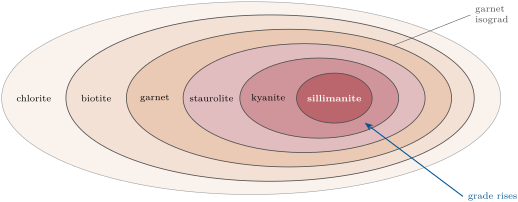
History — Barrow’s zones
In the 1890s, the geologist George Barrow mapped the schists and gneisses of the Highlands of Scotland and noticed that their minerals changed across the country in a regular order. He was the first to divide a region into zones by the minerals its rocks contain. His name is kept for the sequence: rocks that follow it are said to show Barrovian metamorphism.
Grade can also be judged roughly from temperature alone. Rocks heated to 150 to are of very low grade, 300 to of low grade, 450 to of medium grade, and above of high grade. At low grade the rocks are rich in minerals holding water in their structure, such as clays and chlorite; as the grade rises they lose that water.
21.3 Foliation
Squeezed while they grow, minerals do not grow in all directions. Flat grains such as micas, and long ones such as amphiboles, crystallise with their flat faces or their long axes across the direction of the push; grains that were there already are flattened in the same way.
Definition 21.8 (Foliation; schistosity)
A foliation is a set of parallel planes in a metamorphic rock, made by the alignment of its flat or elongated minerals; the rock splits most easily along them. Schistosity is the foliation of a schist, in which the aligned crystals of mica are big enough to be seen.
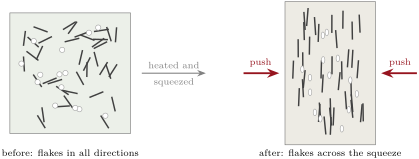
Mud, rich in flat clay flakes, shows the sequence best. With rising grade it becomes, in turn:
- a slate, whose aligned flakes of clay and mica are too small to see; it splits into flat sheets;
- a phyllite, whose micas have grown enough to give a silky sheen;
- a schist, whose micas are visible, often with larger crystals of garnet, kyanite or staurolite among them;
- a gneiss, in which the minerals have separated into light bands (quartz, feldspar) and dark bands, and which holds little or no mica, too hot for it to last.
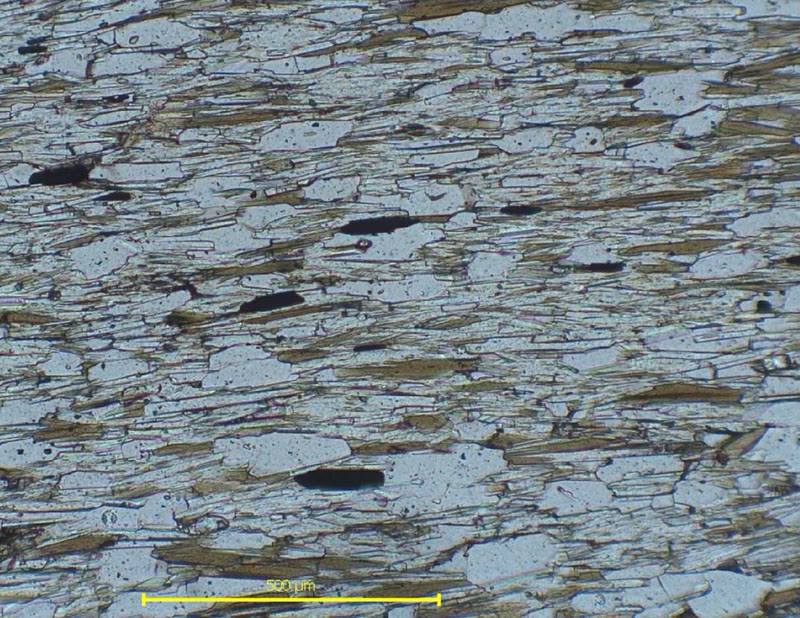
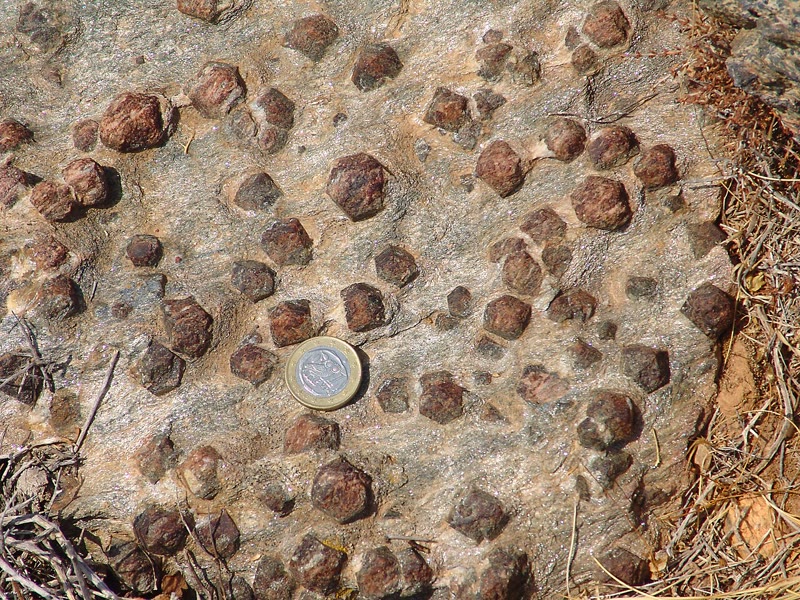
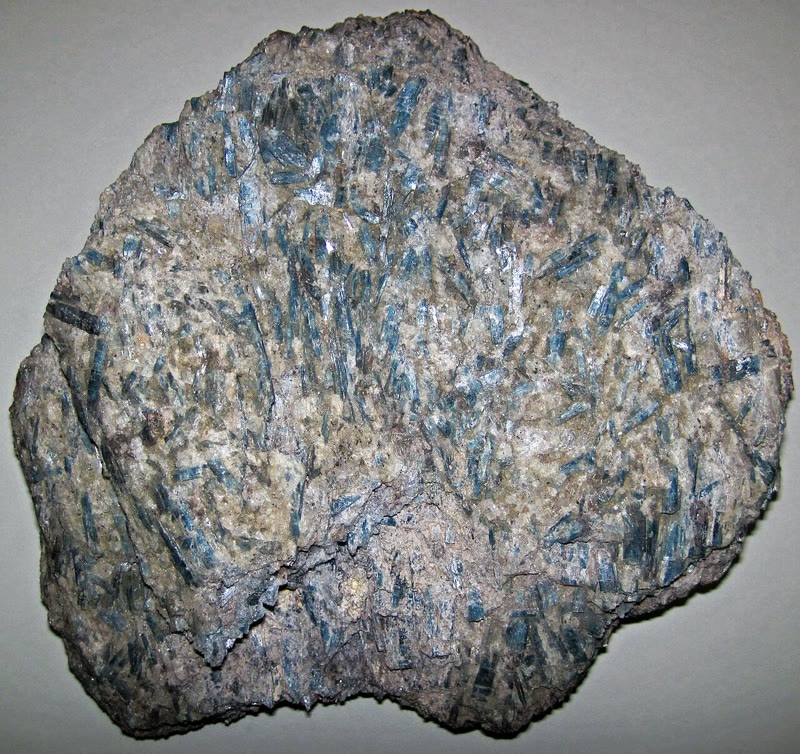
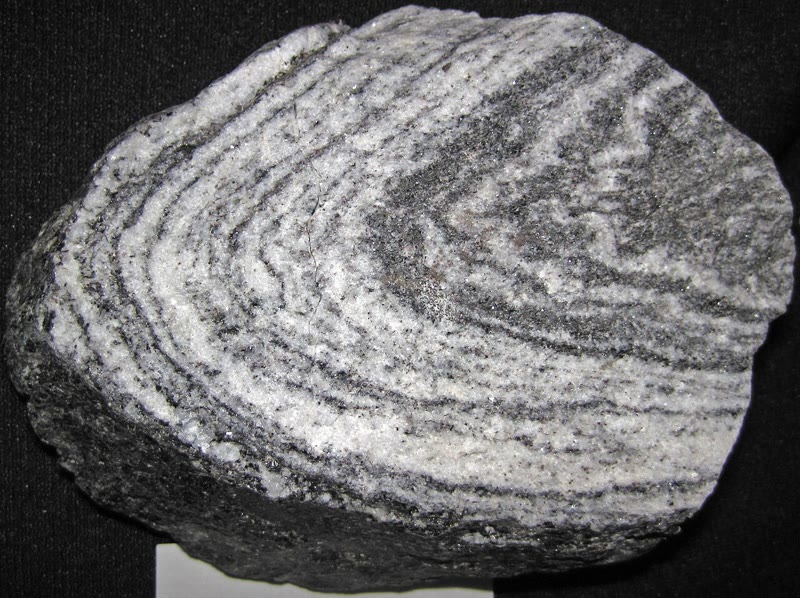
Along a typical geotherm, slate forms between about 5 and down, phyllite between 10 and 15, schist between 15 and 20, and gneiss between 20 and ; deeper still, the rock begins to melt in places. The foliation records the direction of the squeeze: it forms across the shortening that builds mountains (Chapter 20), and the original layering of the mud may still be seen crossing it at an angle.
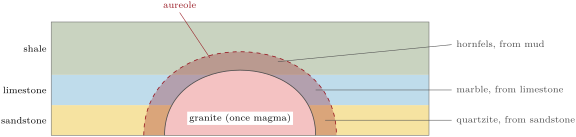
Rocks without flat or long minerals do not show a foliation even when they are squeezed. A limestone becomes a marble, made of larger crystals of calcite in which the fossils have been wiped out; a sandstone becomes a quartzite, whose quartz grains have grown into one another; and a mud heated without being squeezed becomes a hard, fine-grained rock without foliation, a hornfels.
21.4 Contact and regional metamorphism
Definition 21.9 (Contact metamorphism; regional metamorphism; aureole)
Contact metamorphism is the metamorphism of rocks heated by a body of magma that has intruded them; it is confined to a zone around the intrusion, its aureole, in which the grade rises towards the contact. Regional metamorphism affects rocks buried deep over large regions, usually where plates converge; the rocks are squeezed as well as heated, and are almost always foliated.
21.4.1 Around a body of magma
A body of magma at about that rises into the cold upper crust heats the rocks around it. Their temperature can reach 300 to more than , at the low pressures of shallow depths. The aureole is narrow: a few centimetres around a thin sheet of magma, up to several tens of metres around a large body. Its rocks are heated without being squeezed, so they are not foliated: mud becomes hornfels, limestone marble, sandstone quartzite. A body of magma that settles deep in rocks that are already hot makes hardly any aureole.
21.4.2 Under a mountain belt
Regional metamorphism needs burial to 10 or , so it affects thousands of square kilometres at once. The likeliest place is the root of a mountain belt, where collision thickens the crust and pushes its rocks down (Chapter 20). In one old belt whose zones have been mapped, the rocks of the sillimanite zone were heated above and buried 20 to deep, while those of the outer chlorite zone were probably never buried more than about . The mountains above were then worn down over tens of millions of years; as the load was removed, the thick crust rose again, and the once-deep zones now lie at the surface (Chapter 23).
21.4.3 Three geotherms
The polymorphs show at a glance that the same depth does not mean the same rock everywhere: it depends on the geotherm. The figure of the polymorphs carries three of them.
- A typical geotherm, about per kilometre: the temperature reaches about at . It passes beneath the triple point, so kyanite gives way directly to sillimanite, at about and .
- A geotherm of a volcanic area, 40 to per kilometre, steepened by the heat of rising magma: the rocks reach high temperatures at shallow depths. At per kilometre, andalusite appears at about and gives way to sillimanite at about , .
- The geotherm of a subduction zone, under per kilometre: the oceanic crust carried down stays several hundred degrees colder than the mantle around it. At it is only about , deep in the kyanite field. This is the cold, high-pressure path on which basalt becomes blueschist, then eclogite, at about .
So each metamorphic rock carries a record of the geotherm under which it formed, and of the plate setting behind it: andalusite and hornfels point to heat at shallow depths, around bodies of magma; kyanite and sillimanite schists and gneisses to the deep roots of mountain belts; blueschists and eclogites to subduction zones. Most of these rocks could only be seen because they came back to the surface without changing back. As they rise and cool, their reactions slow down, and the water that the reverse reactions would need has escaped on the way down.
21.5 Exercises
Exercise 21.1 ★
Give the word: (a) minerals with the same composition but different crystal structures; (b) the line on a map where an index mineral first appears; (c) the zone of heated rocks around a body of magma; (d) the parallel planes made by aligned flat minerals; (e) the pressure due to the weight of the rocks above.
Solution
Solution of Exercise 21.1.
(a) polymorphs; (b) an isograd; (c) an aureole; (d) a foliation; (e) the lithostatic pressure.
Exercise 21.2 ★
Name the metamorphic rock that each parent rock becomes: (1) a limestone; (2) a sandstone; (3) a mud, at low grade under a squeeze; (4) a mud, at high grade; (5) a mud, heated by a body of magma without being squeezed.
Solution
Solution of Exercise 21.2.
(1) marble; (2) quartzite; (3) slate; (4) gneiss; (5) hornfels.
Exercise 21.3 ★
With and , compute the lithostatic pressure, in , at and at .
Solution
Solution of Exercise 21.3.
: at , ; at , twice as much, .
Exercise 21.4 ★
On the diagram of the polymorphs of , which mineral is stable (1) at and ; (2) at and ; (3) at and ?
Solution
Solution of Exercise 21.4.
(1) Kyanite (the kyanite–andalusite line is near at ). (2) Andalusite. (3) Sillimanite.
Exercise 21.5 ★
(1) Put in order of rising grade: schist, slate, gneiss, phyllite. (2) In which of them can the micas be seen with the naked eye? (3) Which one shows light and dark bands?
Solution
Solution of Exercise 21.5.
(1) Slate, phyllite, schist, gneiss. (2) In the schist. (3) The gneiss.
Exercise 21.6 ★★
(1) Compute the lithostatic pressure at the base of a crust thick () and express it in atmospheres (). (2) Compute the pressure on the floor of an ocean deep, with sea water of density . (3) How many times larger is the first?
Solution
Solution of Exercise 21.6.
(1) , that is atmospheres. (2) . (3) times.
Exercise 21.7 ★★
The triple point of lies at and . (1) At what depth is that pressure reached ()? (2) What geothermal gradient, starting from at the surface, passes exactly through it? (3) Is a rock that holds all three polymorphs likely to be common?
Solution
Solution of Exercise 21.7.
(1) . (2) per kilometre. (3) No: the rock would have to sit exactly at one point of the diagram; such rocks are rare.
Exercise 21.8 ★★
In the photograph of the garnet schist of Syros, the largest garnets are about a third of the coin across, which is . (1) Estimate their diameter. (2) If a garnet’s diameter grows by about in a million years, how long did they take to grow? (3) What does that tell you about the time a rock spends at depth?
Solution
Solution of Exercise 21.8.
(1) . (2) About 8 million years. (3) The rock stayed at depth, at a high temperature, for millions of years.
Exercise 21.9 ★★
Walking westward across an old mountain belt, a geologist records rocks made from mud. At the start they hold chlorite and biotite only; the first garnet appears after , the first staurolite after , the first kyanite after , the first sillimanite after . (1) How many isograds were crossed? Name them in order. (2) In which direction does the grade rise? (3) Where were the rocks buried deepest, and roughly how hot did they become there?
Solution
Solution of Exercise 21.9.
(1) Four: the garnet, staurolite, kyanite and sillimanite isograds, in that order. (2) Westward. (3) At the western end, in the sillimanite zone. Its rocks crossed the kyanite–sillimanite line: buried about (), they were hotter than about .
Exercise 21.10 ★★
A body of magma rises into layers of mud, limestone and sandstone near the surface. (1) Name the rock each layer becomes next to it. (2) Why are these rocks not foliated? (3) A second body of magma settles down, in rocks already near . Why does it make hardly any aureole?
Solution
Solution of Exercise 21.10.
(1) Mud becomes hornfels, limestone becomes marble, sandstone becomes quartzite. (2) They were heated without being squeezed: no directed pressure aligned their minerals. (3) The rocks around it are already hot, so the magma heats them little more.
Exercise 21.11 ★★
A layer of mud is squeezed from the east and the west during a collision, and grows micas as it is heated. (1) How do the micas lie: their flat faces facing east–west or north–south? (2) Is the foliation that forms horizontal or vertical? (3) A marble and a quartzite squeezed in the same way show no foliation. Why?
Solution
Solution of Exercise 21.11.
(1) Across the push: their flat faces face east and west, so the flakes stand in north–south planes. (2) Vertical, running north–south. (3) Calcite and quartz grains are neither flat nor long, so even when they recrystallise under a squeeze there is nothing to line up.
Exercise 21.12 ★★★
Between 500 and , the kyanite–sillimanite boundary is close to the straight line , with in and in . A typical geotherm is ( in ), and . (1) Write the geotherm as as a function of . (2) Find where it crosses the boundary: temperature, pressure, depth. (3) Along this geotherm, which polymorph is stable just above that depth, and which just below?
Solution
Solution of Exercise 21.12.
(1) , so . (2) gives , so , and . (3) Kyanite above that depth, sillimanite below it.
Exercise 21.13 ★★★
(1) Along a subduction geotherm of per kilometre, starting from , what is the temperature at , where eclogite forms? (2) What is it along a typical geotherm of per kilometre? (3) Place both points on the diagram of the polymorphs: which polymorph is stable at the first? (4) Why do blueschists and eclogites form in subduction zones and hardly anywhere else?
Solution
Solution of Exercise 21.13.
(1) . (2) . (3) The pressure at is about ; at that point lies deep in the kyanite field. The second point lies far to the right of the diagram, in the sillimanite field, at temperatures where crustal rocks begin to melt. (4) They need a high pressure at a low temperature, a combination that only the cold crust carried down in a subduction zone provides.
Exercise 21.14 ★★★
The densities of kyanite, sillimanite and andalusite are , and . (1) Compute the volume of of each, in . (2) By what percentage is kyanite smaller than andalusite of the same mass? (3) Explain, with the idea that a high pressure favours the arrangement that takes the least room, why kyanite holds the high-pressure field of the diagram.
Solution
Solution of Exercise 21.14.
(1) Kyanite ; sillimanite ; andalusite . (2) , about . (3) At high pressure the most compact arrangement of the atoms is favoured; kyanite packs the same atoms into the least room.
Exercise 21.15 ★★★
In an old mountain belt, the rocks of the sillimanite zone were heated above and buried 20 to deep. (1) Compute the pressure at 20 and at . (2) Using the line of exercise 12, find the lowest temperature at which sillimanite is stable at each of these pressures. Is consistent with sillimanite? (3) What geothermal gradients, from at the surface, does at 20 and at imply? (4) The rocks were exposed at the surface about 40 million years later. At what mean rate was the rock above them removed, in a year?
Solution
Solution of Exercise 21.15.
(1) at , at . (2) : about at and at . At the rocks were hotter than both, in the sillimanite field: consistent. (3) and per kilometre, close to the typical gradient. (4) to in 40 million years: 0.50 to per million years, that is 0.50 to a year.
Problem 21.1
Weekend problem — The history of a kyanite schist
A schist collected in the core of an old mountain belt holds muscovite, biotite, quartz, garnets up to across, and blue blades of kyanite; it holds neither sillimanite nor andalusite. Laboratory analyses of its garnet and biotite give the conditions under which it crystallised: about and . Take , , at the surface, and the kyanite–sillimanite line of exercise 12, .
Part I — The minerals.
- Why is the rock called a schist? Which of its minerals make the schistosity?
- Kyanite, andalusite and sillimanite share one formula. Write it, and give the word for such minerals.
- The densities of kyanite and andalusite are and . By what percentage is the volume of a kilogram of kyanite smaller? Which one does pressure favour?
- In the sequence of index minerals of rocks made from mud, which zone does the rock belong to? Which isograds did it cross on its way down?
- If the garnets’ diameter grew by about in a million years, how long did the largest ones take to grow?
Part II — Pressure and temperature.
- At , above what pressure is kyanite stable rather than sillimanite?
- Check that the point (, ) lies in the kyanite field.
- The missing sillimanite gives a lowest pressure at . What is it?
- Had the rock been heated further at , at what temperature would its kyanite have turned into sillimanite?
- Express in kilobars () and in atmospheres ().
Part III — The burial depth.
- By how many megapascals does the lithostatic pressure rise per kilometre?
- At what depth was the schist when it crystallised?
- What is the smallest depth allowed by the missing sillimanite (question 8)?
- Redo question 12 with a density of for the rocks above. By what percentage does the depth change?
- A continental crust is normally 35 to thick, and 50 to under mountain belts. Did the schist crystallise in the crust or in the mantle?
Part IV — The geotherm, and the way back up.
- What mean geothermal gradient do at that depth imply?
- Compare it with the gradients of a subduction zone, a typical crust and a volcanic area. Which kind of metamorphism made the rock?
- Along a typical geotherm of per kilometre, what would the temperature be at the depth of question 12? Which polymorph would then be stable at ?
- To bring the schist to the surface, all the rock above it had to be removed. At a mean rate of a year, how long did that take?
- Why did the kyanite not turn back into andalusite on the way up?
- Sum up: at what depth did this kyanite schist crystallise?
Solution
Solution of Problem 21.1.
1. It is foliated, and its micas are big enough to be seen. The micas, muscovite and biotite, make the schistosity.
2. ; they are polymorphs.
3. The volumes of a kilogram are in the ratio : kyanite is about smaller. Pressure favours kyanite.
4. The kyanite zone. On its way down it crossed the biotite, garnet, staurolite and kyanite isograds.
5. About 8 million years.
6. .
7. is above , on the kyanite side of the kyanite–sillimanite line; it is also far above the andalusite field, which at lies below about .
8. .
9. , so .
10. ; atmospheres.
11. per metre, per kilometre.
12. , about .
13. .
14. , about deeper ().
15. In the crust: is less than even a normal crustal thickness.
16. per kilometre.
17. It is much warmer than a subduction zone (under per kilometre) and a little colder than a typical crust (), far from a volcanic area (40 to ): a rock buried deep in the thickened crust of a mountain belt, by regional metamorphism.
18. . The kyanite–sillimanite line, continued, lies at at that temperature; is below it, in the sillimanite field. A typical geotherm would have made sillimanite.
19. ; at a year, about 50 million years.
20. As the rock rose it cooled, so its reactions slowed down, and the water that the reverse reactions need had been driven off on the way down.
21. The kyanite schist crystallised about down, at about .