书籍暂未推出简体中文版——当前显示英文版。
High School Earth and Space Sciences · 10–12 年级
26The Early Earth and Its Atmosphere
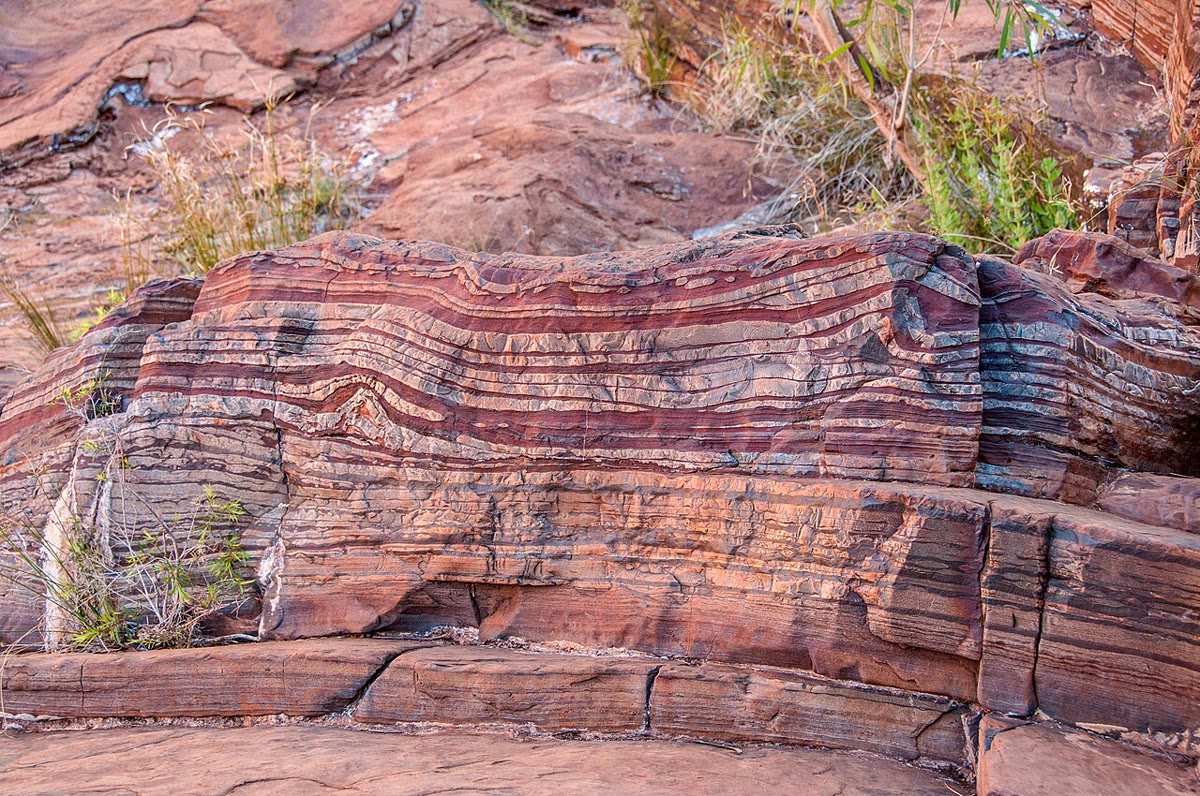
In the Hamersley Ranges of north-western Australia, the walls of Dales Gorge are striped like a layer cake: thin bands of red, grey and black rock. They are a banded iron formation, laid down on a sea floor more than 2.5 billion years ago. The iron in them rusted in that sea, and to rust, it needed oxygen. This chapter asks what the young Earth and its air were like, and how the rocks record the moment oxygen appeared.
You already know
The Earth is 4.54 billion years old (Chapter 25), and zircons show that a crust existed 4.4 billion years ago (Chapter 19). A planet’s equilibrium temperature, , is about for the Earth today (Chapter 2). Today’s dry air is nitrogen and oxygen, and carbon dioxide and methane are greenhouse gases; an element that takes up oxygen is oxidised (the chemistry books). Plants, algae and cyanobacteria make their food by photosynthesis, which releases oxygen (the biology books).
26.1 The young Earth
The Earth grew by the accretion of smaller bodies. About 60 million years after the Solar System began to form, a body perhaps the size of Mars struck it, and the material flung into space formed the Moon. The young Earth was hot and still partly molten. It cooled, and by about 4.4 billion years ago it already had a crust and an ocean: zircons of that age carry the chemical mark of liquid water.
26.2 The primitive atmosphere
Definition 26.1 (Outgassing; primitive atmosphere)
Outgassing is the release, by volcanoes and through the ground, of the gases dissolved in magma. The primitive atmosphere is the Earth’s atmosphere before living things changed it: built mostly by outgassing, it held nitrogen, carbon dioxide and water vapour, more carbon dioxide than today, and almost no free oxygen.
Volcanoes still show how such an atmosphere forms: as magma rises and the pressure falls, its dissolved gases escape, by far the most abundant being water vapour, then carbon dioxide. Nitrogen and carbon dioxide, the gases that dominated the primitive air, are still the main nitrogen- and carbon-bearing gases of volcanoes today. The water vapour condensed into the ocean. Oxygen made up less than of its level in today’s air.
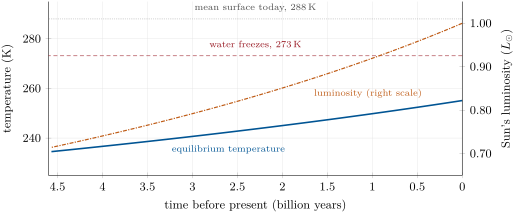
The young Sun shone less brightly than today. As it turns hydrogen into helium in its core, the core contracts and heats up, and the Sun’s power slowly rises.
Proposition 26.2 (The young Sun’s luminosity)
Calling the Sun’s present age and its present luminosity, its luminosity when it was years old was
This approximation of the computed models of the Sun is admitted here. At the Sun’s birth, , it gives : the young Sun was about dimmer.
Example 26.3 (The Earth four billion years ago)
Take billion years. Four billion years ago the Sun was 0.567 billion years old, so and . The sunlight reaching the Earth was . Keeping today’s albedo, the equilibrium temperature scales as the fourth root of the sunlight: , about .
Definition 26.4 (Faint young Sun problem)
The faint young Sun problem is the contradiction between the dimmer Sun of the Earth’s first billions of years, under which the Earth with today’s atmosphere would have frozen, and the rocks, which show that liquid water was present.
The problem was made widely known in 1972 by Carl Sagan and George Mullen, who proposed a stronger greenhouse effect as the answer. Most of the answers studied since call on more greenhouse gases in the primitive atmosphere: much more carbon dioxide than today, methane made by early microbes, or both. In one classic calculation, about a tenth of a bar of carbon dioxide, with a little methane, keeps the young Earth as warm as today; without the methane, about three times more is needed. The problem is not yet regarded as solved.
26.3 Life and oxygen
The fossil record of stromatolites covers almost million years: they are among the oldest signs of life.
Definition 26.5 (Stromatolite)
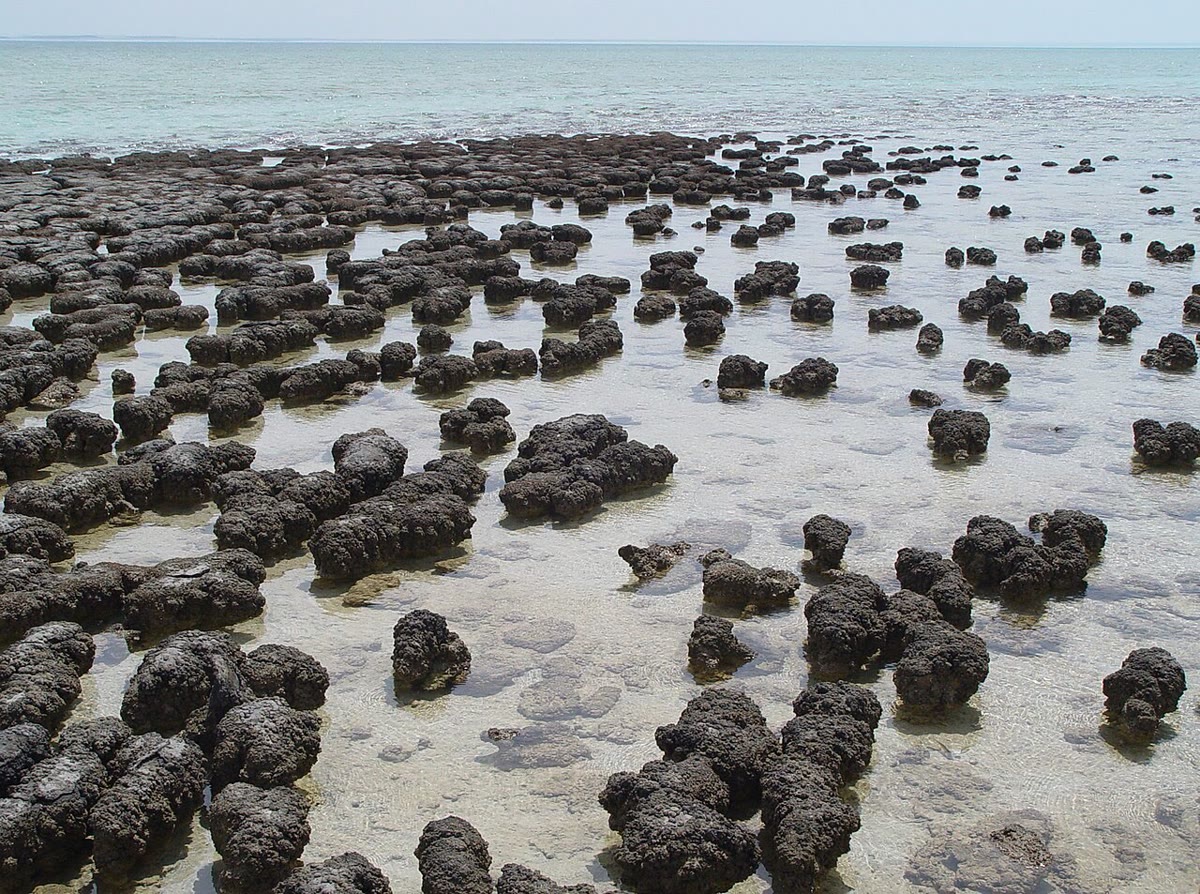
A stromatolite is a layered mound built in shallow water by a mat of microbes, mainly cyanobacteria, which trap and bind grains of sediment and make carbonate grow, layer upon layer.
Fossil stromatolites million years old are found in the Strelley Pool Chert of the Pilbara, in Western Australia. Living ones grow today in the very salty water of Hamelin Pool in Shark Bay, twice as salty as usual sea water, where they are the best-known modern example.
The cyanobacteria brought something new: photosynthesis that releases oxygen. But for a long time the oxygen they made did not stay in the air. It was used up as fast as it was made: by the iron dissolved in the sea, by sulfur and by methane.
26.4 The rise of oxygen
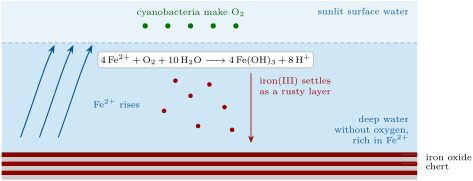
Before oxygen, iron could travel dissolved in sea water as the ion . Oxygen turns it into iron(III), which does not dissolve: it falls to the floor as a rusty sediment.
Proposition 26.6 (Iron takes up oxygen)
Dissolved iron(II) is oxidised by oxygen in water into iron(III) hydroxide, which precipitates:
Each molecule of oxygen removes four ions of dissolved iron; as long as dissolved iron remains, the oxygen made is used up.
Proof. Check the balance. Iron: 4 on each side. Oxygen: on the left, on the right. Hydrogen: on the left, on the right. Charge: on the left, on the right. ∎
Definition 26.7 (Banded iron formation)
A banded iron formation is a sedimentary rock of thin alternating layers of iron oxides, such as hematite, and of chert, a fine-grained silica poor in iron. Almost all are older than 1.8 billion years.
Banded iron formations need two waters at once: a deep ocean without oxygen, which carries dissolved iron, and a shallow, sunlit sea where cyanobacteria make oxygen and the iron precipitates. They are common in rocks from 2.4 to 1.8 billion years old, and those of the Hamersley Ranges are older still. Banded iron formations are a common ore of iron.
Then oxygen began to stay in the air.
Definition 26.8 (Great Oxidation Event)
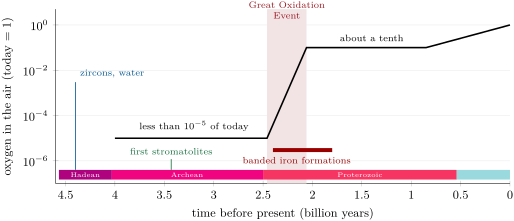
The Great Oxidation Event is the interval, from about to about billion years ago, during which free oxygen first built up in the Earth’s atmosphere and shallow seas, reaching perhaps a tenth of its present level.
The evidence is in the rocks. Some minerals, pyrite and uraninite among them, are destroyed by oxygen; yet grains of them, rolled by rivers, are found in old sediments, and grains of pyrite are missing from those laid down after the rise of oxygen. Sulfur isotopes in rocks older than about 2.45 billion years carry a signature that only an air with less than a hundred-thousandth of today’s oxygen can leave; by 2.09 billion years ago it has gone. And on land appeared red beds.
Definition 26.9 (Red beds)
Red beds are sedimentary rocks — sandstones, siltstones, shales — coloured red by a coating of iron(III) oxide, hematite, on their grains. They form only where there is oxygen enough to oxidise iron.
The formation of banded iron formations essentially stopped after 1.8 billion years ago: by then the deep ocean too had enough oxygen to stop carrying iron. Over the next billion years oxygen changed little; after 0.85 billion years ago it built up again, towards today’s .
Method 26.10 (Reading a geological timeline)
- Find which way time runs on the axis, and its unit (millions or billions of years before present).
- Locate the eons on the coloured band, and read their limits.
- For each event, read its date, or the interval during which it happened, and say what record dates it (a mineral, a fossil, a rock).
- Compute durations by subtraction, and compare them with the age of the Earth.
- Check the order: an effect must not come before its cause.
26.5 Exercises
Exercise 26.1 ★
Give the word: (a) the release of gases dissolved in magma; (b) a layered mound built by a microbial mat; (c) a rock of alternating iron-oxide and chert layers; (d) sedimentary rocks coloured by hematite; (e) the interval when oxygen first built up in the air.
Solution
Solution of Exercise 26.1.
(a) outgassing; (b) a stromatolite; (c) a banded iron formation; (d) red beds; (e) the Great Oxidation Event.
Exercise 26.2 ★
Put in order, from the oldest: the end of most banded iron formations; the first stromatolites of the Pilbara; zircons that show liquid water; the Hamersley banded iron formations; the end of the Great Oxidation Event.
Solution
Solution of Exercise 26.2.
Zircons that show liquid water (4.4 billion years); the first stromatolites of the Pilbara (3.43); the Hamersley banded iron formations (more than 2.5); the end of the Great Oxidation Event (2.06); the end of most banded iron formations (1.8).
Exercise 26.3 ★
Using the luminosity law, compute the Sun’s luminosity at its birth, as a fraction of today’s. By what percentage was it dimmer?
Solution
Solution of Exercise 26.3.
At , : about dimmer, nearly a third less bright than today.
Exercise 26.4 ★
Grains of pyrite rolled by rivers are found in old sediments, but not in those laid down after the rise of oxygen. What does this tell you about the air at the time of the old sediments? Why?
Solution
Solution of Exercise 26.4.
That the air then held almost no oxygen. Pyrite is destroyed by oxygen; its grains could be rolled along by rivers and deposited intact only if the air and the water at the surface lacked it.
Exercise 26.5 ★
Name the two most abundant gases released by volcanoes, and say what became of each in the young Earth.
Solution
Solution of Exercise 26.5.
Water vapour, which condensed into the ocean, and carbon dioxide, which stayed in the air in much larger amounts than today and warmed the Earth by its greenhouse effect.
Exercise 26.6 ★★
Compute the Sun’s luminosity and the Earth’s equilibrium temperature (today , albedo unchanged) 3 billion years ago and 2.45 billion years ago, taking billion years.
Solution
Solution of Exercise 26.6.
3 billion years ago: , , . 2.45 billion years ago: , , .
Exercise 26.7 ★★
How much oxygen is needed to precipitate of dissolved iron as iron(III) hydroxide? (Molar masses: iron , oxygen .)
Solution
Solution of Exercise 26.7.
of iron is moles; one molecule of oxygen takes four ions of iron, so moles of , that is of oxygen.
Exercise 26.8 ★★
Using the timeline, (1) how long did the Great Oxidation Event last? (2) For what fraction of the Earth’s history was there almost no oxygen in the air? (3) How long after the first stromatolites did oxygen start to build up?
Solution
Solution of Exercise 26.8.
(1) billion years, 400 million years. (2) From 4.54 to 2.46 billion years ago: of the Earth’s history. (3) About billion years: the oxygen the microbes made was used up for a long time before it could stay in the air.
Exercise 26.9 ★★
A banded iron formation and a red bed both contain iron(III) oxide. What does each tell you about oxygen, and where: in the deep sea, in the shallow sea, in the air?
Solution
Solution of Exercise 26.9.
The banded iron formation shows a deep sea without oxygen, which could carry dissolved iron, under a shallow sunlit sea with enough oxygen to precipitate it. The red bed, laid down on land, shows oxygen in the air and in the water at the surface, enough to rust the iron of its grains.
Exercise 26.10 ★★
Where can living stromatolites be seen today? What is special about the water there, and how does a stromatolite grow layer upon layer?
Solution
Solution of Exercise 26.10.
In Hamelin Pool, Shark Bay, Western Australia, whose water is twice as salty as usual sea water. A mat of microbes, mainly cyanobacteria, traps and binds grains of sediment and makes carbonate grow; a new mat grows on top, and so on, layer upon layer.
Exercise 26.11 ★★
Oxygen is of today’s air. What percentage was it when it was (1) a hundred-thousandth of today’s level; (2) a tenth of today’s level?
Solution
Solution of Exercise 26.11.
(1) . (2) .
Exercise 26.12 ★★★
Four billion years ago, which albedo would have given the Earth today’s equilibrium temperature, , under the young Sun (, today’s albedo 0.294)? Is a planet with an ocean, clouds and some ice likely to have been so dark? What is the other way out?
Solution
Solution of Exercise 26.12.
The equilibrium temperature is unchanged if equals : , so . The Earth would have had to reflect less than of the sunlight, almost like a black body, which an ocean planet with clouds and some ice cannot do. The other way out is a stronger greenhouse effect.
Exercise 26.13 ★★★
Today the greenhouse effect warms the Earth’s surface from 255 to . Four billion years ago the equilibrium temperature was about . (1) How many kelvins of greenhouse warming were then needed to reach ? To reach ? (2) Compare with today’s. (3) One classic calculation needs about of carbon dioxide, with a little methane; compare with the pressure of today’s whole atmosphere, about .
Solution
Solution of Exercise 26.13.
(1) to reach freezing; to reach today’s mean. (2) Today’s greenhouse effect adds : the young Earth needed a stronger one. (3) is a tenth of the pressure of today’s whole atmosphere, for carbon dioxide alone.
Exercise 26.14 ★★★
A special signature of sulfur isotopes can only be made, and kept in sediments, when the air holds less than of today’s oxygen. It is found in rocks older than 2450 million years, and not in rocks younger than 2090 million years. (1) What do you conclude about the oxygen before 2450 million years ago? After 2090 million years? (2) Is this consistent with the dates of the Great Oxidation Event?
Solution
Solution of Exercise 26.14.
(1) Before 2450 million years ago the signature exists, so the air held less than of today’s oxygen; after 2090 million years it is absent, so the air held more. (2) Yes: the Great Oxidation Event runs from about 2460 to 2060 million years ago, the same interval.
Exercise 26.15 ★★★
The Moon-forming impact happened about 60 million years after the Solar System began to form, which the first solids date to 4567 million years ago. (1) About when did the impact happen? (2) The oldest zircons are million years old. At most how long after the impact did the Earth already have a solid crust and liquid water?
Solution
Solution of Exercise 26.15.
(1) About million years ago. (2) At most million years after the impact: the Earth had a crust and water within about a hundred million years of the impact.
Problem 26.1
Weekend problem — The faint young Sun
The Sun is billion years old. Its luminosity when it was years old was . Today the Earth receives of sunlight, reflects a fraction 0.294 of it, and has an equilibrium temperature of ; its mean surface temperature is .
Part I — The Sun four billion years ago.
- How old was the Sun four billion years ago?
- Compute at that time.
- Compute its luminosity as a fraction of today’s.
- What sunlight did the Earth receive, in ?
- By what percentage was the Sun dimmer than today?
Part II — The equilibrium temperature.
- Write the equilibrium temperature as a function of the sunlight .
- Show that, with the albedo unchanged, the temperature varies as .
- Compute .
- Compute the equilibrium temperature four billion years ago.
- Convert it into degrees Celsius.
Part III — Evidence of liquid water.
- What do zircons 4.4 billion years old show?
- In what kind of water did the stromatolites of the Pilbara, million years old, grow?
- Which rocks of the Hamersley Ranges, laid down in the sea more than 2.5 billion years ago, need liquid water?
- Without a greenhouse effect, would the ocean have frozen four billion years ago? Why?
- State the contradiction this reveals, and give its name.
Part IV — The greenhouse warming needed.
- How many kelvins does today’s greenhouse effect add?
- How many were needed four billion years ago to keep the mean surface above ?
- Which albedo would have given without any extra greenhouse effect? Is it plausible?
- Which gas is thought to have supplied most of the extra warming, and what other gas may have helped?
- Sum up: what was the Earth’s equilibrium temperature four billion years ago?
Solution
Solution of Problem 26.1.
1. billion years.
2. .
3. of today’s.
4. .
5. : dimmer.
6. .
7. With and fixed, is a constant times , so .
8. .
9. .
10. .
11. That there was liquid water at the surface, an ocean, 4.4 billion years ago.
12. In shallow water, as living stromatolites do today.
13. The banded iron formations of the Hamersley Ranges, laid down on a sea floor.
14. Yes: is far below ; with today’s atmosphere the mean surface would have been frozen.
15. The rocks show liquid water under a Sun too faint to keep it liquid with today’s atmosphere: the faint young Sun problem.
16. .
17. At least , more than today’s.
18. : an almost black planet, not plausible.
19. Carbon dioxide, much more abundant than today; methane, made by early microbes, may have helped.
20. The Earth’s equilibrium temperature four billion years ago was about 237 K, some below freezing.