书籍暂未推出简体中文版——当前显示英文版。
High School Earth and Space Sciences · 10–12 年级
9Freshwater Resources
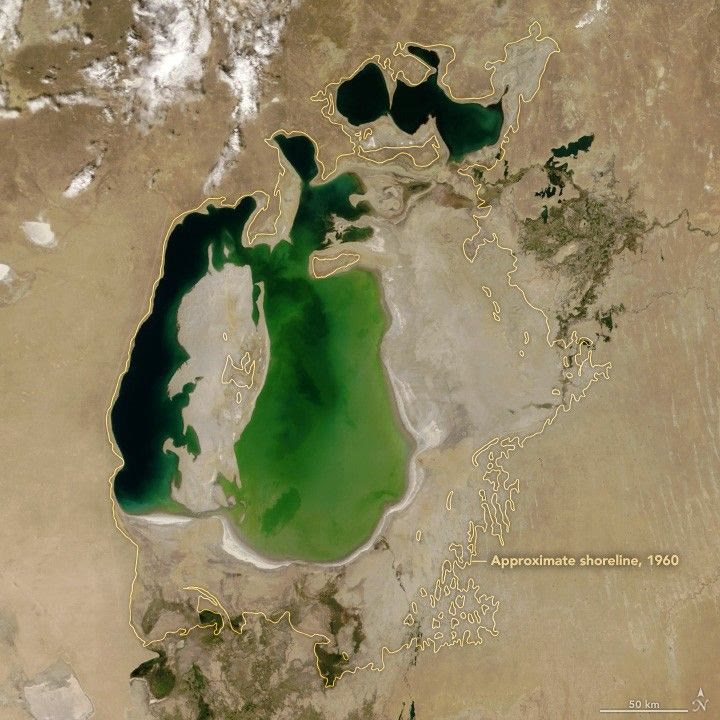
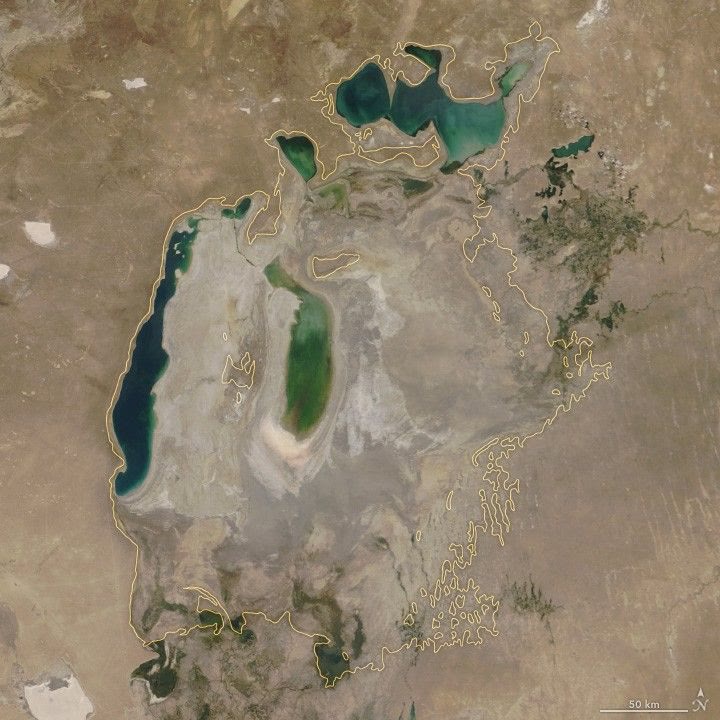
In 1960 the Aral Sea, in the deserts of Central Asia, was the fourth largest lake in the world. Two great rivers, fed by snow and rain in faraway mountains, flowed into it; none flowed out. In the 1960s their water was taken to irrigate the desert. Satellites have watched what followed: the lake has broken into pieces, and most of its bed is now dry land. The cause, overwhelmingly, was not a change of climate but the irrigation: the lake received far less water than evaporation took from it each year. This chapter counts the water of the Earth, where it is stored and how fast it moves, and shows that a resource of water is above all a flow: when more is taken from a reservoir than flows into it, the reservoir empties, at a rate that a simple budget predicts.
You already know
The water cycle moves water between the ocean, the air and the land: evaporation, condensation into clouds, precipitation, runoff; the total mass of water is conserved (the physics books). Rocks with connected pores are permeable; below the water table their pores are full of water, and a layer that holds and lets through enough water to feed wells is an aquifer (Book 1, grade 6). Most of the Earth’s water is salt water (Book 1, grade 2). A river carries away the water of its drainage basin; its discharge is a volume per second (Chapter 8).
9.1 Where the water is
The Earth holds about 1.39 billion cubic kilometres of water. Almost all of it is in the ocean; only is fresh. And most of that fresh water is out of reach: more than two-thirds of it is frozen in the ice caps and glaciers, and almost a third lies underground.
| reservoir | volume () | share of fresh water |
|---|---|---|
| oceans, seas and bays | (salt) | |
| ice caps, glaciers and permanent snow | ||
| fresh groundwater | ||
| ground ice and permafrost | ||
| fresh lakes | ||
| soil moisture | ||
| atmosphere | ||
| rivers |
Rivers and fresh lakes, from which people draw most of the water they use, together hold less than one hundredth of one per cent of all the water. Yet rivers never run dry for long: they are not a store but a flow, refilled by every rain.
9.2 Stocks and fluxes
Definition 9.1 (Stock; flux)
In a budget of water, a stock is the amount of water held in a reservoir — the ocean, the air, the ice, an aquifer, a lake — at a given time, as a volume or a mass. A flux is the amount that passes from one reservoir to another per unit time, for example in cubic kilometres per year.
A stock changes only through its fluxes: what enters minus what leaves. When the two are equal, the stock is in steady state: it stays the same although its water is always being replaced.
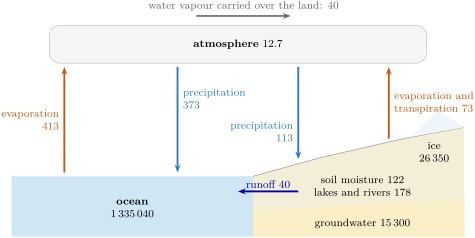
The cycle is balanced. Each year the ocean loses by evaporation and gets back as rain and snow and from the rivers. The air receives and gives back , the same. The land receives of precipitation; return to the air by evaporation and through the leaves of plants, and the remaining run off to the sea, in rivers and underground.
Definition 9.2 (Renewable fresh water)
The renewable fresh water of a region is the flux of fresh water renewed each year by precipitation, which flows through it as runoff in rivers and as groundwater. It is a flux, in cubic kilometres per year, not a stock.
For all the land of the Earth, it is the that reach the sea each year. A region can use its renewable water year after year without running short. What it takes beyond it can only come from a stock, which then shrinks.
9.3 Residence time
How long does a molecule of water stay in a reservoir? Some leave at once, others stay much longer; but on average, the answer follows from the stock and the flux alone.
Definition 9.3 (Residence time)
The residence time of water in a reservoir is the average time that water spends in it between entering and leaving.
Proposition 9.4 (Residence time, stock and flux)
For a reservoir in steady state, holding a stock crossed by a flux (in and out), the residence time is
Proof. In steady state, a volume enters and a volume leaves each year, while the stock stays . After a time , a volume has entered: as much as the whole reservoir holds. On average, the water present at the start has then been replaced, so the water stays in the reservoir. ∎
Example 9.5 (Water in the air)
The atmosphere holds of water, and fall out of it each year as rain and snow. Its residence time is year, about days: the water of the air is renewed every week or two. A cloud that rains today is made of water that left the ocean or the ground a few days ago.
The same computation gives about days for the water in river channels ( carried by a year), a few years for lakes and rivers together, and about years for the ocean ( thousand ). Groundwater can be slower still: the deepest water of some aquifers is hundreds of thousands of years old.
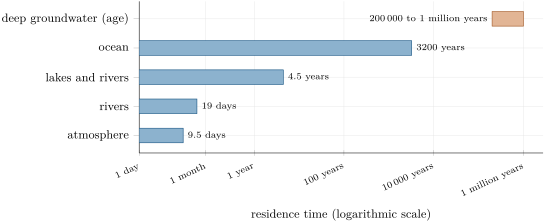
Residence time measures how fast a reservoir recovers. Water taken from a river is replaced in days; a polluted or emptied lake takes years; groundwater that took thousands of years to gather is, on the scale of a human life, not renewed at all.
Method 9.6 (A water budget)
- Choose the reservoir: a lake, an aquifer, a basin, the air.
- List every flux into it (rivers, rain, seepage) and out of it (rivers, evaporation, pumping), in the same unit.
- The change of the stock per year is the sum of the inputs minus the sum of the outputs.
- If the stock does not change, inputs equal outputs, and the residence time is the stock divided by either.
9.4 Aquifers as reservoirs
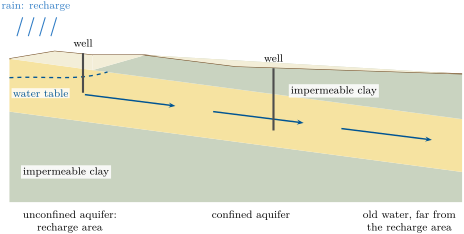
Rain that soaks into the ground and reaches the water table recharges the aquifer below. The water then moves slowly through the pores of the rock, towards springs, rivers or the sea. Where a permeable layer dips under an impermeable one, such as clay, its water is confined: it is fed only where the layer reaches the surface, which may be far away.
Definition 9.7 (Fossil groundwater)
Fossil groundwater is groundwater that entered its aquifer long ago, often under a wetter climate, and that today’s recharge does not renew on the scale of human lifetimes.
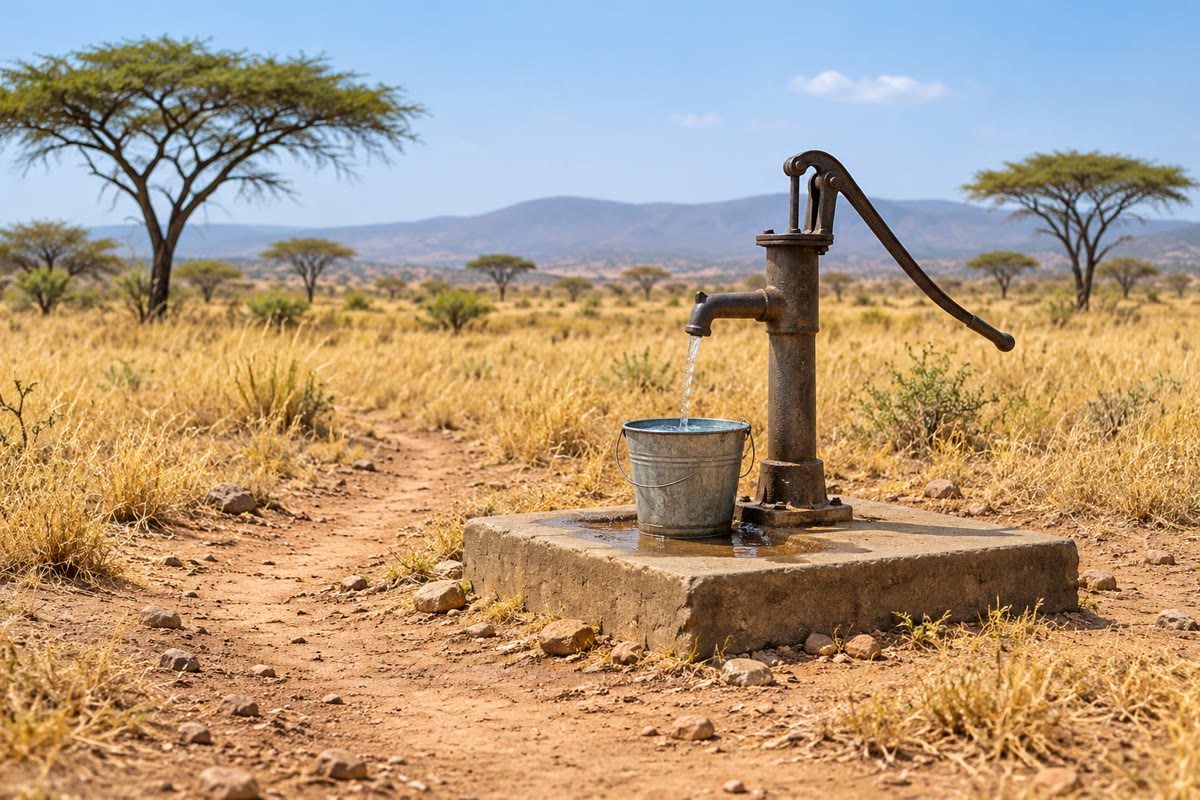
Under the eastern Sahara lies a vast sandstone aquifer. Its deepest water, dated by the decay of a rare radioactive form of krypton, is to a million years old. It flowed in slowly from a recharge area in south-western Egypt, and its chemistry shows that it fell as rain during past wet periods of the ice ages, when moist air from the Atlantic reached the region. Pumped today, such water is a stock being mined, not a flow.
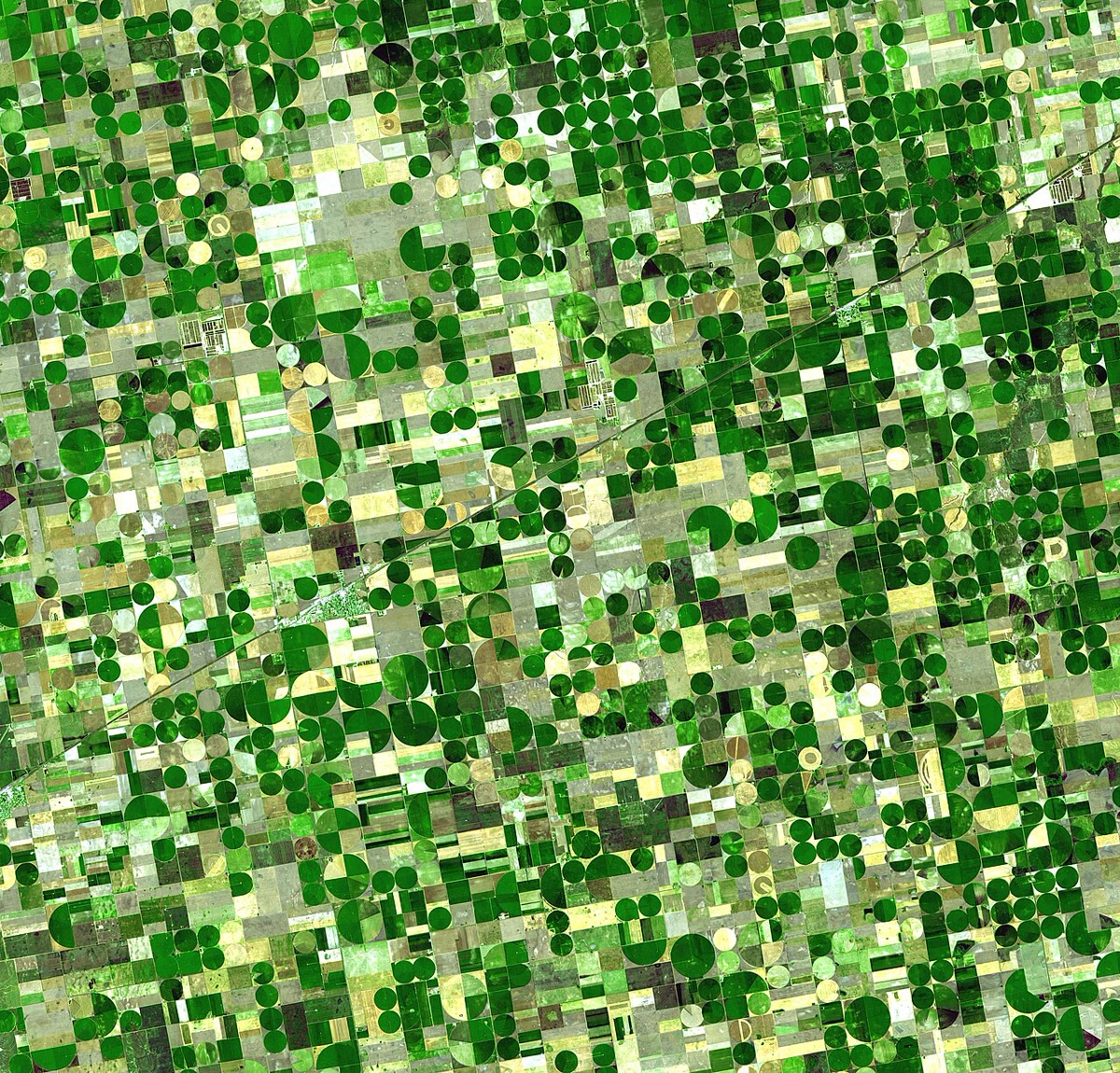
When pumping exceeds recharge, the water table falls. In the High Plains of the central United States, the aquifer under some square miles () has been pumped for irrigation since about 1950. By 2015 its water level had fallen by on average, and by up to (234 feet) in some wells; the aquifer had lost about million acre-feet of water, some .
Groundwater cannot be seen from space, but it can be weighed: two satellites flying one behind the other feel the slight changes in the Earth’s pull caused by the mass of water that comes and goes below them, and map where the stock of water on land rises and falls from month to month.
9.5 Overuse as a physical fact
The Aral Sea has no outlet: the water of its two rivers, the Amu Darya and the Syr Darya, leaves only by evaporation. In 1960 it covered , held and its water contained of salt per litre. That year evaporation removed , and rain on the lake brought : to keep its level, the lake needed a year from its rivers.
From the 1960s the rivers were diverted to irrigate the desert, and almost none of their water reached the lake: in the 1970s and 1980s, often less than a year. Evaporation went on, and the lake began to shrink. Its budget sets how fast. Evaporation takes a layer of water whose thickness depends on the climate, here about a metre a year (). If the inflow stops, the level falls by about that much each year, less the rain. As the lake shrinks, its area and so its evaporation shrink too, and the fall slows down; but it does not stop until the inflow and the evaporation balance again.
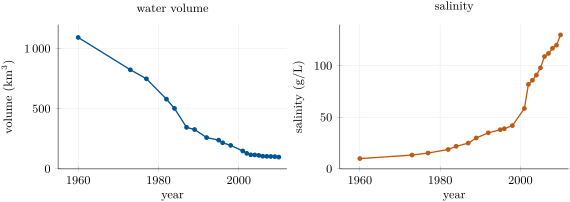
By 2010 the lake held , a tenth of its 1960 volume, over ; its salinity had reached , far saltier than the ocean. Its level had fallen by more than . Salty dust blows from the dry bed. The cause is not hidden: the inflow of the lake was cut while its evaporation was not.
9.6 Exercises
Exercise 9.1 ★
Define a stock, a flux and a residence time, and give the units of each.
Solution
Solution of Exercise 9.1.
A stock is the amount of water held in a reservoir at a given time, in (or kilograms). A flux is the amount that passes from one reservoir to another per unit time, in per year. The residence time is the average time water spends in a reservoir, in days or years; in steady state it is the stock divided by the flux.
Exercise 9.2 ★
From the table of the world’s water: what share of all water is fresh? Of the fresh water, what shares are frozen and underground? Which reservoir holds the least?
Solution
Solution of Exercise 9.2.
About of all water is fresh. Of the fresh water, is frozen in ice caps, glaciers and permanent snow, and is underground. Rivers hold the least, .
Exercise 9.3 ★
Define renewable fresh water and fossil groundwater. Why is the first a flux and the second a stock?
Solution
Solution of Exercise 9.3.
Renewable fresh water is the fresh water renewed each year by precipitation and flowing through a region as runoff and groundwater: a volume per year, a flux. Fossil groundwater is water that entered an aquifer long ago and that today’s recharge does not renew: it is a store that can only be drawn down, a stock.
Exercise 9.4 ★
How many times more water do the world’s fresh lakes ( ) hold than its rivers ( )?
Solution
Solution of Exercise 9.4.
times more.
Exercise 9.5 ★
On the chart of residence times, which reservoir renews its water fastest, and which slowest? How many times longer does water stay in the ocean than in the air?
Solution
Solution of Exercise 9.5.
The atmosphere renews its water fastest (about days), the ocean slowest among the computed reservoirs (about years); deep groundwater is older still. times longer.
Exercise 9.6 ★★
The atmosphere holds of water. Compute its residence time from the evaporation that enters it ( from the ocean and from the land each year), and check that it matches the residence time computed from the precipitation that leaves it.
Solution
Solution of Exercise 9.6.
In: a year, so year days. Out: , the same: the air is in steady state, and the residence time is the same.
Exercise 9.7 ★★
The ocean holds thousand and loses thousand a year by evaporation. Compute its residence time. Why is it the same if computed with what enters it?
Solution
Solution of Exercise 9.7.
years. In steady state the ocean receives as much as it loses: thousand a year, so the residence time computed with the inputs is the same.
Exercise 9.8 ★★
Using the fluxes of the global water cycle, write the budget of the land: what falls on it, what returns to the air, what runs off. What share of the rain falling on land returns to the air?
Solution
Solution of Exercise 9.8.
The land receives a year; return to the air by evaporation and transpiration and run off to the sea: . The share returned to the air is .
Exercise 9.9 ★★
The High Plains aquifer lost about million acre-feet of water from about 1950 to 2015 ( acre-foot = ). Convert this volume to and compare it with the volume of the Aral Sea in 1987 ().
Solution
Solution of Exercise 9.9.
, that is : almost as much as all the water the Aral Sea still held in 1987.
Exercise 9.10 ★★
The average water level of the High Plains aquifer fell by feet from about 1950 to 2015 ( foot = ). What is that in metres, and in centimetres per year?
Solution
Solution of Exercise 9.10.
. Over the 65 years from 1950 to 2015, a year.
Exercise 9.11 ★★
An aquifer holds of water and is recharged with a year. What is the residence time of its water? Wells now pump a year from it. Suppose that the recharge goes on and that the wells are now the only way out for the water: how long will it last?
Exercise 9.12 ★★★
Compute the residence time of the water of the Aral Sea in 1960 (, evaporation a year) and in 2010 (, evaporation a year). Why did its evaporation fall?
Solution
Solution of Exercise 9.12.
1960: years; 2010: years. Evaporation removes about the same thickness of water each year from every square kilometre of the lake; as the lake shrank, its area shrank, and so did the total volume evaporated.
Exercise 9.13 ★★★
A lake with no outlet covers . Evaporation removes of water a year from its surface, and rain adds .
- What inflow, in a year, keeps its level steady?
- The inflow is halved. By how much does the level fall in the first year?
- Why does the fall slow down in the following years?
Solution
Solution of Exercise 9.13.
(1) The net loss is a year over : , a year must flow in. (2) The inflow drops to : the lake loses , a layer of . (3) As the level falls, the shores come out of the water and the lake’s area shrinks: less surface, less evaporation, until evaporation and inflow balance again.
Exercise 9.14 ★★★
In a desert, rain recharges an aquifer with of water a year. The aquifer is thick and water fills of its volume. How long would it take the recharge to fill it? Compare with the age of the deep water of the Sahara aquifer.
Solution
Solution of Exercise 9.14.
The aquifer holds of water, that is : at a year, years. The deep water of the Sahara aquifer is to a million years old, ten to fifty times more: it was recharged during wetter past climates.
Exercise 9.15 ★★★
The High Plains aquifer covers about and lost about of water by 2015. What thickness of water, spread over the whole aquifer, is that? Its water level fell by on average. Why is the fall of the water level larger than the thickness of water lost?
Solution
Solution of Exercise 9.15.
, about of water. The water level fell , about six and a half times more. The water fills only the pores of the rock (and not all of it drains out): when the water table falls by a metre, the water released is a layer much thinner than a metre, here about m.
9.7 Problem: The Aral Sea’s Budget
Problem 9.1
Weekend problem — how fast does a lake disappear?
The table gives the budget of the Aral Sea for four years (volumes in , salinity in grams of salt per litre). In 1960 the lake covered .
| year | river inflow | rain on the lake | evaporation | volume | salinity |
|---|---|---|---|---|---|
| 1960 | 42.0 | 9.4 | 71.1 | 1093.0 | 10.0 |
| 1984 | 0.3 | 3.5 | 47.9 | 502.7 | 21.9 |
| 1987 | 1.0 | 6.2 | 36.8 | 345.6 | 25.0 |
| 1989 | 3.1 | 5.3 | 35.3 | 327.2 | 30.0 |
Part I — The lake in 1960.
- What was the mean depth of the lake in 1960?
- Express its volume in cubic metres.
- What mass of salt did it hold, in tonnes?
- What was the residence time of its water, counted with evaporation?
- Why can a lake with no outlet only lose water by evaporation (and seepage)?
Part II — What the lake needs.
- What thickness of water did evaporation remove from the lake in 1960, in metres?
- What thickness did the rain add?
- What river inflow would have balanced evaporation and rain exactly?
- The two rivers carry on average about and a year out of the mountains. What share of this would the lake need?
Part III — The lake in the late 1980s.
- Write the budget of 1987: inputs, outputs, net change.
- Between 1984 and 1989 the volume fell from to . What was the average fall per year? Compare with the budget of 1987.
- Assume that a square kilometre of lake loses as much water by evaporation as in 1960. What was the area of the lake in 1987?
- What share of its 1960 area is that?
- Why had evaporation fallen from to ?
- What share of its 1960 volume did the lake still hold in 1987?
Part IV — The salt and the level.
- If all the salt of 1960 had stayed in the water, what would the salinity have been in 1987?
- The table gives . What does the difference suggest?
- With no inflow and no rain at all, by how much would the level fall each year?
- In 1987, how much did the rivers and the rain add, as a thickness over the area of question 12?
- By how much did the level of the Aral Sea fall in 1987?
Solution
Solution of Problem 9.1.
1. , about .
2. .
3. is : , about billion tonnes.
4. years.
5. No river leaves it: its water can only leave as vapour (or by seeping into the ground), while the salt stays.
6. , about .
7. , about .
8. a year.
9. : , about half.
10. Inputs ; output ; net change .
11. a year: the same order as the of the 1987 budget (single years differ: evaporation was in 1984).
12. .
13. , about half.
14. The lake had shrunk: half the surface evaporates about half the water.
15. , about a third.
16. .
17. The measured salinity is lower: part of the salt had left the water, crystallised on the exposed bed and carried off by the wind as salty dust.
18. About a year, the thickness evaporated.
19. , about .
20. ( with the unrounded values): in 1987 the level of the Aral Sea fell by about , close to a metre in a single year.