High School Earth and Space Sciences · Grades 10–12
7Soil, a Slow-Forming Resource
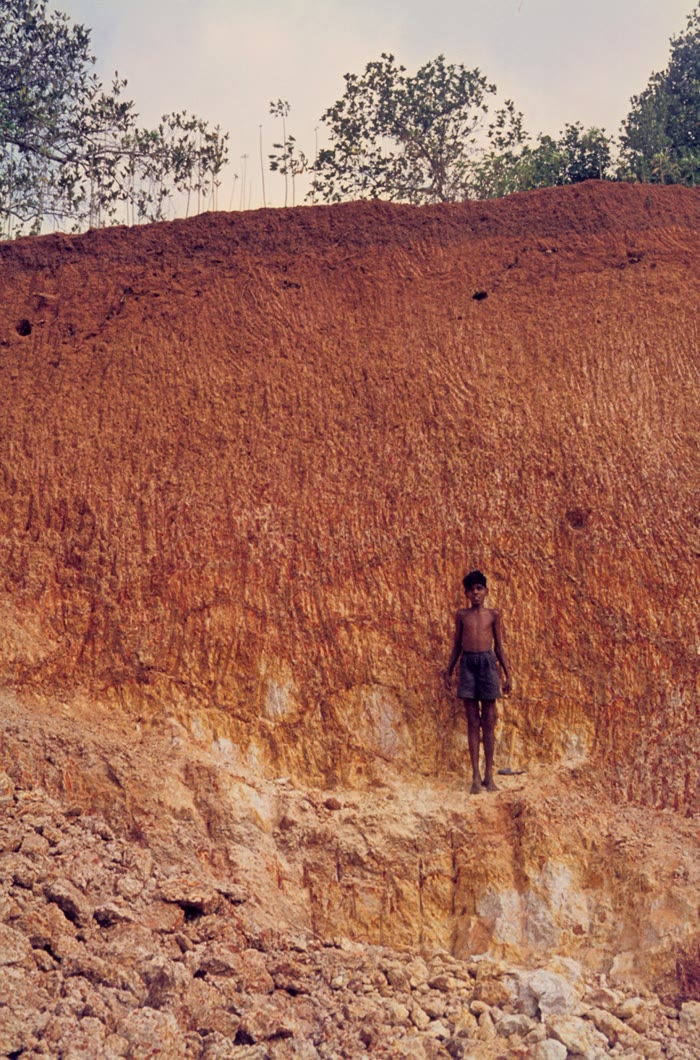
A road cut through a hillside in the humid tropics shows a wall of red earth, several times the height of a person. At its foot the rock is still recognisable: pale, streaked, but so soft that it crumbles between the fingers while still showing the grains and bands of the rock it once was. Upwards it turns into a mottled clay, then into a hard red layer, then into a thin soil where the roots are. The whole wall was once solid rock: it is the rock itself, slowly transformed in place by water and air. Soil, on which all the land’s plants and the food of almost all people grow, is the top of such a column. This chapter explains how rock becomes soil, what chemistry does the work, how climate sets its pace, and why soil, so slow to form, can be lost so quickly.
You already know
Weathering breaks rocks down where they lie; erosion carries the pieces away; deposition lays them down elsewhere (Book 1, grade 5). Rocks are made of minerals, such as quartz, feldspars and micas in a granite (Book 1, grade 6). A soil is a living layer of mineral grains, humus, water, air and organisms; decomposers turn dead matter into humus; a soil is described by its layers, or horizons (the biology books). In an oxidation, a substance loses electrons, often by combining with oxygen (the chemistry books).
7.1 From rock to soil
Physical weathering — frost wedging, heating and cooling, roots — breaks rock into pieces without changing its minerals. Chemical weathering changes the minerals themselves. Together, over long times, they turn the top of the solid rock into a loose mantle that thickens downwards as weathering eats into the rock below.
Definition 7.1 (Parent rock; saprolite)
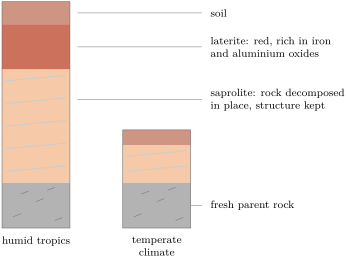
The parent rock of a soil is the rock from which its mineral part was formed. Saprolite is rock decomposed in place by weathering: soft and earthy, it still shows the grains and the structure of the parent rock. A weathering profile is the whole column from the fresh rock, through the saprolite, to the soil at the top.
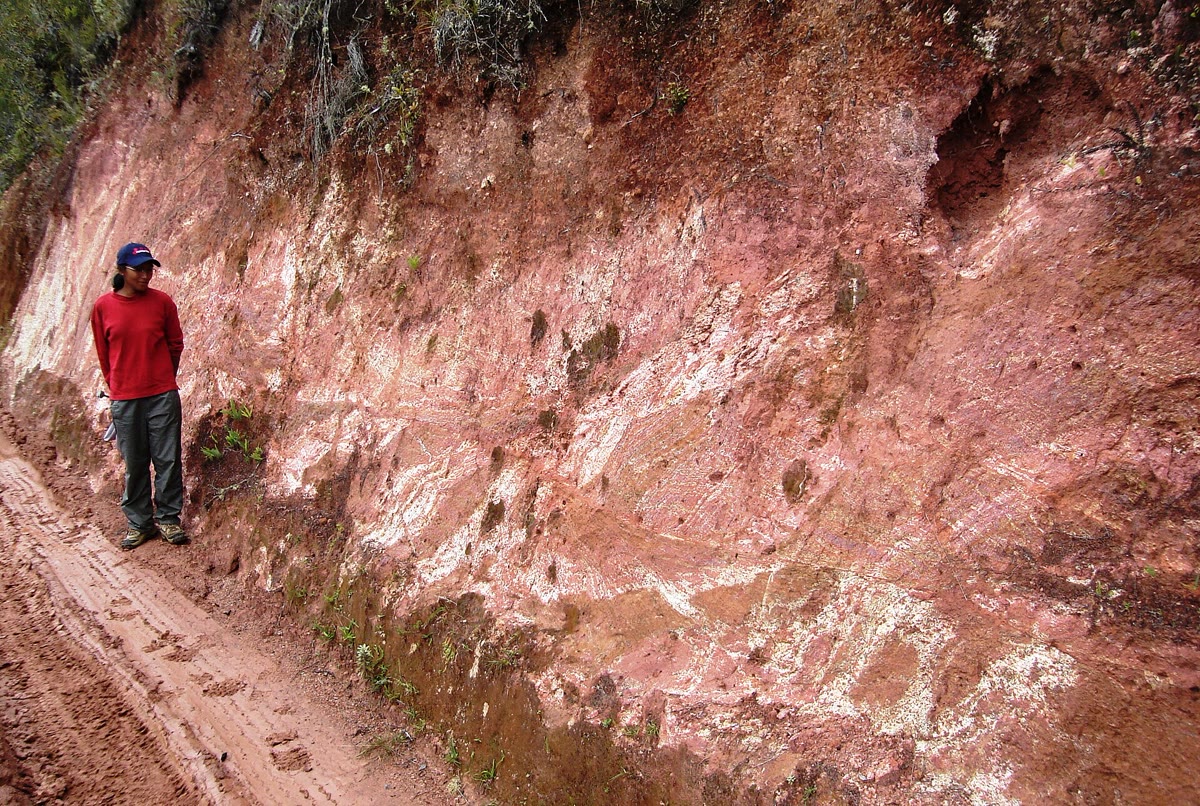
Saprolite can be thick. Under the rolling hills along the eastern side of the Appalachian Mountains, in the eastern United States, it reaches about (150 feet) in places, though its thickness varies a great deal from place to place; the soil is only the upper part of it.
7.2 Chemical weathering
Definition 7.2 (Chemical weathering)
Chemical weathering is the transformation of the minerals of a rock by reactions with water and with the gases it carries, carbon dioxide and oxygen: some minerals dissolve, others are turned into new minerals, stable at the Earth’s surface.
Rainwater dissolves a little carbon dioxide from the air, and much more as it seeps through the soil, where roots and decomposers breathe it out. Part of the dissolved gas forms carbonic acid, which releases hydrogen ions:
These hydrogen ions attack the minerals.
Definition 7.3 (Hydrolysis)
Hydrolysis is the chemical weathering of a silicate mineral by water and its hydrogen ions: the hydrogen ions take the place of the metal ions of the mineral, which go into solution, and the rest of the mineral is rebuilt into a clay mineral.
Proposition 7.4 (Hydrolysis of a feldspar)
The potassium feldspar orthoclase, , is turned by hydrolysis into the clay mineral kaolinite, ; potassium ions and dissolved silica, , are carried away by the water:
Check. Count each element on both sides. Potassium: 2 and 2. Aluminium: 2 and 2. Silicon: 6 and . Oxygen: and . Hydrogen: and . Charge: and . ∎
Proposition 7.5 (Dissolution of calcite)
Calcite, , the mineral of limestone, dissolves completely in water that carries carbon dioxide; nothing solid is left:
Iron is attacked in a third way. In the dark minerals of a rock, such as the black mica of a granite, iron is in the reduced form . Oxygen carried by the water oxidises it, and the iron(III) is left behind as insoluble oxides: yellow-brown goethite, , and red hematite, . For goethite:
These oxides colour weathered rocks and soils yellow, brown and red.
Not all minerals weather at the same pace. In a weathering granite, the black mica rusts and the feldspars turn to clay, but the quartz grains, almost insoluble, come out unchanged: they end up as sand.
Example 7.6 (The weathering of a granite)
A kilogram of orthoclase contains of . By the equation, two moles of orthoclase give one mole of kaolinite: , that is of clay. The potassium, of the mass of orthoclase, , and of silica leave in solution. From a granite of quartz, feldspars and micas, weathering leaves sand (the quartz), clay (from the feldspars and micas) and iron oxides, and sends potassium, sodium, calcium and silica to the rivers.
7.3 Clays and humus
Definition 7.7 (Clay mineral)
A clay mineral is a silicate built of thin sheets of atoms stacked on one another, formed by weathering, which occurs as flakes far smaller than grains of sand. Kaolinite is one of them.
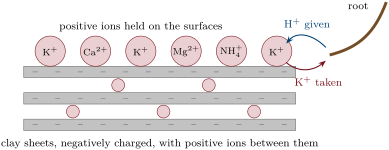
The surfaces of clay flakes carry negative electric charges. They hold positive ions — potassium , calcium , magnesium , ammonium — which would otherwise be washed away by the rain. Humus does the same. Bound together, clay and humus form the clay–humus complex, the soil’s store of mineral nutrients: a root releases hydrogen ions and takes in exchange the potassium or calcium held on the flakes.
7.4 Soils and climate
Chemical weathering needs water, and like most reactions it runs faster when it is warm. Where the climate is both hot and wet, rock decomposes deepest and furthest: the feldspars turn completely to clay, even much of the silica is carried away, and what remains is rich in the least soluble elements, iron and aluminium.
Definition 7.8 (Laterite)
A laterite is a deeply weathered material of hot, wet climates, red or brown, made mainly of iron and aluminium oxides and kaolinite, from which almost everything soluble has been removed.
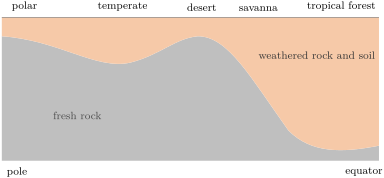
Under cold climates, frozen for much of the year, and under dry climates, where water is scarce, chemical weathering is slow: the soils are thin and the rock lies close below. Between the poles and the equator, the depth of weathering is greatest under the humid tropical forests and smallest in the deserts and the polar regions.
7.5 Slow to form, quick to lose
How fast does soil form? Soil production, the rate at which weathering turns rock into soil at the base of the profile, has been measured at many sites around the world, and so has the rate at which soil is eroded from the surface. A compilation of these measurements gives the typical (median) rates below, each expressed as a thickness of soil per year.
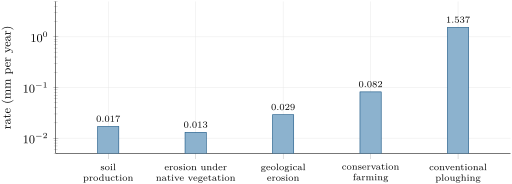
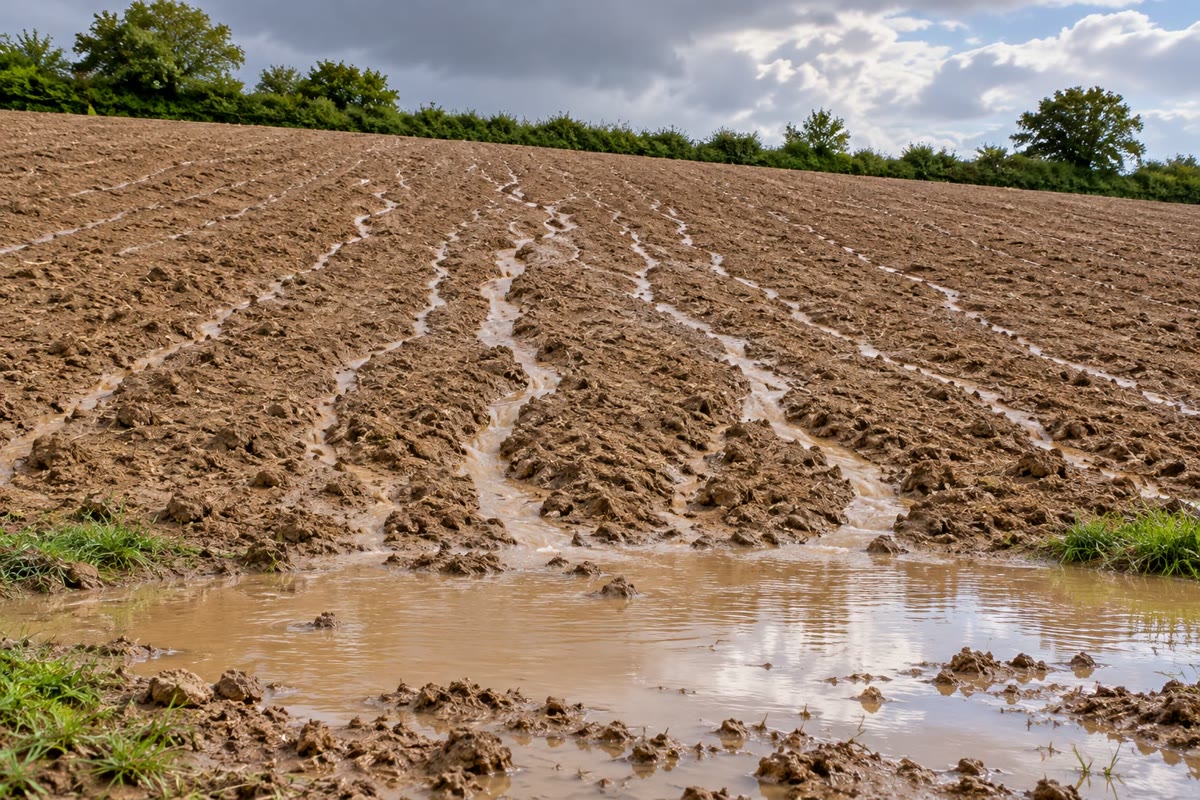
Under natural vegetation, soil is eroded about as fast as it forms, around a year: a centimetre in some six centuries. Under conventional ploughing, which leaves the ground bare between crops, the median erosion rate is a year, ninety times the rate of soil production. Under conservation farming, which disturbs the soil less and keeps it covered, the median falls to a year, much closer to the rate of production.
Method 7.9 (Comparing a formation rate with an erosion rate)
- Express both rates in the same unit (millimetres per year).
- The net loss is the erosion rate minus the production rate .
- A soil of thickness is lost in years; if , the soil is not being lost.
- To form a thickness from scratch takes years.
With these rates, a metre of soil takes about years to form, and under conventional ploughing it can be lost in about years. On human time scales, soil is a resource that is not renewed.
7.6 Exercises
Exercise 7.1 ★
Define chemical weathering and hydrolysis.
Solution
Solution of Exercise 7.1.
Chemical weathering is the transformation of the minerals of a rock by reactions with water and the gases it carries (carbon dioxide, oxygen): some minerals dissolve, others become new minerals stable at the surface. Hydrolysis is the chemical weathering of a silicate by water and its hydrogen ions: the metal ions go into solution and the rest of the mineral is rebuilt into a clay mineral.
Exercise 7.2 ★
What is saprolite? How can you tell saprolite from a soil formed in sand brought by a river?
Solution
Solution of Exercise 7.2.
Saprolite is rock decomposed in place: soft and earthy, it keeps the grains, bands and structure of its parent rock and passes downwards, without a break, into the fresh rock. A soil formed in river sand rests on material brought from elsewhere: its grains are rounded and sorted, and it shows none of the structure of the rock beneath it.
Exercise 7.3 ★
Name the products of the weathering of a granite: what does each of its three main minerals become?
Solution
Solution of Exercise 7.3.
The feldspars become clay (kaolinite), releasing potassium, sodium or calcium and silica into the water; the black mica becomes clay and iron oxides; the quartz is left unchanged, as sand.
Exercise 7.4 ★
Why are weathered rocks and tropical soils so often red, yellow or brown?
Solution
Solution of Exercise 7.4.
The iron of the dark minerals, , is oxidised by the oxygen carried by the water into insoluble iron(III) oxides: yellow-brown goethite and red hematite, which coat the grains and colour the whole material.
Exercise 7.5 ★
Using the bar chart, give the median rate of soil production and the median erosion rate under conventional ploughing. How many times larger is the second?
Solution
Solution of Exercise 7.5.
a year and a year: times larger.
Exercise 7.6 ★★
Check that the equation of the dissolution of calcite is balanced, for each element and for the charge.
Solution
Solution of Exercise 7.6.
Calcium: 1 and 1. Carbon: and 2. Oxygen: and . Hydrogen: 2 and 2. Charge: 0, and .
Exercise 7.7 ★★
Limestone dissolves completely, granite leaves sand and clay. Explain the difference using the two reactions of the chapter.
Solution
Solution of Exercise 7.7.
The dissolution of calcite produces only dissolved ions, and : everything is carried away and a pure limestone leaves no solid residue. The hydrolysis of feldspar produces a solid, kaolinite, which stays; and the quartz of the granite hardly reacts at all. Granite therefore leaves clay and sand.
Exercise 7.8 ★★
Explain how the clay–humus complex keeps potassium in a soil that rain washes through, and how a root takes it.
Solution
Solution of Exercise 7.8.
The clay flakes and the humus carry negative charges that hold the positive potassium ions on their surfaces, so that rainwater passing through does not carry them away. A root releases hydrogen ions, which take the place of the potassium on the flakes; the potassium set free in the soil water is taken up by the root.
Exercise 7.9 ★★
Give two reasons why laterites form under hot, wet climates and not under cold or dry ones.
Solution
Solution of Exercise 7.9.
Chemical weathering needs water, abundant in wet climates and scarce in dry ones (and frozen in cold ones); and its reactions run faster when it is warm. Only under heat and abundant water, over a long time, do the reactions go far enough to remove almost everything soluble and leave iron and aluminium oxides.
Exercise 7.10 ★★
The median rate of soil production is a year. How long does it take to form , and of soil?
Solution
Solution of Exercise 7.10.
years for ; years for ; years for .
Exercise 7.11 ★★
Erosion rates are often given as a mass of soil per hectare per year. With a soil density of , what mass does a loss of a year represent on one hectare ()?
Solution
Solution of Exercise 7.11.
Volume: ; mass: , tonnes per hectare per year.
Exercise 7.12 ★★★
Saprolite thick has formed under the hills of a temperate region. If weathering advanced into the rock at a year, how long would it have taken? What does the answer suggest about the age of such a landscape?
Solution
Solution of Exercise 7.12.
million years. Such a thick saprolite needs a landscape that has been stable, without its weathered mantle being stripped away, for millions of years.
Exercise 7.13 ★★★
Write the equation of the oxidation of into goethite given in the chapter and check it. Then write and balance the oxidation of into hematite, , by oxygen and water, releasing .
Solution
Solution of Exercise 7.13.
Goethite: : iron 4 and 4, oxygen and , hydrogen 12 and , charge and . Hematite: : iron 4 and 4, oxygen and 6, hydrogen 8 and 8, charge and .
Exercise 7.14 ★★★
Under conservation farming the median erosion rate is a year. With soil production at a year, how long does it take to lose of soil? Compare with conventional ploughing.
Solution
Solution of Exercise 7.14.
Net loss a year; years. Under conventional ploughing, years: more than twenty times shorter.
Exercise 7.15 ★★★
A granite contains orthoclase by mass. What mass of kaolinite forms when one tonne of this granite has had all its orthoclase weathered, and what mass of potassium is released?
Solution
Solution of Exercise 7.15.
The tonne contains of orthoclase. Each kilogram gives of kaolinite: . Potassium: .
7.7 Problem: The Lifetime of a Soil
Problem 7.1
Weekend problem — from rock to field and back to the river
Part I — A profile.
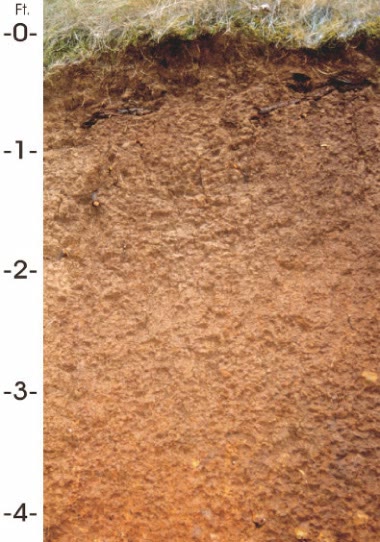
- The scale reaches 4 feet near the bottom of the picture. How deep is that, in metres?
- The dark layer at the top reaches about half a foot. How thick is it, in centimetres?
- What gives this top layer its dark colour?
- Below, the soil is reddish brown. Which minerals give it this colour, and how did they form?
- Is the parent rock visible in the photograph? What would you expect to find below the bottom of the picture?
Part II — The chemistry of a weathering granite.
- Write the equation of the hydrolysis of orthoclase.
- How many moles of orthoclase are there in ()?
- What mass of kaolinite () do they give?
- What leaves in the water, and where does it go?
- What happens to the quartz of the granite?
Part III — Formation against erosion.
- Soil forms at a year. How long does it take to form the profile of Part I?
- Under conventional ploughing, soil is eroded at a year. What is the net loss each year?
- How long would the profile of Part I last?
- Compare the two times of questions 11 and 13.
- Under natural vegetation, erosion is a year. Is the soil being lost?
Part IV — The soil’s lifetime.
- Write the time to lose a thickness of soil as a function of , of the erosion rate and of the production rate .
- Compute for under conventional ploughing.
- Compute for under conservation farming ( a year).
- Why can a soil be called a resource that is not renewed on human time scales?
- How long does it take to lose a metre of soil under conventional ploughing?
Solution
Solution of Problem 7.1.
1. .
2. .
3. Humus, the dark organic matter made by the decomposers from dead plants.
4. Iron oxides, goethite and hematite, formed by the oxidation of the iron(II) of the minerals of the parent material.
5. No. Below, the profile would pass into weathered rock, the saprolite (or other weathered material), and then into the fresh parent rock.
6. .
7. .
8. of kaolinite, .
9. The potassium ions and the dissolved silica: they are carried by the water to the rivers, and by the rivers to the sea.
10. It hardly reacts: the quartz grains are left as sand.
11. years.
12. a year.
13. years.
14. : the profile is lost ninety times faster than it formed.
15. No: , erosion is a little slower than production and the soil holds its own.
16. .
17. years.
18. years.
19. A soil lost in a few centuries takes tens of thousands of years to form again: on the scale of human lives and societies, what is lost is not replaced.
20. years: a metre of soil is lost in about 660 years, a few centuries, under conventional ploughing.