High School Earth and Space Sciences · Grades 10–12
24The Earth’s Internal Heat
Between 1987 and 1995, near the village of Windischeschenbach in Bavaria, geologists drilled a hole deep into the continental crust. At the bottom the rock was at about , too hot to drill any deeper.
From about at the surface to at is a rise of about per kilometre, a typical value. Everywhere on Earth, it gets hotter downwards, so heat flows out of the Earth all the time. This chapter measures that flow, asks where the heat comes from, and shows how it moves.
You already know
The geotherm is the curve of temperature against depth beneath a place, and the geothermal gradient the rise of temperature per kilometre; boreholes measure 25 to per kilometre near the surface (Chapter 12). Some atoms are radioactive: they decay at random, the number left falling by half every half-life, and each decay releases energy, which ends up as heat (the physics books). A convection cell is a loop of fluid warmed from below, which rises, spreads, cools and sinks (Book 1, grade 8). At a hotspot, a plate moves over a plume of hot mantle (Chapter 13).
24.1 Gradient and heat flow
Definition 24.1 (Heat flow)
The heat flow (or heat flux) at a place is the power that leaves the Earth’s interior through each square metre of its surface there. It is measured in milliwatts per square metre ().
Heat flows from hot to cold, and the steeper the temperature gradient, the faster it flows. How much flows also depends on the rock: each rock has a thermal conductivity , in watts per metre per kelvin, which the physics books define.
Proposition 24.2 (Heat flow and gradient)
Through rock of thermal conductivity in which the temperature rises with depth by a gradient (in kelvins per metre), the heat flow up towards the surface is
This law of conduction, due to Fourier, is admitted here; the physics books prove it in a general form.
Method 24.3 (A heat flow from a borehole)
- Measure the temperature at several depths of a borehole, once the hole has had time to come back to the temperature of the rock.
- Plot temperature against depth and take the slope: the gradient , converted to kelvins per metre.
- Measure the conductivity of the rock on cores in the laboratory.
- Multiply: , in , then convert to .
Example 24.4 (A borehole in granite)
A borehole in granite of conductivity measures a gradient of per kilometre, that is . Then , about .
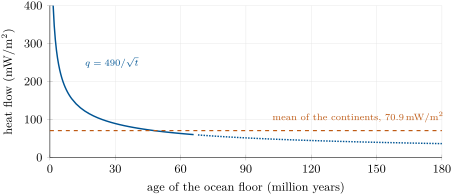
More than 38 000 such measurements have been combined into a map of the whole Earth. The continents lose on average , the ocean floor ; over the whole surface, . Multiplied by the area of the Earth, , the total is
about 47 terawatts, give or take 2.
The ocean floor loses most where it is youngest. New lithosphere leaves a ridge hot, and cools as it moves away; its heat flow falls as one over the square root of its age.
24.2 Where the heat comes from
The heat has two sources. The first is radioactivity.
Definition 24.5 (Radiogenic heat production)
The radiogenic heat production of a rock is the heat released inside it by the decay of its radioactive atoms, per unit volume and time, in microwatts per cubic metre (). Almost all of it comes from four isotopes: uranium-238, uranium-235, thorium-232 and potassium-40.
These elements are concentrated in the rocks of the continental crust. From 2188 analyses, the median heat production of granite is , of basalt , and of the ultramafic rocks of the mantle only , about twenty times less than granite. A layer of granite thick produces under each square metre, : a third of the heat flow of the continents.
How much heat does radioactivity make in the whole Earth? KamLAND, an underground detector in Japan holding 1000 tonnes of liquid, catches the geoneutrinos, the antineutrinos released by the decay of uranium and thorium inside the Earth: it saw the first ones in 2005, and in 2135 days of recording, about 106 of them among 841 candidate events. From that count, with those of a detector in Italy, uranium-238 and thorium-232 together release about 20 terawatts. Potassium-40 escapes the detector; it is known to add about , and uranium-235, scaled from uranium-238, about . Radioactivity therefore supplies about , roughly half of the the Earth loses.
Definition 24.6 (Secular cooling)
The secular cooling of the Earth is its slow loss of the heat stored inside it since it formed, the primordial heat: the part of the heat flow that radioactivity does not replace, by which the mantle and the core grow colder over the ages.
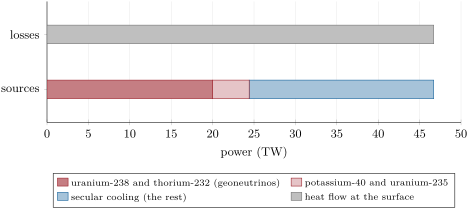
Radioactivity was stronger in the past. Each isotope decays, so there was more of it long ago: one half-life back, twice as much, and twice as much heat. Going back years multiplies the heat of an isotope of half-life by .
Proposition 24.7 (Radiogenic heat in the past)
If an isotope of half-life releases a power today, it released
a time ago.
Proof. The power is proportional to the number of atoms that remain, since each decays with the same probability per second. By the decay law, is divided by 2 every half-life: , so , and the power follows. Finally . ∎
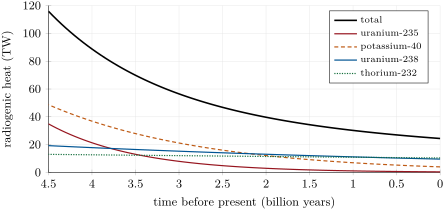
Four and a half billion years ago, radioactivity released about , almost five times today’s value, and most of it came from uranium-235 and potassium-40, the two short-lived isotopes, which have since nearly died out. The young Earth was much hotter inside than today.
24.3 Conduction and convection
Heat can cross a solid only by conduction, from atom to atom, and in rock that is very slow. Heat crosses a distance by conduction in a time of about , where , the thermal diffusivity of the rock, is about . For the of the mantle,
some 260 billion years, nearly sixty times the age of the Earth. If the mantle only conducted heat, the heat of its depths would still be almost all there.
The mantle is solid, but over millions of years it creeps, very slowly, like a very stiff fluid: the asthenosphere flows (Chapter 12). So the mantle loses its heat as the air above a radiator does, by carrying it.
Definition 24.8 (Thermal convection; mantle convection)
Thermal convection is the transport of heat by the motion of the material itself: warmer, lighter material rises, colder, denser material sinks, as in a convection cell. Mantle convection is the thermal convection of the Earth’s solid mantle, which creeps at a few centimetres a year and carries the heat of the interior towards the surface.
The plates are the upper part of this convection. At ridges, hot mantle rises and is added to the plates; the lithosphere cools as it moves away, grows dense, and sinks under its own weight at subduction zones: the slabs are the cold, sinking part of the flow, and seismic images show them sinking deep into the mantle. Plumes of hot rock are thought to rise beneath hotspots from deep in the mantle, possibly from just above the core.
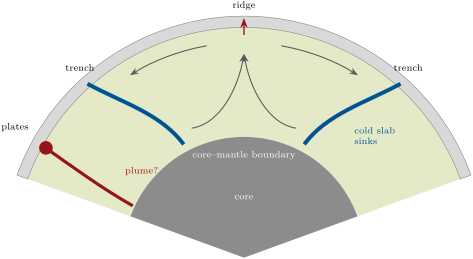
So most of the heat leaves the mantle by convection, and only the last tens of kilometres, through the rigid lithosphere, are crossed by conduction — the conduction that boreholes measure.
24.4 Geothermal energy
Definition 24.9 (Geothermal energy)
Geothermal energy is the heat of the Earth’s interior used by people: hot water or steam from hot rock, drawn up through wells for heating or to make electricity.
The heat flowing out of the Earth is tiny where it reaches the surface, about under each square metre, far too little to use directly. It becomes usable where it is concentrated at a shallow depth. Near volcanoes, rifts and hotspots, and along plate boundaries, hot rock comes close to the surface, and the water circulating in permeable rock comes back hot. A power station needs very hot water or steam, from about 150 to ; some fields give dry steam, which turns the turbines directly. The first electricity from the Earth’s heat was made in 1904 at Larderello, in Tuscany: it lit five light bulbs. Elsewhere, hot water from near the surface is piped into buildings to heat them.
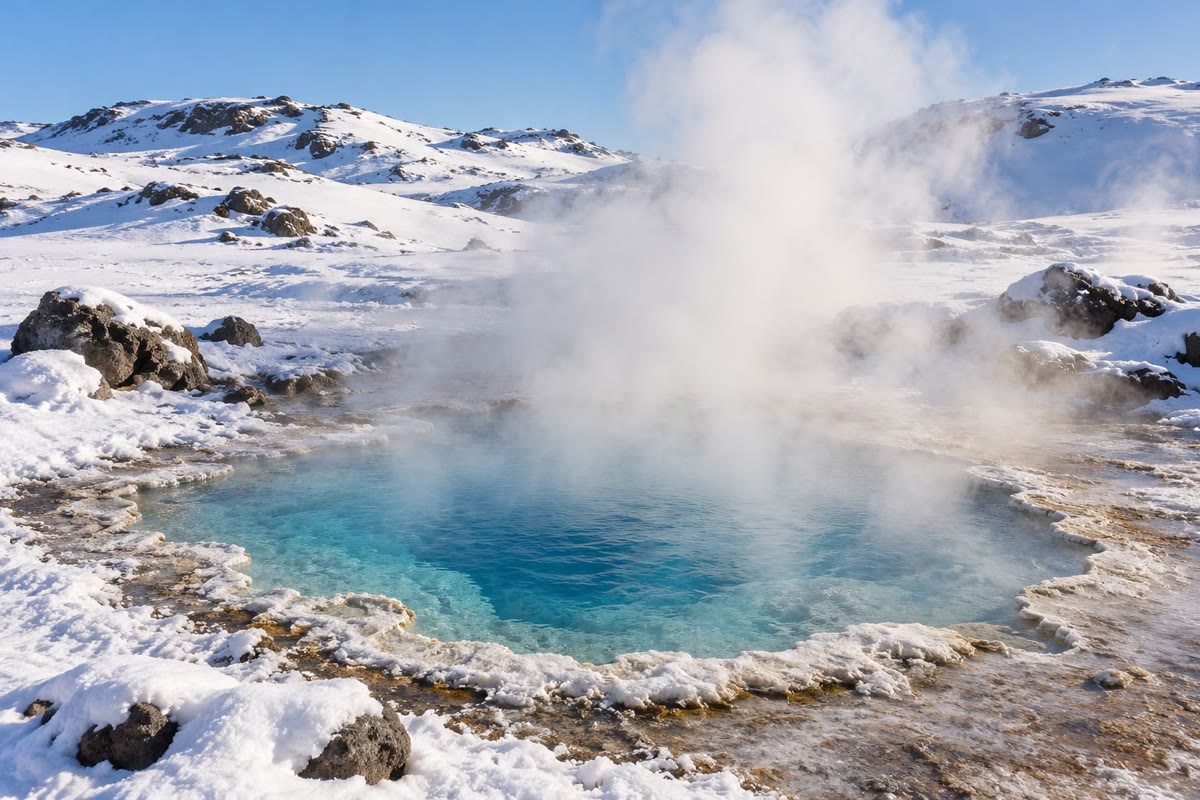
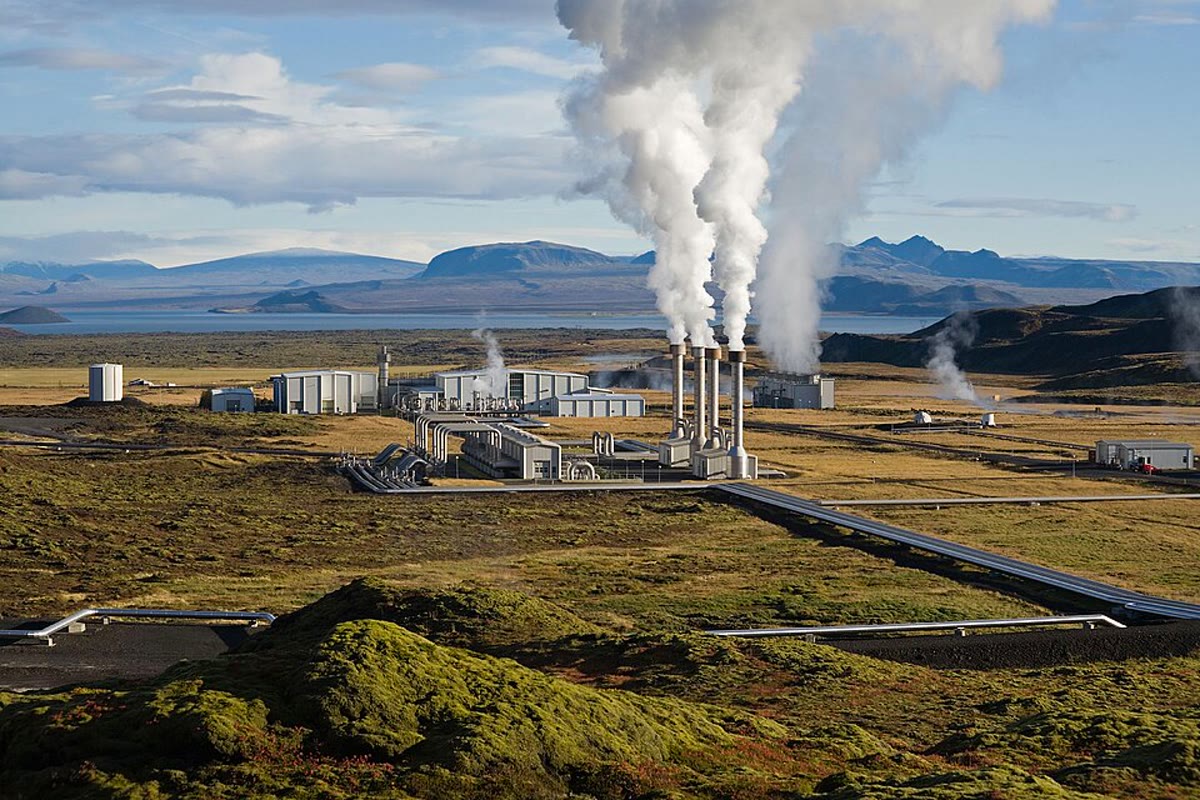
A geothermal field is not inexhaustible on the scale of a human life. At The Geysers, in California, too many wells drew on the steam, faster than the slow heat flow and the rain could make it up: the pressure of the steam fell to less than half its peak, and more than of the power stations’ capacity was lost. Water is now injected back into the field to slow the decline.
24.5 Exercises
Exercise 24.1 ★
Give the word: (a) the power leaving the interior through each square metre of surface; (b) the heat released by the decay of radioactive atoms in a unit volume of rock; (c) the loss of the heat stored since the Earth formed; (d) transport of heat by the motion of the material itself; (e) the Earth’s internal heat used by people.
Solution
Solution of Exercise 24.1.
(a) the heat flow; (b) the radiogenic heat production; (c) secular cooling; (d) thermal convection; (e) geothermal energy.
Exercise 24.2 ★
Convert: (1) into ; (2) into watts; (3) per kilometre into kelvins per metre.
Solution
Solution of Exercise 24.2.
(1) . (2) . (3) : a difference of one degree Celsius is a difference of one kelvin.
Exercise 24.3 ★
Name the four isotopes that make almost all the radiogenic heat, and say which two the KamLAND detector can see.
Solution
Solution of Exercise 24.3.
Thorium-232, uranium-238, potassium-40 and uranium-235. KamLAND sees the geoneutrinos of thorium-232 and uranium-238 only.
Exercise 24.4 ★
Using , compute the heat flow through ocean floor 1, 4, 25 and 49 million years old.
Solution
Solution of Exercise 24.4.
; ; ; , about the mean of the continents.
Exercise 24.5 ★
Why is heat flow measured in boreholes rather than at the surface itself? Why must one wait after drilling before measuring?
Solution
Solution of Exercise 24.5.
Near the surface, the temperature of the ground follows the days and the seasons; only below a few metres does it stay at the mean temperature of the year, and only deeper still does it show the heat coming from below. Drilling stirs the rock and the water in the hole and changes their temperature, so one waits until the hole has come back to the temperature of the rock.
Exercise 24.6 ★★
In the KTB borehole the rock was at about at . (1) Taking at the surface, compute the mean gradient. (2) With a conductivity of , what heat flow does it give? (3) Compare with the mean of the continents.
Solution
Solution of Exercise 24.6.
(1) per kilometre, that is . (2) , about . (3) A little above the mean of the continents, , by about : a typical continental value.
Exercise 24.7 ★★
The continents cover with a mean heat flow of , the oceans with . Compute the power lost by each, the total, and the share lost through the ocean floor.
Solution
Solution of Exercise 24.7.
Continents: . Oceans: . Total about , of which , two thirds, leaves through the ocean floor.
Exercise 24.8 ★★
A layer of granodiorite thick has a heat production of . (1) What heat flow does it produce at the surface? (2) What share is that of ?
Exercise 24.9 ★★
At what age does the ocean floor lose as much heat as the mean continent, , according to ?
Solution
Solution of Exercise 24.9.
, so million years: ocean floor older than about 48 million years loses less heat than the mean continent.
Exercise 24.10 ★★
How much more heat did uranium-235 release 1.4 billion years ago than today? And potassium-40, 2.5 billion years ago?
Solution
Solution of Exercise 24.10.
Uranium-235: times more. Potassium-40: times more. Both are two half-lives back.
Exercise 24.11 ★★
Using with , how long does heat take to cross by conduction (1) a lava flow thick; (2) a lithosphere thick; (3) the mantle? Express each result in sensible units.
Solution
Solution of Exercise 24.11.
(1) , about 3 years. (2) , about 320 million years. (3) , about 265 billion years. The time grows as the square of the distance: ten times thicker, a hundred times longer.
Exercise 24.12 ★★★
Today thorium-232 releases about , uranium-238 , potassium-40 and uranium-235 . Using the half-lives of the figure, compute the heat of each 3 billion years ago, the total, and the share of the two short-lived isotopes.
Solution
Solution of Exercise 24.12.
Multiply each by : thorium-232, ; uranium-238, ; potassium-40, ; uranium-235, . Total about , more than twice today’s . The two short-lived isotopes give of it, against today.
Exercise 24.13 ★★★
The Nesjavellir power station can deliver up to of heat, carried by about of hot water a second. With a specific heat of and a mass of per litre, by how many degrees has this water been warmed? How large an area of average continent loses of heat?
Solution
Solution of Exercise 24.13.
The power is the mass per second times the specific heat times the warming: , so . The average continent loses per square metre, so is the natural heat loss of , about : the plant gathers heat that the Earth lets out naturally over thousands of square kilometres.
Exercise 24.14 ★★★
Suppose a plate takes 100 million years to go from a ridge to a trench, and a loop of convection through the whole mantle about 200 million years. (1) Compare these times with the 260 billion years of conduction across the mantle. (2) Why can convection carry heat so much faster, although the mantle moves only a few centimetres a year?
Solution
Solution of Exercise 24.14.
(1) 100 million years is times shorter than 260 billion years; 200 million years 1300 times shorter. (2) Convection carries the heat with the moving rock: the time to cross the mantle is its thickness divided by the speed, at a few centimetres a year, about a hundred million years. Conduction has no such carrier: its time grows as the square of the distance, and over thousands of kilometres it becomes enormous.
Exercise 24.15 ★★★
Suppose the core loses about of heat into the mantle across the core–mantle boundary, down. (1) What share of the secular cooling, , would that be? Where does the rest come from? (2) Compute the mean heat flow across the core–mantle boundary, and compare it with the mean heat flow at the surface, . (3) Why can the hot core warm the base of the mantle although the mantle is solid?
Solution
Solution of Exercise 24.15.
(1) ; the rest is the cooling of the mantle itself, which loses its own stored heat. (2) The boundary lies at radius ; its area is , and , about , some of the mean at the surface. (3) The heat crosses the boundary by conduction into the lowest layer of the mantle; warmed, this rock becomes lighter than the mantle above it and can rise, carrying the heat upwards: this is how plumes are thought to start, deep down.
Problem 24.1
Weekend problem — The Earth’s heat budget
The heat flow of the Earth has been measured at more than 38 000 places. On average the continents lose over , and the ocean floor over .
Part I — Heat flow and areas.
- Check that the two areas add up to the area of a sphere of radius .
- What fraction of the surface is ocean floor?
- Why does the ocean floor lose more heat per square metre than the continents?
- Using , compute the heat flow through ocean floor 4 million years old.
- A borehole in granite () measures per kilometre. Is its heat flow above or below the continental mean?
Part II — The total.
- Compute the power lost through the continents.
- Compute the power lost through the ocean floor.
- Add them: the total heat flow of the Earth, in terawatts.
- What is the mean heat flow over the whole surface?
- If of granite () lay under every continent, how many terawatts would it produce? Compare with the power lost through the continents.
Part III — Radiogenic heat.
- KamLAND counts geoneutrinos from uranium-238 and thorium-232: together they release about , with of thorium in the Earth for each kilogram of uranium. A kilogram of uranium releases through its uranium-238 and through its uranium-235; a kilogram of thorium, . Compute the heat of uranium-238, then of uranium-235.
- Potassium-40 adds about . Compute the total radiogenic heat.
- Which kind of rock carries most of these elements, and where is it?
- Was the radiogenic heat larger or smaller 3 billion years ago? Why?
Part IV — Secular cooling.
- What power is not supplied by radioactivity?
- Where does it come from?
- Compute the share of the heat flow supplied by secular cooling.
- Models of the Earth’s composition give a radiogenic heat of 11 to . Between which shares does the radiogenic part then lie?
- What carries most of this heat through the mantle?
- Sum up: what share of the Earth’s heat loss does radioactivity supply today?
Solution
Solution of Problem 24.1.
1. , and : yes.
2. , about three fifths.
3. The ocean floor is young: it is made hot at the ridges and cools as it moves away, and young lithosphere loses much heat.
4. .
5. : just below the mean, practically equal to it.
6. .
7. .
8. , the of the published estimate (the global mean of the chapter gives , the value used below).
9. , about .
10. , a third of the lost through the continents: the radioactivity of the continental crust is a large part of their heat flow.
11. For each kilogram of uranium the Earth holds of thorium, which release , against for the uranium-238. Uranium-238 thus makes of the : about . Uranium-235: .
12. .
13. Granite and the other rocks of the continental crust, about twenty times richer than the mantle’s ultramafic rocks.
14. Larger: each isotope was more abundant then, twice as much for every half-life back; 3 billion years ago the total was more than twice today’s.
15. .
16. From the heat stored since the Earth formed: the secular cooling of the mantle and the core.
17. .
18. From to : the geoneutrinos narrow this range a great deal.
19. Mantle convection, which carries most of the heat; only the last tens of kilometres are crossed by conduction.
20. : radioactivity supplies about half of the Earth’s heat loss today, and the slow cooling of the planet the other half.