University Chemistry — Year 1 · Bachelor Year 1
21Organomagnesium Reagents
Most useful organic molecules have more carbon atoms than any cheap starting material, and the central problem of synthesis is to join two carbon skeletons by a new C–C bond. In a carbon compound, carbon is almost always the electron-poor partner of a bond — to oxygen, to a halogen — and two electron-poor carbons do not react with each other. At the turn of the twentieth century a reagent made in one flask from a halogenoalkane and magnesium turned this around: its carbon is electron rich, a nucleophile that attacks the carbon of a carbonyl group. With it, alcohols of almost any skeleton can be built from smaller pieces. This chapter shows how the reagent is prepared, why it needs a perfectly dry flask, what it adds to, and how to plan with it.
You already know
Electronegativity (Chapter 2); Lewis acids and bases and the dative bond (Chapter 3); nucleophiles, electrophiles, curly arrows and the scale of organic species (Chapter 18); the class of an alcohol (primary, secondary, tertiary) follows that of its carbon.
21.1 Preparing a Grignard reagent
Definition 21.1 (Organometallic compound, Grignard reagent)
An organometallic compound contains at least one carbon–metal bond. An organomagnesium compound has a C–Mg bond; the Grignard reagent (X = Cl, Br, I), prepared from a halogenoalkane or halogenoarene and magnesium in an ether, , is the most common.
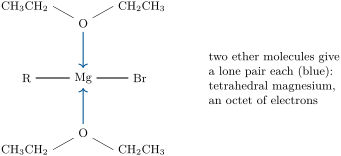
The magnesium inserts itself into the C–X bond. The ether is not an innocent solvent: magnesium in has only four valence electrons around it, and two ether molecules give it their lone pairs, completing its octet and keeping the reagent in solution.
Method 21.2 (Preparing a Grignard reagent)
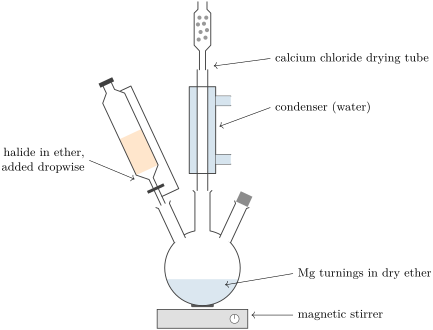
- Dry all glassware in an oven; fit the condenser with a drying tube of calcium chloride; use an anhydrous ether.
- Put the magnesium turnings and a little ether in a three-necked flask fitted with condenser, addition funnel and stirrer.
- Add a small portion of the halide; when the reaction starts (cloudiness, gentle boiling of the ether), add the rest dropwise at a rate that keeps a gentle reflux.
- Use the solution at once, in the same dry apparatus.
In the lab — A reaction that must start
A Grignard preparation sometimes refuses to start: the magnesium is covered with a film of oxide. Crushing a turning with a glass rod, adding a crystal of iodine, or warming the flask locally exposes fresh metal. Once started, the reaction is exothermic and the ether boils on its own; the addition is then slowed so that it does not boil over. Ethoxyethane boils at and its vapour is highly flammable: no flame anywhere in the laboratory, and an ice bath at hand.
21.2 A strong base and a nucleophile
Definition 21.3 (Polarity inversion)
The electronegativity of magnesium (1.31) is much lower than that of carbon (2.55): in the C–Mg bond is polarised with the negative end on carbon, which behaves as a carbanion. In the halide the same carbon was positive (X: 2.96 for Br). Turning an electrophilic carbon into a nucleophilic one is a polarity inversion.
Proposition 21.4 (Grignard reagents are destroyed by acidic hydrogens)
A Grignard reagent reacts quantitatively with water, alcohols, carboxylic acids, amines with N–H bonds and terminal alkynes, giving the alkane : .
Proof. The carbanion-like carbon is the base of the couple /, and alkanes are by far the weakest acids of organic chemistry: no proton can be measured to leave them in water, where hydroxide is the strongest base that can exist (Chapter 10, levelling). Any acid of the list is much stronger, and the proton transfer to has an enormous constant: it is complete and fast. ∎
This is the reason for the dry apparatus: a drop of water destroys an equal amount of reagent. Turned into an advantage, puts a deuterium atom exactly where the bromine was.
21.3 Additions to carbonyl compounds and carbon dioxide
The carbon of a C=O group is electrophilic (Chapter 18). The Grignard reagent adds its R group to it, the C=O pair going to oxygen; an acidic work-up then protonates the alkoxide.

Proposition 21.5 (Alcohols from carbonyl compounds)
After acidic work-up, a Grignard reagent gives: with methanal, a primary alcohol ; with another aldehyde , a secondary alcohol ; with a ketone , a tertiary alcohol . The new C–C bond joins R to the former carbonyl carbon.
Proof. The carbonyl carbon keeps its two substituents and gains R and an OH (from the alkoxide oxygen): methanal brings two H, an aldehyde one H and one carbon group, a ketone two carbon groups. The class of the alcohol is the number of carbon groups on that carbon: one, two or three. ∎
Proposition 21.6 (Carboxylic acids from carbon dioxide)
A Grignard reagent poured onto solid carbon dioxide gives, after acidification, the carboxylic acid with one more carbon: , then .
Proof. is a carbonyl compound whose carbon is attacked like that of a ketone; the carboxylate formed is too unreactive to add a second R group in these conditions (a negatively charged carbonyl is a poor electrophile). Acid protonates it. ∎
21.4 Building carbon skeletons
Method 21.7 (Planning an alcohol)
- Find the carbon bearing the OH in the target alcohol.
- Choose one of its carbon groups as R (it will come from the Grignard reagent, prepared from ); the rest of the molecule, with that carbon as a C=O, is the carbonyl partner.
- List the possible choices (one per carbon group) and prefer the one with simple, available reagents.
- Check that neither partner carries an acidic hydrogen or a second carbonyl that would react too.
Example 21.8 (2-Phenylbutan-2-ol)
The carbon bearing OH carries a phenyl, a methyl and an ethyl group. Three choices: phenylmagnesium bromide with butan-2-one; methylmagnesium bromide with 1-phenylpropan-1-one; ethylmagnesium bromide with 1-phenylethan-1-one (acetophenone). All three work; the last uses two of the commonest reagents.
History — Victor Grignard
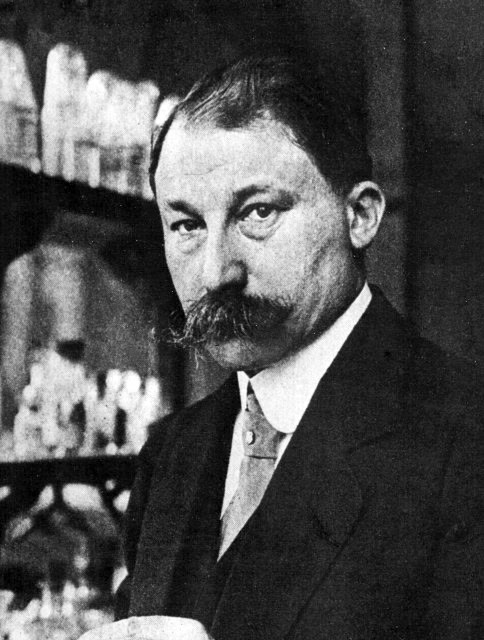
The reagent bears the name of Victor Grignard, who, as a doctoral student at the turn of the twentieth century, found that magnesium dissolves in an ether solution of a halogenoalkane and that the solution adds to carbonyl compounds. Its simplicity — one metal, one solvent, one flask — made it the most used carbon–carbon bond-forming reaction of the century, and earned its discoverer a Nobel Prize in Chemistry. (Photograph, public domain, Wikimedia Commons.)
21.5 Exercises
Exercise 21.1 ★
Write the preparation of ethylmagnesium bromide and of phenylmagnesium bromide. Give the polarisation of the C–Br bond and of the C–Mg bond, with the electronegativities.
Solution
Solution of Exercise 21.1.
; (in dry ether). C–Br: Br (2.96) more electronegative than C (2.55), carbon positive. C–Mg: Mg (1.31) less electronegative, carbon negative.
Exercise 21.2 ★
What does methylmagnesium iodide give with: water; ethanol; ethanoic acid; deuterium oxide ? Write the equations.
Solution
Solution of Exercise 21.2.
Water: . Ethanol: . Ethanoic acid: . Deuterium oxide: .
Exercise 21.3 ★
Give the product (after acidic work-up) of ethylmagnesium bromide with methanal, ethanal, propanone, benzaldehyde and carbon dioxide. Give the class of each alcohol.
Solution
Solution of Exercise 21.3.
Methanal: propan-1-ol (primary). Ethanal: butan-2-ol (secondary). Propanone: 2-methylbutan-2-ol (tertiary). Benzaldehyde: 1-phenylpropan-1-ol (secondary). Carbon dioxide: propanoic acid.
Exercise 21.4 ★
Why must 4-bromobutan-1-ol not be used to prepare a Grignard reagent?
Solution
Solution of Exercise 21.4.
Its OH group is acidic enough to destroy the reagent as soon as it forms: the molecule would protonate itself (or its neighbours), giving the magnesium alkoxide of butan-1-ol, , not a usable reagent. The OH must first be protected (Chapter 23 shows the idea for an aldehyde).
Exercise 21.5 ★★
Write the mechanism of the addition of methylmagnesium bromide to ethanal and of the work-up, with curly arrows. Is the product chiral? Is it obtained as a single enantiomer? Why?
Solution
Solution of Exercise 21.5.
The C–Mg pair attacks the carbonyl carbon of ethanal, the C=O pair going to O: with ; then gives a proton to the oxygen: propan-2-ol. Propan-2-ol carries two methyl groups on the carbinol carbon: it is achiral. (With a different R, e.g. ethylmagnesium bromide on ethanal, the product butan-2-ol is chiral but racemic: the planar carbonyl is attacked on both faces equally.)
Exercise 21.6 ★★
Propose two ways to prepare 3-methylpentan-3-ol from a Grignard reagent and a ketone.
Solution
Solution of Exercise 21.6.
The carbinol carbon carries one methyl and two ethyl groups: ethylmagnesium bromide with butan-2-one, or methylmagnesium bromide with pentan-3-one.
Exercise 21.7 ★★
How would you prepare 2-methylpropanoic acid from 2-bromopropane? Compute the mass of acid obtained from of bromide at yield (: , ).
Solution
Solution of Exercise 21.7.
Prepare from 2-bromopropane and magnesium in dry ether, pour it onto solid , then acidify: . mol; .
Exercise 21.8 ★★
A careless student prepares phenylmagnesium bromide from of bromobenzene in ether containing of water. What fraction of the reagent is destroyed? Which product forms?
Solution
Solution of Exercise 21.8.
of water destroys of reagent: ; benzene forms, .
Exercise 21.9 ★★
Biphenyl, , is a by-product of the preparation of phenylmagnesium bromide. Propose how it forms, and why slow addition of bromobenzene to excess magnesium limits it.
Solution
Solution of Exercise 21.9.
The reagent, a nucleophile, reacts with bromobenzene still present: overall . Adding the bromide slowly to excess magnesium keeps its concentration low: it meets fresh metal rather than the reagent already formed.
Exercise 21.10 ★★★
Plan two syntheses of 1-phenylethan-1-ol from a Grignard reagent, and a synthesis of 2-phenylpropan-2-ol. For each, name the halide that gives the reagent.
Solution
Solution of Exercise 21.10.
1-Phenylethan-1-ol: (from bromomethane) with benzaldehyde, or (from bromobenzene) with ethanal. 2-Phenylpropan-2-ol: with propanone, or with 1-phenylethan-1-one.
Exercise 21.11 ★★★
Explain why the Grignard reagent and the carbonyl compound must be mixed in the order chosen in the problem below, and why the work-up is done with cold dilute acid rather than with water alone.
Solution
Solution of Exercise 21.11.
The ketone is added to the reagent so that the reagent, prepared in the dry flask, never leaves it and the heat released by each portion is absorbed by the boiling ether. Water alone would give the gelatinous basic salt , which traps the product; cold dilute acid dissolves it as , and the cold limits side reactions of the tertiary alcohol in acid.
Exercise 21.12 ★★★
A Grignard reagent made from of a bromide is titrated: an aliquot is poured into excess water, and the basic magnesium salt formed is titrated by hydrochloric acid: scaled to the whole solution, of acid are needed. Explain the principle and give the yield of the preparation.
Solution
Solution of Exercise 21.12.
Each mole of reagent gives with water one mole of basic magnesium salt, , whose is titrated by the acid: the reagent amount equals the acid used, , a yield of .
21.6 Problem: Triphenylmethanol
Problem 21.1
Weekend problem — preparing phenylmagnesium bromide, its addition to benzophenone, the work-up, and the yield of triphenylmethanol
In a dry three-necked flask, of magnesium and of bromobenzene in anhydrous ethoxyethane give phenylmagnesium bromide. A solution of of benzophenone, , in the same ether is then added dropwise. After work-up with cold dilute sulfuric acid, extraction and recrystallisation, of pure triphenylmethanol, , are obtained, and of biphenyl are separated. Molar masses (): Mg 24.3, 156.9, 182.0, 260.0, 154.0, 122.0.
Part I — Phenylmagnesium bromide.
- Write the equation of the preparation.
- Compute the amounts of magnesium and bromobenzene. Which is in excess?
- Why must the apparatus be dry? Write the reaction with water.
- What is the role of the drying tube?
- Why is the ether essential, beyond dissolving the reagents?
- Biphenyl comes from the reaction of the reagent with bromobenzene. Write it and compute the amount of bromobenzene lost to it.
Part II — The addition.
- Compute the amount of benzophenone.
- Write the mechanism of the addition with curly arrows.
- Which reagent limits the formation of triphenylmethanol? Take Part I into account.
- Is triphenylmethanol chiral? Justify.
- Why is the benzophenone added to the reagent, and not the reverse?
- What would a trace of water in the benzophenone solution do?
Part III — Work-up.
- Write the protonation of the alkoxide.
- Why use cold dilute acid rather than water alone?
- Where are triphenylmethanol and the magnesium salts after extraction with ether?
- How is biphenyl separated from triphenylmethanol? (Biphenyl is far more soluble in cold light petroleum.)
- Which test confirms the purity of the crystals?
- Triphenylmethanol survives cold dilute acid, but dissolves in concentrated sulfuric acid to give a deep yellow carbocation. Write its formation and explain its stability (compare with Chapter 18).
Part IV — Yield, and another product.
- Compute the amount of triphenylmethanol obtained.
- Compute the yield relative to the limiting reagent.
- Suggest two causes of loss.
- If the reagent of Part I (corrected for biphenyl) had been poured onto solid carbon dioxide instead, which product would form?
- Compute the theoretical mass of that product.
- Write the equation of that carboxylation.
- State the yield of triphenylmethanol, in per cent.
Solution
Solution of Problem 21.1.
1. . 2. Mg ; : magnesium in slight excess. 3. Water destroys the reagent: . 4. It stops the water vapour of the air entering through the condenser. 5. The ether gives lone pairs to magnesium (Lewis base): without it the reagent does not form or stay in solution. 6. ; biphenyl , which consumed of bromobenzene and as much reagent: of bromobenzene lost in all. 7. . 8. The C–Mg pair attacks the carbonyl carbon, the pair goes to oxygen: . 9. Reagent available at most ; benzophenone : benzophenone limits, just. 10. No: the carbinol carbon carries three identical phenyl groups. 11. The reagent stays in its dry flask, and the heat of each portion of ketone is taken up by the boiling ether. 12. It would destroy part of the reagent (benzene) and leave benzophenone unreacted. 13. . 14. The acid dissolves the basic magnesium salts that water alone would precipitate; the cold limits the formation of the carbocation of question 18. 15. Triphenylmethanol and biphenyl in the ether layer; the magnesium salts in the aqueous layer. 16. Washing (or triturating) the solid with cold light petroleum: biphenyl dissolves, triphenylmethanol stays. 17. A sharp melting point equal to the tabulated one (or a single spot in thin-layer chromatography). 18. : a tertiary carbocation whose charge is spread over three benzene rings by resonance, very stable, and coloured because of that extended conjugation. 19. . 20. . 21. Losses in transfers and recrystallisation; reagent destroyed by traces of moisture; incomplete reaction. 22. Benzoic acid, , after acidification. 23. . 24. , then . 25. .