University Chemistry — Year 1 · Bachelor Year 1
17Spectroscopy for Structure
A perfumer hands the laboratory a colourless liquid that smells of pineapple and asks what it is. Fifty years ago, the answer would have taken weeks of degradation reactions. Today it takes ten minutes: an elemental analysis gives the formula, an infrared spectrum names the functional group, and a proton nuclear magnetic resonance spectrum shows how the atoms are joined. This chapter explains how each spectrum is read — what light of each region does to a molecule, and which features of a spectrum carry which piece of structure — and ends with that pineapple molecule.
You already know
The school volume (grades 11 and 12) measured absorbances with a spectrophotometer and used the Beer–Lambert law to find concentrations, identified functional groups from tables of infrared bands, and read simple proton NMR spectra (number of signals, integration, the rule). Single, double and triple bonds and the bond are those of Chapter 3.
17.1 UV–visible spectroscopy: conjugation and colour
Definition 17.1 (Absorbance and the Beer–Lambert law)
For light of intensity entering a solution and leaving it, the absorbance is . For a dilute solution of one absorbing species, (the Beer–Lambert law), where is the path length, the concentration and the molar absorption coefficient, a property of the species at that wavelength.
A molecule absorbs ultraviolet or visible light when a photon’s energy matches the gap between the highest occupied and the lowest empty electron levels of its bonds. For bonds the gap is large and the absorption lies far in the ultraviolet; bonds absorb closer to the visible, and a chain of alternating double and single bonds absorbs at longer wavelengths the longer the chain.
Definition 17.2 (Conjugated system, chromophore, absorption maximum)
A conjugated system is a chain of atoms each carrying a orbital in a system, as in alternating double and single bonds (buta-1,3-diene, benzene). The group of atoms responsible for an absorption is its chromophore; the wavelength at which its absorbance is greatest is the absorption maximum, .
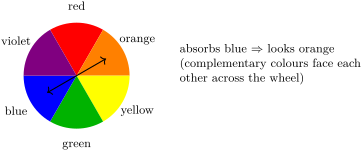
The levels of a conjugated system spread over the whole chain and come closer together as the chain grows, as the levels of a particle in a longer box do: increases with conjugation. Ethene and butadiene absorb in the ultraviolet only; the eleven conjugated double bonds of -carotene bring the absorption into the blue part of the visible. A substance looks the colour complementary to the light it absorbs: absorbing blue and violet, carotene looks orange.
17.2 Infrared spectroscopy in depth
Definition 17.3 (Wavenumber, transmittance, fingerprint region)
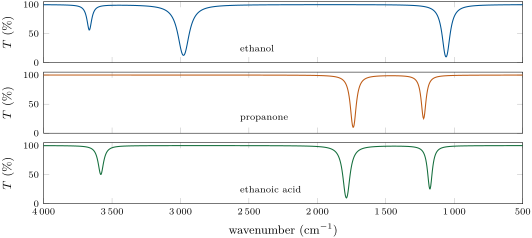
Infrared spectra are plotted against the wavenumber , in , proportional to the energy of the photon. The ordinate is the transmittance , in per cent, so that bands point downwards. Below about many overlapping bands, characteristic of the whole molecule rather than of one bond, form the fingerprint region.
A bond absorbs infrared light at the frequency at which it vibrates. As for two masses joined by a spring, the stiffer the bond and the lighter the atoms, the higher the wavenumber: bonds to hydrogen (O–H, C–H) above , triple bonds near 2200, double bonds near 1700–1600, single bonds between heavier atoms below 1300. The table gives measured positions for the molecules of this chapter, in the gas phase, where the molecules are isolated.
| molecule | bond | () |
|---|---|---|
| ethanol | O–H | 3666 |
| ethanol | C–H | 2978 |
| ethanol | C–O | 1060 |
| propanone | C=O | 1738 |
| ethanoic acid | O–H | 3582 |
| ethanoic acid | C=O | 1788 |
| ethyl ethanoate | C=O | 1764 |
| ethyl ethanoate | C–O | 1238 |
17.3 Proton NMR: chemical shift and integration
In a strong magnetic field, a proton has two energy levels; radio waves of the right frequency make it flip from one to the other. That frequency is proportional to the magnetic field the proton actually feels, which the electrons around it reduce slightly. Protons in different chemical environments therefore resonate at slightly different frequencies.
Definition 17.4 (Chemical shift, shielding, equivalent protons)
The chemical shift of a proton is , in , where is its resonance frequency, that of the protons of tetramethylsilane and the operating frequency of the spectrometer. The reduction of the field at a nucleus by its electrons is its shielding: electron-withdrawing neighbours (O, halogens, C=O) deshield a proton and raise its . Equivalent protons are protons exchanged by a symmetry of the molecule or by a fast rotation; they have the same shift.
Proposition 17.5 (The shift does not depend on the spectrometer)
The chemical shift of a proton is the same on spectrometers of different fields.
Proof. Both and are proportional to the applied field (each multiplied by its own shielding factor), and so is . The ratio is therefore independent of . Differences in hertz, by contrast, grow with the field. ∎
Definition 17.6 (Integration)
The integration of a signal is its area, read on the spectrum as the height of a step curve; areas are proportional to the numbers of protons giving the signals.
17.4 Spin–spin coupling
Definition 17.7 (Spin–spin coupling, coupling constant, multiplet)
Through the bonds, the magnetic state of a proton slightly changes the field felt by protons on the neighbouring carbons: this spin–spin coupling splits each signal into a multiplet of lines separated by the coupling constant , in hertz. Two protons coupled to each other show the same ; equivalent protons do not split each other’s signal.
Proposition 17.8 (The rule)
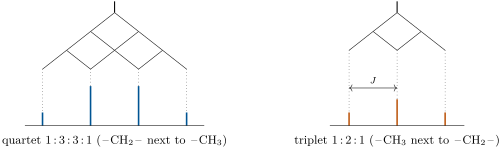
A proton (or a set of equivalent protons) coupled with the same to equivalent neighbours gives lines, separated by , of relative intensities the binomial coefficients , to (the rule).
Proof. Each neighbour is in one of two spin states, shifting the observed line by or . With neighbours the shift is , where is the number in the first state: values, equally spaced by . The two states being almost equally populated, all combinations are equally likely, and of them in the first state happens in ways. ∎
17.5 Solving a structure
Definition 17.9 (Degree of unsaturation)
The degree of unsaturation of a formula is the number of rings plus the number of bonds in the molecule.
Proposition 17.10 (Degree of unsaturation from the formula)
For a molecule (X a halogen), the degree of unsaturation is
Proof. An open chain of carbons with only single bonds carries hydrogens. Each ring or bond removes two of them. A divalent oxygen inserted in a chain changes nothing; a trivalent nitrogen brings one more hydrogen; a halogen takes the place of one hydrogen. Counting the hydrogens missing and dividing by two gives . ∎
Method 17.11 (Solving a structure)
- From the formula, compute .
- From the IR spectrum, find the functional groups (C=O, O–H, N–H, C–O) and the absence of others.
- From the NMR spectrum: number of signals (sets of equivalent protons), integrations (protons per set), shifts (neighbouring groups), multiplicities (number of neighbours by the rule), coupling constants (which signals are neighbours).
- Build fragments, join them, and check every peak against the proposed structure; discard the isomers that disagree.
17.6 Exercises
Exercise 17.1 ★
A solution of a dye at in a cell has an absorbance of 0.64 at its absorption maximum. Compute , and the absorbance of a solution three times more concentrated.
Solution
Solution of Exercise 17.1.
. Three times the concentration: , if the law still holds at that absorbance.
Exercise 17.2 ★
Compute the degree of unsaturation of , , , and (carvone). Propose one structure for each.
Solution
Solution of Exercise 17.2.
: , benzene (a ring and three bonds). : 1, ethyl ethanoate or butanoic acid. : , propanamide. : 1, chloroethene. : : carvone has one ring, two C=C and one C=O.
Exercise 17.3 ★
How many proton signals, with which integrations, do propanone, ethanoic acid, 2-methylpropane and 1,2-dichloroethane give?
Solution
Solution of Exercise 17.3.
Propanone: one signal (6H). Ethanoic acid: two (3H, 1H). 2-Methylpropane: two (9H, 1H). 1,2-Dichloroethane: one (4H).
Exercise 17.4 ★
A signal lies from tetramethylsilane on a spectrometer. What is its shift? How far in hertz would it be at ? Why do high fields separate multiplets better?
Solution
Solution of Exercise 17.4.
; at the signal lies from the reference. Coupling constants stay the same in hertz while shift differences grow with the field: multiplets that overlap at low field separate at high field.
Exercise 17.5 ★★
Predict the multiplicity of each signal of 1-bromopropane, , assuming equal coupling constants, and the relative intensities of the lines of the central signal.
Solution
Solution of Exercise 17.5.
: triplet (3H); central : five neighbours, sextet 1 : 5 : 10 : 10 : 5 : 1 (2H); : triplet (2H), the most deshielded.
Exercise 17.6 ★★
How do the IR spectra of ethanol, propanone and ethanoic acid differ between 1700 and ? Which one compound gives both a C=O and an O–H band?
Solution
Solution of Exercise 17.6.
Ethanol: O–H (3666) and no C=O; propanone: C=O (1738) and no O–H; ethanoic acid: both, O–H (3582) and C=O (1788).
Exercise 17.7 ★★
Two isomers : ethyl ethanoate and methyl propanoate. Predict their NMR spectra (shifts approximately, multiplicities, integrations) and say how to tell them apart.
Solution
Solution of Exercise 17.7.
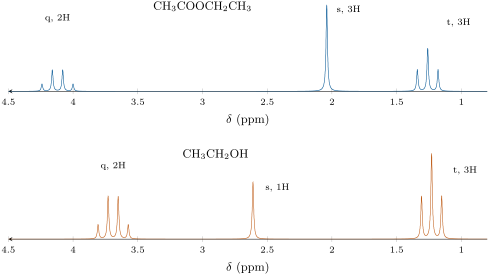
Ethyl ethanoate: quartet (2H) near 4.1, singlet (3H) near 2.0, triplet (3H) near 1.3 ppm. Methyl propanoate: singlet (3H) of , deshielded by the oxygen (near 3.7 ppm), quartet (2H) of (near 2.3), triplet (3H) near 1.1. The quartet is the most deshielded signal in the first and not in the second: a quartet near 4 ppm means .
Exercise 17.8 ★★
Using the simulated spectrum of ethyl ethanoate, read the separation of two lines of the quartet in ppm and convert it to hertz (the spectrum is simulated at ). Compare with the triplet.
Solution
Solution of Exercise 17.8.
Lines apart, that is : the coupling constant. The triplet has the same spacing: the and are coupled to each other.
Exercise 17.9 ★★
A compound shows a strong IR band at and a single NMR signal. Identify it. Which isomer would show a band near and a signal near ?
Solution
Solution of Exercise 17.9.
A C=O band and a single signal: propanone, . The aldehyde isomer, propanal , shows the C–H stretch of the group and its very deshielded proton.
Exercise 17.10 ★★★
Prove the rule in the form: a proton coupled to two different sets of neighbours, with and with , gives lines. When , how many distinct lines are left? Apply to the central of 1-bromopropane.
Solution
Solution of Exercise 17.10.
The first set splits the line into lines; each of these is split by the second set into : lines. If , a line’s position depends only on , which takes values: the rule with . Central of 1-bromopropane: lines in general, six (a sextet) when the two constants are equal.
Exercise 17.11 ★★★
A compound gives no IR band at 1700–1800 but a broad band near in the liquid, and an NMR spectrum with a doublet (6H), a multiplet (1H), a doublet (2H) and a broad singlet (1H). Find the structure.
Solution
Solution of Exercise 17.11.
; an alcohol (O–H band, no C=O). Doublet (6H): two equivalent on one CH; multiplet (1H): that CH; doublet (2H): a next to the CH and bearing the OH; broad singlet: OH. 2-Methylpropan-1-ol, .
Exercise 17.12 ★★★
Show that the absorbance of a mixture of two species obeys , and explain how measurements at two wavelengths give both concentrations.
Solution
Solution of Exercise 17.12.
Each species absorbs independently: . At two wavelengths, with the four coefficients known, two linear equations give and .
17.7 Problem: The Pineapple Molecule
Problem 17.1
Weekend problem — combustion analysis and vapour density, the infrared spectrum, the proton NMR spectrum, and the structure and molar mass of the pineapple-smelling ester
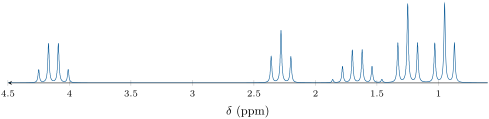
The unknown is a liquid containing only C, H and O. The combustion of gives of carbon dioxide and of water. Its vapour has a density of at and . Gas-phase IR bands: 2982, 1754, (strong), none above . Proton NMR (): 4.13 (q, 2H, ), 2.28 (t, 2H), 1.66 (sextet, 2H), 1.25 (t, 3H, ), 0.95 (t, 3H) ppm. : C 12.0, H 1.0, O ; .
Part I — The formula.
- Compute the mass of carbon in the sample.
- Compute the mass of hydrogen.
- Deduce the mass of oxygen.
- Compute the mass percentages of C, H and O.
- Find the empirical formula.
- From the vapour density, compute the molar mass (ideal gas).
- Give the molecular formula and its degree of unsaturation.
Part II — The infrared spectrum.
- Assign the band at .
- What does the absence of bands above exclude?
- Assign the strong band at .
- Assign the band at .
- With the degree of unsaturation, which family of compounds remains? Why not a carboxylic acid, a ketone with an ether, or a cyclic diol?
Part III — The NMR spectrum.
- How many sets of equivalent protons? Check the total integration.
- Interpret the quartet at 4.13 ppm: neighbours and environment.
- Interpret the triplet at 1.25 ppm. Why do the two share the same ?
- Interpret the triplet at 2.28 ppm.
- Interpret the sextet at 1.66 ppm.
- Interpret the triplet at 0.95 ppm.
- Build the two fragments that these signals describe.
- Why are the signals at 4.13 and 2.28 ppm the most deshielded?
Part IV — The structure.
- Join the fragments through the ester group: two possibilities. Which is consistent with the shifts?
- Explain why propyl propanoate does not fit.
- Explain why butyl ethanoate does not fit.
- Name the compound and draw its structure.
- Check each IR band and each NMR signal against the structure.
- State the molar mass of the pineapple molecule.
Solution
Solution of Problem 17.1.
1. . 2. . 3. . 4. C , H , O . 5. C , H , O mol: ratio , . 6. (density in ). 7. : , . 8. A C=O stretch. 9. Any O–H: no acid, no alcohol. 10. A C–O stretch, strong: the C–O of an ester. 11. C–H stretches of and groups. 12. One bond, used by the C=O; with a strong C–O and no O–H, an ester. An acid needs an O–H; a diol has no C=O. A ketone carrying an ether group would have its C=O near the of propanone, while the observed lies close to the of ethyl ethanoate; the NMR of Part III confirms the ester. 13. Five; , the twelve hydrogens. 14. A with three neighbours (a ), bound to the oxygen (deshielded): . 15. The of that ethyl group, with two neighbours; the two signals are coupled to each other, hence one . 16. A with two neighbours, next to the C=O. 17. A with five neighbours: between a and a . 18. A with two neighbours, far from the functional group. 19. and . 20. The 4.13 ppm protons are on the carbon bound to oxygen, the 2.28 ppm protons next to the C=O: both electron-withdrawing. 21. or . Only the first puts the with three neighbours on the oxygen (the quartet at 4.13 ppm). 22. Propyl propanoate is the second: its would be a triplet and the quartet would lie near 2.3 ppm. 23. Butyl ethanoate, , would show a singlet (3H) near 2.0 ppm and no quartet. 24. Ethyl butanoate, . 25. IR: C=O 1754, C–O 1182, C–H 2982, no O–H. NMR: 4.13 (q), 2.28 (t), central 1.66 (sextet), ester 1.25 (t), chain 0.95 (t), integrations 2, 2, 2, 3, 3. 26. : ethyl butanoate, .