University Chemistry — Year 1 · Bachelor Year 1
22Alcohols: Activating the OH Group
Alcohols are everywhere: made in tonnes from alkenes and from fermentation, delivered by every Grignard addition of the previous chapter. Yet an alcohol does not undergo substitution as a halogenoalkane does: the OH group would have to leave as the hydroxide ion, a strong base and a very poor leaving group (Chapter 19). Chemists have three answers. Remove the proton of the OH instead, and the alkoxide becomes a powerful nucleophile. Add a proton, and the leaving group becomes water. Or replace the hydrogen by a group that turns the oxygen into part of an excellent leaving group, without touching the carbon. This chapter follows the three routes, and the choices of mechanism and stereochemistry that come with them.
You already know
SN1, SN2 and their stereochemistry (Chapter 19); E1, E2 and Zaitsev’s rule (Chapter 20); acidity constants and the predominant-reaction method (Chapter 10); the effect of alkyl groups on the acidity of alcohols (Exercise 18.11).
22.1 Alcohols as acids: alkoxides
Definition 22.1 (Alkoxide)
An alkoxide is the conjugate base of an alcohol : methoxide , ethoxide , tert-butoxide . Alkoxides are strong bases and good nucleophiles.
Proposition 22.2 (Acidity of alcohols)
Alcohols are weaker acids than water or about as weak: 15.5 (methanol), 15.9 (ethanol), 17.1 (propan-2-ol), 19.2 (2-methylpropan-2-ol), against 14.0 for the couple /. Hydroxide therefore deprotonates them only partly; a complete conversion to the alkoxide needs a stronger base or an alkali metal.
Proof. The reaction has , between and : unfavourable. Sodium metal reduces the proton, , and the hydride ion of sodium hydride takes it irreversibly, : the hydrogen escapes, and the reaction is complete whatever its equilibrium constant. ∎
In the lab — Sodium hydride
Sodium hydride is sold as a grey powder dispersed in mineral oil, which protects it from the moisture of the air. It reacts violently with water, releasing flammable hydrogen; it is weighed quickly, added in portions to the dry alcohol under an inert gas, and the bubbling of hydrogen shows the progress of the deprotonation. Excess hydride is destroyed at the end by slow addition of an alcohol, never of water.
22.2 The Williamson ether synthesis
Definition 22.3 (Williamson ether synthesis)
The Williamson ether synthesis prepares an ether by an SN2 reaction of an alkoxide on a halogenoalkane (or a sulfonate ester) .

Method 22.4 (Choosing the two partners)
An ether can be cut on either side of the oxygen.
- Write the two possible pairs: with , and with .
- Keep the pair in which the halide is methyl or primary: SN2 needs an unhindered carbon.
- Reject a pair with a tertiary halide: the alkoxide, a strong base, would eliminate (E2) instead.
- With a secondary halide, expect a mixture of ether and alkene.
Example 22.5 (An unsymmetrical ether)
2-Methoxy-2-methylpropane (methyl tert-butyl ether): sodium tert-butoxide with iodomethane gives it cleanly; sodium methoxide with the tertiary bromide, 2-bromo-2-methylpropane, gives 2-methylpropene by E2. Bulky on the alkoxide side, small on the halide side.
22.3 Activating the OH group
Definition 22.6 (Sulfonate esters)
A sulfonate ester is formed from an alcohol and a sulfonyl chloride in the presence of a base (pyridine). The tosylate, , comes from 4-methylbenzenesulfonyl chloride (tosyl chloride); the mesylate, , from methanesulfonyl chloride. The sulfonate anion , the conjugate base of a strong acid and stabilised by resonance over three oxygens, is an excellent leaving group.

Proposition 22.7 (Configuration through tosylation and substitution)
Tosylation of an alcohol at a stereogenic carbon keeps its configuration (retention); a subsequent SN2 substitution of the tosylate inverts it. The two steps together replace OH by a nucleophile with inversion.
Proof. In the tosylation, the bonds that change are O–H and S–Cl: the oxygen of the alcohol attacks the sulfur and its hydrogen goes to the base. No bond to the stereogenic carbon is broken, so the arrangement around it is the same. In the SN2 step, the C–O bond breaks while the nucleophile bonds on the opposite side (Proposition 19.4). ∎
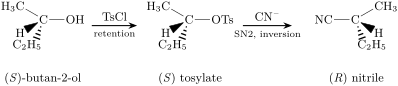
The same goal can be reached in acid: the OH group, protonated, leaves as water, (SN1, E1) or under attack (SN2). Acid limits the nucleophile, though, to those that survive it — halide ions, water, alcohols — and opens the door to carbocations and their side reactions.
22.4 Conversion to halogenoalkanes
Proposition 22.8 (Alcohols and hydrogen halides)
Tertiary alcohols give the halogenoalkane with concentrated hydrochloric acid at room temperature (SN1); primary alcohols need hydrobromic or hydroiodic acid and heating (SN2 on the protonated alcohol); secondary alcohols react at intermediate rates, often by both mechanisms.
Proof. Protonation turns OH into . For a tertiary alcohol, water leaves easily, giving a stable carbocation captured by the halide (SN1): even the modest nucleophile suffices. A primary carbocation is too unstable; the halide must push water out from behind (SN2), which needs a good nucleophile (, , better in protic media than , Proposition 18.12) and heat. ∎
Example 22.9 (A classification test)
A mixture of concentrated hydrochloric acid and zinc chloride (a Lewis acid that helps the OH leave) turns a tertiary alcohol cloudy at once — the insoluble chloride separates — a secondary alcohol within minutes, and a primary alcohol hardly at all at room temperature: the order of carbocation stability made visible in a test tube.
22.5 Dehydration and ether formation in acid
Definition 22.10 (Dehydration of an alcohol)
The dehydration of an alcohol is the elimination of water, catalysed by a strong acid (sulfuric or phosphoric acid) and heat, giving an alkene: .


Proposition 22.11 (Ether or alkene)
A primary alcohol heated with sulfuric acid gives mainly a symmetrical ether at moderate temperature (one molecule substituting another by SN2) and mainly an alkene at higher temperature; secondary and tertiary alcohols give alkenes.
Proof. For a primary alcohol, the protonated alcohol can be attacked either at carbon by a second alcohol molecule (SN2, giving after loss of a proton) or at a hydrogen (E2). Elimination makes more molecules than it consumes and is favoured as the temperature rises (Proposition 20.10); substitution dominates when it is lower. Secondary and tertiary alcohols ionise to carbocations, which lose a proton more easily than they are captured by a weak nucleophile, the more so on heating; the water formed is also removed by distillation of the volatile alkene. ∎
22.6 Exercises
Exercise 22.1 ★
Write the reactions of ethanol with sodium, with sodium hydride, and with sodium hydroxide; compute the constant of the last ( of ethanol 15.9).
Solution
Solution of Exercise 22.1.
; ; , : partial.
Exercise 22.2 ★
Give the products of: sodium methoxide with 1-bromopropane; sodium ethoxide with iodomethane; sodium phenoxide with bromoethane.
Solution
Solution of Exercise 22.2.
1-Methoxypropane; methoxyethane; ethoxybenzene (the phenoxide, a weaker base than an alkoxide, is still a good nucleophile).
Exercise 22.3 ★
Write the tosylation of propan-1-ol and the reaction of the tosylate with sodium iodide. What is the advantage over the direct reaction of the alcohol with sodium iodide?
Solution
Solution of Exercise 22.3.
Tosylation in pyridine gives ; then
Directly, iodide would have to expel : no reaction. The tosylate has an excellent leaving group, and the conditions are neither acidic nor strongly basic.
Exercise 22.4 ★
Give the alkenes formed by acid dehydration of butan-2-ol and of 2-methylpentan-2-ol, and the major one.
Solution
Solution of Exercise 22.4.
Butan-2-ol: but-1-ene, (Z)- and (E)-but-2-ene; major (E)-but-2-ene. 2-Methylpentan-2-ol: 2-methylpent-2-ene (major, trisubstituted) and 2-methylpent-1-ene.
Exercise 22.5 ★★
Propose a Williamson synthesis of 1-ethoxy-2-methylpropane and explain your choice of partners. Why would the other choice give an alkene?
Solution
Solution of Exercise 22.5.
: sodium 2-methylpropan-1-olate with bromoethane, or sodium ethoxide with 1-bromo-2-methylpropane. Both halides are primary, but 1-bromo-2-methylpropane is branched next to the reacting carbon, which slows SN2 and lets the strong base eliminate (2-methylpropene). The first choice is better.
Exercise 22.6 ★★
(R)-octan-2-ol is converted into its tosylate, then treated with sodium ethoxide in ethanol. Give the configuration of the ether. What would be obtained by heating the same alcohol with sulfuric acid?
Solution
Solution of Exercise 22.6.
The tosylate keeps the (R) configuration; SN2 with ethoxide inverts it: (S)-2-ethoxyoctane (OEt ranks first as OTs did). With sulfuric acid and heat: elimination to octenes (mainly (E)-oct-2-ene), via a secondary carbocation, with loss of the stereochemistry.
Exercise 22.7 ★★
Write the mechanism of the reaction of 2-methylpropan-2-ol with concentrated hydrochloric acid and explain why the reaction is fast at room temperature.
Solution
Solution of Exercise 22.7.
Protonation of OH; loss of water to the tertiary carbocation (slow); capture by : 2-chloro-2-methylpropane. Fast because the tertiary carbocation is stable and the chloride, insoluble in the acid, separates.
Exercise 22.8 ★★
Write the mechanism of the formation of ethoxyethane from ethanol in sulfuric acid, and the competing elimination.
Solution
Solution of Exercise 22.8.
; a second ethanol attacks the carbon from behind, water leaving (SN2): , which loses a proton: ethoxyethane. Competing: a base (ethanol, ) takes a proton of as water leaves (E2): ethene.
Exercise 22.9 ★★
In the classification test of this chapter, which alcohol among butan-1-ol, butan-2-ol and 2-methylpropan-2-ol turns cloudy first? Write the product.
Solution
Solution of Exercise 22.9.
2-Methylpropan-2-ol (tertiary), giving 2-chloro-2-methylpropane, insoluble.
Exercise 22.10 ★★★
3,3-Dimethylbutan-2-ol, heated in acid, gives mainly 2,3-dimethylbut-2-ene, whose carbon skeleton differs from that of the alcohol. Propose a mechanism with a 1,2-shift of a methyl group in the carbocation, and justify the shift.
Solution
Solution of Exercise 22.10.
Protonation and loss of water give a secondary carbocation next to a quaternary carbon. A methyl group of that carbon moves with its bonding pair to the cationic carbon: the positive charge is now on a tertiary carbon, more stable. Loss of a proton from a neighbouring carbon gives the tetrasubstituted 2,3-dimethylbut-2-ene, the most stable alkene.
Exercise 22.11 ★★★
Design a synthesis of (S)-2-methoxybutane from (R)-butan-2-ol, and another from (S)-butan-2-ol, each keeping the configuration under control.
Exercise 22.12 ★★★
Show that the equilibrium can be driven to the ether by removing water continuously, using the reaction quotient (Chapter 7).
Solution
Solution of Exercise 22.12.
. Removing water as it forms keeps and small: and the reaction goes on forming ether until the alcohol is consumed.
22.7 Problem: Two Roads to an Ether
Problem 22.1
Weekend problem — the two Williamson routes to methyl tert-butyl ether, a stereochemically controlled ether from an optically active alcohol, the dehydration of a tertiary alcohol, and the mass of ether obtained
2-Methoxy-2-methylpropane (methyl tert-butyl ether, MTBE) was produced on a large scale as a fuel additive. Molar masses (): 74.0, 88.0, 141.9.
Part I — MTBE by the Williamson synthesis.
- Write the two pairs of partners (alkoxide and halide) that could give MTBE.
- Which pair fails? Write the reaction that takes place instead.
- Write the successful reaction and its mechanism.
- How is sodium tert-butoxide prepared from 2-methylpropan-2-ol? Why not with sodium hydroxide?
- Why is the reaction run in the dry alcohol or an aprotic solvent?
- Is the product chiral?
Part II — An optically active ether.
- (R)-Butan-2-ol is converted into its tosylate. Write the reaction and give the configuration of the tosylate.
- The tosylate reacts with sodium methoxide. Write the product and its configuration.
- Which configuration of the alcohol gives (R)-2-methoxybutane by the same route?
- Another route: the alkoxide of (R)-butan-2-ol with iodomethane. Configuration of the product? Why?
- Which side reaction competes in question 8, and why is it limited here?
- Why would heating (R)-butan-2-ol with methanol in sulfuric acid give a nearly racemic ether, if any?
Part III — Dehydration of a tertiary alcohol.
- Write the mechanism of the acid dehydration of 2-methylbutan-2-ol.
- Give the two alkenes and predict the major one.
- Why is no ether formed from this alcohol?
- Why is 2-methylbut-2-ene distilled out as it forms?
- Draw the energy profile of the E1 step and mark the rate-determining step.
- Could a primary alcohol be dehydrated by the same mechanism?
Part IV — Masses.
- of 2-methylpropan-2-ol are converted into the alkoxide. Compute the amount.
- What mass of iodomethane is needed for a excess?
- Compute the theoretical mass of MTBE.
- Compute the mass obtained for a yield.
Solution
Solution of Problem 22.1.
1. Sodium tert-butoxide with a methyl halide; sodium methoxide with a tert-butyl halide. 2. The second: methoxide, a strong base, eliminates from the tertiary halide, . 3. : the alkoxide oxygen attacks the methyl carbon from behind as iodide leaves (SN2). 4. With sodium (or sodium hydride): . Hydroxide is too weak a base: . 5. Water would protonate the alkoxide and attack the halide. 6. No: no stereogenic centre. 7. (R)-butan-2-ol + TsCl (pyridine) (R)-butan-2-yl tosylate: retention. 8. (S)-2-methoxybutane, by SN2 inversion. 9. (S)-butan-2-ol. 10. (R)-2-methoxybutane: the C–O bond of the stereogenic carbon is kept; only O–C(methyl) forms. 11. E2 (methoxide is a strong base and the carbon is secondary), giving butenes; limited by the small base, an excellent leaving group and mild temperature. 12. The protonated alcohol ionises to a planar secondary carbocation, captured on both faces by methanol: racemic ether, together with butenes. 13. Protonation of OH, loss of water (slow) to the tertiary carbocation, loss of a proton. 14. 2-Methylbut-2-ene (major, trisubstituted) and 2-methylbut-1-ene. 15. A tertiary carbocation is hindered and loses a proton far more easily than another alcohol molecule can attack it. 16. To remove a product: with kept small the reaction goes on, and the alkene is not left in contact with the acid. 17. A high first barrier (loss of water, rate-determining) to the carbocation, then a small barrier to the alkene. 18. No: a primary carbocation is too unstable; primary alcohols eliminate by E2 on the protonated alcohol, at higher temperature. 19. . 20. . 21. . 22. of MTBE.