University Chemistry — Year 1 · Bachelor Year 1
14E–pH Diagrams
An iron nail left in rain water rusts; the same nail in a strongly basic solution keeps its shine for weeks. The steel hull of a ship carries blocks of zinc that dissolve in its place, and a copper roof turns green but never disappears. Redox couples whose potential depends on pH, precipitation of hydroxides and oxides, acid–base equilibria: all three act at once, and a single map gathers them. On a graph of potential against pH, each species of an element gets the region where it is the stable form; reading the map tells which species survive in water, which react together, and where a metal corrodes.
You already know
The Nernst equation, standard potentials and the prediction of redox reactions are in Chapter 13; predominance diagrams in Chapter 10; precipitation thresholds of hydroxides and existence domains of solids in Chapter 11. All potentials are at , with .
14.1 Conventions
Definition 14.1 (Potential–pH diagram, working concentration)
The potential–pH diagram of an element is the plane divided into regions, each the domain of predominance (dissolved species) or of existence (solids) of one form of the element. It is drawn for a chosen working concentration , the total concentration of the element in solution, with these conventions:
- on a boundary between two dissolved species, each is at (counted in atoms of the element);
- on a boundary between a dissolved species and a solid, the dissolved species is at and the solid is just present;
- gases are at .
In this chapter .
The forms of the element are ordered by oxidation number: the higher the number, the higher on the diagram (oxidised forms are stable at high potential). At a given oxidation number, the more basic forms (hydroxides, oxides, hydroxo complexes) are to the right.
Proposition 14.2 (Slope of a boundary)
A boundary between two species of different oxidation numbers, whose half-equation exchanges electrons and protons, , is a straight line of slope volt per pH unit. A boundary between two species of the same oxidation number is vertical.
Proof. The Nernst equation gives , and on the boundary the concentrations are fixed by the conventions. Two species of the same oxidation number are linked by an acid–base or precipitation equilibrium without electrons, whose constant fixes the pH of the boundary whatever the potential. ∎
14.2 Water
Proposition 14.3 (The two lines of water)
Under of gas, water is reduced to hydrogen below the line and oxidised to oxygen above the line .
Proof. : at . : . Below the first line is the stable form of the couple (water is reduced); above the second, is. ∎
Definition 14.4 (Stability domain of water)
The band between the two lines, wide at every pH, is the stability domain of water: a species whose domain lies entirely inside it neither oxidises nor reduces water.
14.3 Building a diagram: iron
Method 14.5 (Building a potential–pH diagram)
- List the species and sort them by oxidation number: for iron, (0), and (II), and (III).
- At each oxidation number, find the vertical boundaries from the precipitation (or acid–base) equilibria at the working concentration (Chapter 11).
- For each pair of neighbouring oxidation numbers, write the half-equation in each pH range and its Nernst equation with the conventions; this gives a straight boundary of known slope.
- Assemble the lines from left to right; where three lines meet, each continues only on the side where its two species are both stable.
- Check: the domains must not overlap, and the slopes must agree with Proposition 14.2.
Example 14.6 (The iron boundaries)
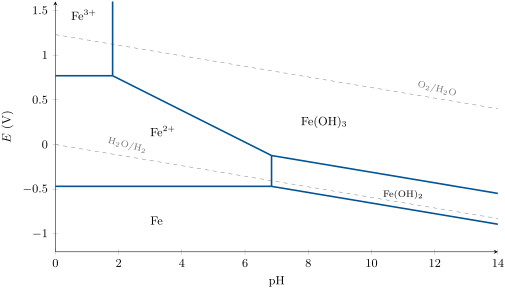
With (and the constants of Chapters 11 and 13):
- /: ; /: .
- /: V (pH below 6.85).
- /: V (both at , pH below 1.82).
- /: , slope : between pH 1.82 and 6.85.
- /: one electron, one proton, ; /: two electrons, two protons, (pH above 6.85).
The intercepts are obtained by continuity at the triple points, or directly from the Gibbs energies of formation; the diagram below is computed from the latter, and its boundaries differ from these rounded values by less than or 0.01 pH unit.
14.4 Copper and zinc
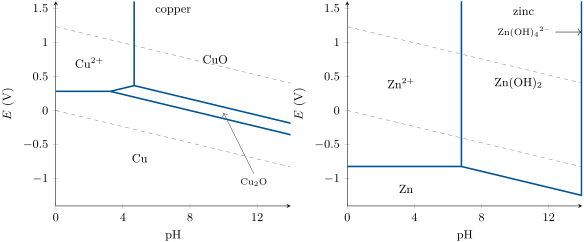
The same method gives the diagrams of copper (species , , at I, , at II) and of zinc (, , , ). For copper, appears at , and the ion, though listed, has no domain at all: in acid, V lies above V, so its would-be domain is crossed out by the two neighbours (Section 14.5). For zinc, the hydroxide appears at pH 6.81 and redissolves as only above 13.97 at this concentration, a sliver at the right edge.
14.5 Reading a diagram
Proposition 14.7 (Disjoint domains)
If, at a given pH, the domain of an oxidant lies entirely above that of a reductant, with no common part, the two react; species whose domains share a region can coexist at equilibrium.
Proof. At that pH, above its boundary the oxidant’s couple has a potential higher than any the reductant’s couple can reach: by Proposition 13.12 the reaction between them has , and it goes on until one of them is used up or their domains meet. Inside a common region both are the stable forms at the same potential: nothing drives a reaction. ∎
Iron and water: the domain of iron metal lies below the line / at every pH. Iron reduces water, in acid solution with a visible release of hydrogen; with dissolved oxygen it is oxidised faster still. Copper: its domain overlaps that of water, so copper does not reduce water or acids that are not themselves oxidants, but the oxygen of air, above it, oxidises it slowly — the green patina of roofs is a later product of that oxidation with carbon dioxide and sulfur compounds. A diagram tells what is possible, not how fast: many reactions it allows are slow, a question treated in the Year 2 volume.
Definition 14.8 (Disproportionation, comproportionation)
Disproportionation is the reaction of a species with itself, one part being oxidised and the other reduced: . The reverse, two species of the same element giving one of intermediate oxidation number, is comproportionation: .
Proposition 14.9 (Criterion of disproportionation)
A species B of intermediate oxidation number, in the couples A/B and B/C, disproportionates if : it then has no domain of its own, and a single boundary A/C replaces the two.
Proof. B is the oxidant of B/C and the reductant of A/B. If the B/C couple lies above A/B, the gamma rule (Method 13.11) makes B (oxidant, upper couple) react with B (reductant, lower couple), giving C and A. Geometrically, B would be stable only above and below , an empty set. ∎
Definition 14.10 (Immunity, corrosion and passivation domains)
On the diagram of a metal, the domain of the metal itself is its immunity domain (it cannot be oxidised); the domains of its dissolved ions form the corrosion domain; the domains of its solid oxides and hydroxides, which may coat the metal, form the passivation domain. Whether a coat really protects the metal is a kinetic matter, treated in the Year 2 volume.
Method 14.11 (Reading a diagram)
- Superpose the lines of water: a species whose domain lies outside the water band reacts with water (thermodynamically).
- For two species of different elements, superpose their diagrams: disjoint domains at the pH of interest mean a reaction.
- For a metal, locate the point (pH, ) of the medium: immunity, corrosion or passivation.
- Remember that a diagram is drawn for one working concentration; the boundaries with dissolved species move by V per decade of concentration.
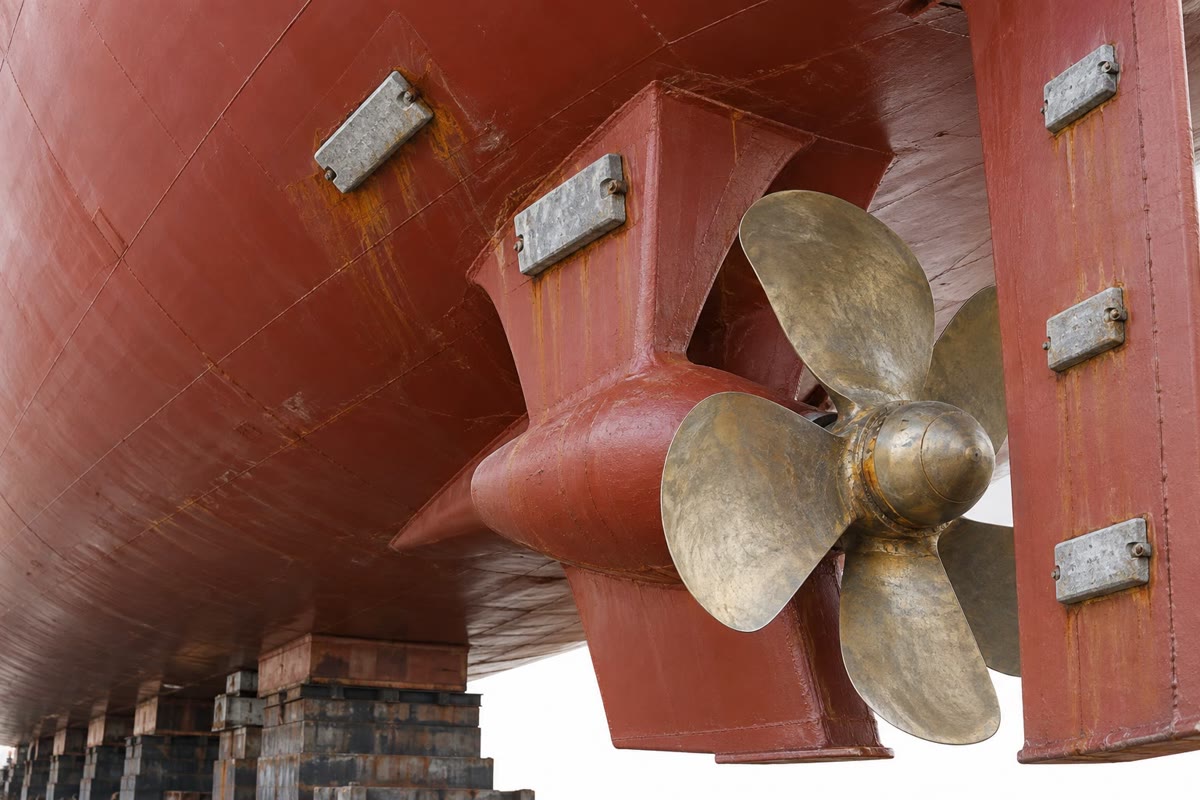
Zinc protects iron: in sea water (pH about 8) the zinc and steel of a hull are in contact; zinc, of lower potential, is oxidised first and the electrons it releases keep the iron in or near its immunity domain. The zinc block is consumed and replaced at each dry dock.
14.6 Exercises
Exercise 14.1 ★
Sort by oxidation number of the element the species , , , , , and , , , , .
Solution
Solution of Exercise 14.1.
Manganese: (0) , (II) (IV) (VII). Chlorine: (I) (0) , (I) (V).
Exercise 14.2 ★
Give the slope of the boundary for each half-equation: ; ; ; . Why does one of them have a positive slope?
Solution
Solution of Exercise 14.2.
; ; ; V per pH unit. For the copper couple the protons are released on the side of the reduced form (): the potential rises with pH.
Exercise 14.3 ★
At what pH do the lines of water pass through 0 V and through ? What is the width of the stability domain of water at pH 7?
Solution
Solution of Exercise 14.3.
/ passes through 0 V at pH 0 and never reaches 0.50 V for . / reaches 0.50 V at and 0 V only at pH 20.8, outside the scale. The band is wide at every pH, pH 7 included (from to V).
Exercise 14.4 ★
Using the iron diagram, give the stable form of iron at (pH 1, V), (pH 4, ), (pH 10, V) and (pH 10, V).
Solution
Solution of Exercise 14.4.
(1, 1.0 V): . (4, 0): the line / is at V and the point lies below it, above V: . (10, V): between and V: . (10, 0.5 V): .
Exercise 14.5 ★★
Recompute the boundary / and the vertical / for a working concentration of , the value used to discuss corrosion. Which domains grow?
Solution
Solution of Exercise 14.5.
/: V. /: . The domains of the dissolved ions (corrosion) grow: extends down to V and to pH 3.15; metal and hydroxides lose ground.
Exercise 14.6 ★★
Derive the boundary /: write the half-equation, its Nernst equation, and use continuity at pH 1.82 to show that .
Solution
Solution of Exercise 14.6.
: . At pH 1.82 the line meets / at 0.77 V, so the constant is V.
Exercise 14.7 ★★
Show with the table of standard potentials that disproportionates at pH 0 and give the potential of the single boundary / at .
Exercise 14.8 ★★
Does copper dissolve in hydrochloric acid at pH 0 without air? in nitric acid (couple /, V)? Justify with the diagram and the potentials.
Solution
Solution of Exercise 14.8.
At pH 0 the domain of copper (below 0.28 V) overlaps that of water and lies above the line of hydrogen: no reaction with hydrochloric acid without air. Nitric acid: / at 0.96 V lies above the domain of copper, which is oxidised: .
Exercise 14.9 ★★
Iron(II) solutions left in air turn yellow-brown. Explain with the iron diagram and the line /, and write the reaction at pH 3.
Solution
Solution of Exercise 14.9.
At pH 3 the line / is at V, above the whole domain of : oxygen oxidises iron(II). Above pH 1.82 the iron(III) formed precipitates as the yellow-brown hydroxide: .
Exercise 14.10 ★★★
Build the diagram of zinc for : compute the vertical boundaries at pH 6.81 and 13.97, the boundary /, and the equations of / and /.
Solution
Solution of Exercise 14.10.
Verticals: ; and, from () with , , pH 13.97. /: V. /: slope , through : . : slope , through : .
Exercise 14.11 ★★★
Superpose the diagrams of iron and of water and discuss the fate of an iron nail in deoxygenated water at pH 2, at pH 7 and at pH 13. What changes with dissolved oxygen?
Solution
Solution of Exercise 14.11.
The domain of iron lies below the hydrogen line at every pH. pH 2: iron is oxidised to with release of hydrogen (corrosion). pH 7: the reaction is still possible, but the hydrogen line ( V) is close to / and the reaction is very slow. pH 13: iron is oxidised to , a passivation domain: a coat forms and the nail keeps its shine. With dissolved oxygen the line /, far above, oxidises iron to iron(III) at every pH: rust, and its dehydrated oxides.
Exercise 14.12 ★★★
Sacrificial anodes. A steel hull in sea water (pH 8) is joined to a zinc block. Using the diagrams, explain which metal is oxidised, write the reactions with dissolved oxygen, and say why magnesium would also work and copper would make things worse.
Solution
Solution of Exercise 14.12.
Zinc has the lower domain: in contact with the steel it is oxidised first, at pH 8, and the electrons it releases reduce the oxygen at the steel surface, which stays metallic. Magnesium ( V) is lower still and works too; copper (0.34 V) is above iron: joined to copper, the iron would be the metal oxidised, faster than alone.
14.7 Problem: Bleach and the Pool
Problem 14.1
Weekend problem — oxidation numbers of chlorine, the acid–base pair HClO/ClO, the potential–pH diagram of chlorine, and the pH above which dissolved chlorine disproportionates
Bleach is a basic solution of sodium hypochlorite and sodium chloride; a swimming pool is disinfected by the hypochlorous acid it contains, at a pH kept a little above 7. Mixing bleach with an acidic cleaner releases chlorine gas. Data at : V, V, , V; working concentration of chlorine atoms.
Part I — The species.
- Give the oxidation number of chlorine in , , and .
- Sort the four species on a vertical axis of oxidation number.
- Which two species have the same oxidation number? How are they related?
- Write the half-equation of /.
- Write the half-equation of /.
- Write the half-equation of / in basic solution.
Part II — Hypochlorous acid.
- Draw the predominance diagram of and against pH.
- Why is their boundary on the potential–pH diagram vertical?
- Compute the fraction of hypochlorous acid at pH 7.4.
- Same at pH 8.0. Hypochlorous acid is the better disinfectant: why do pool operators keep the pH from drifting up to 8?
- In bleach (pH about 12), which form is present?
Part III — The diagram. With the conventions of the chapter, is at and , , at on a boundary.
- Show that the boundary / is at V, independent of pH.
- Show that the boundary / is .
- Find the pH where these two lines cross.
- Beyond that pH, the boundary is /. Write its half-equation and show that its slope is .
- Compute from the two given potentials.
- Write the boundary / above pH 7.55; check its continuity at pH 7.55.
- Sketch the diagram from pH 0 to 14, with the line /.
- Is hypochlorous acid stable in water, thermodynamically? Why does a pool still need only small additions of chlorine every day?
Part IV — Disproportionation and the danger of acid.
- Above the pH of question 14, what happens to dissolved chlorine? Write the reaction in water and in basic solution.
- How is bleach made from chlorine?
- Below the same pH, write the reaction between and . What is it called?
- An acidic toilet cleaner brings bleach to pH 1. What happens?
- Why is the danger smaller with a weakly acidic product (pH 4)? Answer with the diagram, then qualify.
- State, to one decimal, the pH above which dissolved chlorine disproportionates at .
Solution
Solution of Problem 14.1.
1. I, 0, I, I. 2. at the bottom, , then and at the top. 3. and , an acid–base pair. 4. . 5. . 6. . 7. below pH 7.55, above. 8. No electron is exchanged; the boundary is fixed by alone. 9. : . 10. : three quarters of the active chlorine would be the weaker disinfectant . 11. . 12. V; no in the half-equation. 13. . 14. Equating, , . 15. : one proton for two electrons, slope . 16. Adding the two half-equations (one electron per chlorine atom each): , V; boundary . 17. : (constant chosen for continuity: ). 18. below the lines; in a small triangle at above 1.446 V; above the line of slope up to pH 7.55, beyond. The line /, from 1.23 to 0.40 V, lies below all these boundaries (the computed diagram of the chapter’s script has the same shape). 19. No: its domain lies above the line of oxygen, so it can oxidise water, but the reaction is slow. A pool loses its chlorine mainly because it oxidises what swimmers and the air bring in, and through sunlight; it must be topped up. 20. has no domain there: it disproportionates, ; in base . 21. By passing chlorine into sodium hydroxide solution (the reaction of question 20). 22. , a comproportionation. 23. Below pH 1.6, hypochlorite and chloride comproportionate: chlorine forms, and beyond its solubility escapes as a toxic gas. 24. At , pH 4 is outside the domain of . But the boundary depends on : repeating questions 12–14 for a general gives , which reaches 3.6 for , the order of concentration of bleach. Mixing concentrated products near pH 4 is not safe either. 25. pH 1.6: above it, at , dissolved chlorine disproportionates into hypochlorous acid and chloride.