University Chemistry — Year 1 · Bachelor Year 1
28The p-Block II: Oxygen, Halogens and Noble Gases
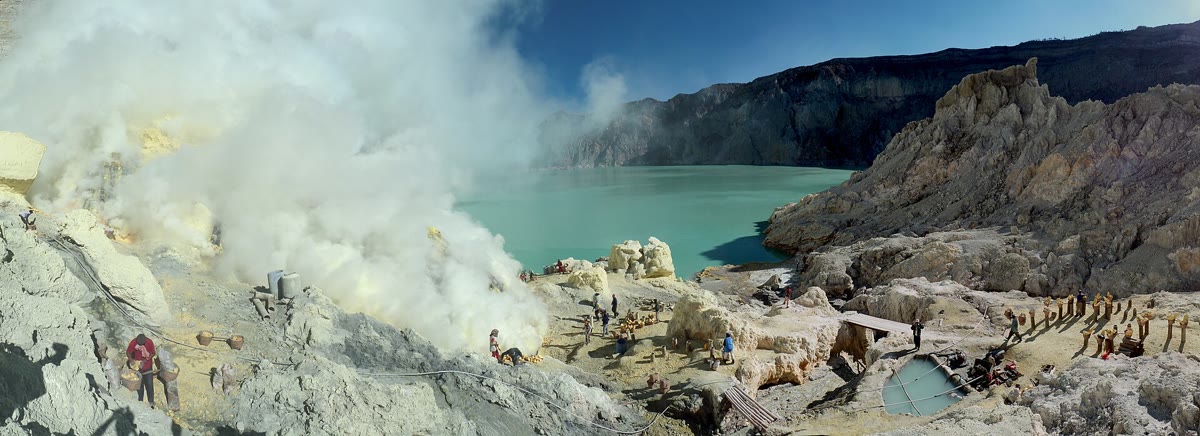
Sulfuric acid is made in larger tonnage than any other chemical: it dissolves phosphate rock for fertilisers, leaches copper and uranium ores, refines oil and fills car batteries, and for a century the output of sulfuric acid was a rough measure of a country’s industry. Most of its sulfur now comes from the cleaning of natural gas and oil; some is still carried by hand out of volcanic craters. Sulfur sits in group 16 under oxygen; the halogens of group 17 and the noble gases of group 18 complete the p-block. This chapter follows oxygen and sulfur from the element to the acid, ranks the halogens as oxidants with their standard potentials, and ends with the compounds that the supposedly inert noble gases do form.
You already know
Lewis structures, expanded octets and the VSEPR shapes (Chapter 3); standard potentials (Chapter 13); the disproportionation of chlorine and the potential–pH diagram of chlorine (Chapter 14); catalysis (Chapter 9). The school volume (grade 10) grouped the halogens and noble gases as families.
28.1 Oxygen, ozone and peroxides
Definition 28.1 (Chalcogens)
The chalcogens are the elements of group 16 (O, S, Se, Te, Po), with six valence electrons nsnp. They form compounds with oxidation numbers from II (oxides, sulfides) to VI (sulfates), the higher ones only for sulfur and below.
Oxygen exists as dioxygen and as ozone , a bent molecule with two resonance structures (Chapter 3). Ozone is a stronger oxidant than dioxygen: V against 1.23 V for /. In the upper atmosphere it absorbs ultraviolet light; near the ground it is a pollutant. Hydrogen peroxide, with an bond and oxygen at I, is both oxidant and reductant and disproportionates slowly (Exercise 13.12).
Example 28.2 (The oxidation numbers of oxygen)
Oxygen, second only to fluorine in electronegativity, is at II in almost all its compounds: water, oxides, hydroxides, sulfates. The exceptions follow from the rule that the shared electrons go to the more electronegative partner and are split equally between identical atoms. In hydrogen peroxide , H–O–O–H, each oxygen takes the electrons of its bond but shares the pair: I. In potassium superoxide , the ion carries one charge for two atoms: on average. In oxygen difluoride , fluorine wins both bonds and oxygen is at II. In and it is at 0. Only the II state is stable towards water; peroxides and superoxides are oxidants, and a fluorinating agent.
28.2 Sulfur and sulfuric acid
Sulfur, unlike oxygen, forms rings and chains of single bonds: ordinary sulfur is made of rings. It burns to sulfur dioxide, a bent molecule (O–S–O angle ), which can be oxidised further to sulfur trioxide, trigonal planar. Both are acidic oxides: gives sulfurous acid ( 1.77 and 7.22), sulfuric acid.
Proposition 28.3 (Steps of the contact process)
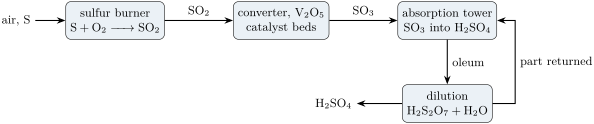
Sulfuric acid is made from sulfur in four steps: (1) ; (2) , over a vanadium(V) oxide catalyst; (3) (oleum), the trioxide being absorbed in concentrated acid; (4) . Overall, .
Proof. Each step is balanced; adding , (2), and , the , and cancel, and the two consumed in step 3 are regenerated in step 4, which leaves . Step 2 is thermodynamically very favourable at room temperature ( at , from the Gibbs energies of formation) but extremely slow: the catalyst, active only when hot, is what makes it run, and the compromise between rate and conversion is studied in the Year 2 volume. is not absorbed in water directly, because its reaction with water vapour forms a fine mist of acid droplets that passes through the absorbers. ∎
Proposition 28.4 (Strength of sulfuric acid)
In water, the first acidity of sulfuric acid is strong (total), the second weak: . A solution is therefore not at pH 1.70 (two protons) nor at 2.00 (one), but in between.
Proof. , with two oxygens without hydrogen on sulfur, is an oxoacid stronger than : levelled (Chapter 10). , already negative, holds its proton more: its , computed from the Gibbs energies of formation, is 1.99. At : , , , with ; solving, and . ∎
Concentrated sulfuric acid is also a powerful dehydrating agent (it chars sugar, taking the elements of water from it) and, hot, an oxidant. Diluting it releases much heat: the acid is always poured into the water, never the reverse. Most of the world’s sulfur, about 84 million tonnes in 2025, is recovered from the hydrogen sulfide of natural gas and refinery streams, and most of it ends as sulfuric acid.
Method 28.5 (Mass balance through the contact process)
- Use the overall equation: one per S atom.
- Correct for the conversion of step 2 (the fraction of oxidised) and for losses in absorption.
- For the air: compute the needed (three halves per S) and divide by its fraction in air.
Example 28.6 (A plant burning a thousand tonnes of sulfur a day)
A plant burns of sulfur a day, converts of the and absorbs of the . Then and , that is of acid a day. The unconverted leaves as : , or a day, which must be removed from the tail gas. The dioxygen needed is ; air, at of , is , or a day at and , before the excess that the plant actually blows in.
28.3 The halogens
Definition 28.7 (Halogens)
The halogens are the elements of group 17 (F, Cl, Br, I, At), with seven valence electrons nsnp. They exist as diatomic molecules and form halide ions .
Proposition 28.8 (Oxidising power of the halogens)
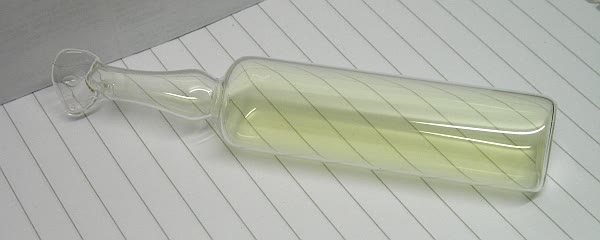
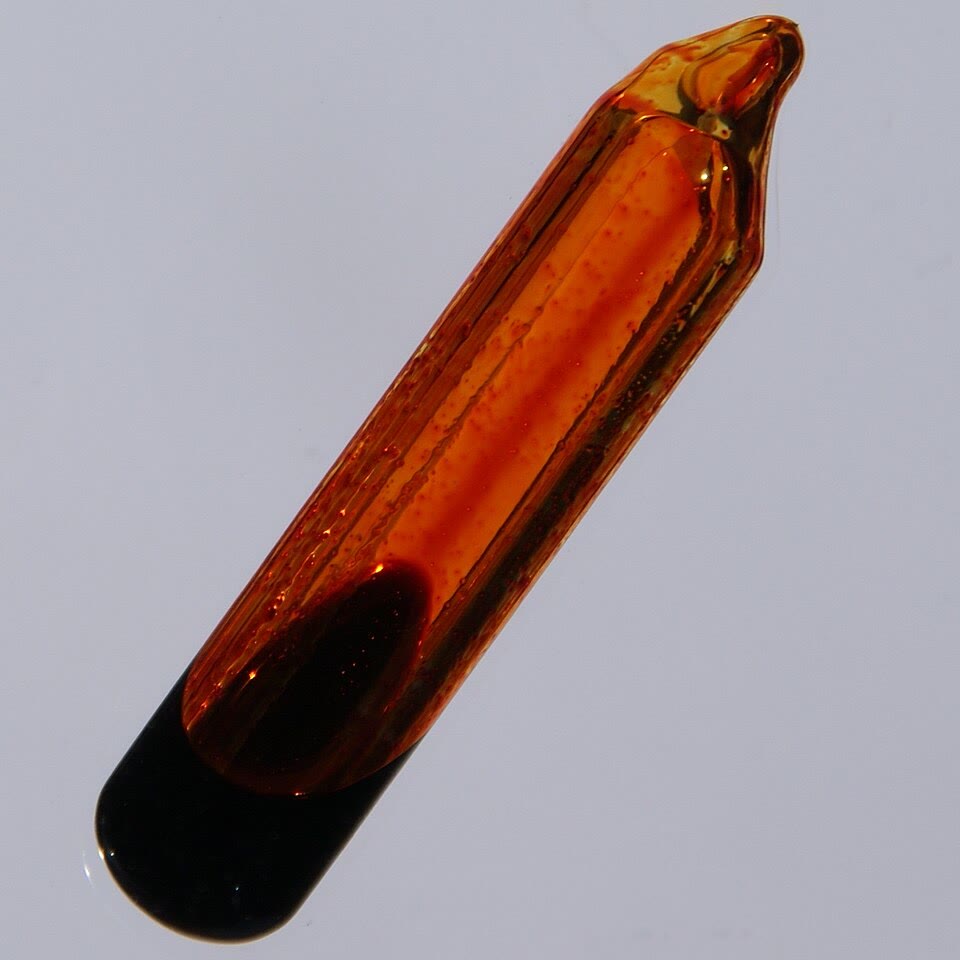
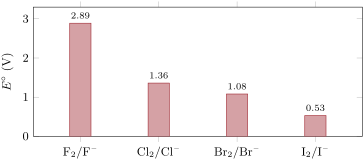
The halogens are oxidants whose strength decreases down the group: V, / 1.36 V, / 1.08 V, / 0.53 V. Each halogen oxidises the halide ions below it in the group.
Proof. The values come from the Gibbs energies of formation of the halide ions (Chapter 13). By the gamma rule, oxidises when the couple / lies above /: for example , . Down the group, the atoms grow, their affinity for an extra electron and the hydration of the smaller halide ions fall, and so does the potential. ∎
The hydrogen halides are all acids in water, but is weak ( 3.16) while , and are strong: the bond is very strong and the small fluoride ion is held in strong hydrogen bonds. Fluorine is the most electronegative element and the strongest oxidant of the table; it is obtained only by electrolysis. Chlorine’s oxoacids — hypochlorous , chloric , perchloric — grow stronger with the number of oxygens without hydrogen, as for all oxoacids (Definition 27.1); their interplay with chloride and chlorine was mapped in Chapter 14.
Definition 28.9 (Interhalogen compounds)
An interhalogen compound is a compound of two different halogens: , , , . The larger, less electronegative halogen is the central atom, with an expanded octet in and above.
In the lab — Handling the halogens
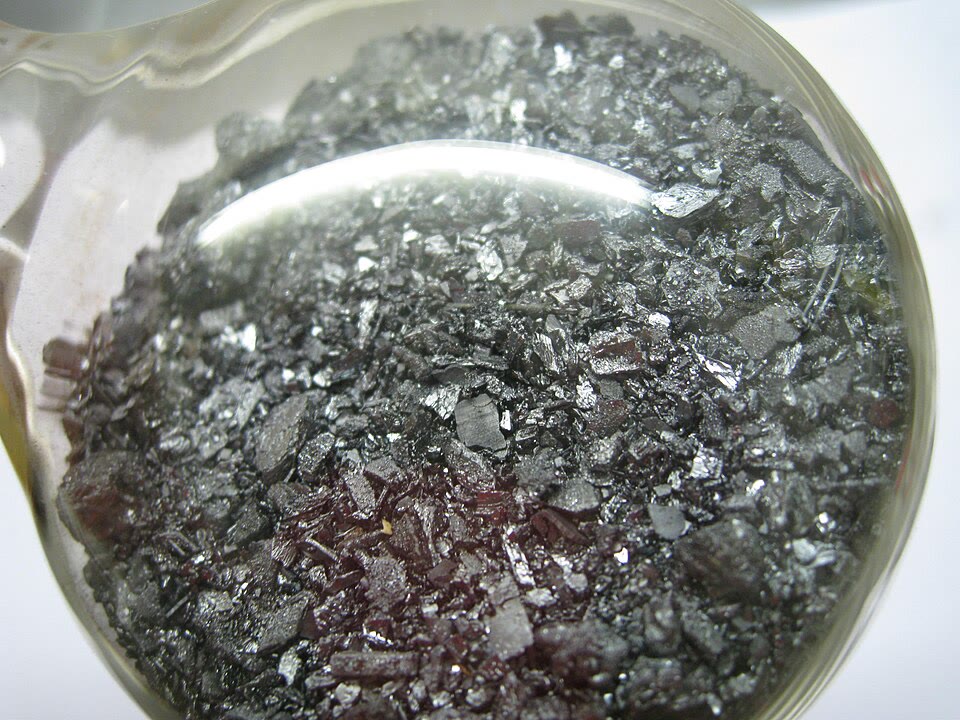
Chlorine is toxic and is prepared only in small amounts in a fume cupboard; bromine burns the skin and its vapour attacks the lungs, and is used diluted, in a fume cupboard, with gloves and goggles, sodium thiosulfate solution at hand to destroy spills (). Iodine is the mildest of the three, but stains and sublimes; it is kept in a closed bottle.
28.4 Noble gases and their compounds
The noble gases (He, Ne, Ar, Kr, Xe, Rn) have filled valence shells and the highest ionisation energies of their periods (Chapter 2). Long believed inert, the heavier ones, whose outer electrons are less tightly held, do react with the most electronegative elements: xenon gives , , and oxides. Their shapes follow the VSEPR rules with lone pairs on xenon.
Example 28.10 (Why xenon, and not argon)
The first ionisation energies of the noble gases fall down the group: He 24.59, Ne 21.56, Ar 15.76, Kr 14.00, Xe 12.13, Rn 10.75 eV. That of dioxygen, , is 12.07 eV, almost the same as xenon’s. An oxidant strong enough to take an electron from , giving the dioxygenyl cation , should therefore oxidise xenon as well, but not argon, which holds its electron 3.7 eV more tightly. Xenon does react with the very strong oxidant platinum hexafluoride , giving a solid of overall composition , and with fluorine itself, which gives the xenon fluorides of the table below. Radon, easier still to ionise, is too radioactive for much chemistry to be done on it.
| molecule | electron pairs on the central atom | shape | measured angle |
|---|---|---|---|
| 2 bonding domains + 1 lone pair | bent | ||
| 6 bonding | octahedral | ||
| 3 bonding + 2 lone pairs | T-shaped | ||
| 2 bonding + 3 lone pairs | linear | ||
| 4 bonding + 2 lone pairs | square planar |
Argon, almost one per cent of air, protects reactive materials in laboratories and welding; helium, from natural gas, cools superconducting magnets, such as those of NMR spectrometers (Chapter 17).
28.5 Exercises
Exercise 28.1 ★
Give the oxidation number of sulfur in , , , , , (average) and .
Solution
Solution of Exercise 28.1.
II; 0; IV; IV; VI; II on average; VI.
Exercise 28.2 ★
Which of these reactions occur: chlorine with potassium iodide; iodine with sodium bromide; bromine with sodium chloride; chlorine with sodium bromide? Write those that do.
Solution
Solution of Exercise 28.2.
A halogen oxidises the halides below it: and occur; iodine with bromide and bromine with chloride do not.
Exercise 28.3 ★
Draw the Lewis structures of , and , with their resonance structures, and give their shapes.
Solution
Solution of Exercise 28.3.
: S with a lone pair, one S=O and one in each of two resonance structures (or two S=O with an expanded octet): bent. : trigonal planar, three equivalent S–O bonds. : central O with a lone pair, one O=O and one O–O, two resonance structures: bent.
Exercise 28.4 ★
Write the reactions of and with water and with sodium hydroxide.
Solution
Solution of Exercise 28.4.
; ; ; .
Exercise 28.5 ★★
Compute the pH of hydrofluoric acid at and compare with hydrochloric acid at the same concentration. Explain the difference.
Solution
Solution of Exercise 28.5.
HF: , , pH 2.10. HCl: pH 1.00. The H–F bond is strong and the fluoride ion strongly hydrogen bonded: HF is a weak acid.
Exercise 28.6 ★★
Predict with VSEPR the shapes of , (seven bonding pairs, pentagonal bipyramid), and .
Solution
Solution of Exercise 28.6.
: five bonds and one lone pair, square pyramidal. : pentagonal bipyramidal. : four bonds and two lone pairs, square planar. : three bonds and one lone pair, trigonal pyramidal.
Exercise 28.7 ★★
Compute the constant of and say why chlorine water turns a starch–iodide paper blue.
Exercise 28.8 ★★
Show that ozone can oxidise iodide ions to iodine and write the reaction in acid. Why is this used to measure ozone?
Solution
Solution of Exercise 28.8.
V: . The iodine formed is titrated with thiosulfate (Exercise 13.7): one per .
Exercise 28.9 ★★
Concentrated sulfuric acid chars sucrose, . Write the dehydration to carbon and compute the mass of carbon from of sugar.
Solution
Solution of Exercise 28.9.
; , , carbon .
Exercise 28.10 ★★★
Compute the pH of sulfuric acid at , taking the second acidity into account (). How much does the second acidity add?
Solution
Solution of Exercise 28.10.
: , , instead of 1.00: the second acidity adds about to .
Exercise 28.11 ★★★
Using the potentials, explain why fluorine cannot be prepared by oxidising fluoride with any chemical oxidant in water, and why it must be made by electrolysis of a molten fluoride, not of an aqueous solution.
Solution
Solution of Exercise 28.11.
/ (2.89 V) lies above every other couple: no oxidant can take the electron from fluoride. In aqueous electrolysis water, oxidised at a much lower potential (/, 1.23 V), would react instead; a molten fluoride contains no water.
Exercise 28.12 ★★★
Iodine is only slightly soluble in water but dissolves in potassium iodide solution as the triiodide ion . Using the Gibbs energies of (), () and (), compute the constant of .
Solution
Solution of Exercise 28.12.
, , .
28.6 Problem: One Tonne of Sulfur
Problem 28.1
Weekend problem — burning sulfur, the catalytic oxidation of sulfur dioxide, absorption and oleum, the second acidity of sulfuric acid, and the mass of acid made from one tonne of sulfur
A sulfuric acid plant burns sulfur recovered from natural gas. Molar masses (): S 32.1, 32.0, 64.1, 80.1, 98.1, 18.0; air contains of by volume; ; .
Part I — Burning sulfur.
- Give the oxidation number of S in S, , and .
- Write the combustion of sulfur.
- Draw the Lewis structure of and predict its shape.
- Compute the amount of sulfur in one tonne.
- Compute the volume of air (, ) for the combustion alone.
- Why is the gas from the burner cooled before the converter?
Part II — Catalytic oxidation.
- Write the oxidation of to .
- Its constant at is about . Why is a catalyst nevertheless needed?
- What is the role of vanadium(V) oxide, in the language of Chapter 9?
- Draw the shape of .
- Why is excess air used?
- What fraction of is lost if the conversion is ?
Part III — Absorption.
- Write the absorption of in sulfuric acid.
- Why is not absorbed directly in water?
- Write the dilution of oleum.
- Write the overall equation of the process.
- Compute the mass of water consumed per tonne of sulfur.
- Why must the acid be poured into water and never the reverse?
Part IV — The acid.
- Compute the pH of a solution of sulfuric acid with the second acidity taken into account.
- Compute the mass of sulfuric acid for a overall yield.
- The world produced about of sulfur in 2025. What mass of sulfuric acid would it give if all were converted?
- State the mass of sulfuric acid obtainable from one tonne of sulfur (complete conversion).
Solution
Solution of Problem 28.1.
1. 0, IV, VI, VI. 2. . 3. S with two bonding domains and a lone pair: bent, about . 4. . 5. of : , air . 6. The combustion is very exothermic; the catalyst works in a limited temperature range, and the oxidation of , also exothermic, is less complete when hot. 7. . 8. A large equilibrium constant says nothing about the rate: at room temperature the reaction does not proceed. 9. It provides a path of lower activation energy and is regenerated: a heterogeneous catalyst. 10. Trigonal planar. 11. More oxygen keeps the quotient lower: the conversion of goes further. 12. . 13. . 14. It forms a mist of fine acid droplets that passes through the absorber. 15. . 16. . 17. One water per sulfur: . 18. Dilution releases a lot of heat; water poured onto the acid boils at once and spatters acid. 19. : , , . 20. . 21. . 22. of sulfuric acid per tonne of sulfur.