বইগুলো এখনো বাংলা ভাষায় পাওয়া যায় না — ইংরেজি সংস্করণ দেখানো হচ্ছে।
University Earth and Space Sciences — Year 1 · স্নাতক প্রথম বর্ষ
8Optical Mineralogy
Between crossed polars a thin section of gabbro lights up like stained glass. Long grey and white laths, striped like a barcode, cross the field; between them, grains glow blue, yellow and magenta; a few stay black whatever the angle. Each of these effects has a cause that can be calculated, and each tells which mineral is there. This chapter explains how light crosses a crystal, why a mineral between crossed polars is coloured, how the colour measures a property of the mineral, and how a petrologist names the grains of a thin section with nothing but a microscope. It ends with an unknown section whose minerals, and whose true thickness, are found from what it shows.
You already know
A thin section is a slice of rock about thick on a glass slide; the polarising microscope looks at it in plane-polarised light (one polariser) and between crossed polars (Chapter 6). The refractive index of a medium is the ratio of the speed of light in vacuum to its speed in the medium, and refraction at an interface obeys Snell’s law (physics, University Year 1). Light is a transverse wave; a polariser passes only the component of the electric field along its direction, so that an analyser at angle to it passes the fraction of the intensity (Malus’s law, physics).
8.1 Light in crystals
In a glass, a liquid or a cubic crystal, light travels at the same speed in every direction and whatever its vibration direction. In most minerals it does not: the arrangement of atoms differs along different directions, and so does the response of the electrons to the electric field of the wave.
Definition 8.1 (Isotropic and anisotropic minerals)
A mineral is an isotropic mineral when its refractive index is the same for every direction of propagation and of vibration of light; cubic minerals (garnet, halite, spinel) and glasses are isotropic. It is an anisotropic mineral when its refractive index depends on the vibration direction; all minerals of the other crystal systems are anisotropic.
A plate cut from an anisotropic crystal does not let light through as a single wave. We admit the following result of crystal optics (physics, University Year 2): for a given direction of propagation, a plate of an anisotropic mineral transmits two waves that vibrate in two perpendicular directions fixed in the plate, its vibration directions, and travel with two different refractive indices and . Light vibrating along one of these directions crosses the plate unchanged in polarisation; light vibrating in any other direction is split into its two components along them. The two indices depend on the direction of propagation, and there are particular directions in which they are equal.
Definition 8.2 (Optic axis, uniaxial and biaxial minerals)
An optic axis of an anisotropic mineral is a direction of propagation along which light travels with a single refractive index, whatever its vibration direction, as in an isotropic medium. A mineral is uniaxial when it has one optic axis (minerals of the trigonal, tetragonal and hexagonal systems, such as quartz and calcite) and biaxial when it has two (orthorhombic, monoclinic and triclinic minerals, such as olivine, pyroxenes, amphiboles, micas and feldspars).
The geometry is summarised by a surface, the indicatrix: an ellipsoid whose radius in each direction is the refractive index for light vibrating in that direction. The section of the ellipsoid perpendicular to the direction of propagation is an ellipse whose axes are the two vibration directions and whose semi-axes are and . For a uniaxial mineral the ellipsoid is one of revolution about the optic axis, with two principal indices and : quartz has and , calcite and .
A biaxial mineral has three principal indices and two circular sections, perpendicular to its two optic axes: forsterite has , and .
Definition 8.3 (Birefringence (of a mineral))
The birefringence of a mineral is the difference between its largest and its smallest principal refractive indices: in absolute value for a uniaxial mineral, for a biaxial one. In a grain cut in any other direction, the difference lies between 0 (a section perpendicular to an optic axis) and (a section containing the directions of and ).
The birefringence is a property of the mineral, like its density: quartz , calcite , forsterite , fayalite . A thin section cuts the grains of a mineral in every orientation, so its grains show every value from 0 to ; only the highest is characteristic.
8.2 Observations in plane-polarised light
With the lower polariser only, the microscope shows the shape of the grains, their colour, their cleavages and their relief.
Definition 8.4 (Pleochroism)
A mineral is pleochroic when its colour, seen in plane-polarised light, changes as the stage is rotated; the pleochroism is this change. It arises because the absorption of light depends on its vibration direction in the crystal.
Biotite is the textbook case: a grain cut across its cleavage passes from pale yellow-brown to dark brown as it turns, darkest when the cleavage traces lie along the polariser. Hornblende changes from yellow to green. Most other rock-forming silicates (quartz, feldspars, olivine, diopside, muscovite) are colourless in thin section, and their colourless grains are told apart by other means.
Definition 8.5 (Relief, Becke line)
The relief of a grain in thin section is how strongly its outline, cracks and surface stand out against the mounting medium; it is high when the refractive indices of the grain and of the medium differ much, low when they are close. The Becke line is the thin bright line that borders a grain whose index differs from that of its surroundings when the microscope is slightly out of focus.
Proposition 8.6 (Relief and refractive index)
A ray crossing at incidence a boundary between a mounting medium of index and a grain of index close to is deviated by
(in radians), to first order in . The deviations at the inclined edges of a grain, and so its relief, grow in proportion to .
Proof. Snell’s law gives . Write with small and with small. Then , so to first order, that is , with . ∎
A thin section is mounted in a resin of index about .
Quartz (–) and the feldspars (–) are nearly invisible against it: low relief, the grain boundaries hard to see. Olivine (–), pyroxenes and amphiboles stand out with dark rims and a rough-looking surface: high relief. Garnet () looks almost black-rimmed. Calcite, whose index runs from to with the vibration direction, changes relief as the stage turns, an effect called twinkling.
The relief tells only how far is from , not on which side; the Becke line tells the side.
Method 8.7 (The Becke line test)
Focus on the edge of a grain in plane-polarised light, close the aperture diaphragm a little, and raise the focus slightly (move the objective away from the section). The bright Becke line moves into the medium of higher refractive index: if it moves into the grain, the grain has the higher index (positive relief); if it moves out into the mount or the neighbouring grain, the grain has the lower index (negative relief).
The method works because a grain boundary is never exactly vertical: at an inclined boundary, light is refracted towards the side of higher index, and beyond the critical angle it is totally reflected on that side, so that the light crossing the boundary is concentrated above the higher-index medium. Raising the focus looks at a plane above the section, where that concentrated light lies inside the higher-index material.
8.3 Between crossed polars
With the analyser inserted, at right angles to the polariser, an isotropic grain is black in every position: light reaches it vibrating along the polariser and leaves it vibrating the same way, and the analyser stops it entirely. An anisotropic grain is generally bright and coloured. The reason is the delay between its two waves.
Definition 8.8 (Retardation (in a crystal plate))
The retardation of a plate of an anisotropic mineral is the difference between the optical paths of its two waves on leaving the plate, the slower wave lagging behind the faster.
Proposition 8.9 (Retardation and birefringence)
A plate of thickness whose two waves have indices has the retardation
and its two waves leave it with a phase difference for light of wavelength in vacuum. In a thin section, the largest retardation shown by grains of one mineral is .
Proof. A wave crossing a thickness at speed takes the time ; its optical path, the distance light would cover in vacuum in that time, is . The two waves enter together; on leaving, the slower one is behind by , a delay that is the fraction of a period, that is a phase . The largest value of among all orientations is (Definition 8.3). ∎
A quartz grain of the most favourable orientation in a section thick has ; a calcite grain .
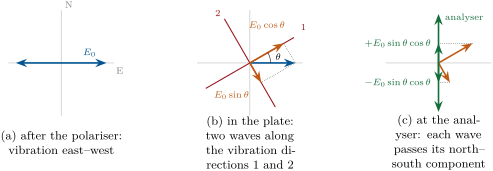
Theorem 8.10 (Intensity between crossed polars)
A plate of retardation whose vibration directions make the angle with the polariser, between crossed polars, transmits at the wavelength the intensity
where is the intensity that leaves the polariser.
Proof. Take the polariser along and the analyser along , and write the field leaving the polariser as the real part of along , with up to a constant. The plate’s vibration direction 1 is the unit vector , direction 2 is . The incident field has the components along 1 and along 2. The plate leaves wave 1 unchanged, up to a common phase, and delays wave 2 by (Proposition 8.9); in complex amplitudes the waves leaving the plate are along 1 and along 2. Their components along are and ; the analyser passes their sum,
Since and , the intensity is , that is . If wave 1 is the slower one, changes sign and is unchanged. ∎
The theorem contains the whole of what the microscope shows between crossed polars. Its first factor depends only on the orientation of the grain on the stage; the second only on the grain’s retardation and on the colour of the light.
Definition 8.11 (Extinction position, extinction angle)
An anisotropic grain between crossed polars is in an extinction position when it is dark because its vibration directions are parallel to the polariser and the analyser. The extinction angle of a grain is the angle between a direction visible in it (a cleavage trace, an elongation, a twin plane) and the nearest extinction position, read on the graduated stage.
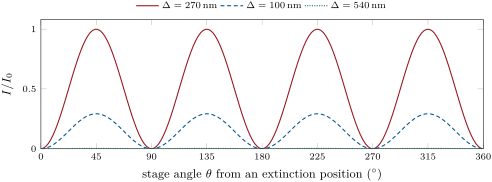
The factor vanishes at , , and : a grain goes dark four times in a full turn of the stage, and is brightest midway, at from extinction (figure below). A grain with — an isotropic mineral, or a section perpendicular to an optic axis — stays dark throughout. The extinction angle depends on the symmetry of the crystal: a mineral whose vibration directions are tied to its cleavages, as in orthorhombic minerals, extinguishes parallel to them (straight extinction); a monoclinic or triclinic one generally does not (inclined extinction). The largest extinction angle between the cleavage traces and the slow vibration direction is about in diopside and – in hornblende, in sections parallel to : one of the ways of telling a pyroxene from an amphibole in thin section.
8.3.1 Interference colours
In white light, the second factor acts as a filter that depends on the wavelength. A grain with passes almost all the green and yellow ( near nm, where the factor is 1) and somewhat less of the violet and red: it looks white. A grain with suppresses the yellow-green () and passes red and blue: it looks magenta. As grows, the suppressed wavelengths move across the spectrum and new ones appear, and the colour runs through a fixed sequence.
Definition 8.12 (Interference colour, order, Michel-Lévy chart)
The interference colour of an anisotropic grain is its colour between crossed polars in white light, at from extinction; it depends only on its retardation . The colours repeat in bands of about of retardation, each ending with a red-violet tint; each band is an order (first, second, third…). The Michel-Lévy chart shows the interference colours against the retardation, with the lines that relate the thickness of a section, the birefringence of a mineral and its colour.
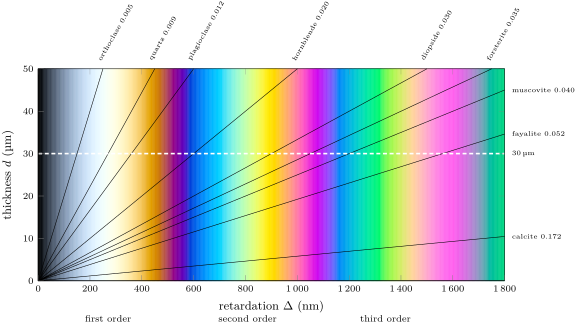
The chart is computed exactly as the theorem says. For each retardation, each wavelength of the light is weighted by ; the transmitted spectrum is then turned into a colour as the eye sees it, by the standard colour-matching functions of colorimetry, and into the red, green and blue of a screen or a printer by the sRGB transform. Three features are worth noticing. The first order starts black, passes through grey and white (the only white of the chart is near , where the spectrum is passed almost entirely), then yellow, orange and red. The second and third orders are the brightest, with vivid blue, green, yellow and magenta. Beyond the fourth order the colours fade: when is many wavelengths, the filter oscillates several times across the visible spectrum, passes every colour in turn and, on average, half the light: the grain looks pale pinkish or greenish grey, the high-order white of calcite.
Reading the chart is the core of optical mineralogy. In a section of known thickness, the highest colour shown by a mineral gives its birefringence: follow the thickness across to the colour, then the line through that point back to its birefringence. Conversely, a mineral of known birefringence gives the thickness: in a good section quartz never shows more than a first-order white or the palest yellow, and a section in which quartz shows yellow or orange is too thick.
History — Auguste Michel-Lévy
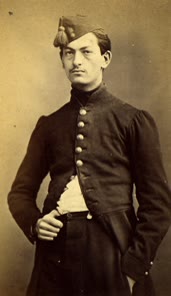
Auguste Michel-Lévy (1844–1911), who became director of the Geological Survey of France, was among the first to identify minerals in rocks systematically with the polarising microscope. Before him, the colours of minerals between crossed polars were used empirically; he showed that what matters is the maximum birefringence of each mineral, which can be measured by matching the colours of its grains against a wedge of quartz whose retardation grows steadily along its length. With his student Alfred Lacroix he published in 1888 Les minéraux des roches, a handbook of the optical properties of rock-forming minerals. The chart that bears his name, colours against retardation with lines of equal birefringence, is still the way interference colours are read.
Two waves leaving a grain can be given an extra, known retardation by an accessory plate inserted above the section at to the polars. The commonest one is cut to show the first-order red, a retardation of about . If the slow vibration direction of the grain is parallel to the slow direction of the plate, the delays add and the grain’s colour rises by about one order; if it is parallel to the fast direction, they subtract and the colour falls. A first-order grey grain of becomes second-order blue () in one orientation and first-order orange () in the other; the test shows which of the grain’s two vibration directions is the slow one, a property used to identify elongated minerals.
8.4 Identifying minerals in thin section
Definition 8.13 (Twin, polysynthetic twinning)
A twin is an intergrowth of two or more crystals of the same mineral whose lattices are related by a symmetry that the crystal itself does not have, such as a reflection across a plane (the twin plane). Polysynthetic twinning is repeated twinning on parallel planes, which divides a crystal into thin parallel lamellae whose orientations alternate.
Between crossed polars the lamellae of a polysynthetic twin extinguish alternately: half of them are dark when the other half are bright, and the crystal looks striped. Plagioclase almost always shows these stripes, which distinguish it at once from quartz and from alkali feldspar; its other feature, low relief and first-order grey to white colours, it shares with them. The extinction angles of the two sets of lamellae, measured either side of the twin plane, depend on the composition of the plagioclase, and charts of those angles give its anorthite content.
Method 8.14 (Identifying a mineral in thin section)
- In plane-polarised light: note whether the grain is opaque; its colour and pleochroism (rotate the stage); its relief, and on which side of its index lies (Becke line); its shape and cleavages, and the angle between two cleavages.
- Between crossed polars: check whether it stays dark (isotropic, or a section perpendicular to an optic axis); among the grains of the same mineral, find the highest interference colour and read the birefringence on the Michel-Lévy chart for the thickness of the section.
- Measure the extinction angle on grains showing a cleavage or an elongation; look for twinning (polysynthetic stripes, simple twins).
- Compare with a table of optical properties (Table 8.1) and with the minerals the rock can contain (Chapter 7).
| mineral | colour (PPL) | indices | birefringence | highest colour at | other features |
|---|---|---|---|---|---|
| quartz | colourless | 1.544–1.553 | 0.009 | first-order white | no cleavage; no twins visible; uniaxial |
| orthoclase | colourless, often cloudy | 1.518–1.525 | 0.005 | first-order grey | negative relief; simple twins |
| plagioclase | colourless | 1.526–1.590 | 0.008–0.013 | first-order white to pale yellow | polysynthetic twinning |
| muscovite | colourless | 1.552–1.618 | 0.035–0.042 | bright second- to third-order | one perfect cleavage; straight extinction |
| biotite | brown, green | 1.565–1.696 | 0.04–0.07 | masked by its own colour | strong pleochroism; one perfect cleavage |
| hornblende | green, brown | 1.675–1.695 | 0.020 | second-order blue | pleochroic; cleavages at /; extinction – |
| diopside | colourless | 1.664–1.694 | 0.030 | second-order yellow | cleavages at about /; extinction about |
| olivine | colourless (Mg) to pale yellow (Fe) | 1.635–1.879 | 0.035–0.052 | end of second order to third order | high relief; irregular cracks, no good cleavage |
| garnet | colourless to pale pink | 1.830 (almandine) | isotropic | black | very high relief; six- or eight-sided outlines |
| calcite | colourless | 1.486–1.658 | 0.172 | high-order white | relief changes on rotation; rhombohedral cleavage |
| magnetite | opaque | — | — | — | black in both lights |
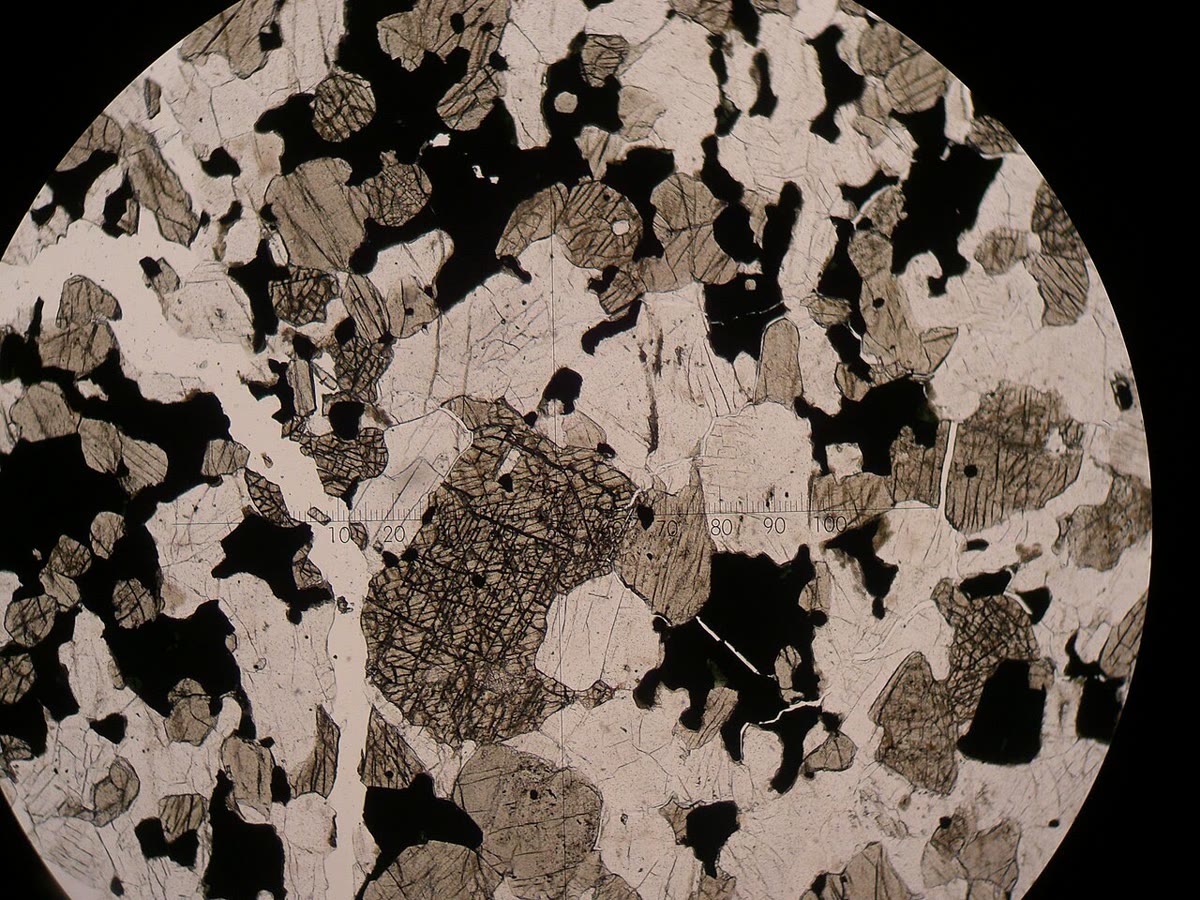
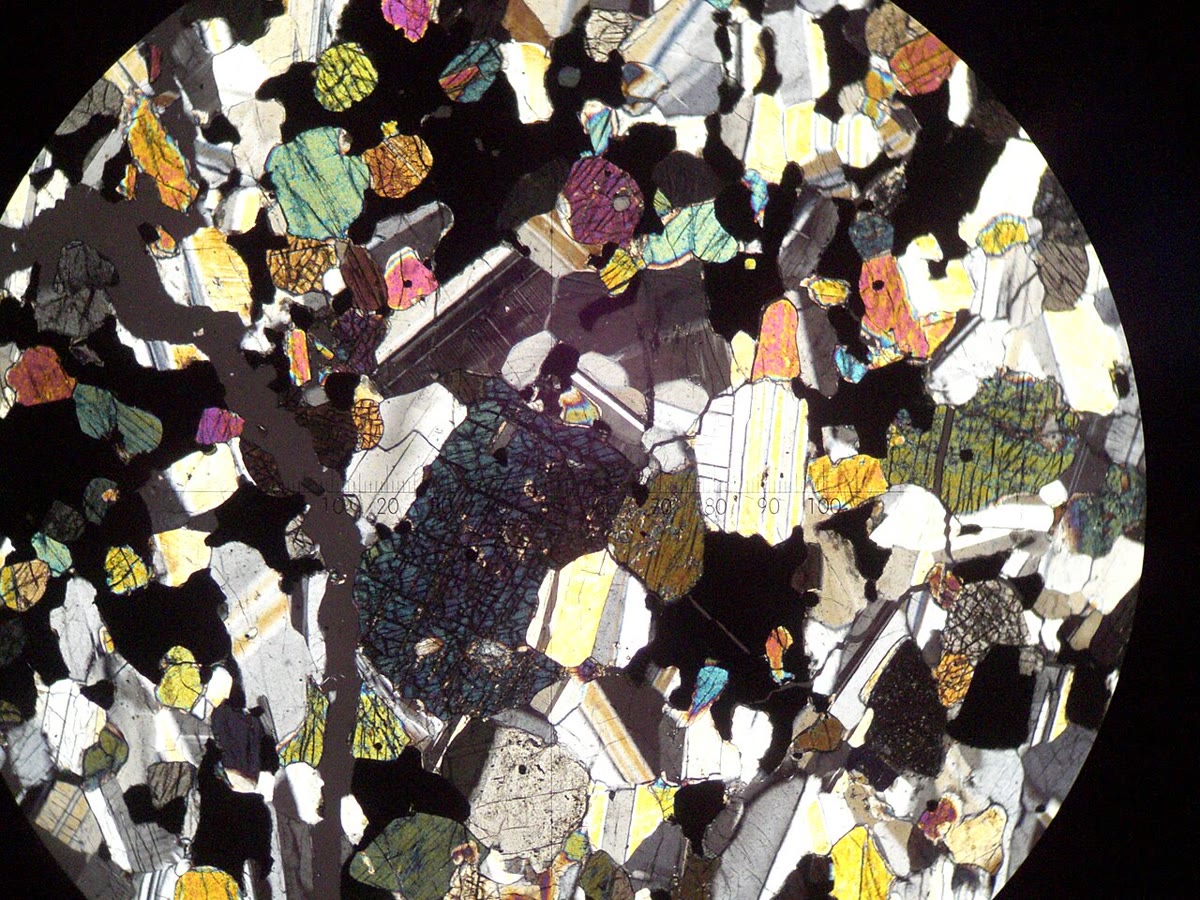
In the lab — A session at the microscope
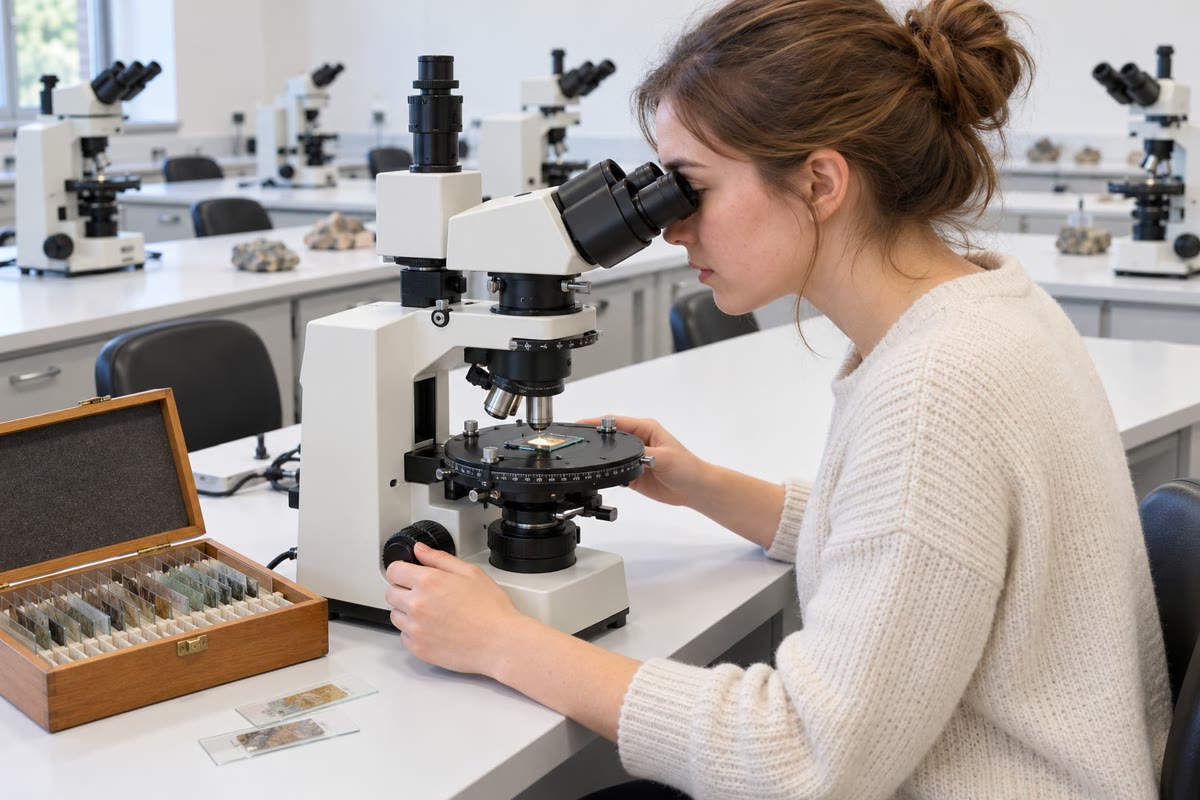
A petrologist describing a new thin section works through it at low magnification first, to see the texture and the main minerals, then grain by grain. For each mineral she records the observations of the method above, estimates its proportion in the field, and notes how the grains touch: which crystallised first, which fill the spaces left, which replace others. Light measurements are made with the stage graduated in degrees and an accessory plate; compositions, when they matter, are measured later with a microprobe on the same section. A teaching laboratory works the same way, one microscope per student and a box of reference sections of known minerals beside it.
8.5 Exercises
Exercise 8.1 ★
Compute the largest retardation of quartz () and of calcite () in a section thick. Using the Michel-Lévy chart, describe the colour of each.
Solution
Solution of Exercise 8.1.
Quartz: , a first-order white. Calcite: , far beyond the chart: a pale high-order white, faintly pink or green.
Exercise 8.2 ★
A grain is turned on the stage between crossed polars. Compute , as a fraction of its maximum, at , , , and from an extinction position.
Solution
Solution of Exercise 8.2.
: at ; at ; at ; at ; at .
Exercise 8.3 ★
Explain why a garnet stays black between crossed polars whatever the position of the stage, and why a quartz grain may do the same. How would you tell them apart in plane-polarised light?
Solution
Solution of Exercise 8.3.
Garnet is cubic, hence isotropic: light leaves it vibrating as it entered, along the polariser, and the analyser stops it; in every position. A quartz grain cut perpendicular to its optic axis also has for light travelling along that axis, so : it too stays dark. In plane-polarised light the garnet has very high relief ( against ), the quartz almost none.
Exercise 8.4 ★
Rank by relief, in a mount of index , orthoclase ( about ), quartz (), forsterite () and almandine (). Which has negative relief? In which direction does its Becke line move when the focus is raised?
Solution
Solution of Exercise 8.4.
: almandine , forsterite , orthoclase , quartz ; relief in that order, from highest to lowest. Orthoclase has the lower index: negative relief, and its Becke line moves out of the grain, into the mount, when the focus is raised.
Exercise 8.5 ★★
In a section, the grains of a green pleochroic mineral with two cleavages at and show at most a second-order blue, read on the chart as . Compute its birefringence and name the mineral with Table 8.1.
Solution
Solution of Exercise 8.5.
. A green pleochroic mineral with cleavages at and and a birefringence near : hornblende.
Exercise 8.6 ★★
Using Proposition 8.6 with and , compute the deviation at the edge of a quartz grain () and of a forsterite grain (), in degrees, and the ratio of the two. Check the second with Snell’s law exactly.
Solution
Solution of Exercise 8.6.
. Quartz: . Forsterite: . Ratio . Exactly: , , a deviation of : the first-order formula overestimates by for so large an index difference.
Exercise 8.7 ★★
A first-order red plate has . A quartz grain of is placed at with the plate inserted. What are the two possible total retardations, and the colours they give on the chart? Which orientation puts the two slow directions parallel?
Solution
Solution of Exercise 8.7.
, a second-order green, when the slow directions of the grain and the plate are parallel (the delays add); , first-order white again, when the slow direction of the grain is parallel to the fast direction of the plate.
Exercise 8.8 ★★
At its tapering edge, a grain of fayalite () thins from to zero. How many red-violet tints, which end the orders at 542, 1074 and , appear as coloured fringes between the edge and the full-thickness part of the grain?
Solution
Solution of Exercise 8.8.
At full thickness . From the edge () inwards, the retardation passes 542 and but not : two red-violet fringes.
Exercise 8.9 ★★
On several elongated grains with one good cleavage, a geologist measures extinction angles of , , and between the cleavage trace and the slow vibration direction. Why do the values differ? Is the mineral more likely diopside or hornblende?
Solution
Solution of Exercise 8.9.
The extinction angle measured on a grain depends on how the grain is cut: only sections in a particular orientation show the largest angle, and others show less, down to zero. The largest value, about , is the one to compare: it matches diopside (about ), not hornblende (at most ).
Exercise 8.10 ★★★
Redo the proof of Theorem 8.10 with the analyser parallel to the polariser, and show that . What colour does a grain of show at between parallel polars?
Solution
Solution of Exercise 8.10.
With the analyser along , the components of the two waves are and , so and
using . Since and , . At each wavelength, : the colours between parallel polars are the complements of those between crossed polars. A grain of , magenta between crossed polars, is pale yellowish green between parallel polars.
Exercise 8.11 ★★★
For a calcite grain with , the factor vanishes whenever is a whole number. (a) How many times does it vanish between and ? (b) Show that near two successive zeros are about apart, and compute it. (c) Explain why the grain looks nearly white.
Solution
Solution of Exercise 8.11.
(a) runs from to ; it passes the whole numbers 8 to 12: five zeros. (b) The zeros are at ; two successive ones are apart, that is near . (c) Five narrow dark bands spread across the spectrum remove a little of every colour, and the rest passes with an average weight of one half: the eye sees a pale, nearly neutral tint.
Exercise 8.12 ★★★
Show that, averaged over a full turn of the stage, a grain between crossed polars passes . A geologist estimates birefringences from the highest colour of each mineral, assuming , in a section that is in fact thick. By what factor are all her values wrong, and in which direction?
Solution
Solution of Exercise 8.12.
The mean of over a turn is , so the mean intensity is . She computes instead of (in nm): all her values are of the true ones, too low by .
8.6 Problem: Identifying the minerals of an unknown thin section
Problem 8.1
Weekend problem — observing relief, pleochroism and interference colours, measuring the thickness of a section with quartz, and naming its minerals
A thin section of an unknown igneous rock, mounted in a resin of index , is said to be thick. It contains five minerals, labelled A to E. Use the table of optical properties of the chapter, the Michel-Lévy chart, and the following values: quartz , ; diopside , , .
Part I — Plane-polarised light.
- Mineral A is colourless, with grain boundaries hard to see. Mineral B is colourless, with strong dark rims and two cleavages meeting at about . Which has the higher relief?
- For A, taken as quartz, and B, taken as diopside, compute using the mean of the principal indices of each.
- Using Proposition 8.6, compute the ratio of the deviations at their edges for the same inclination of the boundary.
- On raising the focus, the Becke line of B moves into the grain. What does this show?
- Mineral C turns from pale yellow to dark brown as the stage rotates, darkest when its single cleavage lies along the polariser. Name the property and the mineral.
- Mineral D is colourless, of low relief, in long laths; E is green to yellow and pleochroic, with two cleavages at . What does the angle suggest for E?
Part II — The thickness of the section.
- What is the largest retardation of quartz in a section of exactly ? What colour is it?
- Why must the largest retardation be sought among many grains of A, rather than measured on any one of them?
- The highest colour shown by the grains of A is a first-order pale yellow; a quartz-wedge comparator gives its retardation as . Compute the real thickness of the section.
- By how many per cent is the section thicker than it should be?
- At and from extinction, compute for this quartz grain, and for the same grain in a section of .
- Compute the range of retardations of D, taken as plagioclase ( to ), in this section, and say whether its colours remain in the first order.
Part III — The birefringence of B.
- The highest colour of B is a blue read as . In which order is it?
- Compute the birefringence of B with the thickness found in question 9.
- What birefringence would one have found by assuming ? Which colourless mineral of high relief would that have suggested, and why is it out of place in a rock with quartz (consider )?
- Compare the result of question 14 with the table, together with the relief and the cleavages of B, and conclude.
- What colour would B show at most in a correct section?
- The section is ground down to . By how much must it be thinned, and what is then the highest colour of quartz?
Part IV — Extinction and twinning.
- The laths of D are divided into parallel stripes that extinguish alternately. Name the feature and the mineral.
- The stripes of one lath extinguish at and either side of the twin plane. What do such angles, measured on many laths, give when compared with published charts?
- The highest extinction angle between the cleavages of E and its slow direction is . Name E.
- Compute the largest retardation of E in this section and the colour it shows.
- A grain of B stays dark during a full rotation. Explain how it can be the same mineral as the bright grains of B.
- List the minerals A to E, and say what kind of rock they make.
- What is the real thickness of the section, in micrometres?
Solution
Solution of Problem 8.1.
1. B: dark rims mean high relief; A’s barely visible boundaries mean low relief.
2. A: , . B: , .
3. The deviations are proportional to : .
4. B has a higher index than the mount: positive relief.
5. Pleochroism; biotite.
6. Two cleavages at and : an amphibole.
7. : first-order white.
8. Each grain is cut in its own orientation and shows a value of between 0 and ; only grains cut parallel to the optic axis show itself. The highest colour among many grains is the one to use.
9. .
10. .
11. ; at , .
12. to : white to orange-red, all below the end of the first order at .
13. Between 1074 and : third order.
14. .
15. , which would suggest an olivine. A magnesian olivine and quartz react to give pyroxene, ; a rock that has crystallised with quartz should not keep both.
16. is the birefringence of diopside; its high relief, its lack of colour and its two cleavages near agree: B is a clinopyroxene, diopside.
17. : second-order yellow.
18. By ; quartz then shows at most , first-order white.
19. Polysynthetic twinning: D is plagioclase.
20. The composition of the plagioclase (its anorthite content).
21. An amphibole with an extinction angle of : hornblende (–), not a pyroxene ( for diopside).
22. : a second-order green.
23. It is cut perpendicular to an optic axis: its two indices are equal for light travelling along the axis, , and it stays dark like an isotropic grain.
24. A quartz, B diopside, C biotite, D plagioclase, E hornblende: an intermediate igneous rock with some quartz, such as a quartz diorite.
25. The section is thick.