University Earth and Space Sciences — Year 1 · Bachelor Year 1
7Rock-Forming Minerals
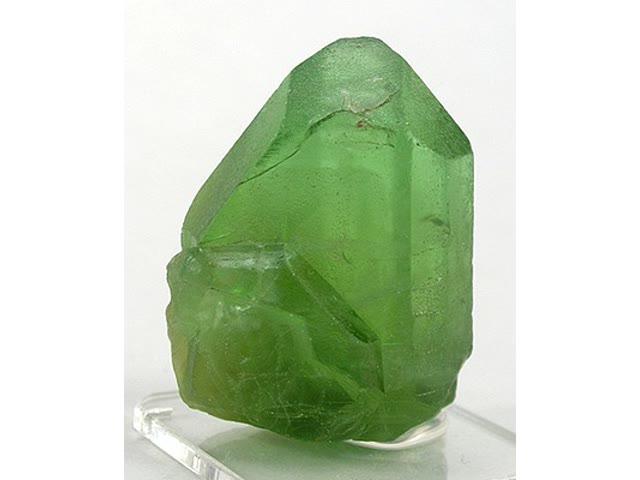
A granite worktop shows three or four kinds of grain: glassy grey quartz, pink or white feldspar, flakes of black mica. A beach sand is almost all quartz. The small green crystals scattered through a basalt are olivine, and the same mineral, in a slightly different composition, makes up most of the upper mantle. A handful of minerals builds almost every rock, and nearly all of them are silicates: oxygen and silicon, the two most abundant elements of the crust, joined into tetrahedra that link in a few simple ways. This chapter explains how the linkage fixes the formula and the habit of a silicate, how one element replaces another in a crystal so that a mineral is a range of compositions rather than one, how a chemical analysis becomes a formula, and what the main rock-forming minerals are. It ends with an olivine from a basalt, analysed, recalculated and weighed.
You already know
A crystal is a solid whose atoms repeat on a lattice; the unit cell is the smallest box that repeats, and the coordination number of an ion counts its nearest neighbours of opposite charge (chemistry, University Year 1). Ionic radii depend on the charge and on the coordination. A mineral is identified in the hand by its habit, cleavage, hardness and lustre (Book 2, grade 11). The amount of substance is counted in moles, and a molar mass is the mass of one mole (chemistry).
7.1 What a mineral is
Definition 7.1 (Mineral)
A mineral is a naturally occurring solid with a definite crystal structure and a chemical composition that is either fixed or varies within definite limits. Almost all minerals are inorganic.
A rock, by contrast, is an aggregate of grains of one or several minerals (or of glass): granite is quartz, feldspars and mica; limestone is mostly calcite. The two halves of the definition are independent. Window glass has the composition of a silicate but no crystal structure: it is not a mineral, and neither is the glass of a quenched lava. Conversely, the same composition can crystallise in several structures, and each structure is a different mineral.
Definition 7.2 (Polymorph)
Two minerals are polymorphs of each other when they have the same chemical composition and different crystal structures.
Carbon crystallises as graphite, a stack of sheets of hexagons with a density of , and as diamond, a framework in which each atom has four neighbours, with a density of . Calcium carbonate is calcite () or aragonite (); silica is quartz () or coesite (); is kyanite (), andalusite () or sillimanite ().
In every pair the denser polymorph is the one that forms at higher pressure: at a given temperature, raising the pressure favours the state of smaller volume (chemistry, the displacement of an equilibrium). Diamond in a kimberlite and coesite in a rock struck by a meteorite therefore record pressures found only deep in the mantle or in an impact. The three polymorphs, whose fields of stability divide the pressure–temperature plane among them, are used to read the conditions of metamorphism (University Year 2).
7.2 The silicate tetrahedron and its linkages
In every common silicate, each silicon atom sits at the centre of four oxygen atoms placed at the corners of a regular tetrahedron: the unit recalled from chemistry. The silicon ion is small ( in fourfold coordination) and the oxide ion large, so four oxygens fit around it and no more; the silicon–oxygen bond is strong and partly covalent. An isolated unit carries a charge .
The tetrahedra can stand alone, their charge balanced by metal cations between them, or share corners: an oxygen common to two tetrahedra is a bridging oxygen. Two tetrahedra never share an edge or a face, which would bring two silicons too close. Silicates are classified by the number of corners that each tetrahedron shares (Definition 7.3).
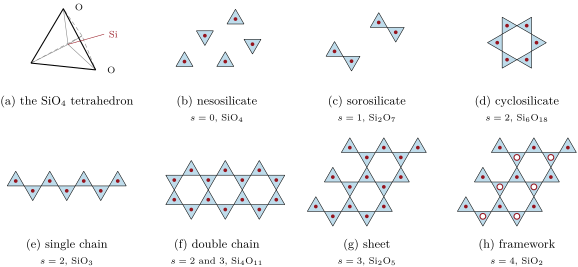
Definition 7.3 (The silicate classes)
Silicates are classified by how their tetrahedra link. In a nesosilicate the tetrahedra are isolated; in a sorosilicate they are linked in pairs by one shared oxygen; in a cyclosilicate they form closed rings, each sharing two corners; in an inosilicate they form endless chains, single (each tetrahedron sharing two corners) or double (two single chains joined side by side, half the tetrahedra sharing three corners); in a phyllosilicate they form endless sheets, each sharing three corners; in a tectosilicate they form a three-dimensional framework, each sharing all four corners.
Proposition 7.4 (The silicon to oxygen ratio)
If each tetrahedron of a silicate shares on average of its four corners with other tetrahedra, and each shared oxygen belongs to exactly two tetrahedra, then the silicate network contains oxygens per silicon, and carries a charge of per silicon.
Proof. Count the oxygens tetrahedron by tetrahedron. A tetrahedron with shared corners owns its unshared oxygens entirely and half of each of its shared ones, since each is counted again by the neighbouring tetrahedron: it contributes oxygens. Summing over tetrahedra and dividing by gives oxygens per silicon, with the mean of the . Each silicon brings a charge and each oxygen , so the charge per silicon is . ∎
The proposition gives the anion of each class at once. Isolated tetrahedra (): . Pairs (): , that is . Rings and single chains (): , written for a ring of six, for two tetrahedra of a chain. Double chains (half with , half with , so ): , . Sheets (): . Frameworks (): , neutral — quartz is a framework of silicon and oxygen alone. The more the tetrahedra share, the smaller the charge to balance and the fewer the metal cations: olivine has two metal ions per silicon, a pyroxene such as enstatite one, quartz none.
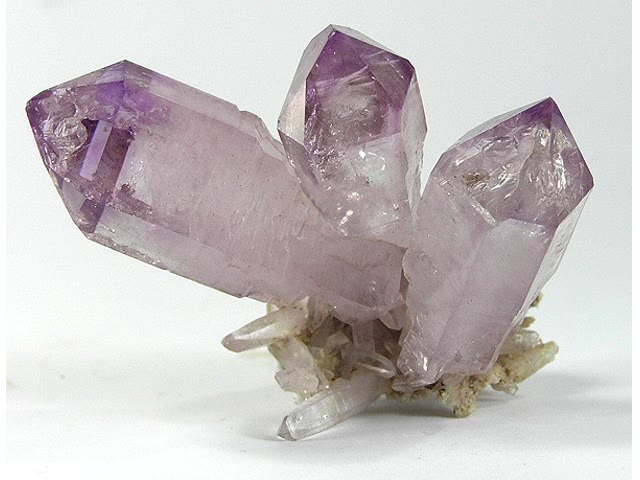
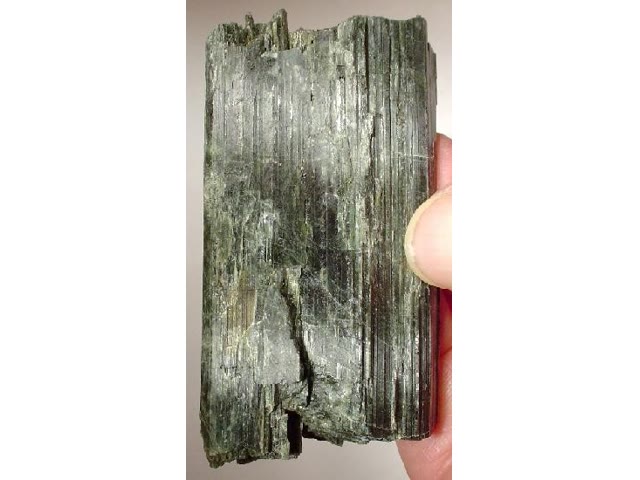
The linkage also shapes the crystal. A sheet silicate splits easily between its sheets, where the bonds are weak: micas peel into thin flexible flakes. Chain silicates cleave parallel to their chains, along two planes at an angle fixed by how the chains pack: about and in pyroxenes, whose chains are narrow, and in amphiboles, whose double chains are wider. The two cleavage angles, seen on a broken crystal or in thin section, are the classic way to tell the two groups apart.
7.3 Ionic substitution and solid solutions
A crystal is a set of sites, and a site is defined by its size and by the charge it needs, not by one element. An ion of the right size and charge can take the place of another in the growing crystal, and no rock is pure enough to supply only one.
Definition 7.5 (Ionic substitution, coupled substitution)
An ionic substitution is the replacement, in a site of a crystal structure, of one ion by another of similar radius, without change of the structure. A coupled substitution is a pair of substitutions on two different sites whose changes of charge cancel, so that the crystal stays neutral.
Two empirical rules, due to Goldschmidt, say which substitutions are possible. The radii must be close: substitution is free when they differ by less than about , limited between about 15 and , and rare beyond. The charges must differ by no more than one unit, and a difference of charge must be compensated elsewhere in the structure. In the sixfold site of olivine, () is replaced freely by (, larger) and by (), little by (), hardly by (, larger).
The rules are guides: temperature widens the possible range, because a hot crystal tolerates more strain, which is why a mineral grown at high temperature often contains more of the misfit ions than the same mineral grown cool.
Definition 7.6 (Solid solution, end-member)
A solid solution is a mineral in which one or more structural sites are occupied, in proportions that vary continuously, by two or more ions. The end-members of a solid solution are the compositions at its limits, each with every varying site filled by one ion only; an intermediate composition is given by the mole fractions of the end-members.
Olivine is the solid solution between forsterite (Fo) and fayalite (Fa), complete from one end-member to the other: an olivine with of its sixfold sites filled by magnesium and by iron is written , or . Garnet, pyroxene, amphibole and mica are solid solutions in the same way. The plagioclase feldspars are a solid solution of a different kind, between albite (Ab) and anorthite (An). Sodium and calcium have nearly the same radius ( and in sixfold coordination) but different charges; each calcium that enters must be accompanied by an aluminium replacing a silicon in a tetrahedron:
a coupled substitution that leaves the total charge unchanged. Aluminium can enter a tetrahedron because it is small enough ( in fourfold coordination); it is the commonest replacement for silicon in silicates.
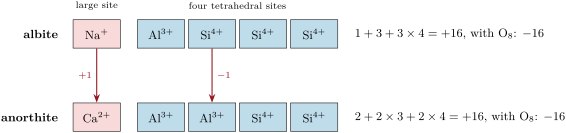
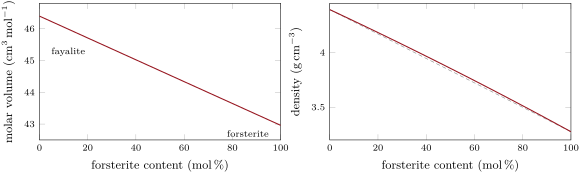
The properties of a solid solution vary with its composition, and this is what makes them useful: a measured density, a refractive index or a cell dimension gives the composition. The simplest model treats the solid solution as an ideal mixture in volume: one mole of takes up the volume of mole of forsterite and mole of fayalite. It is a model, to be compared with measurements, and it already tells something non-obvious about the density.
Proposition 7.7 (Molar volume and density of an ideal solid solution)
Let two end-members have molar masses , and molar volumes , . In a solid solution with mole fraction of end-member 1, the molar mass is . If the molar volume is (ideal mixing), the density is
which equals at and at , and is a linear function of only when or .
Proof. One mole of the solid solution contains mole of the first formula unit and mole of the second; its mass is , its volume by hypothesis, and . At , ; at , . If , is affine. Otherwise write with . If it were affine, , then for all , and the coefficient of gives , so : would be constant, . Conversely, equal end-member densities make constant. ∎
For olivine, with the measured densities for forsterite and for fayalite and molar masses and , the molar volumes are and : replacing magnesium by the larger iron ion swells the crystal by , and adds to its mass. The density curve lies slightly above the straight line joining the end-members, by up to about (Exercise 7.10): a straight-line interpolation is close, but not exact.
7.4 Mineral formulas
Definition 7.8 (Structural formula, Mg number)
The structural formula of a mineral gives, for a fixed number of oxygen atoms, the number of atoms of each element and the site each occupies, the ions sharing a site written together: olivine , a plagioclase . The Mg number of a mineral or a rock is
the numbers of atoms being counted in moles (or per formula unit).
A chemical analysis of a mineral, made with an electron microprobe on a polished thin section (Chapter 6), does not give a formula: it gives the mass of each element, reported by convention as the mass of its oxide, in per cent of the mass of the sample. Turning these percentages into a formula is a routine calculation.
Method 7.9 (Recalculating an analysis on a fixed number of oxygens)
Let an analysis give the oxides in weight per cent, and let the mineral have oxygens per formula unit (4 for olivine, 8 for a feldspar, 6 for a pyroxene, 12 for a garnet).
- Divide each oxide’s weight per cent by its molar mass: this gives the moles of oxide in of mineral.
- Multiply by the number of oxygens in the oxide (2 for , 3 for , 1 for ) to get moles of oxygen, and by the number of cations in the oxide (2 for and , 1 for ) to get moles of cation.
- Add the moles of oxygen, and compute the factor .
- Multiply every number of moles of cation by : the results are the atoms of each element per formula unit.
- Assign the cations to sites (silicon and enough aluminium to fill the tetrahedra, the rest to the larger sites), and check that each site holds the number of atoms of the ideal formula.
Worked example: an olivine with , and . With the molar masses , and , the moles in are , and ; the oxygens are , and the factor is . Per four oxygens: Si , Mg , Fe . The tetrahedral site holds atom and the octahedral sites , very close to 1 and 2: the analysis is good, and the olivine is , , with an Mg number of 90. Note that the charges add up to automatically, whatever the analysis, as long as every cation keeps the charge of its oxide: the recalculation itself makes the formula neutral. The site totals are the real test.
A cation sum too large on the chosen number of oxygens says that some iron is , which brings more oxygen per atom than the analysis assumed (Exercise 7.12); a sum too small, or a total far below , says that something was not analysed — water in an amphibole or a mica, carbon dioxide in a carbonate. Hydrous minerals are therefore recalculated on their anhydrous oxygens: 23 for an amphibole whose formula has , 22 for a mica with in a doubled formula unit.
7.5 The main rock-forming minerals
Definition 7.10 (The main mineral groups)
Olivine is the nesosilicate solid solution . Garnet is a group of cubic nesosilicates , X a divalent ion (Mg, Fe, Mn, Ca), Y a trivalent one (Al, Fe, Cr). A pyroxene is a single-chain inosilicate ; an amphibole is a double-chain inosilicate with hydroxyl, of about . A mica is a sheet silicate with a potassium ion between the sheets, such as muscovite and biotite . A feldspar is an aluminium framework silicate of sodium, potassium or calcium. The plagioclase feldspars form the solid solution albite – anorthite ; the alkali feldspars lie between albite and orthoclase .
| group | end-members or example | class | density () | hardness | cleavage |
|---|---|---|---|---|---|
| olivine | forsterite – fayalite | neso | 3.28–4.39 | 6.5–7 | imperfect; conchoidal fracture |
| garnet | almandine ; pyrope | neso | 4.32; 3.74 | 7–7.5 | none |
| pyroxene | diopside ; enstatite | ino, single chain | 3.22–3.38; 3.2 | 5.5–6.5 | two, at about and |
| amphibole | hornblende | ino, double chain | 3.10–3.28 | 5–6 | two, at and |
| mica | muscovite ; biotite | phyllo | 2.77–2.88; 2.7–3.3 | 2.5–3 | one, perfect: thin flakes |
| feldspar | albite ; anorthite ; orthoclase | tecto | 2.55–2.76 | 6–6.5 | two good, {001} and {010} |
| quartz | tecto | 2.65 | 7 | none; conchoidal fracture | |
| carbonates | calcite ; dolomite | — | 2.71; 2.84 | 3; 3.5–4 | three, rhombohedral |
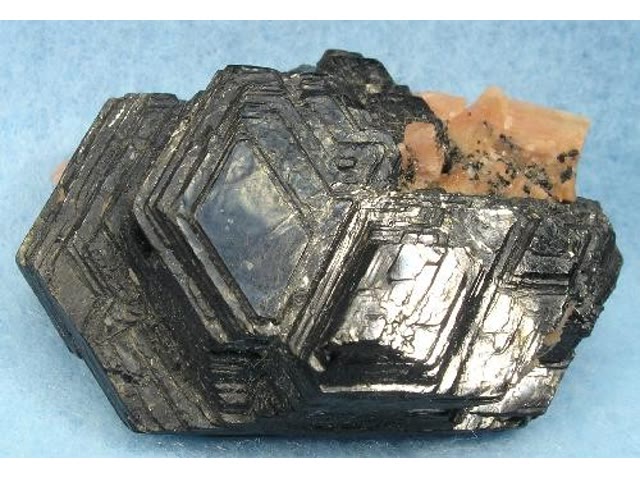
| iron oxide | magnetite | — | 5.18 | 5.5–6.5 | none; strongly magnetic |
Table 7.1 gathers the minerals that make up nearly all the rocks of the crust and the mantle. Where they occur follows from their chemistry and from the conditions under which they crystallise.
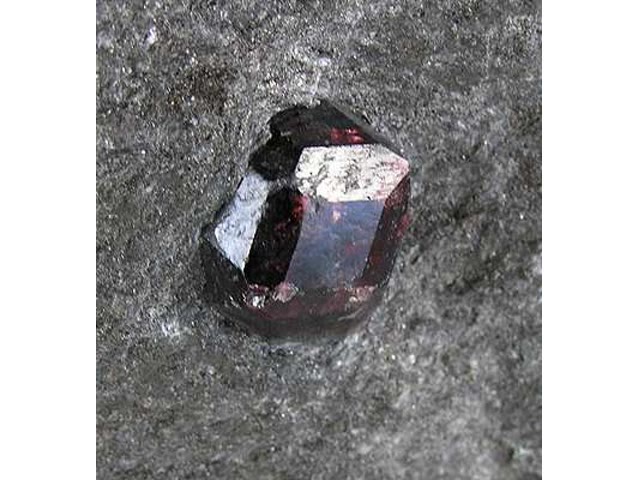
The dark silicates. Olivine, pyroxenes, amphiboles, biotite and many garnets are rich in magnesium and iron; they are dense and dark. Olivine and pyroxenes crystallise from hot magnesium-rich melts: they are the minerals of basalt and gabbro, and of the peridotite of the upper mantle, which is mostly olivine. Amphiboles and biotite contain hydroxyl and need water in the melt or the rock: they occur in andesites, diorites and granites, and in many metamorphic rocks. Garnet grows mainly in metamorphic rocks — the red grains of a mica schist are almandine — and in deep mantle rocks, where pyrope is stable.
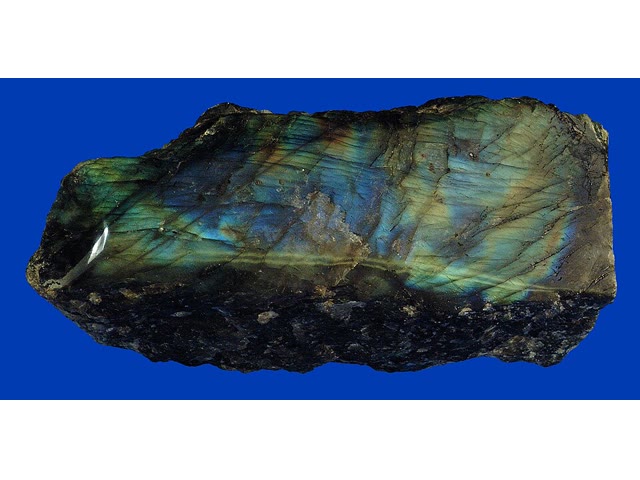
The light silicates. Feldspars, quartz and muscovite are rich in silicon, aluminium and the alkalis; they are light-coloured and lighter in density. Feldspars are the most abundant minerals of the crust: plagioclase in basalts, gabbros and most other igneous rocks, alkali feldspar in granites. Quartz crystallises last from silica-rich melts, filling the spaces between the other grains of a granite; because it is hard, without cleavage, and nearly insoluble, it survives weathering and transport and accumulates as sand. The clay minerals, sheet silicates formed at the surface, are the subject of Chapter 19.
The others. Calcite and dolomite make limestones, dolostones and marbles; calcite is the one common mineral that fizzes in cold dilute acid, and it breaks along three cleavages into rhombohedra. Magnetite, present in small amounts in many igneous rocks, carries most of their magnetisation, the record read by the magnetic methods of later chapters.
7.5.1 Minerals and the density of rocks
The density of a rock follows from its minerals. If a rock free of pores is made of minerals in volume fractions (summing to 1) with densities , a volume of rock contains a mass , so that
where is the mass fraction of mineral . Take a granite of quartz (), feldspars (about ) and biotite (about ), and a gabbro of plagioclase (about ), pyroxene (about ) and olivine (about ), each density chosen within the ranges of Table 7.1. Then
The difference, about , comes from the dark silicates: the iron and magnesium that a granite lacks. It is the reason why a continent, built largely of granitic rocks, stands higher than an ocean floor of basalt and gabbro, a balance taken up in Chapter 11. In the gabbro, the olivine is of the volume but of the mass: a dense mineral weighs more in a rock than its share of the volume.
In the lab — Telling the minerals apart
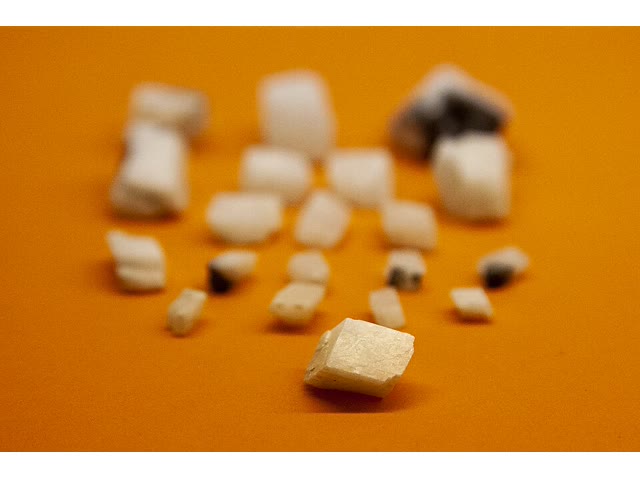
In the laboratory, a mineralogist identifying a hand specimen tests the properties of Table 7.1 in turn: the hardness against a steel point and a glass plate, the cleavage on a fresh broken surface, the density from the weight of the specimen in air and in water, and, for a carbonate, the reaction with a drop of cold dilute hydrochloric acid under a fume extraction. The cleavage of calcite is the textbook case: a crystal breaks again and again into smaller rhombohedra with the same angles. Grains too small for the hand are identified in thin section with the polarising microscope (Chapter 8), and their exact composition by microprobe analysis, recalculated as in Method 7.9.
7.6 Exercises
Exercise 7.1 ★
Name the silicate class of each anion, and give the number of corners shared by each tetrahedron: , , , , . Which class could belong to?
Solution
Solution of Exercise 7.1.
: nesosilicate, . : sorosilicate, . : cyclosilicate, . : phyllosilicate, . : tectosilicate, . has , so : a ring (cyclosilicate) or a single chain (inosilicate); the ratio alone cannot tell them apart.
Exercise 7.2 ★
With the atomic weights O , Si , Mg and Fe , compute the molar masses of forsterite and fayalite, then their molar volumes from the densities and .
Solution
Solution of Exercise 7.2.
Forsterite: ; fayalite: . Molar volumes: and .
Exercise 7.3 ★
In sixfold coordination the radii are , , , and . Compute the difference of each from the radius of in per cent, and say, by Goldschmidt’s rules, which can replace magnesium freely in olivine.
Solution
Solution of Exercise 7.3.
for ; for ; for ; for . Iron and nickel, under , replace magnesium freely; manganese, just above, is limited; calcium, beyond , hardly enters. All four have the same charge as magnesium.
Exercise 7.4 ★
Graphite and diamond have densities and ; calcite and aragonite and . By how many per cent is the density raised in each change? Which polymorph of each pair forms at the higher pressure?
Solution
Solution of Exercise 7.4.
from graphite to diamond; from calcite to aragonite. The denser polymorphs, diamond and aragonite, are the high-pressure forms.
Exercise 7.5 ★★
Write the structural formula of the plagioclase ( of the large sites filled by calcium), and check that it is neutral.
Solution
Solution of Exercise 7.5.
With in : . Charges: , and .
Exercise 7.6 ★★
In a double chain, half the tetrahedra share two corners and half share three. Count the oxygens of a repeating group of four tetrahedra directly on panel (f) of the linkage figure, and check the formula given by Proposition 7.4.
Solution
Solution of Exercise 7.6.
A repeating group has two tetrahedra sharing three corners (those whose apex joins the two chains) and two sharing two. The four tetrahedra have corners, of which are shared, that is shared oxygens; the others are unshared. Total oxygens for 4 silicons: , with charge . The proposition gives the same with : oxygens per silicon, charge per silicon.
Exercise 7.7 ★★
Recalculate on four oxygens the olivine analysis , , , (molar mass of ). Give its structural formula, check it, and give its forsterite content. Then show that the forsterite content can be found from the and percentages alone.
Solution
Solution of Exercise 7.7.
Moles in : ; ; ; . Oxygens: ; . Per four oxygens: Si , Mg , Fe , Ni . The octahedral sites hold , the tetrahedral site : a good analysis, . . The factor multiplies Mg and Fe alike, so it cancels in the ratio: .
Exercise 7.8 ★★
Check that muscovite is neutral. Its sheets of tetrahedra have one aluminium for three silicons: what charge does this give the sheet per formula unit, and which ion balances it?
Solution
Solution of Exercise 7.8.
Positive: ; negative: . A sheet of composition would carry (Proposition 7.4, ); replacing one silicon in four by aluminium adds one negative charge, so carries . The two octahedral aluminiums with the two hydroxyls, , balance four of the five; the potassium ion between the sheets balances the fifth.
Exercise 7.9 ★★
Using the molar volumes and and the molar masses and : (a) compute the density of by ideal mixing, and compare it with the mean of the end-member densities; (b) find the forsterite content of an olivine of density .
Solution
Solution of Exercise 7.9.
(a) , , ; the mean of the densities is , less. (b) Solve : , so : the olivine is (to the nearest per cent).
Exercise 7.10 ★★★
With the notation of Proposition 7.7, show that
Deduce that the density of olivine lies above the straight line between the end-members, and compute the gap at .
Solution
Solution of Exercise 7.10.
With ,
Expanding the product, the numerator is , and , , so it is . For olivine (1 = forsterite) both differences are negative, and , so their product is positive and the density lies above the straight line. At : , which agrees with Exercise 7.9 to the rounding of the molar volumes.
Exercise 7.11 ★★★
A plagioclase from a gabbro gives , , , and (molar masses , , , , ). Recalculate it on eight oxygens; check that the tetrahedral sites (Si + Al) hold 4 atoms and the large site (Ca + Na + K) 1; check the coupled substitution by comparing with Ca; give the anorthite content .
Solution
Solution of Exercise 7.11.
Total . Moles of oxide: , , , , . Oxygens: ; . Cations (twice the moles for , , ): Si , Al , Ca , Na , K . Tetrahedral sites: ; large site: . Then , equal to Ca within the rounding: each calcium came in with one aluminium. : a labradorite, .
Exercise 7.12 ★★★
A microprobe cannot tell from and reports all iron as . (a) Show that pure magnetite , analysed this way, totals . (b) Recalculate this analysis on four oxygens, and say why the result is impossible for a mineral with three cations per four oxygens. (c) Recalculate on three cations instead, and find the numbers of and by requiring the formula to be neutral. (d) Re-express the analysis as and , and give the new total.
Solution
Solution of Exercise 7.12.
(a) . Its three irons, reported as , weigh , that is ; the oxygen bound to the , beyond what accounts for, is missing from the total. (b) mole of and of oxygen; ; four irons per four oxygens, . Magnetite has three cations for four oxygens. The oxygens were undercounted: each holds one and a half oxygens, not one as assumes. (c) On three cations, Fe with and : and , so , : . (d) One and one per formula unit: and , total .
7.7 Problem: An olivine from a basalt
Problem 7.1
Weekend problem — recalculating a microprobe analysis of an olivine, writing and checking its formula, and finding its composition, its density and its mass in a cubic metre of basalt
The green crystals of a basalt are olivine. A microprobe analysis of one of them gives, in weight per cent of oxides:
| oxide | ||||||
| weight % | 39.50 | 16.53 | 0.23 | 43.32 | 0.20 | 0.22 |
The atomic weights are O , Si , Fe , Mn , Mg , Ni , Ca . Forsterite has density and fayalite .
Part I — From oxides to cations.
- Compute the molar masses of the six oxides.
- Compute the total of the analysis. What would a total of have suggested?
- Compute the number of moles of each oxide in of olivine.
- Compute the moles of oxygen they contain, and their sum.
- Compute the moles of each cation.
- Compute the factor that brings the oxygens to four.
- Give the number of atoms of each element per four oxygens, to three decimals.
Part II — The structural formula.
- Olivine has one tetrahedral site and two octahedral sites per four oxygens. Compute the sum of the cations other than silicon, and compare both site totals with the ideal formula.
- Write the structural formula of the olivine.
- Check that the formula is neutral, and explain why this check, unlike that of question 8, could not have failed.
- Using the ionic radii ( , , , , , all sixfold), explain why nickel is common in olivine and calcium rare.
- The probe reports all iron as . Explain why the total number of cations found in question 7 shows that the olivine contains no significant .
Part III — The composition.
- Compute the forsterite content , to one decimal.
- What is the Mg number of the olivine? Why is it equal to the forsterite content here?
- Write the olivine as a binary solid solution , ignoring Mn, Ni and Ca, and give the proportion of its octahedral sites holding iron.
- Show that the forsterite content can be computed from the and percentages alone, without the factor of question 6, and do it.
- An olivine that grew later in the same lava has and . Compute its forsterite content. Which olivine is richer in iron?
Part IV — Density and mass.
- Compute the molar masses and the molar volumes of forsterite and fayalite (molar volumes to two decimals).
- Taking the olivine as the binary of question 15, with rounded to three decimals, compute its molar mass and its molar volume by ideal mixing.
- Deduce its density, to three decimals.
- Compare it with the straight-line interpolation between the end-member densities.
- The basalt contains olivine by volume. What mass of olivine does a cubic metre of the basalt contain?
- The basalt has a density of . What is the proportion of olivine by mass?
- What is the forsterite content of the olivine, rounded to the whole per cent?
Solution
Solution of Problem 7.1.
1. ; 71.844; 70.937; 40.304; 74.692; 56.077 ().
2. . A total of would have suggested a component not analysed (water, or oxygen bound to reported as ), or a poor analysis.
3. ; 0.23008; 0.00324; 1.07483; 0.00268; 0.00392.
4. for , the same numbers as in question 3 for the others; sum .
5. Each oxide has one cation: the numbers of question 3.
6. .
7. Si ; Fe 0.350; Mn 0.005; Mg 1.635; Ni 0.004; Ca 0.006.
8. for the octahedral sites and 1.000 for the tetrahedral site: exactly the ideal 2 and 1.
9. .
10. against . Each cation was counted with the charge of its oxide, so the positive charges are twice the oxygens by construction: the check cannot fail. The site totals of question 8 could have.
11. Nickel differs from magnesium by , well within : it substitutes freely. Calcium is larger, beyond : it hardly enters.
12. Iron counted as when part of it is gives too few oxygens per cation, hence more than three cations on four oxygens (Exercise 7.12). The sum is : no significant .
13. .
14. : all the iron is (question 12), so and the two definitions coincide.
15. , ; iron fills of the octahedral sites in the binary model ( with the minor elements).
16. The factor multiplies Mg and Fe alike and cancels: .
17. and ; . The later olivine is richer in iron.
18. and ; and .
19. ; .
20. .
21. , () below the ideal-mixing value: close, as Exercise 7.10 predicts.
22. .
23. : the dense olivine makes up a larger share of the mass than of the volume.
24. The olivine is : its forsterite content is 82 per cent.