书籍暂未推出简体中文版——当前显示英文版。
University Earth and Space Sciences — Year 1 · 本科一年级
16Stress, Strain and Rheology
In the 1960s, waste fluid pumped down a disposal well at the Rocky Mountain Arsenal, near Denver, spread through fractured crystalline basement between and below the surface, and earthquakes followed. They stayed inside the part of the rock where the fluid pressure had risen by more than about .
Half a century later the same thing happened on a larger scale in Oklahoma, where salty water brought up with oil and gas is pumped back underground. In and around the state, the earthquakes of magnitude 3 or more numbered one to five a year from 2005 to 2008, then in 2009, in 2014 and in 2015, more than two a day; shocks of magnitude 5.7 and 5.8 shook Prague, in 2011, and Pawnee, in 2016. Four high-volume disposal wells alone could account for a fifth of the earthquakes of the central United States, and set off some more than away.
The water pushed nothing aside; it only raised the pressure of the fluid in the pores of the rock. Why should that make a fault slip? The answer needs three ideas, which are the subject of this chapter: the stress on a plane inside a rock, the condition under which the plane gives way, and the fact that the pressure of the pore fluid counts against the force pressing the two sides together. With them, and with a law of creep for hot rock, we can draw the strength of the whole lithosphere against depth.
You already know
A force spread over a surface acts through its force per unit area, in pascals; the pressure in a fluid at rest grows with depth as (physics books). A spring, and a solid in small deformations, obey Hooke’s law: the strain is proportional to the stress, with Young’s modulus as the constant; a viscous fluid resists in proportion to its rate of shear, with its viscosity as the constant. The physics books’ University Year 3 volume describes stress and strain in three dimensions with tensors; this chapter needs only two. A symmetric matrix has two real eigenvalues and two perpendicular eigenvectors (mathematics, Year 1). The geotherms of Chapter 10 give the temperature at depth; faults were met in Book 1, grade 7.
16.1 Stress in two dimensions
Cut a rock in thought along a small flat surface. The rock on one side presses on the rock on the other with a force, and the force per unit area is the traction on that surface, in the physics books’ word. Its direction is not, in general, the direction of the normal to the surface.
Definition 16.1 (Normal stress)
On a plane through a point of a rock, the force per unit area that the rock on one side exerts on the other has a component along the normal to the plane, the normal stress , and a component along the plane, the shear stress . In the Earth sciences the normal stress is counted positive when it compresses.
The sign convention is the opposite of the engineer’s. It is chosen because nearly every stress in the solid Earth is a compression: the weight of the rock above presses on everything below it.
We work in a vertical plane, with an axis horizontal and an axis . On a plane perpendicular to the normal stress is and the shear stress ; on a plane perpendicular to they are and . The two shear stresses are equal: on a small square, the shear forces on the vertical sides make a couple of moment for a side , those on the horizontal sides a couple turning the other way, and the square would spin if they differed. So three numbers describe the stress at a point, and they are enough to give it on every plane.
Proposition 16.2 (Stress on an inclined plane)
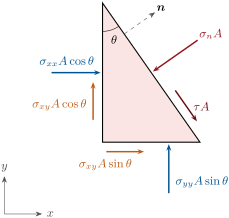
Let a plane have the unit normal , at the angle from the axis , and let be the unit vector along the plane. The normal and shear stresses on it are
with counted positive along .
Proof. Cut out a small prism, as in the figure below: an inclined face of area with the outward normal , a vertical face of area and a horizontal face of area , per unit length in the third direction. Its weight and its inertia scale as its volume, which shrinks faster than its faces; for a small enough prism the forces on the faces must balance on their own. Compression being positive, the rock outside pushes on the vertical face with the force and on the horizontal face with ; on the inclined face it pushes with . The sum is zero:
The scalar product with gives , with gives , since . The second forms follow from , and . ∎
Theorem 16.3 (Principal stresses)
At every point of a rock there are two perpendicular planes on which the shear stress is zero. The normal stresses on them are the largest and the smallest normal stress over all planes through the point,
where is the angle from the axis to the normal of the plane that carries .
Proof. Write , and choose and with and ; then and is as stated. The second forms of Proposition 16.2 become
The normal stress is largest, , for , and smallest, , for ; at both, . Note also that : the normal stress is stationary exactly where the shear stress vanishes. ∎
Definition 16.4 (Principal stresses, differential stress)
The principal stresses at a point are the normal stresses on the two planes free of shear stress, and their directions are the principal directions. In three dimensions there are three, , on three perpendicular planes. The differential stress is , and the mean stress in the plane is .
A state of stress is easiest to read in its principal directions. If we measure the angle from the direction of instead of from the axis , the formulas lose their last terms.
Proposition 16.5 (Mohr’s circle)
On a plane whose normal makes the angle with the direction of ,
As turns, the point runs over the upper half of the circle of centre and radius , at the angle from its end. The largest shear stress, , acts on the planes at to the principal directions.
Proof. In the principal axes , and , and Proposition 16.2 gives the two formulas. Then , the equation of the circle; is largest for . ∎
The sign of only says in which sense the two sides would slide, so the upper half of the circle is usually drawn alone. The construction is named after the engineer Christian Otto Mohr, who also built on it a criterion of failure, which is where we are going (Section 16.3).
Stress at depth
Definition 16.6 (Lithostatic pressure, pore-fluid pressure, effective stress)
At the depth , the weight of the rock above, per unit of horizontal area, is the vertical stress , which is in a layer of uniform density . When the stress is the same in every direction and equal to it, the rock is under the lithostatic pressure. The pressure of the water, oil or gas in the pores and cracks of the rock is the pore-fluid pressure ; it is hydrostatic, , when the pores connect to the surface. The effective stress is the stress minus the pore pressure, , on every plane; is the pore-pressure ratio.
In a crust of density , the vertical stress grows by per kilometre and a hydrostatic pore pressure by per kilometre: . The pore fluid pushes the grains apart with the same pressure in every direction; it takes nothing from the shear stress, but it takes from every normal stress. Where the pores are sealed, by clay or salt for instance, the fluid can carry part of the weight of the rock above, and rises towards 1.
The stress in the crust is not lithostatic. Plates push and pull, the crust bends, mountains weigh on their roots, and the horizontal stresses differ from the vertical one. Near the surface, which carries no shear stress, one principal direction is vertical, as Chapter 17 shows: is , or , and the three cases are the three ways faults move.
16.2 Strain
Stress is a cause; strain is what the rock records. A fossil drawn out, a pebble flattened, a bed shortened into folds all measure a change of shape.
Definition 16.7 (Extension, stretch, shear strain)
A line of material of length deformed to the length has the extension and the stretch ; a shortening is a negative extension, a stretch below 1. Two lines of material that were perpendicular and now make the angle have been sheared by the angle , and the shear strain is .
A strain is homogeneous when every small region of the rock deforms in the same way. The new position of the point is then a linear function, , with a constant matrix (and , since rock does not turn inside out). Straight lines stay straight and parallel lines parallel; a square becomes a parallelogram, and a circle becomes an ellipse.
Proposition 16.8 (The strain ellipse)
Under the homogeneous strain , the circle of radius 1 becomes an ellipse whose semi-axes are the square roots of the eigenvalues of , along its perpendicular eigenvectors. and are the largest and smallest stretches of all lines of material, and the area is multiplied by .
Proof. The point comes from a point of the circle, , so , that is . The matrix is symmetric with positive eigenvalues (); in its perpendicular eigenvectors the equation reads , an ellipse of semi-axes and . A line of material along the unit vector has the stretch , and lies between the eigenvalues of , which are those of . Finally . ∎
Definition 16.9 (Strain ellipse)
The strain ellipse is the ellipse into which a homogeneous strain turns a circle of radius 1; its semi-axes are the principal stretches , and its axes the principal directions of the strain.
Two strains that change the shape of a body equally can be very different.
Definition 16.10 (Pure shear, simple shear)
A pure shear is a homogeneous strain that keeps the area and keeps its principal directions fixed in the rock: in those axes, with . A simple shear moves every point parallel to one direction, the shear direction, by times its distance from a fixed plane parallel to it: .
Both keep the area, since both determinants are 1. In pure shear the lines of material along the axes of the strain ellipse are the same lines at every stage: the strain is coaxial. In simple shear they are not, as the next proposition and the figure after it show.
Proposition 16.11 (The ellipse of simple shear)
A simple shear has the principal stretches
and the long axis of its strain ellipse makes with the shear direction the angle given by .
Proof. has the trace and the determinant 1. So and , hence , , and . The eigenvector of the largest eigenvalue of a symmetric matrix makes with the first axis the angle given by (Theorem 16.3 is the same computation): here . ∎
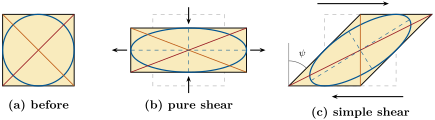
The strain ellipse records the total, or finite, strain. A deformation that goes on for millions of years is the sum of many small increments, each an infinitesimal strain; for a small the proposition gives and . In simple shear the increments always stretch fastest at to the shear direction, while the finite ellipse turns towards it, at , at , ever closer as grows. This is why flattened pebbles and stretched minerals in a zone of intense shear lie almost in its plane, and why the angle they make with the zone measures how far it has moved.
16.3 Rheology
Definition 16.12 (Rheology, brittle and ductile behaviour)
The rheology of a material is the way it deforms and flows under stress: the relation between stress, strain and the rate of strain. A rock shows brittle behaviour when it deforms by fracture or by sliding on fractures, on discrete surfaces, with a sudden loss of strength; it shows ductile behaviour when it deforms permanently and continuously through its volume, without losing its cohesion.
Rocks show all the behaviours of the physics books. Under small, brief stresses they are elastic: the strain is proportional to the stress, as in Hooke’s law, and disappears with it; seismic waves (Chapter 9) travel through elastic rock. Over long times the hot mantle flows like a very viscous fluid, the strain rate growing with the stress. In between, cold rock breaks and slides, and warm rock creeps. Which behaviour wins depends on the stress, the temperature, the pressure, the fluid in the pores and the time allowed.
Brittle failure
Definition 16.13 (Coulomb failure criterion)
A rock obeys the Coulomb failure criterion if a plane through it breaks, or an existing fracture slips, as soon as on that plane
where is the cohesion of the rock, its coefficient of internal friction and its angle of internal friction.
The criterion bears the names of Coulomb and Mohr. Its constants are measured on samples in the laboratory, and differ from rock to rock. An existing fracture has lost its cohesion: for it, , and the friction on it hardly depends on the rock (Proposition 16.15), with between 0.6 and 0.85, an angle of friction between and .
Theorem 16.14 (The angle of failure)
A rock obeying the Coulomb criterion first breaks on the planes that make the angle with the direction of , on either side of it, and it breaks when
Proof. Draw the Mohr circle in effective stresses, of centre and radius (figure below); the pore pressure has moved it by , since it takes from every normal stress and nothing from the shear. While the whole circle lies below the line , no plane breaks. As the stresses change, the first plane to break is the point where the circle touches the line. There the radius is perpendicular to the line; the line rises at the angle above the horizontal, so the radius to the point of contact makes the angle with the direction of the end. By Proposition 16.5 this point is the plane whose normal makes the angle with , where ; the plane itself makes with , and the lower half of the circle gives the symmetric plane. Contact means that the distance from the centre to the line equals the radius: , since and . ∎
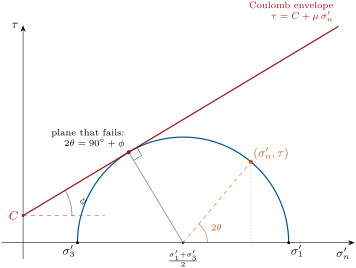
With , a rock breaks on planes at to , and the two possible planes make with each other, cut in two by . This is the angle between the conjugate faults that are seen in the field, and the reason, as Chapter 17 shows, why normal faults dip steeply and thrusts gently.
For sliding on fractures that already exist, experiment gives the friction itself, and it gives it with a surprising simplicity.
Proposition 16.15 (Byerlee’s law)
For most rocks, sliding on an existing fracture or fault starts when the shear stress reaches
whatever the kind of rock: this is Byerlee’s law.
Proof. Admitted at this level. ∎
The law is a result of experiment, not of theory. James Byerlee measured, in 1975, the fracture strength and the frictional strength of a sandstone under confining and pore pressures, and found both governed by the effective stress alone, the difference between the two pressures; the strength of fracture varied by up to with the cement between the grains, but the friction did not depend on the rock, and the same law held for gabbro, dunite, serpentinite, granite and limestone. The two lines meet at , where both give .
The law of effective stress is the key to the opening of this chapter. Raising the pore pressure by lowers every effective normal stress by and leaves every shear stress as it was: the Mohr circle slides to the left, unchanged in size, towards the failure line. A fault that was safe can be brought to slip without any change in the tectonic stress. The critical shear stress on a fault is , and injection works on its last term. At Denver the earthquakes kept to the rock where the pore pressure had risen by more than about , as if that rise were what the faults there needed.
Method 16.16 (Testing a fault for slip)
To decide whether a fault at the depth will slip, and what would make it:
- Find the principal stresses in the plane perpendicular to the strike of the fault: , and the horizontal stress, measured or assumed; take the pore pressure (hydrostatic, , if nothing else is known).
- Measure the angle between the normal to the fault and the direction of .
- Compute and on the fault with Proposition 16.5, then .
- Compare with the friction of Proposition 16.15: below it, the fault holds; against 0.85 measures the margin.
- The rise of pore pressure that brings it to slip is on the lower branch of the law (, in megapascals, on the upper one).
Ductile creep
Hot rock does not wait to break. Above a few hundred degrees in quartz-rich rock, and at higher temperatures in olivine, crystals deform by the slow movement of defects through their lattice, and the rock creeps at a rate that grows steeply with the stress and with the temperature.
Proposition 16.17 (Power-law creep)
At high temperature a rock deforming by dislocation creep flows at the strain rate
where is the absolute temperature, the pressure, the gas constant, and , , (the activation energy) and (the activation volume) are constants of the material, measured in the laboratory. To flow at the rate , it needs the differential stress
Proof. Admitted at this level. ∎
The mechanisms behind the law are the subject of the Year 3 volume. Its constants come from experiments; for wet quartzite, , and (stress in megapascals, time in seconds), after Gleason and Tullis (1995); for dry olivine, , , and , after Hirth and Kohlstedt (2003); .
Two features of the law shape the lithosphere. The stress depends only weakly on the rate: ten times faster asks only times more stress of quartzite. And it depends enormously on the temperature: the exponential divides the strength of quartzite by several for each hundred degrees. Natural strain rates are slow. A belt of crust wide that absorbs of plate motion a year deforms at , the rate we shall use.
In the lab — Measuring the strength of rock
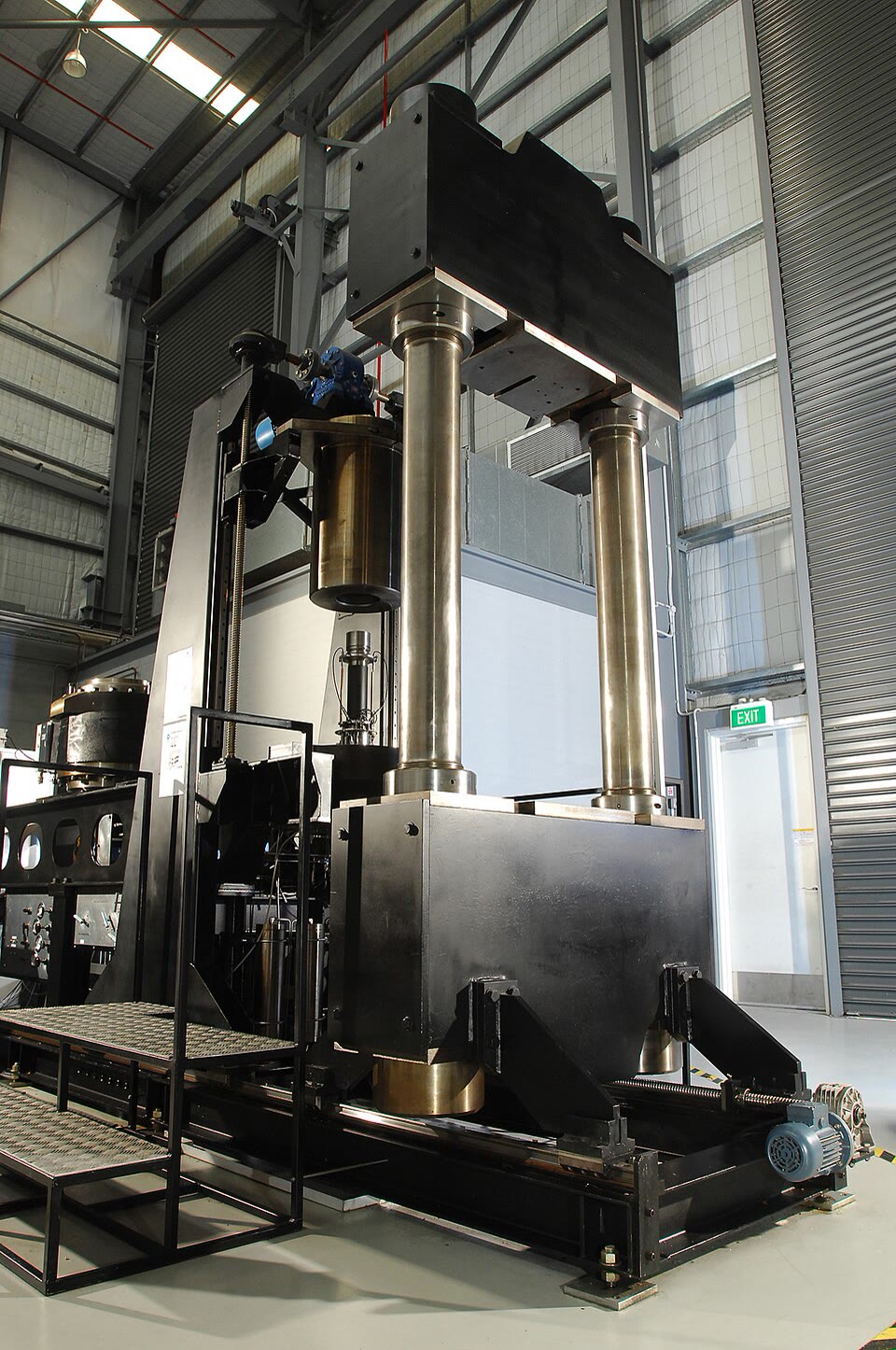
Rock-mechanics laboratories measure strength in a triaxial cell. A cylinder of rock, cored and ground flat at its ends, is sealed in a jacket of rubber or soft metal that keeps the confining fluid out of its pores. It sits in a thick-walled pressure vessel: oil around it sets the confining pressure, which plays the part of ; a piston bears on its ends and adds the axial load, . A separate line fills the pores with water at a pressure of its own, so that the effective stress can be varied with the total stress fixed. The machine records the axial force and the shortening of the sample as it is loaded at a steady rate, until it breaks or, in a sample sawn across in advance, until the cut starts to slide. A furnace inside the vessel heats samples for experiments on creep, which are run at strain rates many orders of magnitude faster than any in the Earth and must be extrapolated to it.
16.4 The strength of the lithosphere
At every depth the lithosphere can fail in two ways: by sliding on faults, with a strength that grows with the effective pressure, or by creep, with a strength that falls as it gets hotter. It deforms in whichever way needs the smaller stress.
Definition 16.18 (Strength envelope, brittle–ductile transition, seismogenic layer)
The strength envelope of the lithosphere is the curve, against depth, of the largest differential stress it can bear at a given strain rate: at each depth, the smaller of the frictional strength and the creep strength. The brittle–ductile transition is the depth at which the two are equal: above it the rock deforms by faulting, below it by creep. The seismogenic layer is the range of depths in which most earthquakes start.
Proposition 16.19 (Frictional strength with depth)
In a layer of density with a hydrostatic pore pressure, one principal stress vertical, faults of every orientation and no cohesion, sliding with friction starts at the differential stress
with : the first case gives normal faults, the second thrusts.
Proof. The vertical effective stress is . With and , Theorem 16.14 says that a fault slips when , with the radius and the centre of the effective Mohr circle. If , then and , so and . If , then and . The differential stress is . ∎
With and , grows by per kilometre and the frictional strength by per kilometre under extension and per kilometre under compression, nearly five times more: a crust is far easier to pull apart than to push together. Beyond an effective normal stress of the upper branch of Byerlee’s law takes over, and the slope falls, in compression, to about per kilometre.
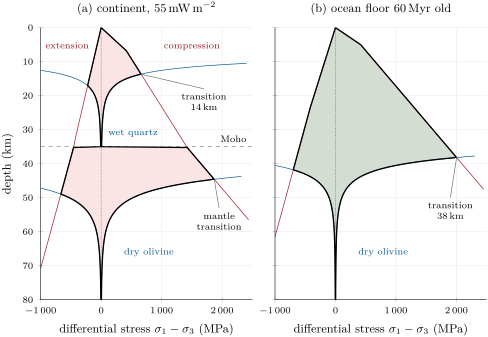
The figure above puts the two strengths together for two lithospheres. The continent has the geotherm of Chapter 10 with a surface heat flow of , a crust of wet quartzite thick, and dry olivine below; the ocean floor is old, with the half-space geotherm of the same chapter, and olivine from the sea floor down. The strain rate is . The is the average depth of the Moho under the continents in the reference Earth model of Chapter 9.
Under the continent the brittle–ductile transition falls at in compression, at , and at in extension. A warmer crust would bring it up, a colder one push it down, since the creep law depends on the temperature alone at a given stress. The transition is the strongest level of the crust. Below it the strength collapses: at the Moho, at , quartzite flows under , while olivine at the same temperature would need some , so far beyond the frictional strength that the top of the mantle is brittle again. A second transition follows at in compression. The lower crust of this model is a soft layer between two strong ones: the “jelly sandwich”. Under the ocean the whole lithosphere is olivine, and the strength grows down to a single transition at , at .
The earthquakes agree with the oceanic envelope: inside the oceanic plates, they reach depths where the temperature is , close to the of the model’s single transition. Deeper earthquakes occur only where one plate sinks under another, down to more than (Chapter 14).
The continental mantle is where the picture is disputed. For about twenty years the jelly sandwich was the prevailing view, built on laboratory measurements of dry olivine and on a few earthquakes thought to lie beneath the Moho. In 2002 James Jackson argued that it should be abandoned: better depths showed that earthquakes in the continents are confined to a single layer, usually the upper crust, sometimes the whole crust, with no convincing earthquakes in the mantle beneath, even where the Moho is only . Small amounts of water, a few parts per million in olivine, are enough to weaken it dramatically, and the continental mantle may well hold that much; the strength of the continents would then lie mostly in their crust. The two views draw different envelopes from the same laws, with dry or wet olivine below the Moho.
Whichever is right, an envelope is a bound and not a measurement: the laboratory laws are extrapolated over many orders of magnitude of strain rate, and the peak stresses it shows, more than a gigapascal, are far above the that earthquakes are seen to release.
16.5 Exercises
Exercise 16.1 ★
Take a crust of density and . At a depth of , compute (a) the vertical stress, (b) the hydrostatic pore pressure, (c) the vertical effective stress and the pore-pressure ratio .
Solution
Solution of Exercise 16.1.
(a) . (b) . (c) , and , which is .
Exercise 16.2 ★
(a) A bed long is stretched to : give its extension and its stretch. (b) Another, long, is shortened to . (c) Two lines of a rock that were perpendicular now make an angle of : what are the angular shear and the shear strain?
Solution
Solution of Exercise 16.2.
(a) and . (b) , a shortening of , and . (c) The angle has closed by , and .
Exercise 16.3 ★
At a point, and . (a) Draw the Mohr circle. (b) What is the largest shear stress, on which planes does it act, and what normal stress acts on them? (c) Compute and on the plane whose normal makes with .
Solution
Solution of Exercise 16.3.
(a) Centre , radius . (b) The largest shear stress is the radius, , on the planes at to and , which carry the normal stress of the centre, . (c) : and .
Exercise 16.4 ★
A rock has the cohesion and the angle of internal friction . (a) At what angle to does it break, and what angle do the two possible fracture planes make with each other? (b) With , what effective breaks it?
Solution
Solution of Exercise 16.4.
(a) to , on either side of it, so the two planes make with each other. (b) With , the condition of Theorem 16.14 reads , so
and .
Exercise 16.5 ★★
In the axes (horizontal) and (vertical), , and . (a) Compute the principal stresses and the angle . (b) Check with Proposition 16.2 that the plane of normal carries no shear stress and the normal stress . (c) What is the largest shear stress at this point?
Solution
Solution of Exercise 16.5.
(a) and : and ; , , . (b) At this angle , and : , and . (c) , on the planes at to the principal directions.
Exercise 16.6 ★★
A shear zone has deformed its rock by a simple shear . (a) Compute the principal stretches and the angle of the long axis of the strain ellipse to the shear direction. (b) Check that the area has not changed. (c) A line of material was at to the shear direction, rising in the sense of the shear: where does it lie now, and what is its stretch? Compare with (a).
Solution
Solution of Exercise 16.6.
(a) : and ; , . (b) , which is : no change of area. (c) The line along goes to , at from the shear direction, with the stretch . It has turned past the long axis of the ellipse, at , towards the shear plane; its stretch is a little less than , as it must be, since no line stretches more than .
Exercise 16.7 ★★
In a shear zone thick, small round spots in a slate have become ellipses with axes in the ratio 4 to 1. Assume a simple shear, with no change of area. (a) Find , and . (b) At what angle to the walls of the zone should the long axes lie? (c) How far has one wall moved past the other?
Solution
Solution of Exercise 16.7.
(a) and give and ; by Proposition 16.11, . (b) , : the long axes should lie at to the walls. (c) .
Exercise 16.8 ★★
A fault at a depth of , in crust of density , carries the normal stress and the shear stress . (a) With a hydrostatic pore pressure, does it slip according to Byerlee’s law? (b) And if the pores are sealed and ? (c) Find the value of at which it starts to slip.
Solution
Solution of Exercise 16.8.
. (a) , , and Byerlee allows , more than the applied: the fault holds. (b) , , and the friction gives only : the fault slips. (c) gives .
Exercise 16.9 ★★
Use the creep law of wet quartzite (Proposition 16.17). (a) By what factor must the stress rise to make it flow ten times faster? (b) By what factor does its strength fall between and , at the same rate and with ? (c) Explain with these two results why the depth of the brittle–ductile transition depends much more on the geotherm than on the strain rate.
Solution
Solution of Exercise 16.9.
(a) The stress goes as : . (b) The ratio of the strengths is
(c) A tenfold change of rate changes the creep strength by a factor 1.78, which the temperature does in only ; on a geotherm of about per kilometre, that moves the transition by about . A change of geotherm moves the isotherms, and with them the transition, by far more.
Exercise 16.10 ★★★
Where the vertical stress is , faults are strike-slip. Assume that the vertical effective stress is then the mean . (a) Show that sliding with friction and no cohesion starts at . (b) Compute the slope in megapascals per kilometre for and , and place it between the slopes of normal and thrust faulting. (c) Express each of the three slopes as a multiple of the vertical effective stress.
Solution
Solution of Exercise 16.10.
(a) With , a fault slips when (Theorem 16.14). Here , so . (b) grows by per kilometre, and : the slope is per kilometre, between (normal faults) and per kilometre (thrusts). (c) , and , with : the differential stress at slip is 0.79, 1.30 and 3.68 times the vertical effective stress.
Exercise 16.11 ★★★
Model the oceanic lithosphere old as a half-space cooled from , with a surface at and : . (a) Compute . (b) Find the depths of the and isotherms. (c) Earthquakes inside the oceanic plates reach the depths where the temperature is . Compare with the brittle–ductile transition in the oceanic strength envelope of this chapter, at and .
Solution
Solution of Exercise 16.11.
(a) and . (b) for : ; for : . (c) The earthquakes should reach ; the envelope puts the base of the brittle layer at , within that range and near its top, at a temperature, , in the range observed.
Exercise 16.12 ★★★
A rock is crossed by fractures of every orientation, all containing the direction of , with no cohesion and friction 0.85. The effective principal stresses are and . (a) Show that some fractures slip. (b) Find the range of the angle between the slipping fractures and . Which one is in the middle of the range? (c) Down to what value of , with fixed, does at least one fracture still slip?
Solution
Solution of Exercise 16.12.
(a) and ; the distance from the centre to the line is , less than the radius: the circle crosses the line, and the planes on the arc above it slip. (b) With the angle from the end, slip needs , that is , or , where . So , between and , between and : the normals lie at to from , and the slipping fractures at to from . The middle of the range, , is , the plane of Theorem 16.14. (c) Only that plane slips when the circle just touches the line: , , and .
16.6 Problem: Will the fault slip?
Problem 16.1
Weekend problem — the stress on a normal fault at a depth of five kilometres, its safety margin, and the rise of pore pressure that would make it slip
A fault strikes north–south and dips to the east. A disposal well reaches it at a depth of , in crust of density whose pores connect to the surface. A measurement in the well gives the horizontal stress perpendicular to the fault, ; the horizontal stress along the strike lies between it and the vertical stress, so the problem is two-dimensional in the vertical plane east–west. Take , water of density and Byerlee’s law. Give stresses to .
Part I — The state of stress.
- Compute the vertical stress at the depth of the fault.
- Compute the hydrostatic pore pressure there, and the ratio .
- Which of the two stresses is and which ? What kind of fault does this state of stress drive?
- Compute the differential stress, the centre and the radius of the Mohr circle.
- Compute the effective principal stresses and the centre of the effective circle.
- With horizontal to the east and vertical, write the three components , , . Why is zero?
Part II — The stresses on the fault.
- Give the unit normal to the fault in the axes of question 6, and the angle between it and .
- Compute and on the fault with Proposition 16.2.
- Check both values with Mohr’s circle: at what angle from the end does the fault lie?
- Compute the effective normal stress on the fault.
- Compute the ratio and compare it with 0.85.
- What shear stress would make the fault slip under the present effective normal stress? By how many megapascals is it short?
Part III — Mohr’s circle and Byerlee’s law.
- Draw the effective Mohr circle and Byerlee’s line to scale.
- Compute the distance from the centre of the circle to the line and compare it with the radius. Can any plane through the rock slip?
- Which plane would slip first? Give its angle to and its dip.
- With Proposition 16.19, compute the differential stress at which normal faults slip at this depth, and check it against the slope of per kilometre.
- How low would the horizontal stress have to fall for the best-oriented plane to slip?
- How low for the fault of the problem to slip? Explain why it is lower.
Part IV — Injection.
- Explain why a rise of the pore pressure moves the effective circle by to the left without changing its radius.
- Compute the rise of pore pressure that brings the best-oriented plane to slip.
- The well is full of water. What extra pressure must the pump apply at the wellhead to raise the pore pressure at the fault by that amount? How high a column of water is it equivalent to?
- If the friction on the fault were 0.6 rather than 0.85, would it be slipping already? What does the quiet of the fault say about its friction?
- At what ratio does the best-oriented plane slip?
- To one decimal, in megapascals, what rise of pore pressure brings this fault to slip?
Solution
Solution of Problem 16.1.
1. .
2. , and .
3. , vertical, and , horizontal east–west: the crust is being stretched east–west under its own weight, the state that drives normal faults, such as this one.
4. ; centre ; radius .
5. , , centre .
6. , and : the axes are the principal directions, one of them vertical, so the planes perpendicular to them carry no shear stress.
7. Down its dip the fault runs along the unit vector , east and down; its upward normal is , at from . Its angle with , along , has the cosine 0.500: .
8. With from : , and .
9. At from the end: and .
10. .
11. , below 0.85: the fault holds.
12. ; the shear stress falls short of it by .
13. The circle has its centre at and the radius , from to ; Byerlee’s line is (all normal stresses here are below ); the fault is the point , at from the end.
14. , more than the radius, : the whole circle lies below the line, and no plane through the rock can slip.
15. : the plane at from the vertical , dipping .
16. and ; the slope gives .
17. .
18. The fault slips when with and ; solving gives , . It is lower than for the best plane: the fault does not lie at the point where the circle first touches the line, so the circle must grow further before it reaches the fault’s own point.
19. Every effective normal stress, and included, falls by , and their difference does not change; the shear stresses do not depend on the pore pressure at all.
20. The best plane slips when the distance equals the radius: , so .
21. The column of water in the well weighs the same as before, so the pump must add the whole at the wellhead, about 103 times the atmospheric pressure: the weight of a column of water high.
22. With the fault could bear only , less than the it carries: it would be slipping already. Since it is quiet, its friction is at least , or it has some cohesion.
23. The best-oriented plane slips when the pore pressure reaches , that is , well short of the lithostatic value 1.
24. , more than the that would move a plane of the best orientation. To one decimal, the rise of pore pressure that brings the fault to slip is .
本章定义的术语
- Coulomb failure criterion
- Extension, stretch, shear strain
- Lithostatic pressure, pore-fluid pressure, effective stress
- Normal stress
- Principal stresses, differential stress
- Pure shear, simple shear
- Rheology, brittle and ductile behaviour
- Strain ellipse
- Strength envelope, brittle–ductile transition, seismogenic layer