High School Mathematics · Grades 10–12
1Numbers and Sets of Numbers
Mathematics begins with numbers, and not all numbers are of the same kind: counting numbers, negative numbers, fractions, and numbers like or that no fraction can express. This chapter organizes them into nested families, introduces intervals to describe portions of the number line, and uses the absolute value to measure distances between numbers.
1.1 The families of numbers
Definition 1.1 (Sets of numbers)
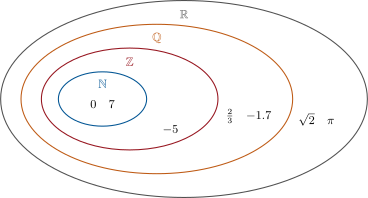
- is the set of natural numbers:
- is the set of integers:
- is the set of rational numbers: all quotients with , and .
- is the set of real numbers: all the numbers that can be placed on the number line.
Notation 1.2
The symbol reads “belongs to”: , , . The symbol reads “is included in”: every natural number is an integer, every integer is a rational number (e.g. ), and every rational number is real, so
A slash negates a symbol: .
Example 1.3
Let us place a few numbers in the smallest family that contains them.
- , so even though it is written as a fraction: always simplify first.
- is rational but not an integer.
- (the digit repeating forever) equals , a rational number.
- and are real but not rational, as we are about to see for ; such numbers are called irrational.
Theorem 1.4 (Irrationality of )
The number is not rational: no fraction of integers has square .
Proof. We reason by contradiction, in small steps.
- Suppose where and are positive integers, and the fraction is fully simplified, so and are not both even.
- Squaring both sides gives , that is . So is even.
- If were odd, say , then would be odd. Since is even, must be even: for some integer .
- Substituting: , so , so . By the same argument as in step 3, is even.
- Now and are both even, contradicting step 1. The assumption was impossible: is irrational.
∎
Remark 1.5
Rational numbers are exactly the numbers whose decimal expansion either stops (like ) or eventually repeats the same block forever (like or ). Irrational numbers like have decimal digits that never fall into a repeating pattern. We admit this characterization at this level.
1.2 The number line and intervals
Real numbers fill a line: choosing an origin and a unit of length, every real number corresponds to exactly one point.
Definition 1.6 (Interval)
Let and be real numbers with . An interval is the set of all real numbers between two bounds. A square bracket means the bound is included, a parenthesis means it is excluded:
| notation | description |
|---|---|
| (both ends included) | |
| (both ends excluded) | |
The symbols and (“infinity”) are not numbers, only a way of saying that the interval continues forever; the bracket next to them is always a parenthesis. The whole line is the interval .

Definition 1.7 (Intersection and union)
Let and be two sets of real numbers. The intersection (“ and ”) is the set of numbers belonging to both; the union (“ or ”) is the set of numbers belonging to at least one of them.
Example 1.8
Take and . Draw both on the same line: they overlap between and . Therefore
Note the brackets: so , but and , so .
Method 1.9 (Working with intervals)
To find the intersection or union of two intervals:
- draw the number line and mark the four bounds;
- shade the first interval above the line and the second below it;
- the intersection is where the shadings overlap, the union is where at least one shading is present;
- decide each bracket by testing whether the bound itself belongs to both sets (intersection) or to at least one (union).
1.3 Absolute value and distance
Definition 1.10 (Absolute value)
The absolute value of a real number is
For instance and . In every case .
Proposition 1.11 (Distance on the line)
For all real numbers and , the distance between the points and on the number line is . In particular is the distance from to .
Proof. If , the distance from to is , which equals . If , the distance is , which is again by definition of the absolute value. ∎
Proposition 1.12 (Absolute value and intervals)
Let be a real number and . Then
Proof. says that the distance from to is at most , i.e. that lies no further than from on either side. The numbers satisfying this are exactly those between and , bounds included. ∎

Example 1.13
Solve . The solutions are the numbers at distance at most from : the interval . Conversely, the interval has center and radius , so it is described by .
1.4 Approximations
Irrational numbers, and even most fractions, cannot be written exactly with finitely many decimal digits, so in practice we approximate them.
Definition 1.14 (Approximation to a given accuracy)
A number is an approximation of to within when . Truncating or rounding the decimal expansion after the -th digit both give such approximations.
Example 1.15
From : the truncation and the rounding are both approximations of to within . The rounding is at distance less than , the truncation only guarantees . Writing frames between two decimal bounds.
1.5 Exercises
Exercise 1.1 ★
For each number, give the smallest of the sets , , , to which it belongs:
Solution
Solution of Exercise 1.1.
. . (it is not an integer: ). . (irrational, since is not the square of a rational — admitted here, in the spirit of Theorem 1.4). . .
Exercise 1.2 ★
Write each statement with interval notation, then draw it on a number line: (a) ; (b) ; (c) ; (d) the distance from to is at most .
Solution
Solution of Exercise 1.2.
(a) : filled dot at , hollow dot at . (b) : hollow dot at , shading to the right. (c) : shading from the left up to a filled dot at . (d) “distance from to at most ” means , i.e. : filled dots at and .
Exercise 1.3 ★
Compute and for
Exercise 1.4 ★
Compute without a calculator:
Solution
Solution of Exercise 1.4.
; ; ; so ; so as well (a number and its opposite have the same absolute value).
Exercise 1.5 ★
Solve the equations and inequalities and give the solution sets:
(Note that is a distance to .)
Solution
Solution of Exercise 1.5.
: distance from , so or .
: distance from , so or .
: distance at most from , so .
: distance strictly less than from , so .
Exercise 1.6 ★★
Describe each interval by an inequality of the form or :
Solution
Solution of Exercise 1.6.
Each interval is described by its center (midpoint of the bounds) and radius (half the length).
: , , so .
: , , open bounds, so .
: , , so .
Exercise 1.7 ★★
Show that (the block repeating forever) is rational. (Hint: call it and compute .)
Solution
Solution of Exercise 1.7.
Let Then , and subtracting:
so and , a quotient of integers: is rational.
Exercise 1.8 ★★
True or false? Justify each answer with an argument or a counterexample.
- The sum of two integers is an integer.
- The quotient of two integers is an integer.
- The sum of two rational numbers is rational.
- The sum of a rational number and an irrational number is irrational.
Solution
Solution of Exercise 1.8.
1. True: adding integers (positive or negative whole numbers) always produces an integer.
2. False: is a quotient of the integers and and is not an integer.
3. True: is again a quotient of integers (with nonzero denominator).
4. True: suppose is rational, irrational, and were rational. Then would be a difference of two rationals, hence rational (by 3, applied with ) — contradiction. So is irrational.
Exercise 1.9 ★★
Using , frame the numbers , and between two decimal bounds.
Solution
Solution of Exercise 1.9.
Multiplying by : .
Adding : .
Multiplying by reverses the inequalities: .
Exercise 1.10 ★★★
Adapt the proof of Theorem 1.4 to show that is irrational. (Replace “even” by “multiple of ”: first check that if is a multiple of , then so is , by examining the remainders , , of upon division by .)
Solution
Solution of Exercise 1.10.
First the auxiliary fact. Divide by : the remainder is , or , i.e. , or . Squaring:
Only the first is a multiple of : if is a multiple of , then is too.
Now suppose fully simplified. Squaring gives , so is a multiple of , so . Then , so and is also a multiple of — but then the fraction was not fully simplified: contradiction. So is irrational.
1.6 Problem: Between any two numbers
Problem 1.1
Weekend problem — rationals and irrationals interlace: every interval, however small, contains infinitely many of each, and no measurement can ever tell them apart
The rationals look like a crowd (all the fractions!) and the irrationals like exotic exceptions (, ). This problem reveals the true picture: the two families interlace so finely that every interval of the number line, however microscopic, contains infinitely many of each — with strange consequences, such as this: no physical measurement, however precise, can ever decide whether a length is rational.
Part I — The four kingdoms.
- For each number, name the smallest of the sets , , , containing it (Definition 1.1): ; ; ; (recall the repeating-decimals weekend problem of the Middle School volume); ; (admit its irrationality — proved only in the university volumes).
- Prove that is stable under addition and multiplication: if and are rational, write and as single fractions.
- Deduce by contradiction: (a) the sum of a rational and an irrational is irrational; (b) the product of a nonzero rational and an irrational is irrational.
- Show that the set of irrationals is stable under neither operation: exhibit two irrationals whose sum is rational, and two whose product is rational.
- Locate and in the four kingdoms (simplify first, the Middle School volume’s method).
Part II — The rationals are dense.
- Find a rational strictly between and ; then a second one; then describe how to produce as many as desired (the zoom of the no-next-number weekend problem of the Middle School volume, now with a proof in sight).
- The general theorem. Let be any two reals, with gap . Choose with , and consider the multiples of (the decimal grid of step ). Explain why at least one grid point falls strictly between and , and conclude: every interval of positive length contains a rational number.
- Upgrade the conclusion: every such interval contains infinitely many rationals. (Apply question 7 again, inside a smaller interval.)
- Now the irrationals: given , take a rational strictly inside (question 7) and consider the numbers . Using question 3, show they are irrational, and that for large enough they still lie in the interval: every interval also contains infinitely many irrationals.
- Two classic riddles settled: is there a smallest positive real number? A real number “just after ”? Answer both with question 7’s theorem, and salute the childhood version (the no-next-number weekend problem of the Middle School volume).
Part III — Absolute value, the geometry of .
- Solve, and express the solutions as intervals or unions (Proposition 1.12): ; ; .
- A piston must be manufactured to mm within a tolerance of mm. Write the requirement with an absolute value, then as an interval. Two pistons measure and mm: verdicts?
- The triangle inequality on the line: . Check it on and , prove it when and have the same sign and when they have opposite signs, and state exactly when equality holds.
- Solve by reading it as an equality of distances on the line. Which point of the two-mirrors weekend problem of the Middle School volume have you just computed, one dimension down?
- Simplify — carefully. Test your formula on and , then use it to solve with an absolute value.
Part IV — What no measurement can decide.
- A physicist measures a rod: m. Can any such measurement — this one or a future, more precise one — ever prove that the rod’s length is irrational? Or that it is rational? Use questions 7 and 9 on the tolerance interval, and explain why only proof (as for the diagonal, the irrationality weekend problem of the Middle School volume) can settle irrationality.
- The truncations , , , of are all rational. What do they show about how close presses against every irrational? Formulate the general fact.
- Interval arithmetic: measured values and . Bracket and between certain bounds. Which operation degrades the precision more?
- An engineer’s rule says errors of independent measurements “add” for sums: express with the triangle inequality (question 13) why the error of is at most the sum of the errors — the inequality is the engineering rule.
- Finale, in a short paragraph: assemble the picture of the real line established by this problem and its ancestors — no next number (the no-next-number weekend problem of the Middle School volume), rationals repeating decimals (the repeating-decimals weekend problem of the Middle School volume), both families dense (questions 8 and 9), measurement forever undecided (question 16). End with the teaser this chapter cannot yet prove: in a precise sense there are vastly more irrationals than rationals — the university volumes count the infinities.
Solution
Solution of Problem 1.1.
1. ; ; ; (the repeating-decimals weekend problem of the Middle School volume); is irrational: smallest set ; : .
2. and : quotients of integers with nonzero denominators — rational.
3. (a) If is rational, irrational and were rational, then would be a difference of rationals, hence rational (question 2): contradiction. (b) If and rational, then is rational: contradiction.
4. and are irrational with sum ; and have product . Rational results from irrational ingredients: the irrationals form no stable kingdom.
5. , so : irrational (question 3b, multiplier ). And : the product of two irrationals lands in the smallest kingdom of all.
6. , then (or , , …): appending decimal digits produces fresh rationals between the two forever.
7. The multiples of march along the line in steps of . The first multiple strictly greater than — it exists, since the multiples eventually exceed — lies at most one step beyond , hence before : strictly between and . A grid point is a decimal, hence a rational: every interval of positive length contains one.
8. Between and the rational found in question 7 there is (question 7 again) a rational ; between and a rational ; and so on: infinitely many, all distinct, all in the original interval.
9. is the sum of a rational and an irrational ( is irrational by question 3b), hence irrational. Since shrinks below any bound, for large enough still lies before : an irrational inside the interval — and varying gives infinitely many.
10. No smallest positive real: if were it, the interval would still contain a rational (question 7), positive and smaller than . No number just after : any candidate leaves the interval , which is not empty — the no-next-number weekend problem of the Middle School volume’s game, now a theorem about .
11. : or . : . : distance to at least : .
12. , i.e. . The piston at passes; the one at fails by a hundredth of a millimeter.
13. : . : : equality. Same signs: is the sum of the distances, equal to . Opposite signs: the walk doubles back, is the difference of the distances, strictly less than their sum (unless one of them is ). Equality exactly when and have the same sign or one is zero.
14. The solutions are the points equidistant from and : the midpoint, . It is the perpendicular bisector of the two-mirrors weekend problem of the Middle School volume, collapsed to one dimension: a single point.
15. , not : for , . Then reads , i.e. : .
16. The measurement asserts only that the length lies in the interval — and by questions 7 and 9 that interval contains infinitely many rationals and infinitely many irrationals. The same holds for every future tolerance, however small. No measurement can ever separate the two families; only a proof about the exact length — like the one for the diagonal of the unit square (the irrationality weekend problem of the Middle School volume) — can.
17. They approach with errors below : rationals press against at every scale. The general fact: every real number is approached as closely as desired by rationals (its decimal truncations) — density once more, seen from the target’s side.
18. : uncertainty (errors added). : an uncertainty of about around — relative errors add for products, so precision degrades faster.
19. Write the true values , with . Then the error of the sum is : the engineer’s rule is the triangle inequality of question 13.
20. The real line has no gaps and no neighbours: after any number, no “next” one (question 10). Its points split into the rationals — exactly the stopping or repeating decimals (the repeating-decimals weekend problem of the Middle School volume) — and the irrationals, and the two families are interwoven so tightly that every interval holds infinitely many of each (questions 8 and 9), which is why no measurement, only proof, can tell them apart (question 16). And the final surprise, left as a promise: the irrationals outnumber the rationals — not by counting one by one, but in the precise sense of comparing infinities, a theory built in the university volumes.