Integration answers two questions at once: what is the area under a curve, and how can one recover a function from its rate of change? The fundamental theorem of calculus states that these are the same question — the deepest and most useful discovery of seventeenth-century mathematics.
25.1 The integral of a continuous function
Definition 25.1(Integral of a positive function)
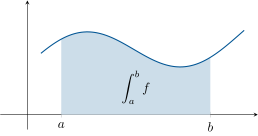
Let f be continuous and positive on [a,b]. The integral
∫abf(x)dx
is the area, in units of area, of the region bounded by the curve of f, the x-axis, and the vertical lines x=a and x=b.
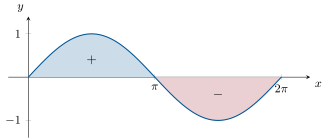
For a function of arbitrary sign, areas below the x-axis are counted negatively; and one sets ∫baf(x)dx=−∫abf(x)dx.
Signed areas: ∫02πsinxdx=0, the region below the axis (red) cancelling the region above (blue).
Positivity: if a≤b and f≥0 on [a,b], then ∫abf≥0; if f≤g, then ∫abf≤∫abg.
Proof. Chasles and positivity are immediate from the area interpretation (areas add up when regions are juxtaposed; a region of positive height has positive area). The comparison follows by applying positivity to g−f. Linearity is intuitively clear for the sum of positive functions (stack the areas) and is proved rigorously at university; it is admitted here. ∎
Proof. If G′=F′=f, then (G−F)′=0 on the intervalI, so G−F is constant.1 Conversely every F+c is a primitive. The condition F(x0)=y0 pins down the constant. ∎
is the primitive of f on I vanishing at a. Consequently, for any primitiveG of f and a,b∈I:
∫abf(t)dt=[G(t)]ab=G(b)−G(a).
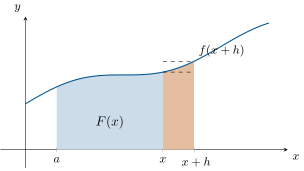
The idea of the proof: the increment F(x+h)−F(x) is the area of the narrow strip (orange), squeezed between the rectangles of heights f(x) and f(x+h) over a base of length h.
Proof when f is increasing. Fix x∈I and h>0 with x+h∈I. By Chasles,
F(x+h)−F(x)=∫xx+hf(t)dt.
Since f is increasing, f(x)≤f(t)≤f(x+h) for t∈[x,x+h], and by comparison of integrals (the integral of a constant c over an interval of length h is ch):
hf(x)≤F(x+h)−F(x)≤hf(x+h),
so
f(x)≤hF(x+h)−F(x)≤f(x+h).
As h→0+, f(x+h)→f(x) by continuity, and the squeeze theorem gives that the difference quotient tends to f(x); the case h<0 is symmetric. Hence F′=f, and F(a)=0. The general (non-monotonic) continuous case is proved at university.
Method 25.7(Recognizing the form u′×(something in u))
To integrate a product, look for a factor which is the derivative of an inner functionu, up to a multiplicative constant. For instance in ∫01xex2dx, the factor x is 21(x2)′:
Proof. The product rule gives (uv)′=u′v+uv′; integrating both sides over [a,b] and using the fundamental theorem for the left-hand side yields [uv]ab=∫abu′v+∫abuv′. ∎
Proof. Integrate the inequalities m≤f(t)≤M over [a,b] and divide by b−a>0. ∎
Method 25.12(Area between two curves)
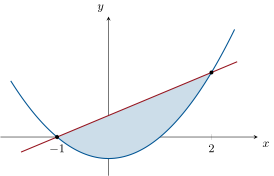
If f≥g on [a,b], the area between the two curves is ∫ab(f(x)−g(x))dx. If the curves cross, split the interval at the crossing points and integrate ∣f−g∣ piece by piece.
The area between the line y=x+1 (red) and the parabolay=x2−1 (blue) is ∫−12((x+1)−(x2−1))dx=29.
25.4 Exercises
Exercise 25.1★
Compute
∫12(3x2−x21)dx,∫0π/2costdt,∫012t+1dt.
Solution
Solution of Exercise 25.1.
∫12(3x2−x21)dx=[x3+x1]12=(8+21)−2=213.
∫0π/2costdt=[sint]0π/2=1.
With u=2t+1, 2t+11=21uu′:
∫012t+1dt=21[ln(2t+1)]01=2ln3.
Exercise 25.2★
Find the primitiveF of f(x)=xex2 on R such that F(0)=1.
Solution
Solution of Exercise 25.2.
xex2=21(x2)′ex2 has primitives21ex2+c. The condition F(0)=1 gives 21+c=1, so
F(x)=2ex2+1.
Exercise 25.3★
Compute the mean value of f(t)=sint on [0,π], and interpret the result on a graph.
Solution
Solution of Exercise 25.3.
μ=π1∫0πsintdt=π1[−cost]0π=π2≈0.64.
Graphically, the rectangle of base [0,π] and height π2 has the same area as the arch of the sine curve.
For n∈N, let In=∫011+ttndt. Show that In+In+1=n+11, and that 0≤In≤n+11.
Deduce that 1−21+31−⋯+n(−1)n−1n→+∞ln2.
Solution
Solution of Exercise 25.6.
1.I=[ln(1+t)]01=ln2.
2.
In+In+1=∫011+ttn(1+t)dt=∫01tndt=n+11.
On [0,1], 0≤1+ttn≤tn, so by comparison 0≤In≤n+11.
3. From the recurrence, by a telescoping induction,
In=(−1)n(I0−(1−21+⋯+n(−1)n−1)),
i.e.k=1∑nk(−1)k−1=ln2−(−1)nIn (recall I0=ln2). Since ∣In∣≤n+11→0, the alternating harmonic sum tends to ln2.
Exercise 25.7★★
The speed of a train (in m/s) during the first 100 seconds after departure is modeled by v(t)=30(1−e−t/50). Compute the distance traveled during these 100 seconds, and the train’s average speed over the interval.
Numerically d≈1500+203=1703 m. Average speed: 100d=15(1+e−2)≈17.0 m/s.
Exercise 25.8★★★
For n≥1, let Sn=n1k=1∑n1+k/n1.
Interpret Sn as an area of rectangles approximating a region under the curve of t↦1+t1 on [0,1].
Using the monotonicity of t↦1+t1, show that
Sn≤∫011+tdt≤Sn+n1(1−21),
and deduce n→+∞limSn=ln2.
Solution
Solution of Exercise 25.8.
1.Sn is the total area of n rectangles of width n1 and heights f(nk), k=1,…,n, where f(t)=1+t1: it is the “right endpoint” rectangle approximation of the area under f on [0,1].
2.f is decreasing, so on each interval[nk−1,nk], f(nk)≤f(t)≤f(nk−1); integrating and summing over k:
Sn≤∫01f(t)dt≤Sn+n1(f(0)−f(1))=Sn+2n1.
(The middle term of the exercise’s display, with f(0)−f(1)=1−21, is exactly this bound.) Hence 0≤ln2−Sn≤2n1→0, so Sn→ln2.
Exercise 25.9★★★
(Wallis integrals.) For n∈N, let Wn=∫0π/2sinntdt.
Compute W0 and W1.
Writing sinn+2t=sint⋅sinn+1t and integrating by parts, show that Wn+2=n+2n+1Wn.
Deduce W2, W3, W4 and show that (Wn) is decreasing and positive.
Solution
Solution of Exercise 25.9.
1.W0=∫0π/2dt=2π and W1=[−cost]0π/2=1.
2. Integrate by parts with u′=sint, v=sinn+1t, so u=−cost, v′=(n+1)sinntcost:
the bracket vanishing at both ends. Hence Wn+2=(n+1)(Wn−Wn+2), i.e.Wn+2=n+2n+1Wn.
3.W2=21W0=4π, W3=32W1=32, W4=43W2=163π. On (0,2π), 0<sint<1, so sinn+1t≤sinnt with strict inequality on the interior; integrating, 0<Wn+1≤Wn (in fact <): (Wn) is decreasing and positive.
25.5 Problem: Archimedes against the machine
Problem 25.1
Weekend problem — the area under the parabola, computed three ways across twenty-two centuries, and the logarithm’s secret identity as an area
Around 240 BC, Archimedes computed the exact area of a parabolic segment — without coordinates, without limits, without algebra. Nineteen centuries later, Riemann’s rectangles redid it by brute squeeze; and the fundamental theorem of calculus (Theorem 25.5) now does it in one line. This problem plays all three matches, then uses the same machine to reveal what the logarithm really is: an area with a scaling symmetry.
Part I — Fluency.
Compute ∫01(3x2−2x+1)dx, ∫1exdx, and ∫0π/2cosxdx.
Spot the u′u-forms (Method 25.7): ∫01xex2dx and ∫01x2+12xdx.
Riemann’s setup for the area under y=x2 on [0,1]: write the lower sum Ln and the upper sum Un over n equal rectangles (as in Exercise 25.8).
Prove by induction (Problem 20.1’s machine) the sum-of-squares formula
12+22+⋯+n2=6n(n+1)(2n+1).
Deduce closed forms for Un and Ln, compute their common limit, and conclude: the area is 31.
Now the machine: compute ∫01x2dx by the fundamental theorem, in one line. Compare the efforts.
Archimedes stated it otherwise: a parabolic segment is 34 of its inscribed triangle. For the segment cut from y=x2 by the chord joining (−1,1) to (1,1): compute the segment’s area with an integral, the inscribed triangle’s area (apex at the vertex (0,0)), and verify the master’s ratio.
Archimedes’ own method: fill the segment with the big triangle T, then two triangles totalling 4T, then four totalling 16T, and so on. Sum the geometric series and recover 34T — the endlessly bitten chocolate bar of the Middle School volume, eaten by a Greek geometer.
One sentence each: exhaustion (Archimedes), squeeze (Riemann), anti-differentiation (Newton–Leibniz) — what does each need, and what does each give?
Part III — The logarithm is an area. For x>0, set A(x)=∫1xtdt.
The scaling miracle: fix a>0 and study g(x)=A(ax)−A(x). Compute g′ (chain rule), deduce that g is constant, evaluate the constant — and conclude the functional equation
ln(ab)=lna+lnb,
proved by pure calculus: the area from 1 to ab splits into scaled copies.
Deduce from question 14: ln(an)=nlna and lna1=−lna.
Exercise 25.8 reads n+11+n+21+⋯+2n1 as rectangles under 1+t1: compute this sum for n=10 (three decimals) and compare with ln2. Which harmonic-flavored sums, divergent term by term, here converge to an area?
Part IV — Accumulation.
A car accelerates with speed v(t)=3t2 m/s for t∈[0,10]. Compute the distance covered, the mean speed, and the instant at which the instantaneous speed equals the mean speed.
A 4-meter rod has linear density ρ(x)=2+x kg/m. Compute its total mass and its center of mass ∫04ρ(x)dx∫04xρ(x)dx — the balance point of the Middle School volume’s cardboard triangle, finally computed with weights that vary.
Wallis’s integrals (Exercise 25.9): compute W0, W1, and W2=∫0π/2sin2tdt using the linearization of Problem 24.1. (Their infinite ladder climbs, in the university volumes, to a product formula for π and to the normalization of the bell curve.)
Finale — integration’s three faces: an area by definition, an accumulation in the world (distance, mass), an anti-derivative by the fundamental theorem; and its history in three names. Close with the chapter’s pearl: which everyday button on the calculator is secretly the area under t1 — and which identity did that area prove?
Solution
Solution of Problem 25.1.
1.[x3−x2+x]01=1; [lnx]1e=1; [sinx]0π/2=1.
2.[21ex2]01=2e−1; [ln(x2+1)]01=ln2.
3.∫01xex=[xex]01−∫01ex=e−(e−1)=1. And ∫1elnx=[xlnx]1e−∫1e1=e−(e−1)=1.
4.π1∫0πsinxdx=π2≈0.64: the average height of the sine arch is π2, noticeably more than one half — the arch is fat near its top.
5.∫01(x−x2)dx=21−31=61.
6.Ln=n1∑k=0n−1(nk)2 and Un=n1∑k=1n(nk)2: rectangles of width n1 with heights read at the left (below the curve) or right (above) endpoints.
7. True for n=1 (1=61⋅2⋅3). If it holds for n, then adding (n+1)2:
8.Un=n31⋅6n(n+1)(2n+1)=6(1+n1)(2+n1)→62=31, and Ln=Un−n1→31: squeezed between its staircases, the area is exactly 31.
9.∫01x2dx=[3x3]01=31: one line. The fundamental theorem converts an infinite squeeze into a single anti-derivative evaluation — that is why it is called fundamental.
10. Segment: ∫−11(1−x2)dx=2−32=34. Triangle with base the chord (length 2, at height 1) and apex (0,0): area 21×2×1=1. Ratio: 34 — exactly Archimedes’ theorem, verified by the machine he lacked.
11.T(1+41+161+…)=T⋅1−411=34T (geometric series of ratio 41): with T=1, the segment’s area 34 again. Archimedes summed the series by a purely geometric argument — the quarter-bites of the chocolate-bar kind, two millennia before limits were words.
12. Exhaustion needs a clever geometric self-similarity and gives exact areas case by case; Riemann needs only monotonicity and gives a universal definition at the price of computing sums; the fundamental theorem needs the whole edifice of derivatives and repays it by making areas one-line computations.
13.A(1)=0 and A′(x)=x1 (fundamental theorem): A is the primitive of x1 on (0,+∞) vanishing at 1 — which is precisely the natural logarithm.
14.g′(x)=axa−x1=0: g is constant; at x=1: g(1)=A(a)−A(1)=A(a). Hence A(ax)=A(a)+A(x) for all x, and with x=b: ln(ab)=lna+lnb. The hyperbola’s area does not care about horizontal scale: stretching t by a squashes t1 by a, and the area survives — addition of logarithms is a scaling symmetry.
15. Iterating: ln(an)=nlna (induction on n). And 0=ln1=ln(a⋅a1)=lna+lna1: lna1=−lna.
16.111+121+⋯+201≈0.669, against ln2≈0.693: ten rectangles under 1+t1, already close. The harmonic series diverges, but its slices from n to 2n settle on ln2: divergence at a crawl, measured by an area.
17. Distance: ∫0103t2dt=1000 m. Mean speed: 100 m/s. Instant with v=100: 3t2=100: t=3100≈5.77 s.
18. Mass: ∫04(2+x)dx=8+8=16 kg. Moment: ∫04(2x+x2)dx=16+364=3112. Center of mass: 16112/3=37≈2.33 m — pushed beyond the middle by the heavier right end, as intuition demands.
19.W0=2π; W1=[−cost]0π/2=1; and W2=∫0π/221−cos2tdt=4π.
20. Area: the definition, squeezed by staircases. Accumulation: distances from speeds, masses from densities — the integral as a running total. Anti-derivative: the fundamental theorem, Newton’s and Leibniz’s shortcut through Archimedes’ patience. The pearl: the ln button is the area under t1, and that area’s scaling symmetry is the identity ln(ab)=lna+lnb.