High School Mathematics · कक्षा 10–12
5Coordinate Geometry
Descartes’ great idea was to describe points by pairs of numbers, turning geometry problems into computations. With just two formulas — the midpoint and the distance — one can prove that a triangle is isosceles, that a quadrilateral is a parallelogram, or that three points are aligned, without drawing a single auxiliary line.
5.1 Coordinates in the plane
Definition 5.1 (Coordinate system)
A coordinate system of the plane consists of an origin and two graduated axes through : the horizontal -axis and the vertical -axis. Every point then has a unique pair of coordinates : its abscissa and its ordinate . The system is orthonormal when the axes are perpendicular and carry the same unit of length. All systems in this chapter are orthonormal.
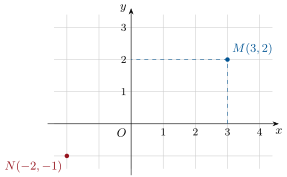
5.2 Midpoint of a segment
Proposition 5.2 (Midpoint formula)
Let and . The midpoint of the segment has coordinates
Proof. Consider the horizontal coordinates. Going from to , the abscissa changes by ; the point halfway has abscissa
the average of the two abscissas. The same computation applies to the ordinates. ∎
Example 5.3
With and , the midpoint of is
The formula also runs backwards: if and the midpoint is , then satisfies and , so and : the point is the symmetric of about .
5.3 Distance between two points
Theorem 5.4 (Distance formula)
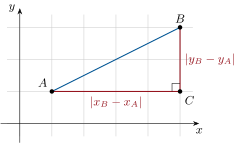
In an orthonormal system, the distance between and is
Proof. Let be the point : it has the same height as and the same abscissa as , so the triangle has a right angle at . Its legs are horizontal and vertical segments, of lengths and . By the Pythagorean theorem,
and taking the square root (both sides are nonnegative) gives the formula. ∎
Example 5.5
With and :
Distances are usually kept in exact (square root) form; only round at the very end if a decimal answer is needed.
Remark 5.6
The order of the points does not matter: . But do not forget the squares! The distance is not .
5.4 Using the formulas in geometry
Method 5.7 (Nature of a triangle)
Given three points , , by their coordinates:
- compute the three squared lengths , , with the distance formula (keeping squares avoids square roots);
- two equal squared lengths the triangle is isosceles;
- if the largest squared length is the sum of the two others, the triangle is right-angled at the vertex opposite the longest side, by the converse of the Pythagorean theorem.
Example 5.8
Let , and . Then
First, , so : the triangle is isosceles at . Moreover , so by the converse of the Pythagorean theorem the triangle is also right-angled at .
Method 5.9 (Recognizing a parallelogram)
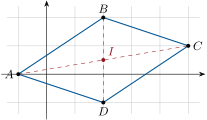
A quadrilateral is a parallelogram exactly when its diagonals and have the same midpoint. So: compute both midpoints with the midpoint formula and compare them.
Example 5.10
Let , , and . The midpoint of is ; the midpoint of is . They coincide, so is a parallelogram.
5.5 Exercises
Exercise 5.1 ★
Let and . Compute the coordinates of the midpoint of and the distance .
Exercise 5.2 ★
Let and . Find the coordinates of the point such that is the midpoint of .
Exercise 5.3 ★
Which of the points , and is closest to the origin ? Answer with exact distances.
Solution
Solution of Exercise 5.3.
; ; . Since , the square root being increasing, is the closest to the origin.
Exercise 5.4 ★
Plot the points , , on graph paper, then show by computation that the triangle is isosceles. Is it right-angled?
Solution
Solution of Exercise 5.4.
Squared lengths:
: the triangle is isosceles at . Moreover : by the converse of the Pythagorean theorem it is right-angled at as well.
Exercise 5.5 ★★
Let , , and .
- Show that is a parallelogram.
- Compute and . Is a rhombus (all sides equal)?
- Compute and . Is a rectangle (equal diagonals)?
Exercise 5.6 ★★
The circle with center and radius consists of all points at distance from . Which of the points , , lie on this circle? Inside it? Outside it?
Solution
Solution of Exercise 5.6.
Compute squared distances to and compare with :
and are on the circle; is inside it ().
Exercise 5.7 ★★
Let and . Find all points of the -axis that are equidistant from and . (Write and solve for .)
Solution
Solution of Exercise 5.7.
and . Setting :
The unique such point is .
Exercise 5.8 ★★
Let , .
- Compute the coordinates of the midpoint of .
- Show that , then verify by computing , that is equidistant from and .
- Find a second point, on the -axis, equidistant from and .
Solution
Solution of Exercise 5.8.
1. .
2. is indeed . And , : the midpoint is equidistant from the two endpoints, as expected.
3. Look for with :
so : the point .
Exercise 5.9 ★★
The points , and are given. Compute , and , and deduce that , , are aligned. (Three points are aligned exactly when the largest of the three distances is the sum of the two others.)
Solution
Solution of Exercise 5.9.
Then : the triangle inequality is an equality, so lies on the segment — the three points are aligned.
Exercise 5.10 ★★★
Let and with , and let be the midpoint of . Show by computation that , where is the origin. (This proves a classical theorem: in a right triangle, the midpoint of the hypotenuse is equidistant from the three vertices.)
5.6 Problem: Descartes’ bridge — circle equations and how to find where you are
Problem 5.1
Weekend problem — the circle becomes an equation, old theorems become computations, and three beacons locate a point: trilateration by algebra
In 1637 René Descartes built a bridge between two continents: every curve of geometry became an equation, every geometric question a computation. This problem walks the bridge in both directions — deriving the circle’s equation from the distance formula (Theorem 5.4), re-proving classical theorems in three lines of algebra, and ending where the bridge carries the most traffic today: computing a position from distance signals, the flat-earth heart of GPS.
Part I — The circle gets an equation.
A point lies on the circle of center and radius exactly when . Square this condition to obtain the circle’s equation:
- Test membership: which of , , are on the circle, inside it, outside it?
A circle in disguise: complete the squares (Problem 2.1) in
and give its center and radius.
- Do the same with . What does the completed form reveal? State the criterion: when does describe a circle, a single point, or nothing at all?
- Intersect the circle of question 3 with the horizontal line : substitute and solve. How many points, and what is the geometric name of such a line?
Part II — Old theorems in three lines.
- The circle theorem of the Middle School volume’s circle theorem (a right angle in every half-circle), re-proved by algebra: let and be the ends of a diameter and any point of the circle . Compute and conclude with the converse of Pythagoras that is right.
The median theorem: with , (so the midpoint of is the origin ), show that for every point :
- Deduce the locus of the points with when : what curve, which center, what radius?
- A different locus: , ; find all points with . (Square, expand, complete the squares: a famous circle appears — Apollonius knew it without coordinates.)
- In one or two sentences: what does Descartes’ bridge change about how theorems get proved? Compare question 6 with the rectangle proof of the Middle School volume’s circle theorem (a right angle in every half-circle).
Part III — Three beacons find you. Your position is unknown. Beacon measures your distance as ; beacon also measures .
- Write the two circle equations, subtract them, and watch the squares cancel: what simple equation survives? Combine with one circle to find the two candidate positions.
- A third beacon measures your distance as . Compute its distance to each candidate and decide where you are.
- Explain why subtracting two circle equations always yields the equation of a line (which terms cancel?), and what that line is geometrically when the circles cross at two points.
- Real satellite positioning works in space and with imperfect clocks: each satellite gives (via signal travel time) one distance, hence one sphere. How many unknowns does a receiver have (position and its own clock error), and why does GPS therefore listen to at least four satellites?
- Precision: suppose beacon ’s distance is really instead of (all else unchanged). Redo the subtraction of question 11 to find the new , and quantify how far the estimate moved. (Compare the error budget ideas of Problem 1.1.)
Part IV — The surveyor’s toolkit.
- The shortest watering path: a camp at , a barn at , a straight river along the axis . To go from to the river and then to with the least walking: reflect across the river into , and find where the segment crosses the river. Give the crossing point and the minimal total length. (The idea is the billiard-bounce exercise of the Middle School volume, now fully computable.)
- Confirm minimality on a rival: compute the total path via and check it loses to your answer.
- Classify the quadrilateral , , , completely: parallelogram? rhombus? rectangle? square? (Method 5.9, Method 5.7 — compare diagonals too.)
- Given , , , find such that is a parallelogram (the diagonal-midpoint trick of the half-turns weekend problem of the Middle School volume, now in formulas).
- Finale: three tools — midpoint formula, distance formula, subtraction of circle equations. For each, name the kind of question it settled in this problem, and state what the next two chapters add to the kit (directions and slopes: vectors and line equations).
Solution
Solution of Problem 5.1.
1. by the distance formula (Theorem 5.4) — squaring is harmless, both sides being positive.
2. : : on the circle. : : on it too. : : inside.
3. and , so the equation reads : center , radius .
4. : a sum of squares is never negative — no point satisfies it: the empty set. In general is a circle of radius if , the single point if , and empty if .
5. With : , so : the single point . One contact point: the line is tangent to the circle.
6. (using ). Since , the triangle satisfies : right-angled at (converse of Pythagoras) — three lines, as promised.
7. , and . Identity proved.
8. gives : the circle of center the midpoint and radius .
9. : , i.e. , or : completing, — the circle of center and radius (the circle of Apollonius of ratio ).
10. The bridge converts constructions into computations: no auxiliary rectangle, no case analysis — one expansion and the theorem falls out. The price: computations carry less geometric insight; the classical proof shows why, the algebraic one shows that — a working mathematician keeps both.
11. and . Subtracting: , i.e. : . Then : . Candidates and .
12. From to : — matches. From : — wrong. You are at .
13. Both equations carry the same (or with equal coefficients after expansion): subtraction cancels the squares and leaves an equation of degree one — a line. When the circles meet twice, that line passes through both meeting points: it is the line of the common chord.
14. Four unknowns: three coordinates plus the receiver’s clock error (a cheap watch, corrected by the mathematics). Each satellite supplies one equation, so four satellites give four equations for four unknowns — with more satellites improving the precision.
15. Subtraction now gives : a cm error in one distance moved the estimate about cm here. Errors propagate through every formula — the interval-arithmetic caution of Problem 1.1, now with coordinates.
16. . The line has slope and crosses at : drink at . Minimal length: .
17. Via : . The reflected straight line wins.
18. Diagonal midpoints: : ; : — equal: parallelogram. Sides: : rhombus. Diagonals: : not a rectangle, hence not a square. Verdict: a rhombus, and nothing more.
19. : then and share the midpoint .
20. Midpoint formula: parallelograms and centers (questions 18, 19). Distance formula: circles, loci, triangle natures, shortest paths (questions 1–9, 16). Subtraction of circle equations: the line that locates a position (questions 11–15). Missing from the kit: a clean algebra of directions — vectors — and of slopes — line equations and systems: the next two chapters supply exactly that.