High School Mathematics · Grades 10–12
13Sequences: A First Course
A sequence is a list of numbers produced by a rule: the successive balances of a savings account, the sizes of a population year after year. This chapter studies the two families that dominate applications — arithmetic sequences, which grow by equal steps, and geometric sequences, which grow by equal ratios. The rigorous theory of limits is developed in Chapter 20.
13.1 Defining a sequence
Definition 13.1 (Sequence)
A sequence assigns to each integer (or ) a real number , its term of index . A sequence can be given
- explicitly, by a formula for in terms of : e.g. ;
- recursively, by its first term and a rule to pass from each term to the next: e.g. and .
Example 13.2
For : , , , and directly. For , : , , — each term needs the previous one; reaching takes ten steps (or a general formula, see Exercise 13.11).
13.2 Arithmetic sequences
Definition 13.3 (Arithmetic sequence)
A sequence is arithmetic with common difference if each term is obtained from the previous one by adding :
Equivalently: the difference is constant, equal to .
Theorem 13.4 (General term)
If is arithmetic with first term and common difference , then
Proof. To go from to , the rule “add ” is applied times: one step gives , two steps give , and after steps every application has contributed one , so . (This “and so on” is made rigorous by induction in Chapter 20.) The general formula follows by counting the steps from to . ∎
Theorem 13.5 (Sum of consecutive integers)
For every integer :
More generally, a sum of consecutive terms of an arithmetic sequence equals
Proof. Write the sum twice, the second time in reverse order, and add column by column:
There are columns, each summing to , so . For a general arithmetic sequence the same pairing works: first last second second-to-last , because moving one step forward at the left end () is compensated by one step backward at the right end (). ∎
Example 13.6
. The sum of the odd numbers ( terms) is .
13.3 Geometric sequences
Definition 13.7 (Geometric sequence)
A sequence is geometric with common ratio if each term is obtained from the previous one by multiplying by :
Equivalently, when no term vanishes: the ratio is constant, equal to .
Theorem 13.8 (General term)
If is geometric with first term and ratio , then
Proof. Same step-counting as in Theorem 13.4: from to , the rule “multiply by ” is applied times, contributing a factor . ∎
Theorem 13.9 (Geometric sum)
For every real and integer :
Proof. Let . Multiply by : . Subtract:
because every intermediate term appears once in each sum and cancels. Hence , and dividing by gives the formula. ∎
Example 13.10
: doubling grains of rice on the squares of a chessboard overwhelms any granary well before the th square, where the total is .
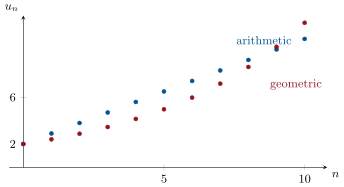
Method 13.11 (Recognizing the type of a sequence)
Compute and simplify. If the result is a constant , the sequence is arithmetic. Otherwise compute (terms nonzero) and simplify: a constant means geometric. If neither is constant, the sequence is of neither type — never conclude from the first few terms alone.
Example 13.12
For : for all : geometric with ratio . For : but , and is not even defined — neither arithmetic nor geometric.
13.4 Monotonicity
Definition 13.13 (Monotonic sequence)
A sequence is increasing if for all , and decreasing if for all .
Method 13.14 (Studying monotonicity)
Study the sign of . For sequences with positive terms, one may instead compare to .
Example 13.15
An arithmetic sequence is increasing when (), decreasing when . A geometric sequence with and is increasing: ; with and it is decreasing.
13.5 Long-run behaviour, informally
What happens to when becomes very large? For an arithmetic sequence with , the terms exceed any fixed number eventually. For a geometric sequence with , the terms shrink towards : multiplying repeatedly by , say, erodes any starting value. And for the terms explode, as in Example 13.10.
Remark 13.16
These statements can be made perfectly precise — “the terms eventually stay within any given distance of ” — and proved. That is the theory of limits, the opening theme of Chapter 20.
13.6 Exercises
Exercise 13.1 ★
For each sequence, compute , , :
Solution
Solution of Exercise 13.1.
: , , .
, : , , .
: , , .
Exercise 13.2 ★
is arithmetic with and . Compute and . is arithmetic with and . Find the common difference and .
Solution
Solution of Exercise 13.2.
and .
For : gives , so ; then .
Exercise 13.3 ★
is geometric with and . Compute . is geometric with positive terms, and . Find the ratio and .
Solution
Solution of Exercise 13.3.
.
For : gives , so and (the terms are positive). Then .
Exercise 13.4 ★
Compute
Solution
Solution of Exercise 13.4.
.
is arithmetic with and terms: sum .
is geometric with and terms: .
Exercise 13.5 ★
Determine whether each sequence is arithmetic, geometric, or neither:
Solution
Solution of Exercise 13.5.
: arithmetic with .
: geometric with .
, , : the differences and differ, so not arithmetic; is not even defined, and the ratios : neither.
Exercise 13.6 ★★
A theater has rows: seats in the first row, and each row has more seats than the one before it. How many seats are in the last row? In the whole theater?
Solution
Solution of Exercise 13.6.
The row sizes are arithmetic: first term , difference . The last (20th) row has seats. The total is seats.
Exercise 13.7 ★★
A population of bacteria doubles every hour; at noon there are bacteria. How many are there at 8 p.m.? After how many full hours does the population first exceed one million? (Solve by trying successive powers of .)
Solution
Solution of Exercise 13.7.
After hours the population is . At 8 p.m., : bacteria. We need , i.e. : since and , the population first exceeds one million after full hours, at 11 p.m.
Exercise 13.8 ★★
Every month, a saver deposits euros into an account that pays interest per month on the existing balance (interest is credited just before the deposit). Let be the balance right after the -th deposit, so and . Compute and , and explain why is neither arithmetic nor geometric.
Solution
Solution of Exercise 13.8.
and . The differences and are not equal, so is not arithmetic; the ratios and are not equal either, so it is not geometric. (Mixed “multiply then add” recursions like this one are solved by the auxiliary-sequence trick of Exercise 13.11.)
Exercise 13.9 ★★
Study the monotonicity of the sequences
where . (For , compare to .)
Solution
Solution of Exercise 13.9.
: negative for , positive for . So decreases down to , then increases: it is not monotonic.
has positive terms and
which is for , for , and for : the sequence increases up to , then decreases.
Exercise 13.10 ★★
The sum of the first terms of an arithmetic sequence with and equals . Find . (Set up a quadratic equation in and use Chapter 10.)
Solution
Solution of Exercise 13.10.
The first terms are , with and . Their sum is
so . Here , and (the negative root is rejected). Check: .
Exercise 13.11 ★★★
Let and .
- Compute and conjecture a formula for .
- Let . Show that is geometric, give its ratio and first term.
- Deduce an explicit formula for and verify your conjecture.
Solution
Solution of Exercise 13.11.
1. , , : each term is one more than , suggesting .
2. With :
so is geometric with ratio and first term .
3. Hence and , confirming the conjecture. (The number subtracted in is the fixed point of ; the same idea reappears for in Chapter 20.)
13.7 Problem: The tower of Brahma and Fibonacci’s rabbits
Problem 13.1
Weekend problem — two legendary recurrences: the tower that ends the world, the sequence that grows like gold, and the auxiliary trick that tames loans
Two sequences rule the folklore of mathematics. One counts the moves of the tower of Brahma — sixty-four golden disks whose transfer, legend says, will end the world. The other counts Fibonacci’s rabbits and hides the golden ratio. Neither is arithmetic, neither is geometric — and both surrender to this chapter’s weapons: recurrences, geometric sums (Theorem 13.9), and the auxiliary-sequence trick of Exercise 13.11, which also computes your mortgage.
Part I — The tower of Brahma. The puzzle: disks of decreasing size are stacked on peg A; move the whole stack to peg C, one disk at a time, never placing a larger disk on a smaller one (peg B may help). Let be the minimal number of moves.
- Play (with coins) and record , , .
- Explain the strategy behind the recurrence : what must happen before and after the largest disk moves?
- Solve the recurrence with the trick of Exercise 13.11: set , show is geometric, and conclude .
- The legend’s tower has disks, and the monks move one disk per second. Using , estimate the transfer time in years (a year is about seconds; compare Example 13.10, the same giant in another story). Should we worry?
- Why can no strategy beat moves? Argue that any solution obeys : what must be true of the top disks just before, and just after, the bottom disk’s move?
Part II — Fibonacci. Define and (each term the sum of the two before — the rhythm-counting rule of the Middle School volume, now with its European name).
- List through .
- Show that is neither arithmetic nor geometric, but that it is strictly increasing from on (Method 13.14 and the recurrence).
Prove the sum identity
by telescoping: write each as and watch the sum collapse. Verify it for .
- Prove the squares identity , telescoping with . Verify for . (Picture: squares of sides tile a rectangle — the famous Fibonacci spiral’s skeleton.)
- Cassini’s identity states . Verify it for — and recognize the engine of the vanishing-square trick played in the Middle School volume’s areas problem.
- Show from the recurrence that : Fibonacci at least doubles every two steps — it grows at least as fast as a geometric sequence of ratio .
- Compute the ratios for to (three decimals). Admitting that they settle on a limit , pass the relation to the limit and solve: which number of Problem 2.1 do the rabbits worship?
Part III — The auxiliary trick, at the bank.
- Generalize Exercise 13.11: for with , let (the fixed point). Show is geometric of ratio , and conclude .
- A loan: euros at interest per month, repaid euros per month, so the debt obeys . Apply question 13 (fixed point first!) to get an explicit formula for .
- With a calculator, find the first month at which the debt is cleared, and the total amount repaid. How much did the borrowing itself cost?
- A town of inhabitants grows by a year and welcomes newcomers besides: . Give the explicit formula and the population after years.
Part IV — The two royal families.
- Compute (Theorem 13.5 — little Gauss’s sum from the Middle School volume, now official), and (Theorem 13.9).
- Compute the sum of the arithmetic sequence (how many terms?).
- Savings plan: euros deposited each month, earning monthly; after the -th deposit the balance is . Compute the balance after years ().
- Finale — the sequence-tamer’s kit: explicit against recurrent descriptions; the two royal families and their sum formulas; the auxiliary sequence that turns affine recurrences into geometric ones; and Fibonacci, first citizen outside both families, tamed today by identities and awaiting matrices (grade 12) and limits for full capture. One sentence each.
Solution
Solution of Problem 13.1.
1. , , .
2. To move the biggest disk, the disks above it must first migrate to the spare peg ( moves); the big disk crosses ( move); the disks must then climb back on top of it ( moves): .
3. : geometric of ratio with , so and .
4. seconds; dividing by seconds per year: about years — six hundred billion years, forty times the age of the universe. The monks can take coffee breaks.
5. In any legal solution, consider the bottom disk’s first move: at that instant the other disks must all sit on the one remaining peg (at least moves to get them there), and after the bottom disk’s last move they must all come back on top of it (at least more): any solution needs at least moves. The recurrence is a floor as well as a ceiling: is optimal.
6. .
7. Not arithmetic ( but , : differences change); not geometric ( but ). Increasing: for , .
8. , so
For : .
9. ; summing telescopes to (with ): the sum of squares is . For : .
10. ; ; : alternating . This off-by-one between and is exactly the magician’s gained-or-lost square unit: cutting a square into pieces reassembled as an rectangle must create or swallow one unit — the sliver.
11. (the sequence increases): every two indices, at least a doubling — growth at least geometric of ratio per index.
12. ; ; ; ; ; ; ; . If : from , dividing by : , so , i.e. : , the golden ratio of Problem 2.1. The rabbits multiply in gold.
13. ; since , this is : geometric of ratio . Hence and .
14. Fixed point: gives . So .
15. requires : , : the st payment clears the debt (and is slightly smaller than ). Total repaid: just under euros — the borrowed cost about euros of interest.
16. Fixed point , so . After years: : inhabitants.
17. ; and .
18. From to in steps of : terms; sum .
19. Balance euros — of which deposited and about earned: geometric sums are the bank’s native tongue.
20. Explicit formulas answer “what is ” instantly; recurrences describe how systems actually evolve — the art is converting the second into the first. Arithmetic sequences add, geometric ones multiply, and each family owns a sum formula (Gauss’s pairing; the doubling trick). The fixed-point-and-auxiliary trick converts every affine recurrence into a geometric one — loans, populations, and the tower all fell to it. Fibonacci obeys neither family, yet telescoping identities caught its sums and squares; its full portrait (an exact formula, the golden limit) awaits stronger tools.