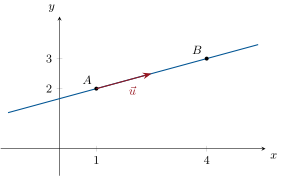
Vectors encode displacements; lines are their trajectories. The key new tool of this chapter is the determinant, a single number that decides whether two vectors are collinear — and, from there, produces equations of lines and settles alignment and parallelism questions by pure computation. The same ideas extend to space in Chapter 31.
15.1 Vectors: a recap
Definition 15.1(Vector, coordinates)
A vectoru represents a displacement: all arrows with the same direction, orientation and length represent the same vector. In a coordinate system, u(x,y) records the displacement (x horizontally, y vertically); for points A(xA,yA) and B(xB,yB),
AB(xB−xA,yB−yA).
Vectors add coordinate-wise, and λu has coordinates(λx,λy).
Proof.M is characterized by AM=21AB: coordinate-wise, xM−xA=21(xB−xA), so xM=2xA+xB, and similarly for yM. ∎
15.2 Collinearity and the determinant
Definition 15.3(Collinear vectors)
Two vectors are collinear if one is a scalar multiple of the other: v=λu for some λ∈R (or u=0). Geometrically: they have the same direction, or one of them is zero.
Proof. (⇒) If v=λu, then x′=λx and y′=λy, so det(u,v)=x(λy)−(λx)y=0; if u=0, the determinant is trivially 0.
(⇐) Suppose xy′−x′y=0 and u=0, say x=0 (the case y=0 is symmetric). Set λ=xx′. Then x′=λx by construction, and the relation xy′=x′y=λxy gives, after dividing by x=0, y′=λy. Hence v=λu. ∎
Example 15.6
u(3,−2) and v(−6,4): det=3×4−(−6)×(−2)=12−12=0, collinear (indeed v=−2u). u(3,−2) and w(2,1): det=3+4=7=0, not collinear.
Method 15.7(Alignment of three points)
A, B, C are aligned if and only if AB and AC are collinear: compute both vectors and check det(AB,AC)=0.
15.3 Cartesian equations of lines
Definition 15.8(Direction vector)
A direction vector of a line d is any nonzero vectoru such that AB is collinear with u for all points A,B of d.
an equation of the announced form with c=−(axA+byA). Conversely, the solutions of ax+by+c=0 with, say, b=0 are the points (x,−bax+c): subtracting two of them shows every chord is collinear with (−b,a), and one solution always exists — it is the line through it directed by (−b,a). ∎
Method 15.10(Line through two points)
To find an equation of the line (AB): compute the direction vectorAB(xB−xA,yB−yA); match it with (−b,a), i.e. take a=yB−yA and b=−(xB−xA); determine c by plugging in the coordinates of A.
Example 15.11
Line through A(1,2) and B(4,3): AB(3,1), so a=1, b=−3, and the equation is x−3y+c=0. Plugging in A: 1−6+c=0, so c=5. Equation: x−3y+5=0. Check with B: 4−9+5=0.
Remark 15.12
When b=0, the equation can be solved for y: y=mx+p with slopem=−ba. The cartesian form ax+by+c=0 is more general: it also covers vertical lines (b=0), which have no slope.
The line through A(xA,yA) with direction u(α,β) is the set of points
M(xA+tα,yA+tβ),t∈R.
The number t is the parameter: each value of t produces one point of the line, as if travelling along it at constant speed u.
Example 15.14
The line of Example 15.11 is also {(1+3t,2+t):t∈R}: t=0 gives A, t=1 gives B. Eliminating t (t=y−2, so x=1+3(y−2)) recovers x−3y+5=0.
15.5 Relative positions of two lines
Proposition 15.15(Parallel or intersecting)
Two lines with direction vectorsu and v are parallel if and only if det(u,v)=0. In equation form: d:ax+by+c=0 and d′:a′x+b′y+c′=0 are parallel if and only if ab′−a′b=0. Non-parallel lines meet in exactly one point.
Proof. Parallelism means collinear directions, which is Theorem 15.5; with u(−b,a) and v(−b′,a′), the determinant is (−b)a′−(−b′)a=ab′−a′b. If the lines are not parallel, solving the two equations simultaneously (by substitution or combination) leads to a unique solution: the system behaves like a nonzero-determinant2×2 system. ∎
Method 15.16(Intersection of two lines)
Solve the system of the two equations: isolate one unknown in one equation and substitute into the other, or combine the equations to eliminate one unknown. Always check the resulting point in bothequations.
Example 15.17
Intersect d:x−3y+5=0 and d′:2x+y−4=0. From d′: y=4−2x. Substituting into d:
x−3(4−2x)+5=0⟺x−12+6x+5=0⟺7x=7⟺x=1,
then y=2. The lines meet at (1,2). Check in d: 1−6+5=0.
15.6 Exercises
Exercise 15.1★
Given A(2,−1), B(5,3) and C(−1,1), compute the coordinates of AB, AC, AB+AC and 2AB−3AC, and the midpoint of [BC].
Solution
Solution of Exercise 15.1.
AB(3,4), AC(−3,2), AB+AC(0,6), 2AB−3AC(6+9,8−6)=(15,2). The midpoint of [BC] is (25+(−1),23+1)=(2,2).
Find a cartesian equation of the line through A(2,1) with direction vectoru(3,−1), then of the line through B(0,4) and C(2,0).
Solution
Solution of Exercise 15.3.
Through A(2,1), direction (3,−1): matching (−b,a)=(3,−1) gives a=−1, b=−3, so −x−3y+c=0; plugging in A: −2−3+c=0, c=5. Multiplying by −1: x+3y−5=0.
Through B(0,4) and C(2,0): BC(2,−4), so a=−4, b=−2: −4x−2y+c=0; plugging in B: −8+c=0, c=8. Simplifying by −2: 2x+y−4=0. Check with C: 4+0−4=0.
Exercise 15.4★
For the line d:3x−2y+6=0, give a direction vector, the intersections with the two coordinate axes, and decide whether the points P(2,6) and Q(1,4) belong to d.
Solution
Solution of Exercise 15.4.
A direction vector is (−b,a)=(2,3). Intersections: x=0 gives y=3, point (0,3); y=0 gives x=−2, point (−2,0). For P(2,6): 3×2−2×6+6=0, so P∈d. For Q(1,4): 3−8+6=1=0, so Q∈/d.
Exercise 15.5★★
Are the points A(1,2), B(4,8), C(−2,−4) aligned? Same question for D(0,1), E(2,4), F(5,9).
Solution
Solution of Exercise 15.5.
AB(3,6) and AC(−3,−6): det=3×(−6)−(−3)×6=0, so A, B, C are aligned.
DE(2,3) and DF(5,8): det=2×8−5×3=1=0: D, E, F are not aligned.
d:2x+y−7=0 and d′:x−y+1=0;e:x−2y+3=0 and e′:−2x+4y+1=0.
Solution
Solution of Exercise 15.6.
First pair: adding the two equations, (2x+y−7)+(x−y+1)=3x−6=0, so x=2, then y=x+1=3: they meet at (2,3) (check: 4+3−7=0).
Second pair: ab′−a′b=1×4−(−2)×(−2)=0, so the lines are parallel; multiplying e by −2 gives −2x+4y−6=0, which differs from e′ (−6=1): strictly parallel, no intersection.
Exercise 15.7★★
Give a parametric representation of the line d:2x−y+3=0, and a cartesian equation of the line {(1+2t,−3+t):t∈R}.
Solution
Solution of Exercise 15.7.
For d:2x−y+3=0: direction (−b,a)=(1,2) and the point (0,3) lies on d, so d={(t,3+2t):t∈R}.
For the parametric line through (1,−3) with direction (2,1): a=1, b=−2, so x−2y+c=0; plugging in (1,−3): 1+6+c=0, c=−7. Equation: x−2y−7=0 (check t=1, point (3,−2): 3+4−7=0).
Exercise 15.8★★
Find the equation of the line through P(1,−2) parallel to d:4x−3y+2=0, and the value of m for which the line mx+2y−5=0 is parallel to d.
Solution
Solution of Exercise 15.8.
A parallel line has the same (a,b): 4x−3y+c=0; through P(1,−2): 4+6+c=0, so c=−10 and the line is 4x−3y−10=0.
Parallelism of mx+2y−5=0 with d requires ab′−a′b=4×2−m×(−3)=8+3m=0, so m=−38.
Exercise 15.9★★
Let A(−1,0), B(3,2) and C(1,−4). Find a cartesian equation of the median of the triangle ABC issued from C (the line joining C to the midpoint of [AB]).
Solution
Solution of Exercise 15.9.
The midpoint of [AB] is M(2−1+3,20+2)=(1,1). The median is the line (CM) with C(1,−4): both points have abscissa1, so the median is the vertical line
x−1=0.
Exercise 15.10★★
For which value(s) of the parameter m are the vectorsu(m,2) and v(3,m−1)collinear?
Solution
Solution of Exercise 15.10.
det(u,v)=m(m−1)−3×2=m2−m−6. It vanishes when m2−m−6=0: Δ=1+24=25, rootsm=21±5, i.e. m=3 or m=−2.
Exercise 15.11★★★
Let ABCD be a parallelogram, I the midpoint of [AB], and J the point defined by DJ=32DI. Working in the coordinate system where A(0,0), B(1,0), D(0,1) (so C(1,1)):
Show that A, J and C are aligned. (A nice fact: the line (DI) cuts the diagonal (AC) one third of the way up.)
Solution
Solution of Exercise 15.11.
1.I=(21,0). Then DI=(21−0,0−1)=(21,−1) and DJ=32DI=(31,−32), so
J=D+DJ=(31,31).
2.AJ(31,31) and AC(1,1): det=31×1−1×31=0, so A, J, C are aligned — in fact AJ=31AC: the line (DI) cuts the diagonal (AC) at exactly one third of its length from A.
15.7 Problem: Collision courses and clever coordinates
Problem 15.1
Weekend problem — crossing paths is not colliding: closest approach at sea, and theorems proved by choosing the right frame
Two ships’ straight courses cross — must the ships collide? Not unless they reach the crossing at the same time: paths are sets of points, motions are parametric, and confusing the two has sunk real ships. This problem runs a small vessel-traffic service on parametric lines (Definition 15.13), then turns to pure geometry with the other superpower of coordinates: choosing them cleverly, as in Exercise 15.11, to make classical theorems compute themselves.
Part I — Lines, three ways.
Give a parametric representation of the line through A(1,2) with direction vectoru(3,−1), then eliminate the parameter to obtain a Cartesian equation.
For the line 2x−5y+3=0: read off a direction vector (Theorem 15.9), find one point, and write a parametric representation.
Confirm with the determinant (Theorem 15.5) that those two lines had to intersect; then show that 2x−5y+3=0 and −4x+10y+1=0 are strictly parallel.
Are A(2,1), B(5,3), C(11,7) aligned (Method 15.7)?
Part II — The vessel-traffic service. At time t (hours), ship P is at (2t,3+t) and ship Q at (10−t,2t−1) (distances in nautical miles).
Find the Cartesian equations of the two paths, and compute where the paths cross.
At what time does each ship pass the crossing point? Do the ships collide? State the general warning in one sentence: crossing paths against meeting motions.
Compute the squared distance D2(t) between the ships at time t, and reduce it to a quadratic in t. At what time are the ships closest, and how close do they come (Problem 10.1 vertex technology)?
Regulations demand a separation of at least 1 mile. Is it violated? If so, solve D2(t)<1 and give the duration of the violation.
Explain why, for any two ships on straight courses at constant speeds, D2(t) is always a quadratic function of t — so “closest point of approach” is always a vertex computation.
Interception: a patrol boat starts at the origin at t=0 with constant velocity (a,b) and must meet ship P exactly at t=3. Compute the required (a,b) and the patrol boat’s speed.
Part III — Clever coordinates. Work in the frame of Exercise 15.11: the parallelogram ABCD becomes A(0,0), B(1,0), C(1,1), D(0,1); let I be the midpoint of [AB] and K the midpoint of [CD].
Intersect (DI) with the diagonal (AC): recover Exercise 15.11’s fact — the cut lies exactly one third of the way up the diagonal.
Now the line (BK): find its equation, intersect with (AC), and conclude the full classical theorem: the cevians (DI) and (BK) trisect the diagonal (AC).
Why was it legitimate to prove the theorem in this one special frame? (What does the choice of coordinates preserve, and what does the statement involve?) Answer in two or three sentences.
One more trisection for practice: let E be the midpoint of [BC]. Where does the line (AE) cut the other diagonal (DB)?
Part IV — Position puzzles.
Are the three lines x+y=4, 2x−y=2, x−2y=−2 concurrent? (Intersect two, test the third.)
For each real m, let dm be the line mx−y+2−3m=0. Show that everydm passes through one fixed point. (Group the terms in m.)
In the family (dm): which member is parallel to y=2x+7? Which passes through the origin?
Finale — the three costumes of a line: Cartesian (membership tests in one substitution), reduced (slope and graph at sight), parametric (motion, timing, interception); the determinant as parallelism oracle; and the well-chosen frame as a theorem factory. One sentence each.
Solution
Solution of Problem 15.1.
1.x=1+3t, y=2−t. From the second, t=2−y; substituting: x=1+3(2−y)=7−3y: Cartesian equationx+3y−7=0.
2. For ax+by+c=0, a direction vector is (−b,a): here (5,2). A point: y=1 gives x=1: (1,1). Parametric: x=1+5t, y=1+2t.
3. From x=7−3y in 2x−5y+3=0: 14−6y−5y+3=0, so y=1117 and x=7−1151=1126: the point (1126,1117).
4. Directions (5,2) and (3,−1): det=5×(−1)−2×3=−11=0: intersecting, as found. For the second pair: directions (5,2) and (10,4) have det=0 (parallel), and doubling 2x−5y+3=0 gives −4x+10y−6=0=−4x+10y+1=0: strictly parallel.
5.AB(3,2), AC(9,6): det=18−18=0: aligned.
6.P: from x=2t, y=3+t: y=3+2x. Q: from x=10−t: t=10−x, so y=2(10−x)−1=19−2x. Crossing: 3+2x=19−2x gives x=6.4, y=6.2: the paths cross at (6.4,6.2).
7.P passes there when 2t=6.4: t=3.2 h. Q when 10−t=6.4: t=3.6 h. Twenty-four minutes apart: no collision. Warning: a chart shows paths; only the parametric clocks say whether two motions occupy the same point at the same instant.
8.D2(t)=(3t−10)2+(4−t)2=10t2−68t+116: vertex at t=2068=3.4 h, where D2=0.4: closest approach D=0.4≈0.63 mile at t=3.4.
9. Violated: 0.63<1. D2(t)<1 reads 10t2−68t+115<0: Δ=4624−4600=24, roots2068±24=3.4±0.245: the ships are too close from t≈3.16 to t≈3.64 — about 29 minutes of infraction. One of them must alter course.
10. Each coordinate of each ship is an affinefunction of t, so each difference of coordinates is affine, and D2 — a sum of two squared affine functions — is a quadratic (with nonnegative leading coefficient). Closest approach is therefore always read off a vertex.
11. Meeting P at t=3, i.e. at (6,6): (3a,3b)=(6,6) gives (a,b)=(2,2), speed 8≈2.8 knots.
12.D(0,1), I(21,0): direction (21,−1), i.e. (1,−2): equation2x+y=1.
13.(AC): y=x. Then 2x+x=1: x=31: the point (31,31), one third of the way from A to C.
14.B(1,0), K(21,1): direction (−21,1), equation2x+y=2. With y=x: x=32: the point (32,32). The two cevians cut (AC) at its two trisection points: theorem proved, twice three lines of arithmetic.
15. Any parallelogram is carried onto the unit square by choosing A as origin and AB, AD as the two axes’ units. That choice preserves everything the theorem speaks of — midpoints, alignment, and ratios along a given line (all expressible with vectors and scalars) — so proving the statement in the square proves it for every parallelogram. (It would not transport lengths or angles: those the frame distorts.)
16.E(1,21): line (AE): y=2x. Diagonal (DB): from (0,1) to (1,0): y=1−x. Intersection: 2x=1−x: x=32: the point (32,31) — again a trisection point, now of the other diagonal. Midpoint cevians love thirds.
17. First two: x+y=4 and 2x−y=2 give 3x=6: (2,2). Third: 2−4=−2: satisfied. Concurrent at (2,2).
18.mx−y+2−3m=m(x−3)+(2−y)=0: for the equation to hold for everym, take x=3, y=2 — and indeed every dm contains (3,2). A pencil of lines through one point, one line per slopem.
19. Parallel to y=2x+7: slopem=2, the line 2x−y−4=0. Through the origin: 2−3m=0: m=32.
20. Cartesian: plug in a point, membership answered. Reduced: slope and intercept visible, graph immediate. Parametric: the clock built in — collisions, closest approach, interception. The determinant: one multiplication cross, and parallelism is decided. The chosen frame: a parallelogram becomes a unit square, and a classical trisection theorem becomes three intersections of lines.