Mathematics · Book 2 · Grades 10–12

High School Mathematics

High School Mathematics · Grades 10–12

24Trigonometric Functions

The functions cos\cos and sin\sin turn the geometry of the circle into analysis. Defined by winding the real line around the unit circle, they are the archetype of periodic functions, and their derivatives make them solutions of the equation of oscillations y=yy'' = -y.

24.1 The unit circle

Definition 24.1 (Cosine and sine)

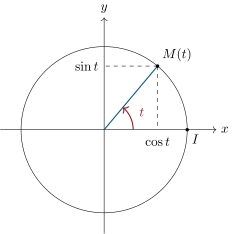
Let C\mathcal{C} be the circle of radius 1 centered at the origin of an orthonormal coordinate system. To each real tt, associate the point M(t)M(t) obtained by winding a length t\abs{t} along C\mathcal{C} from the point I(1,0)I(1,0), counterclockwise if t0t \geq 0 and clockwise otherwise. Then cost\cos t and sint\sin t are the coordinates of M(t)M(t):

M(t)=(cost,sint).M(t) = (\cos t, \sin t).

Since the circle has circumference 2π2\pi, the point M(t)M(t) is unchanged when tt increases by 2π2\pi; and since M(t)M(t) lies on the unit circle:

Proposition 24.2 (Fundamental identities)

For all tRt \in \R and kZk \in \Z:

cos2t+sin2t=1,cos(t+2kπ)=cost,sin(t+2kπ)=sint,\cos^2 t + \sin^2 t = 1, \qquad \cos(t + 2k\pi) = \cos t, \qquad \sin(t + 2k\pi) = \sin t,
cos(t)=cost,sin(t)=sint,\cos(-t) = \cos t, \qquad \sin(-t) = -\sin t,
cos(πt)=cost,sin(πt)=sint,cos(π2t)=sint,sin(π2t)=cost.\cos(\pi - t) = -\cos t, \quad \sin(\pi - t) = \sin t, \quad \cos\left(\tfrac{\pi}{2} - t\right) = \sin t, \quad \sin\left(\tfrac{\pi}{2} - t\right) = \cos t .

Proof. The first identity is the equation of the unit circle; the others express the symmetries of the circle: M(t)M(-t) is the reflection of M(t)M(t) in the xx-axis, M(πt)M(\pi - t) in the yy-axis, and M(π2t)M(\frac\pi2 - t) in the line y=xy = x.

The values to know by heart:

tt00π6\dfrac{\pi}{6}π4\dfrac{\pi}{4}π3\dfrac{\pi}{3}π2\dfrac{\pi}{2}
[6pt] cost\cos t1132\dfrac{\sqrt3}{2}22\dfrac{\sqrt2}{2}12\dfrac1200
[6pt] sint\sin t0012\dfrac1222\dfrac{\sqrt2}{2}32\dfrac{\sqrt3}{2}11

Proposition 24.3 (Addition formulas)

For all a,bRa, b \in \R:

cos(a+b)=cosacosbsinasinb,sin(a+b)=sinacosb+cosasinb,cos(ab)=cosacosb+sinasinb,sin(ab)=sinacosbcosasinb.\begin{align*} \cos(a+b) &= \cos a \cos b - \sin a \sin b, & \sin(a+b) &= \sin a \cos b + \cos a \sin b,\\ \cos(a-b) &= \cos a \cos b + \sin a \sin b, & \sin(a-b) &= \sin a \cos b - \cos a \sin b. \end{align*}

In particular cos2a=2cos2a1=12sin2a\cos 2a = 2\cos^2 a - 1 = 1 - 2\sin^2 a and sin2a=2sinacosa\sin 2a = 2 \sin a \cos a.

Proof. The vectors u=(cosa,sina)\vect{u} = (\cos a, \sin a) and v=(cosb,sinb)\vect{v} = (\cos b, \sin b) are unit vectors making an angle aba - b; their scalar product equals both cosacosb+sinasinb\cos a\cos b + \sin a \sin b (coordinates) and uvcos(ab)=cos(ab)\norm{\vect u}\,\norm{\vect v}\cos(a-b) = \cos(a - b) (geometry), which is the third formula. Replacing bb by b-b gives the first; the sine formulas follow using sinx=cos(π2x)\sin x = \cos(\frac\pi2 - x). The duplication formulas are the case b=ab = a combined with cos2+sin2=1\cos^2 + \sin^2 = 1.

24.2 Analytic study

Lemma 24.4 (Fundamental limit)

limt0sintt=1andlimt0cost1t=0.\lim_{t \to 0} \frac{\sin t}{t} = 1 \qquad\text{and}\qquad \lim_{t \to 0} \frac{\cos t - 1}{t} = 0 .

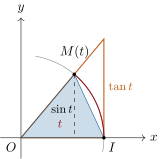
Proof. For 0<t<π20 < t < \frac{\pi}{2}, compare three areas in the unit circle: the triangle OIM(t)OIM(t), the circular sector OIM(t)OIM(t), and the right triangle with base OIOI and height tant\tan t:

sint2t2tant2.\frac{\sin t}{2} \leq \frac{t}{2} \leq \frac{\tan t}{2}.
The three nested areas: the triangle OIM (blue, area t/2), the circular sector (bounded by the red arc, area t/2), and the right triangle of height t (orange, area t/2).
The three nested areas: the triangle OIMOIM (blue, area sint2\frac{\sin t}{2}), the circular sector (bounded by the red arc, area t2\frac{t}{2}), and the right triangle of height tant\tan t (orange, area tant2\frac{\tan t}{2}).

The first inequality gives sintt1\frac{\sin t}{t} \leq 1; the second gives costsintt\cos t \leq \frac{\sin t}{t}. As t0+t \to 0^+, cost1\cos t \to 1 (continuity), and the squeeze theorem yields sintt1\frac{\sin t}{t} \to 1; parity extends this to t0t \to 0. For the second limit,

cost1t=cos2t1t(cost+1)=sinttsintcost+1t0102=0.\frac{\cos t - 1}{t} = \frac{\cos^2 t - 1}{t(\cos t + 1)} = -\frac{\sin t}{t}\cdot\frac{\sin t}{\cos t + 1} \xrightarrow[t\to0]{} -1 \cdot \frac{0}{2} = 0. \qedhere

Theorem 24.5 (Derivatives of sine and cosine)

The functions sin\sin and cos\cos are differentiable on R\R, with

(sin)=cos,(cos)=sin.(\sin)' = \cos, \qquad (\cos)' = -\sin .

More generally, (sin(ax+b))=acos(ax+b)(\sin(ax+b))' = a\cos(ax+b) and (cos(ax+b))=asin(ax+b)(\cos(ax+b))' = -a\sin(ax+b).

Proof. By the addition formulas,

sin(x+h)sinxh=sinxcosh1h+cosxsinhhh0sinx0+cosx1=cosx,\frac{\sin(x+h) - \sin x}{h} = \sin x\,\frac{\cos h - 1}{h} + \cos x\,\frac{\sin h}{h} \xrightarrow[h\to0]{} \sin x \cdot 0 + \cos x \cdot 1 = \cos x,

using Lemma 24.4. The computation for cos\cos is identical, and the general form follows from the chain rule.

Proposition 24.6 (Variations)

On [0,π]\intcc{0}{\pi}, cos\cos decreases from 11 to 1-1. On [π2,π2]\intcc{-\frac\pi2}{\frac\pi2}, sin\sin increases from 1-1 to 11. Both functions are 2π2\pi-periodic and have ranges [1,1]\intcc{-1}{1}; cos\cos is even, sin\sin is odd.

Proof. On (0,π)\intoo{0}{\pi}, (cos)=sin<0(\cos)' = -\sin < 0 since the point M(t)M(t) has positive ordinate there; similarly (sin)=cos>0(\sin)' = \cos > 0 on (π2,π2)\intoo{-\frac\pi2}{\frac\pi2}. Periodicity and parity come from Proposition 24.2.

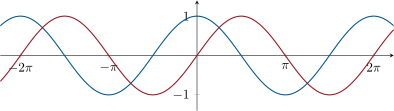
The curves of  (blue) and  (red).
The curves of cos\cos (blue) and sin\sin (red).

Method 24.7 (Solving cosx=a\cos x = a and sinx=a\sin x = a)

For a[1,1]a \in \intcc{-1}{1}, find one particular solution α\alpha (from the table of values or a calculator). Then all solutions are:

cosx=cosα    x=α+2kπ or x=α+2kπ,kZ;\cos x = \cos\alpha \iff x = \alpha + 2k\pi \text{ or } x = -\alpha + 2k\pi, \quad k \in \Z;
sinx=sinα    x=α+2kπ or x=πα+2kπ,kZ.\sin x = \sin\alpha \iff x = \alpha + 2k\pi \text{ or } x = \pi - \alpha + 2k\pi, \quad k \in \Z.

For inequalities, locate the solution arcs on the unit circle and read off the intervals within one period.

Example 24.8

Solve cosx=12\cos x = \frac12 in (π,π]\intoc{-\pi}{\pi}: a particular solution is π3\frac\pi3, so the solutions are x=π3x = \frac\pi3 and x=π3x = -\frac\pi3. In all of R\R: x=±π3+2kπx = \pm\frac\pi3 + 2k\pi, kZk \in \Z.

24.3 Exercises

Exercise 24.1

Compute cos2π3\cos\frac{2\pi}{3}, sin5π6\sin\frac{5\pi}{6}, cos7π4\cos\frac{7\pi}{4} and sin(π3)\sin\left(-\frac{\pi}{3}\right) using the identities of Proposition 24.2.

Solution

Solution of Exercise 24.1.

cos2π3=cos(ππ3)=cosπ3=12\cos\frac{2\pi}{3} = \cos\left(\pi - \frac\pi3\right) = -\cos\frac\pi3 = -\frac12.

sin5π6=sin(ππ6)=sinπ6=12\sin\frac{5\pi}{6} = \sin\left(\pi - \frac\pi6\right) = \sin\frac\pi6 = \frac12.

cos7π4=cos(2ππ4)=cos(π4)=22\cos\frac{7\pi}{4} = \cos\left(2\pi - \frac{\pi}{4}\right) = \cos\left(-\frac\pi4\right) = \frac{\sqrt2}{2}.

sin(π3)=sinπ3=32\sin\left(-\frac\pi3\right) = -\sin\frac\pi3 = -\frac{\sqrt3}{2}.

Exercise 24.2

Differentiate f(x)=sin2xf(x) = \sin^2 x, g(x)=cos(3x)+xsinxg(x) = \cos(3x) + x\sin x and h(x)=sinx2+cosxh(x) = \dfrac{\sin x}{2 + \cos x}.

Solution

Solution of Exercise 24.2.

f(x)=2sinxcosx=sin2xf'(x) = 2\sin x\cos x = \sin 2x (chain rule).

g(x)=3sin(3x)+sinx+xcosxg'(x) = -3\sin(3x) + \sin x + x\cos x (chain and product rules).

Quotient rule:

h(x)=cosx(2+cosx)sinx(sinx)(2+cosx)2=2cosx+cos2x+sin2x(2+cosx)2=2cosx+1(2+cosx)2.h'(x) = \frac{\cos x\,(2 + \cos x) - \sin x\,(-\sin x)}{(2+\cos x)^2} = \frac{2\cos x + \cos^2 x + \sin^2 x}{(2+\cos x)^2} = \frac{2\cos x + 1}{(2+\cos x)^2}.

Exercise 24.3

Solve in (π,π]\intoc{-\pi}{\pi}, then in R\R:

(a) sinx=32;(b) cos(2x)=22.\text{(a) } \sin x = \frac{\sqrt3}{2}; \qquad \text{(b) } \cos\left(2x\right) = \frac{\sqrt2}{2} .
Solution

Solution of Exercise 24.3.

(a) A particular solution of sinx=32\sin x = \frac{\sqrt3}{2} is π3\frac\pi3. General solutions: x=π3+2kπx = \frac\pi3 + 2k\pi or x=ππ3+2kπ=2π3+2kπx = \pi - \frac\pi3 + 2k\pi = \frac{2\pi}{3} + 2k\pi. In (π,π]\intoc{-\pi}{\pi}: x{π3,2π3}x \in \left\{\frac\pi3, \frac{2\pi}{3}\right\}.

(b) cos2x=22=cosπ4\cos 2x = \frac{\sqrt2}{2} = \cos\frac\pi4 gives 2x=±π4+2kπ2x = \pm\frac\pi4 + 2k\pi, so x=±π8+kπx = \pm\frac\pi8 + k\pi. In (π,π]\intoc{-\pi}{\pi}: x{7π8,π8,π8,7π8}x \in \left\{-\frac{7\pi}{8}, -\frac\pi8, \frac\pi8, \frac{7\pi}{8}\right\}.

Exercise 24.4 ★★

Using the addition formulas, compute the exact value of cosπ12\cos\frac{\pi}{12} and sinπ12\sin\frac{\pi}{12}. (Hint: π12=π3π4\frac{\pi}{12} = \frac{\pi}{3} - \frac{\pi}{4}.)

Solution

Solution of Exercise 24.4.

With a=π3a = \frac\pi3, b=π4b = \frac\pi4:

cosπ12=cosacosb+sinasinb=1222+3222=2+64,\cos\frac{\pi}{12} = \cos a\cos b + \sin a \sin b = \frac12\cdot\frac{\sqrt2}{2} + \frac{\sqrt3}{2}\cdot\frac{\sqrt2}{2} = \frac{\sqrt2 + \sqrt6}{4},
sinπ12=sinacosbcosasinb=32221222=624.\sin\frac{\pi}{12} = \sin a\cos b - \cos a \sin b = \frac{\sqrt3}{2}\cdot\frac{\sqrt2}{2} - \frac12\cdot\frac{\sqrt2}{2} = \frac{\sqrt6 - \sqrt2}{4}.

Exercise 24.5 ★★

Solve in [0,2π]\intcc{0}{2\pi} the inequality 2sin2xsinx102\sin^2 x - \sin x - 1 \geq 0. (Hint: factor the quadratic in sinx\sin x.)

Solution

Solution of Exercise 24.5.

Set s=sinxs = \sin x: 2s2s1=(2s+1)(s1)02s^2 - s - 1 = (2s + 1)(s - 1) \geq 0 iff s12s \leq -\frac12 or s=1s = 1.

sinx=1\sin x = 1 gives x=π2x = \frac\pi2. sinx12\sin x \leq -\frac12: on the unit circle, the arc below the horizontal line y=12y = -\frac12, which in [0,2π]\intcc{0}{2\pi} is x[7π6,11π6]x \in \intcc{\frac{7\pi}{6}}{\frac{11\pi}{6}}. Hence

S={π2}[7π6,11π6].S = \left\{\frac{\pi}{2}\right\} \cup \intcc{\frac{7\pi}{6}}{\frac{11\pi}{6}} .

Exercise 24.6 ★★

Compute the limits

limx0sin3xx,limx01cosxx2,limx+xsin1x.\lim_{x\to0} \frac{\sin 3x}{x}, \qquad \lim_{x\to0} \frac{1 - \cos x}{x^2}, \qquad \lim_{x\to+\infty} x \sin\frac{1}{x}.
Solution

Solution of Exercise 24.6.

sin3xx=3sin3x3x31=3\dfrac{\sin 3x}{x} = 3\,\dfrac{\sin 3x}{3x} \to 3 \cdot 1 = 3 (composition with u=3x0u = 3x \to 0).

Using 1cosx=sin2x1+cosx1 - \cos x = \dfrac{\sin^2 x}{1 + \cos x}:

1cosxx2=(sinxx) ⁣211+cosxx0112=12.\frac{1 - \cos x}{x^2} = \left(\frac{\sin x}{x}\right)^{\!2} \frac{1}{1 + \cos x} \xrightarrow[x\to0]{} 1 \cdot \frac12 = \frac12 .

Substituting u=1x0+u = \frac1x \to 0^+: xsin1x=sinuu1x \sin\frac1x = \frac{\sin u}{u} \to 1.

Exercise 24.7 ★★

Study the function f(x)=x+cosxf(x) = x + \cos x on [0,2π]\intcc{0}{2\pi}: variations and extrema. Show that ff is increasing on R\R although ff' vanishes at infinitely many points.

Solution

Solution of Exercise 24.7.

f(x)=1sinx0f'(x) = 1 - \sin x \geq 0 for all xx, with equality exactly when sinx=1\sin x = 1, i.e. x=π2+2kπx = \frac\pi2 + 2k\pi. On [0,2π]\intcc{0}{2\pi}, ff is increasing from f(0)=1f(0) = 1 to f(2π)=2π+1f(2\pi) = 2\pi + 1 (the zero of ff' at π2\frac{\pi}{2} is isolated, so the increase is even strict); minimum 11 at 00, maximum 2π+12\pi + 1 at 2π2\pi. On R\R, f0f' \geq 0 everywhere with only isolated zeros, so ff is (strictly) increasing by Theorem 22.7, although ff' vanishes at every π2+2kπ\frac\pi2 + 2k\pi.

Exercise 24.8 ★★★

Let f(x)=Acosx+Bsinxf(x) = A\cos x + B \sin x with (A,B)(0,0)(A,B) \neq (0,0).

  1. Show that ff can be written f(x)=Rcos(xφ)f(x) = R\cos(x - \varphi) with R=A2+B2R = \sqrt{A^2 + B^2} and a suitable φ\varphi.
  2. Deduce the maximum and minimum of ff, and solve cosx+sinx=1\cos x + \sin x = 1 in (π,π]\intoc{-\pi}{\pi}.
Solution

Solution of Exercise 24.8.

1. Let R=A2+B2>0R = \sqrt{A^2 + B^2} > 0. The point (AR,BR)\left(\frac AR, \frac BR\right) lies on the unit circle, so there exists φ\varphi with cosφ=AR\cos\varphi = \frac AR and sinφ=BR\sin\varphi = \frac BR. Then

Rcos(xφ)=R(cosxcosφ+sinxsinφ)=Acosx+Bsinx=f(x).R\cos(x - \varphi) = R\bigl(\cos x\cos\varphi + \sin x \sin\varphi\bigr) = A\cos x + B\sin x = f(x).

2. Since cos\cos has range [1,1]\intcc{-1}{1}, ff has maximum RR and minimum R-R. For cosx+sinx\cos x + \sin x: A=B=1A = B = 1, R=2R = \sqrt2, φ=π4\varphi = \frac\pi4, so the equation becomes 2cos(xπ4)=1\sqrt2\cos\left(x - \frac\pi4\right) = 1, i.e. cos(xπ4)=22\cos\left(x - \frac\pi4\right) = \frac{\sqrt2}{2}, giving xπ4=±π4+2kπx - \frac\pi4 = \pm\frac\pi4 + 2k\pi: in (π,π]\intoc{-\pi}{\pi}, x{0,π2}x \in \left\{0, \frac\pi2\right\}.

Exercise 24.9 ★★★

Show that sin\sin and cos\cos both satisfy the differential equation y=yy'' = -y. Conversely, let yy be a solution of y=yy'' = -y with y(0)=ay(0) = a and y(0)=by'(0) = b; show that y=acos+bsiny = a\cos + b\sin. (Hint: consider g=(yacosbsin)g = (y - a\cos - b\sin) and the “energy” E=g2+(g)2E = g^2 + (g')^2.)

Solution

Solution of Exercise 24.9.

(sin)=(cos)=sin(\sin)'' = (\cos)' = -\sin and (cos)=(sin)=cos(\cos)'' = (-\sin)' = -\cos: both solve y=yy'' = -y.

Let g=yacosbsing = y - a\cos - b\sin. Then g=gg'' = -g (linearity of differentiation), g(0)=y(0)a=0g(0) = y(0) - a = 0 and g(0)=y(0)b=0g'(0) = y'(0) - b = 0. Set E=g2+(g)2E = g^2 + (g')^2. Then

E=2gg+2gg=2gg2gg=0,E' = 2g g' + 2g' g'' = 2g g' - 2g' g = 0,

so EE is constant equal to E(0)=0E(0) = 0. A sum of two squares vanishing identically forces g=0g = 0, hence y=acos+bsiny = a\cos + b\sin.

24.4 Problem: The pendulum’s secret

Problem 24.1

Weekend problem — one geometric limit powers the derivatives of sine and cosine, and from them all of oscillation: springs, pendulums, beats and the meter that almost was

Every clock that ever ticked, every string that ever sounded, obeys the same mathematics: a restoring force proportional to displacement, hence the equation y=ω2yy'' = -\omega^2 y, hence cosines. At the base of it all sits one innocent-looking limit, sinxx1\frac{\sin x}{x} \to 1 — promised in grade 9, used by Theorem 24.5, and proved here with a picture. This problem climbs from that limit to the swing of a one-meter pendulum, and explains why the meter is, by a whisker, not defined by it.

Part I — The fundamental limit.

  1. Warm up numerically: compute sinxx\frac{\sin x}{x} for x=0.1x = 0.1 and x=0.01x = 0.01 (radians!).
  2. The sandwich, on the unit circle with 0<x<π20 < x < \frac\pi2: express by elementary geometry the areas of (i) the triangle with vertices OO, A(1,0)A(1,0) and the circle point M(cosx,sinx)M(\cos x, \sin x); (ii) the circular sector OAMOAM; (iii) the right triangle OATOAT where T(1,tanx)T(1, \tan x).
  3. From the area sandwich deduce sinx<x<tanx\sin x < x < \tan x, then cosx<sinxx<1\cos x < \frac{\sin x}{x} < 1, and conclude by the squeeze theorem that limx0sinxx=1\lim_{x \to 0} \frac{\sin x}{x} = 1 (parity handles x<0x < 0).
  4. Deduce limx01cosxx2=12\lim_{x \to 0} \frac{1 - \cos x}{x^2} = \frac12 (multiply by the conjugate).
  5. Explain why this limit is the engine of Theorem 24.5 (what is sin(0)\sin'(0)?), and why it also settles an old debt: in what sense are radians the only angle unit for which sin=cos\sin' = \cos holds without a constant?

Part II — Harmonic motion.

  1. Verify by the chain rule that y(t)=Rcos(ωtφ)y(t) = R\cos(\omega t - \varphi) satisfies y=ω2yy'' = -\omega^2 y.
  2. A mass on a spring obeys y=4yy'' = -4y, with y(0)=3y(0) = 3 and y(0)=8y'(0) = 8. Admitting (from Exercise 24.9) that all solutions are Acos2t+Bsin2tA\cos 2t + B\sin 2t, determine AA and BB.
  3. Rewrite the solution as Rcos(2tφ)R\cos(2t - \varphi) (Exercise 24.8): give the amplitude RR, the period, and the phase φ\varphi (three decimals).
  4. At what time does the mass first pass through the equilibrium position y=0y = 0?
  5. The pendulum: a bob on a string of length LL obeys exactly θ=gLsinθ\theta'' = -\frac gL \sin\theta — unsolvable by elementary functions. For small swings, replace sinθ\sin\theta by θ\theta (Part I justifies it!) and deduce the period T=2πLgT = 2\pi\sqrt{\frac Lg}. Compute TT for L=1L = 1 m (g=9.81g = 9.81): Galileo’s famous discovery — what does the formula not depend on?
  6. The seconds pendulum: what length gives T=2T = 2 s exactly? The French Academy of 1791 hesitated between this length and the ten-millionth of the quarter-meridian for defining the meter — by how many millimeters do the two candidates differ?

Part III — Addition formulas at work.

  1. Show with the addition formulas (Proposition 24.3) that cos(x+π2)=sinx\cos\left(x + \frac\pi2\right) = -\sin x and sin(x+π2)=cosx\sin\left(x + \frac\pi2\right) = \cos x: circular differentiation is a quarter-turn — check consistency with Theorem 24.5.
  2. Derive the product-to-sum identity cosacosb=12(cos(ab)+cos(a+b))\cos a \cos b = \frac12\left(\cos(a - b) + \cos(a + b)\right) and the linearization cos2x=1+cos2x2\cos^2 x = \frac{1 + \cos 2x}{2} (the integration chapter will thank you).
  3. Beats: derive sinp+sinq=2sinp+q2cospq2\sin p + \sin q = 2 \sin\frac{p + q}{2} \cos\frac{p - q}{2}, and apply it to two tuning forks at 440440 and 444444 Hz: what tone does the ear hear, and how many throbs per second? (This is how orchestras tune.)
  4. Derive the triple-angle identity cos3x=4cos3x3cosx\cos 3x = 4\cos^3 x - 3\cos x (write 3x=2x+x3x = 2x + x). Setting x=20x = 20^\circ, what cubic equation must cos20\cos 20^\circ satisfy? (That this cubic cannot be solved with square roots alone is precisely why the trisection of the angle defeated ruler and compass for two millennia — the full story is told in the university volumes.)
  5. An alternating current reads I(t)=3cos(100πt)+33sin(100πt)I(t) = 3\cos(100\pi t) + 3\sqrt3 \sin(100\pi t). Rewrite it as Rcos(100πtφ)R\cos(100\pi t - \varphi): peak current and phase?

Part IV — The oscillating world.

  1. Periods: what is the (smallest) period of sin2t\sin^2 t (use question 13)? Of sin(2t)+sin(3t)\sin(2t) + \sin(3t)?
  2. A real pendulum damps: y(t)=et/10cos(2πt)y(t) = \eu^{-t/10}\cos(2\pi t). Describe the motion, compute the envelope’s value at t=10t = 10 (an old friend appears, Problem 23.1), and name the chapter where equations with such solutions are solved.
  3. Why do sines and cosines rule every vibration? Give the physics-to-mathematics dictionary in two sentences (restoring force proportional to displacement \rightarrow which equation \rightarrow which solutions), and say what Exercise 24.9 contributes to the claim.
  4. Finale: the chapter’s arc in four steps — one geometric limit, two derivatives, one differential equation, all of oscillation. And the honest asterisk: for large swings the pendulum’s true period involves an elliptic integral, computed at lightning speed by …Gauss’s arithmetic–geometric mean, the dessert of Problem 20.1. The series’ threads tie themselves.
Solution

Solution of Problem 24.1.

1. 0.998330.99833\ldots and 0.999980.99998\ldots: creeping to 11.

2. Triangle OAMOAM: base 11, height sinx\sin x: area sinx2\frac{\sin x}{2}. Sector OAMOAM: fraction x2π\frac{x}{2\pi} of the unit disk: area x2\frac x2. Triangle OATOAT: base 11, height tanx\tan x: area tanx2\frac{\tan x}{2}.

3. The triangle sits inside the sector inside the big triangle: sinx2<x2<tanx2\frac{\sin x}{2} < \frac x2 < \frac{\tan x}{2}, i.e. sinx<x<tanx\sin x < x < \tan x. From sinx<x\sin x < x: sinxx<1\frac{\sin x}{x} < 1; and from x<tanx=sinxcosxx < \tan x = \frac{\sin x}{\cos x}, multiplying by cosxx>0\frac{\cos x}{x} > 0: cosx<sinxx\cos x < \frac{\sin x}{x}. As x0+x \to 0^+, cosx1\cos x \to 1: squeezed, sinxx1\frac{\sin x}{x} \to 1; and sinxx\frac{\sin x}{x} is even, so the two-sided limit is 11.

4. 1cosxx2=1cos2xx2(1+cosx)=(sinxx)211+cosx1×12\frac{1 - \cos x}{x^2} = \frac{1 - \cos^2 x}{x^2 (1 + \cos x)} = \left(\frac{\sin x}{x}\right)^2 \frac{1}{1 + \cos x} \to 1 \times \frac12.

5. sin(0)=limh0sinh0h=1\sin'(0) = \lim_{h \to 0} \frac{\sin h - 0}{h} = 1: the whole differentiation of sine and cosine flows from this one limit. Measured in degrees, the limit would be π180\frac{\pi}{180}, and every derivative would drag that constant: radians are exactly the unit that makes the calculus of oscillation clean.

6. y=Rωsin(ωtφ)y' = -R\omega\sin(\omega t - \varphi), y=Rω2cos(ωtφ)=ω2yy'' = -R\omega^2\cos(\omega t - \varphi) = -\omega^2 y.

7. ω=2\omega = 2. y(0)=A=3y(0) = A = 3; y(0)=2B=8y'(0) = 2B = 8: B=4B = 4: y=3cos2t+4sin2ty = 3\cos 2t + 4\sin 2t.

8. R=9+16=5R = \sqrt{9 + 16} = 5; period 2π2=π\frac{2\pi}{2} = \pi; phase φ=arctan430.927\varphi = \arctan\frac43 \approx 0.927: y=5cos(2t0.927)y = 5\cos(2t - 0.927).

9. 5cos(2tφ)=05\cos(2t - \varphi) = 0 first when 2tφ=π22t - \varphi = \frac\pi2: t=π/2+0.92721.25t = \frac{\pi/2 + 0.927}{2} \approx 1.25 s.

10. With sinθθ\sin\theta \approx \theta: θ=gLθ\theta'' = -\frac gL \theta: harmonic with ω=gL\omega = \sqrt{\frac gL}, period T=2πω=2πLgT = \frac{2\pi}{\omega} = 2\pi\sqrt{\frac Lg}. For L=1L = 1: T2.006T \approx 2.006 s. The period does not depend on the amplitude (for small swings) — Galileo’s isochronism, the fact that makes pendulum clocks possible.

11. L=g(T2π)2=9.81π20.994L = g\left(\frac{T}{2\pi}\right)^2 = \frac{9.81}{\pi^2} \approx 0.994 m: the seconds pendulum is about 66 mm short of the meridian meter. The Academy chose the meridian (gravity varies from place to place, betraying the pendulum); had gg been a whisker larger, our meter would tick.

12. cos(x+π2)=cosxcosπ2sinxsinπ2=sinx\cos\left(x + \frac\pi2\right) = \cos x \cos\frac\pi2 - \sin x \sin\frac\pi2 = -\sin x; sin(x+π2)=cosx\sin\left(x + \frac\pi2\right) = \cos x. So differentiating sine gives sine shifted a quarter turn (cos\cos), and again (sin-\sin), and again, and home in four steps: differentiation rotates the circle.

13. Adding the two expansions of cos(ab)\cos(a \mp b): cos(ab)+cos(a+b)=2cosacosb\cos(a-b) + \cos(a+b) = 2\cos a\cos b. With a=b=xa = b = x: 1+cos2x=2cos2x1 + \cos 2x = 2\cos^2 x, i.e. cos2x=1+cos2x2\cos^2 x = \frac{1 + \cos 2x}{2}.

14. With p=p+q2+pq2p = \frac{p+q}{2} + \frac{p-q}{2} and qq its mirror, expanding and adding: sinp+sinq=2sinp+q2cospq2\sin p + \sin q = 2\sin\frac{p+q}{2}\cos\frac{p-q}{2}. For 440440 and 444444 Hz: a tone at 442442 Hz whose loudness is modulated by cos(2π2t)\cos(2\pi \cdot 2t) — the loudness peaks 44 times per second (the envelope’s absolute value): four beats a second, vanishing as the forks agree.

15. cos3x=cos2xcosxsin2xsinx=(2cos2x1)cosx2sin2xcosx=4cos3x3cosx\cos 3x = \cos 2x\cos x - \sin 2x \sin x = (2\cos^2 x - 1)\cos x - 2\sin^2 x\cos x = 4\cos^3 x - 3\cos x. At x=20x = 20^\circ: cos60=12\cos 60^\circ = \frac12, so c=cos20c = \cos 20^\circ satisfies 8c36c1=08c^3 - 6c - 1 = 0 — a cubic with no square-root solution: constructing 2020^\circ, i.e. trisecting 6060^\circ, is beyond ruler and compass.

16. R=9+27=6R = \sqrt{9 + 27} = 6; tanφ=333=3\tan\varphi = \frac{3\sqrt3}{3} = \sqrt3: φ=π3\varphi = \frac\pi3: I(t)=6cos(100πtπ3)I(t) = 6\cos\left(100\pi t - \frac\pi3\right): peak 66 amperes, phase lag 6060^\circ.

17. sin2t=1cos2t2\sin^2 t = \frac{1 - \cos 2t}{2}: period π\pi. sin2t\sin 2t has period π\pi, sin3t\sin 3t has 2π3\frac{2\pi}{3}: the sum repeats after the smallest common multiple, 2π2\pi.

18. An oscillation of period 11 inside the shrinking envelope ±et/10\pm\eu^{-t/10}: each swing about 10%10\,\% lower. At t=10t = 10 the envelope is e10.368\eu^{-1} \approx 0.368 — the constant of Problem 23.1 yet again. Equations with such damped solutions (y+ay+by=0y'' + a y' + b y = 0) are solved in the differential equations chapter.

19. A force pulling back proportionally to the displacement gives y=ω2yy'' = -\omega^2 y; and Exercise 24.9 shows the solutions of that equation are exactly the combinations of cos\cos and sin\sin — existence by exhibition, uniqueness by the exercise: vibration has no choice but to be sinusoidal.

20. One limit (sinxx1\frac{\sin x}{x} \to 1, by sandwiched areas), two derivatives (sin=cos\sin' = \cos, cos=sin\cos' = -\sin), one equation (y=ω2yy'' = -\omega^2 y), a world of clocks, strings, currents and tides. Asterisk: for wide swings, T=4Lgπ/2M(1,cos(θ0/2))T = 4\sqrt{\frac Lg} \cdot \frac{\pi/2}{M(1, \cos(\theta_0/2))} — the arithmetic–geometric mean of Problem 20.1 computes the elliptic integral in a handful of iterations: Gauss’s diary entry and Galileo’s pendulum, one formula apart.