High School Mathematics · Grades 10–12
31Vectors, Lines and Planes in Space
Three-dimensional geometry becomes computational once vectors and coordinates are available: lines get parametric representations, planes get Cartesian equations, and the scalar product measures angles and distances. This chapter builds this toolbox and uses it to solve the classical intersection and distance problems.
31.1 Vectors in space
Vectors in space obey the same rules as in the plane: they add, they scale, and exactly when is a parallelogram. In a coordinate system , every vector has coordinates .
Definition 31.1 (Collinearity, coplanarity)
Two vectors are collinear if one is a multiple of the other. Three vectors are coplanar if one of them can be written as a combination of the other two, say .
Proposition 31.2
If are not coplanar, every vector of space decomposes uniquely as .
Idea of proof. Through the tip of the vector to decompose, draw the line parallel to ; it meets the plane of in a single point, which splits the vector into a component in that plane (uniquely , plane geometry) and a component along . Uniqueness: a difference of two decompositions would express one of the vectors in terms of the other two, contradicting non-coplanarity. ∎
31.2 Lines and planes
Definition 31.3 (Parametric representation of a line)
The line through with direction vector is the set of points
Definition 31.4 (Plane)
The plane through directed by two non-collinear vectors is the set of points with , .
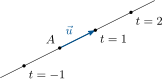
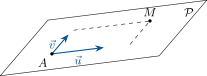
Proposition 31.5 (Relative positions)
Two distinct planes are either parallel or intersect in a line. A line and a plane are either parallel (possibly contained) or intersect in a single point. Two lines in space may be intersecting, strictly parallel, identical, or skew (non-coplanar).
Sketch. These are incidence statements; each case analysis reduces, in coordinates, to solving a linear system and counting its solutions — see Method 31.10. ∎
31.3 Scalar product
Definition 31.6 (Scalar product)
The scalar product of and is
where is the length of . If both vectors are nonzero, where is the angle between them; and in an orthonormal coordinate system,
Two vectors are orthogonal if their scalar product is .
Proposition 31.7 (Properties)
The scalar product is symmetric (), bilinear (), and .
Proof. In an orthonormal system, all three properties are immediate on the formula , which itself follows from the defining formula and the Pythagorean computation of lengths: . ∎
Definition 31.8 (Normal vector)
A normal vector of a plane is a nonzero vector orthogonal to every vector lying in (it suffices that it be orthogonal to two non-collinear directions of ).
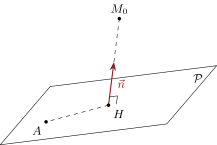
Theorem 31.9 (Cartesian equation of a plane)
In an orthonormal coordinate system, the plane through with normal vector has equation
where . Conversely, every such equation with defines a plane with normal vector .
Proof. , which expands to the equation. Conversely, pick any solution point of the equation; the same computation backwards shows the solution set is , the plane through normal to . ∎
Method 31.10 (Intersections in practice)
- Line plane: substitute the parametric coordinates of the line into the plane equation; solve for (one solution: one point; nonzero: parallel; : line contained).
- Plane plane: solve the system of the two equations, parametrizing by one free coordinate; the solution is a line (or the planes are parallel when the normal vectors are collinear).
- Orthogonality checks: line plane iff its direction is collinear with the normal; two planes are perpendicular iff their normals are orthogonal.
Proposition 31.11 (Distance from a point to a plane)
In an orthonormal system, the distance from to the plane is
Proof. Let be the orthogonal projection of on : the foot of the perpendicular, so is collinear with the unit normal , and the distance is . For any , (using the equation at ), whence the formula after dividing by . ∎
Example 31.12
Distance from the origin to the plane : .
31.4 Exercises
In all exercises the coordinate system is orthonormal.
Exercise 31.1 ★
Let , and . Are the points , , aligned? Give a parametric representation of the line .
Solution
Solution of Exercise 31.1.
and are not proportional (), so the points are not aligned. Line :
Exercise 31.2 ★
Determine a Cartesian equation of the plane through with normal vector . Does the point belong to it?
Solution
Solution of Exercise 31.2.
, i.e.
For : : yes, lies on the plane.
Exercise 31.3 ★
Compute the angle at (to the nearest degree) of the triangle with vertices , and .
Solution
Solution of Exercise 31.3.
, :
so .
Exercise 31.4 ★★
Consider the line through with direction , and the plane . Determine .
Solution
Solution of Exercise 31.4.
Points of : . Substituting into the equation of :
Unique intersection point: .
Exercise 31.5 ★★
Let and . Show that and intersect in a line and give a parametric representation of it.
Solution
Solution of Exercise 31.5.
The normal vectors and are not collinear, so the planes intersect in a line. Adding the two equations: , so ; then the first equation gives . With :
a line with direction vector . (Both equations check identically.)
Exercise 31.6 ★★
Show that the lines
are skew (not coplanar).
Solution
Solution of Exercise 31.6.
Directions and are not collinear, so the lines are not parallel. Intersecting would require
The first two give and , so , ; but then the third reads , absurd. No common point and not parallel: the lines are skew.
Exercise 31.7 ★★
Let .
- Compute the distance from to .
- Determine the coordinates of the orthogonal projection of on , and check the distance .
Solution
Solution of Exercise 31.7.
1. .
2. with , choosing so that :
Hence , and
matching the distance formula.
Exercise 31.8 ★★★
The cube has side ; place coordinates so that , , , (with , , , as vectors from ).
- Show that the diagonal is orthogonal to the plane .
- Compute the distance from to the plane , and the point where pierces it.
Solution
Solution of Exercise 31.8.
Coordinates: , and the plane passes through , , .
1. The plane has equation (satisfied by the three points, and they are not aligned), so is normal to it. Since , the diagonal is orthogonal to the plane .
2. Distance from : . The line is ; it meets the plane when : at the point , the centroid of the triangle .
Exercise 31.9 ★★★
(Volume of a tetrahedron.) Let , , and .
- Verify that , , are not coplanar (the points form a genuine tetrahedron).
- Find a vector orthogonal to both and , and deduce a Cartesian equation of the plane .
- Compute the distance from to the plane and the area of the triangle , using the formula for the triangle spanned by .
- Deduce the volume of the tetrahedron ().
Solution
Solution of Exercise 31.9.
1. , , . If , the coordinates give , , : the first two force , contradicting . Not coplanar.
2. , . Solving : from , ; then gives . With : . Plane through :
3. Distance from : . Area of : , , , so
4.
31.5 Problem: Slicing the cube
Problem 31.1
Weekend problem — a plane cuts a cube into a perfect hexagon, a regular tetrahedron hides in the corners, and the diagonal’s angle shapes every diamond
Slice a cube and you expect squares and rectangles — yet one famous cut produces a regular hexagon, and four clever corner cuts leave behind a regular tetrahedron. Both surprises, and the angle that carbon atoms worship, fall to this chapter’s toolkit: parametric lines, plane equations and the scalar product (Theorem 31.9, Proposition 31.11). Use throughout the cube of Exercise 31.8: side , , , , , , , , .
Part I — Fluency.
- Write the equation of the plane through with normal vector , a parametric representation of the line through directed by , and their intersection point.
- Compute the distance from to that plane (Proposition 31.11).
- Are the vectors and orthogonal?
- Position of the planes and ? Of the line through directed by relative to the first plane?
- List the midpoints of the six edges of the cube, and verify that all six satisfy the equation .
Part II — The hexagonal section. Let be the plane .
- Show that is perpendicular to the great diagonal and passes through the cube’s center.
- Compute the distances between consecutive midpoints of question 5 around the section: what do you find?
- Compute the angle of the section’s polygon at one vertex (two consecutive edge-vectors and a dot product). Conclude: the section is a regular hexagon.
- Compute the hexagon’s perimeter and area, and compare the area with that of a face of the cube. (For the record: the largest planar section of the unit cube is the diagonal rectangle, of area — the regular hexagon takes silver.)
- Where does the diagonal pierce ? Verify that the piercing point is the midpoint of .
- Slide the cut: describe the sections as grows from to — compute the section for (which polygon, which size?), and narrate the morphing that passes through your hexagon at .
- Why can no plane cut a cube in a polygon with seven sides? (Where must each side of the section lie?)
Part III — The hidden tetrahedron.
- Compute the volume of the corner tetrahedron (base, height, and the one-third formula the Middle School volume admitted — Exercise 31.9 computes such volumes in general).
- The four vertices , , , : compute all six pairwise distances and conclude that is a regular tetrahedron. Then obtain its volume by subtracting corner tetrahedra from the cube.
- Compute the distance from the cube’s center to the plane .
- The diamond angle: compute the angle between the diagonals and of the cube. Its supplement, about , is the angle between bonds in diamond and methane — why do four electron pairs around a carbon atom choose the corners of question 14’s tetrahedron?
Part IV — Genuinely three-dimensional.
- Find where the line through directed by pierces the hexagon’s plane .
- Show that the lines and neither meet nor are parallel: skew lines, the phenomenon that cannot happen in a plane.
- Compute the orthogonal projection of onto (walk from along the normal until the plane), and check your point satisfies ’s equation.
- Finale — the space surveyor’s kit: parametric lines for piercing, normal vectors for angles and distances, plane equations for sections; and the cube as the playground where they produced a hexagon, a regular tetrahedron, the diamond angle and a pair of skew lines. One sentence each.
Solution
Solution of Problem 31.1.
1. Plane: . Line: . Intersection: : .
2. .
3. : orthogonal.
4. Same normal , but : strictly parallel planes. The line: direction : not parallel to the plane, so it pierces it at one point.
5. Midpoints: , , , , , : each has coordinate sum .
6. ’s normal is , the direction of : perpendicular. The center has coordinate sum : on .
7. Consecutive midpoints differ by vectors like : length each time — six equal sides.
8. At : edge-vectors and : dot product , norms : : angle . Equal sides, equal angles: a regular hexagon.
9. Perimeter . Area : larger than a face (area ) — a slice bigger than any side of the box; only the diagonal rectangle () beats it.
10. meets at : the center — which is the midpoint of ( at , at ).
11. For : the plane cuts the three edges at ’s corner, at , , : an equilateral triangle of side . As grows, the triangle grows, its corners get truncated into a hexagon (regular exactly at ), then the picture shrinks symmetrically back to a triangle at ’s corner: the crystal-cut morphing.
12. Each side of the section is the intersection of the cutting plane with one face of the cube, and a plane meets a face (a flat polygon) in at most one segment: at most sides. Seven is impossible; three through six all occur (questions 8 and 11 show two of them).
13. Base : right triangle of area ; height : volume .
14. Every pair among differs in exactly two coordinates by : all six distances equal — regular. The cube splits into plus four corner tetrahedra congruent to : volume .
15. Plane : ; center : distance .
16. , : : , supplement . Four electron pairs repel one another and spread as far apart as possible around the carbon: the optimum is the regular tetrahedron’s corners, whose center-to-vertex directions meet at exactly this angle — diamond is question 14 crystallized.
17. on : : : the point .
18. : points ; : points . Meeting would need in the third coordinate: never. Parallel would need and collinear: no. Neither meeting nor parallel: skew — two corridors on different floors.
19. on : : : projection , whose coordinate sum is : on , as required.
20. Parametric lines pierce (questions 1, 10, 17); normal vectors measure angles and distances (questions 2, 8, 15, 16); plane equations carve sections (the triangle-to- hexagon morphing). And the playground repaid the visit: a regular hexagon in a box of squares, a regular tetrahedron in the corners, the angle of diamond, and two lines that ignore each other — geometry only space can offer.