High School Mathematics · Grades 10–12
26Differential Equations
A differential equation relates a function to its derivatives. Physics, chemistry, biology and economics express their laws in this form: the rate of cooling of a body, the decay of a radioactive nucleus, the growth of a population are all statements about . This chapter solves completely the linear first-order equations with constant coefficients.
26.1 The equation
Definition 26.1 (Differential equation)
A differential equation is an equation whose unknown is a function , involving and its derivatives. A solution on an interval is a differentiable function satisfying the equation at every point of .
Theorem 26.2 (Solutions of )
Let . The solutions on of the equation are exactly the functions
For every pair there is a unique solution with .
Proof. Each satisfies . Conversely, let be any solution and set . Then
so is constant, say , and . The initial condition forces , uniquely. ∎
Remark 26.3
The exponential is thus characterized by the simplest of all differential equations: growth proportional to size. This is why it appears everywhere in nature.
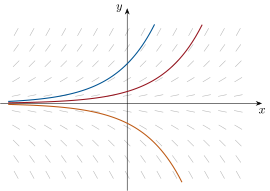
Example 26.4 (Radioactive decay)
A radioactive quantity satisfies with , so ; see Example 23.9 for the half-life.
26.2 The equation
Theorem 26.5 (Solutions of )
Let and . The solutions on of are exactly the functions
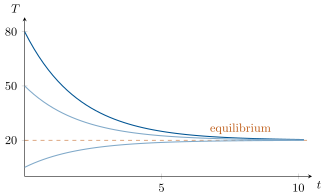
The constant function is the equilibrium solution. For every there is a unique solution with ; if , every solution tends to the equilibrium as .
Proof. The constant satisfies . Now is a solution if and only if
that is, if and only if solves . By Theorem 26.2, , whence the formula, the existence and the uniqueness. If , as , so . ∎
Method 26.6 (Solving with an initial condition)
- Find the equilibrium solution (solve ).
- Write the general solution .
- Determine from the initial condition.
- Check the long-term behavior against physical intuition (does the solution converge to equilibrium?).
The same strategy — particular solution + general solution of the homogeneous equation — extends to : see Proposition 26.8.
Example 26.7 (Newton’s law of cooling)
A cup of coffee at C sits in a room at C. Newton’s law states that the temperature satisfies for some , i.e. . The equilibrium is , and : the coffee cools exponentially fast to room temperature.
26.3 The equation
Proposition 26.8 (Structure of the solution set)
Let be continuous on an interval and let be one particular solution of
on . Then the solutions on are exactly the functions , .
Proof. As in Theorem 26.5: is a solution if and only if satisfies , if and only if . ∎
Method 26.9 (Guessing a particular solution)
Look for a particular solution of the same shape as :
- polynomial of degree : try a polynomial of degree ;
- with : try ;
- (resonant case): try .
Substitute into the equation and identify the coefficients.
Example 26.10
Solve . Try : for all forces and , so , . General solution: .
26.4 Exercises
Exercise 26.1 ★
Solve on : (a) with ; (b) with ; (c) with .
Solution
Solution of Exercise 26.1.
(a) ; gives .
(b) , so ; gives .
(c) Equilibrium ; ; gives : .
Exercise 26.2 ★
A bacterial population grows at a rate proportional to its size, doubling every hours. Write the differential equation satisfied by the population and determine the proportionality constant.
Solution
Solution of Exercise 26.2.
, so . Doubling in hours means , i.e.
Exercise 26.3 ★
Verify that is a solution of , and give all solutions on .
Solution
Solution of Exercise 26.3.
: is a particular solution (this is the resonant case of Method 26.9). By Proposition 26.8, the solutions are , .
Exercise 26.4 ★★
Solve with . (Hint: look for a particular solution of the form .)
Solution
Solution of Exercise 26.4.
Try : gives , so . General solution ; the condition gives :
Exercise 26.5 ★★
Carbon-14 decays with a half-life of years. An archaeological sample contains of the carbon-14 of a living organism. Estimate its age.
Exercise 26.6 ★★
A tank contains L of pure water. Brine containing kg of salt per liter flows in at L/min, the mixture (kept uniform) flows out at the same rate. Let be the mass of salt in the tank at time (in minutes).
- Justify that .
- Solve, and determine the limit of as . Interpret.
Solution
Solution of Exercise 26.6.
1. Salt flows in at kg/min. The outflow carries concentration kg/L at L/min, i.e. kg/min. Hence .
2. Equilibrium ; , and gives :
In the long run the tank’s concentration equals that of the incoming brine: kg/L L kg.
Exercise 26.7 ★★
A skydiver of mass kg falls subject to gravity () and air resistance proportional to speed, so that her speed satisfies with kg/s.
- Solve the equation with .
- Compute the terminal velocity , and the time needed to reach of it.
Solution
Solution of Exercise 26.7.
1. with . Equilibrium m/s; , and gives
2. Terminal velocity m/s ( km/h). We want , i.e. :
Exercise 26.8 ★★★
(Logistic equation.) A population (as a fraction of the maximal population) satisfies
- Let . Show that satisfies the linear equation .
- Solve for , then for , with .
- Show that as and sketch the shape of the solution curve.
Solution
Solution of Exercise 26.8.
1. gives .
2. Equilibrium , so . From , , so and
3. As , and . The curve is the classic S-shaped (sigmoid) logistic curve: slow growth at first ( small, ), fastest growth when (where is maximal), then saturation towards the carrying capacity .
Exercise 26.9 ★★★
Let be a solution of and let for . Show that satisfies an arithmetico-geometric recurrence , and express and in terms of and . What does the condition correspond to for the differential equation?
Solution
Solution of Exercise 26.9.
By Theorem 26.5, . Hence
with and . The condition means , i.e. : exactly the condition under which the solutions of the differential equation converge to the equilibrium — and indeed the fixed point of the recurrence is .
26.5 Problem: The clock inside things
Problem 26.1
Weekend problem — carbon-14 dates the caves, Newton’s cooling law times a crime, and one small equation wears four costumes
A differential equation is a law of change; solving it turns the law into a clock. The same tiny equation (Theorem 26.5) ticks inside prehistoric charcoal, cooling coffee, falling raindrops and hospital drips — and reading those clocks is this problem’s business: it dates the Lascaux paintings, fixes a time of death, and audits its own assumptions like a good scientist.
Part I — Fluency.
- Solve , ; then , (Method 26.6).
- Re-derive the uniqueness trick behind Theorem 26.2: if , compute the derivative of and conclude that every solution is .
- For : find the equilibrium solution, and describe the fate of every other solution as . (The fixed points of Problem 13.1’s recurrences, gone continuous.)
- For the decay law : show that the half-life is .
- Sketch (or describe) the family of solutions of : what do solutions starting above do? Below ? On ?
Part II — Carbon-14. Living tissue maintains a constant ratio of radioactive carbon-14; at death the intake stops and the stock decays: , with half-life years.
- Compute (per year).
- A bone retains of the living ratio: how old is it?
- Charcoal from the painted caves of Lascaux retains about : date the paintings.
- The Iceman Ötzi, found in an Alpine glacier, measured about : date him (the archaeologists say about years — how did you do?).
- Why can carbon-14 not date dinosaurs? Compute the fraction remaining after ten half-lives, state the fraction after million years as a power of , and conclude.
- Error bars: if Ötzi’s is only known to , compute the age range. What lab precision buys what dating precision?
Part III — Newton’s cooling, and a crime. A body at temperature in surroundings at constant cools by .
Solve the equation (substitute ):
- Coffee poured at C in a C room reads C after minutes. Determine , then the waiting time until the drinkable C.
- The milk question: to drink the warmest possible coffee in ten minutes, should the cold milk go in now or at the last moment? Answer with the equation (what does adding milk do to the gap , and how does the gap drive the loss?).
- Forensics: a body is found at midnight at C in a C room; one hour later it reads C. Assuming C at the time of death, recover from the two measurements, then compute the time of death.
- Audit the coroner’s clock: name three real-world violations of the model’s assumptions and the direction in which each would bias the estimated time of death.
Part IV — Four costumes and an S-curve.
- The logistic equation of Exercise 26.8, with : using the exercise’s substitution, derive , and find the time of the inflection point — the epidemiologist’s date of Problem 22.1, now computable.
- A raindrop obeys (gravity minus drag), . Find the terminal velocity, solve for , and compute when the drop reaches of terminal speed.
- A hospital drip delivers a drug at constant rate while the body eliminates it proportionally: , . Find the steady-state concentration and the time to reach half of it. State in one sentence the parallel with the loan recurrences of Exercise 26.9.
- Finale — one equation, four costumes: decay, cooling, falling, dosing, all with different signs and names. Recite the modeling loop this problem ran four times (law equation solution calibration prediction audit), and name the phenomenon that needs — and which problem already met it.
Solution
Solution of Problem 26.1.
1. . For the second: equilibrium , so with : : .
2. : the product is a constant , so — no solution escapes.
3. Equilibrium: . Every other solution is with : the exponential dies and the solution glides to — a stable fixed point, the continuous twin of the recurrence fixed points of Problem 13.1.
4. halves when : .
5. All solutions are vertical translates of the decay towards : those starting above fall to , those below rise to , and the constant solution sits still — a funnel around the equilibrium.
6. per year.
7. : years.
8. years: the bulls of Lascaux are late Ice Age.
9. years: within a lifetime of the archaeologists’ value — the clock works.
10. Ten half-lives leave : at the edge of measurement. After million years the fraction is : no atom of the original stock remains in any fossil — dinosaurs are dated by slower clocks (potassium–argon and kin).
11. gives years, gives : the of chemistry becomes roughly years of history — precision in the lab is precision in the museum label.
12. satisfies : , and .
13. The initial gap is ; after five minutes the gap is , so : per minute. Drinkable: : minutes.
14. The loss rate is proportional to the gap : piping-hot coffee bleeds heat fastest. Adding the milk now slashes the gap immediately, so less heat is lost over the ten minutes; adding it at the end lets the coffee cool at full speed first. For the warmest cup: milk first. (Impatient hosts have the thermodynamics backwards.)
15. Gaps from ambient: at midnight , an hour later : : per hour. At death the gap was ; it decayed to by midnight: hours. Time of death: about .
16. A heated or draughty room ( not constant) bends the clock either way; clothing or body mass changes (the coroner’s tables adjust for it) — a wrong scales the whole interval; and a body moved from elsewhere resets mid-decay, faking an earlier or later death. The equation is honest; the assumptions carry the risk.
17. obeys : (from ), so . Inflection at : : — the epidemic’s turning date, straight from the formula.
18. Terminal velocity: at m/s. Solution: . Then : : s — raindrops hit their cruising speed within seconds, which is why rain does not kill.
19. Steady state: . Half of it: : : hours. The drip is the continuous twin of the loan: constant inflow, proportional outflow — Exercise 26.9 makes the dictionary exact.
20. Decay (, ), cooling (), falling (, : approach to equilibrium from below), dosing (same, in a vein): one equation, four worlds. The loop: state the law of change; write the equation; solve (Method 26.6); calibrate constants on measurements; predict; then audit the assumptions (question 16). Oscillation needs — met, solved and set swinging in Problem 24.1.