High School Mathematics · Grades 10–12
4Reference Functions
A handful of simple functions — affine, square, inverse, square root, cube — appear everywhere, alone or combined. Knowing their graphs and variations by heart turns many problems into a quick sketch. This chapter studies each of them in turn and proves their variations with the comparison technique of Chapter 3.
4.1 Affine functions
Definition 4.1 (Affine function)
An affine function is a function of the form
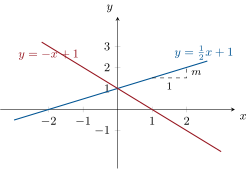
where and are fixed real numbers. Its graph is a straight line: is the slope and the -intercept (the line crosses the vertical axis at ). When the function is linear: expresses proportionality.
Proposition 4.2 (Slope and variations)
Let .
- For any two distinct inputs : (the slope is the change of the output per unit change of the input).
- If , is strictly increasing on ; if , strictly decreasing; if , constant.
Proof. 1. Compute , then divide by .
2. If , then has the sign of , since : positive gives (increasing), negative gives (decreasing). ∎
Example 4.3
Find the affine function whose graph passes through and . The slope is
Then , and gives , so : . Check with : .
4.2 The square function
Proposition 4.4 (Square function)
The function , defined on :
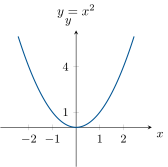
- is strictly decreasing on and strictly increasing on , with minimum at ;
- satisfies for all : its graph, a parabola, is symmetric about the vertical axis.
Proof. 1. Let . Then
since and : is strictly increasing on . If , then but , so : strictly decreasing. Finally for all .
2. ; so the points and , mirror images across the vertical axis, are both on the graph. ∎
Remark 4.5 (Squares and order)
Because the square function decreases on the negative side, taking squares reverses the order of negative numbers: but . Never square both sides of an inequality without checking signs.
4.3 The inverse function
Proposition 4.6 (Inverse function)
The function , defined for :
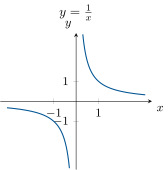
- is strictly decreasing on and strictly decreasing on ;
- satisfies : its graph, a hyperbola, is symmetric about the origin.
Proof. 1. Let . Then
since and : strictly decreasing on . On the same quotient has and again (product of two negatives), so decreases there too.
2. . ∎
Remark 4.7
Careful: is not decreasing on its whole domain. From to the value jumps from up to . The two branches must be studied separately.
4.4 Square root and cube
Proposition 4.8 (Square root function)
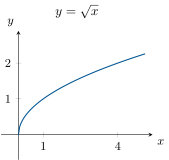
The function , defined on , is strictly increasing.
Proof. Let . Multiply and divide by the conjugate:
since and (note , so ). ∎
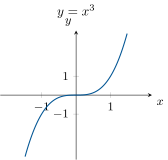
Proposition 4.9 (Cube function)
The function , defined on , is strictly increasing, and its graph is symmetric about the origin.
Proof. Admitted at this level. ∎
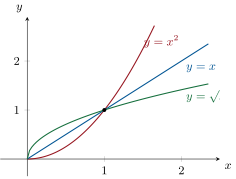
Proposition 4.10 (Comparing , and )
For : . For : . At and the three values are equal.
Proof. Suppose . Multiplying by gives . Next, : since both sides are positive and squaring is increasing on positive numbers, this inequality is equivalent to , which we just proved. For , multiplying by gives , and follows by the same squaring argument. ∎
Method 4.11 (Comparing images)
To compare and for a reference function :
Example 4.12
Compare and : both inputs are in , where the inverse function decreases, and , so . Compare and : on the square decreases, and , so — indeed .
4.5 Exercises
Exercise 4.1 ★
For each affine function, give its slope, its -intercept, and say whether it is increasing or decreasing:
Solution
Solution of Exercise 4.1.
: slope , intercept , increasing. : slope , intercept , decreasing. : slope , intercept , constant. : slope , intercept , decreasing (and linear).
Exercise 4.2 ★
Find the affine function whose graph passes through and ; then the one through and .
Exercise 4.3 ★
Without a calculator, compare:
Solution
Solution of Exercise 4.3.
: the square increases on positives.
: the square decreases on negatives and .
: the inverse decreases on positives.
: the square root increases.
Exercise 4.4 ★
Using the graph of the square function, solve , then , then .
Solution
Solution of Exercise 4.4.
: two solutions, and (the horizontal line cuts the parabola twice).
: the parabola is below the line between the two intersection points: .
: the parabola is strictly above outside : .
Exercise 4.5 ★
Let . Order the numbers , , and from smallest to largest, and check your answer with .
Solution
Solution of Exercise 4.5.
For : multiplying repeatedly by gives , and Proposition 4.10 gives , so
Check with : , , , .
Exercise 4.6 ★★
Solve graphically, then algebraically: , and for . What changes if we also allow ?
Solution
Solution of Exercise 4.6.
has the unique solution (the hyperbola meets the horizontal line once, on the positive branch).
For : . Multiplying by : , so : solution set .
If is allowed: every negative satisfies , so the full solution set is .
Exercise 4.7 ★★
Knowing that the square function decreases on and increases on , frame when:
(In case (c), be careful: the minimum of is not at an endpoint.)
Exercise 4.8 ★★
A taxi company charges a fixed fee of plus per kilometer; another charges no fee and per kilometer. Model each price by an affine function of the distance , plot both lines, and find from which distance the first company is cheaper.
Solution
Solution of Exercise 4.8.
First company: ; second: . The first is cheaper when
Beyond km, the first company is cheaper; at exactly km both charge .
Exercise 4.9 ★★
Show that for all : . (Hint: both sides are nonnegative, so compare their squares.) When is there equality?
Solution
Solution of Exercise 4.9.
Both sides are nonnegative, so the inequality is equivalent to the one between their squares:
Since , the second square is at least the first, which proves . Equality holds exactly when , i.e. when or .
Exercise 4.10 ★★★
Let , defined for .
- Show that for all .
- Deduce the variations of on from those of the inverse function.
Solution
Solution of Exercise 4.10.
1. Put the right-hand side over a common denominator:
2. On , as increases, increases and stays positive, so decreases (inverse function, times the positive constant ), so decreases: is strictly decreasing on .
4.6 Problem: The laws of nature speak in reference functions
Problem 4.1
Weekend problem — braking distances grow as , levers obey , planets follow : reading physics with the reference functions
Open a physics book and the same few graphs appear on every page: the parabola, the hyperbola, the root curve. Nature writes its laws with this chapter’s reference functions — and knowing their shapes (Proposition 4.4, Proposition 4.6, Proposition 4.8, Proposition 4.9) is enough to brake a car, balance a lever, and time the planets. The grand finale is Kepler’s third law, read straight off the solar system’s data.
Part I — The square law of braking. A rule of thumb for a car’s braking distance on dry road: meters, at speed km/h.
- Compute the braking distances at , , and km/h.
- Doubling the speed multiplies the braking distance by how much? Explain from the square function’s scaling, and check on km/h.
- Forensics: skid marks measure m. What speed does the formula convict the driver of (to the km/h)? Which reference function answered — and on which domain is the reading unambiguous (Proposition 4.8)?
- Compare the extra distance caused by one km/h more, at low and at high speed: compute and . Which property of the parabola (Proposition 4.4) do the two answers illustrate?
- Real stopping adds reaction time — about one second, during which the car covers meters: . Compute and . Which of the two terms — affine or square — dominates at city speed, and which on the highway?
Part II — The hyperbolas of daily life.
- A lever balances when force distance is the same on both sides. A kg child sits m from the pivot; the balancing force at distance on the other side is (in kg-equivalents). Compute , , .
- What do the variations of the inverse function (Proposition 4.6) say about levers — and why does Archimedes’ boast (“give me a place to stand and I shall move the Earth”) hide in the hyperbola’s tail? What forbids ?
- Sound and light fade with the square of the distance: at m from a lamp the intensity is units; give it at , and m. Explain the exponent with a sphere: over what area has the light spread at distance (Archimedes’ tombstone problem, in the Middle School volume)?
- A bus for the school trip costs euros, split equally among participants. Tabulate the cost per head for , find how many participants bring it to euros or less, and state what the hyperbola’s shape promises — and refuses — as grows.
- Producing posters costs euros ( euros of setup). Show that the average cost per poster is , describe its variations, and interpret its horizontal asymptote economically. (Compare the algebra of Exercise 4.10.)
Part III — Kepler’s harmony. For each planet, let be its mean distance to the Sun (in astronomical units, Earth ) and its period (in years). Data: Mars , ; Jupiter , ; Saturn , .
- Compute and for the Earth, Mars and Jupiter. What did Kepler notice in 1618?
- State the law as a function: . Test it on Saturn.
- Two predictions: an asteroid orbits at AU — find its period (the numbers come out whole); a comet returns every years — find its mean distance (look for a perfect cube).
- Which three reference functions does the law braid together? And its scaling rule: when is multiplied by , what happens to ? (Check with the asteroid against the Earth.)
- Kepler read this law in Tycho Brahe’s data seventy years before Newton’s gravitation explained it. In one sentence: what does this episode say about the power of recognizing a reference function in a table of numbers?
Part IV — The tortoise and the hare.
- Order , and on and on (Proposition 4.10), and verify the two orderings at and .
- Solve completely (for , square soundly and finish with a sign table).
- Bring in the cube: order , , at and at , and find all points where the square and the cube functions cross.
- Two savings schemes pay, after years, euros (scheme A) or euros (scheme B). Show that B overtakes A when , and give the crossover time to the month. Moral about roots against powers in the long run?
- Finale: for each law of this problem — braking (), the lever (), the lamp (), Kepler (), scheme A () — say in one clause which feature of its reference graph carries the physical meaning (steepening rise, vertical asymptote, spreading sphere, scaling exponent, flattening growth). Conclusion: the reference functions are the alphabet; nature writes with them.
Solution
Solution of Problem 4.1.
1. m; m; m; m.
2. Doubling doubles and multiplies its square by : m . Twice the speed, four times the distance — the square function’s scaling.
3. gives , so km/h. The square root answered; the reading is unambiguous because speeds are positive, and on the square function climbs strictly (Proposition 4.8: one positive preimage).
4. m, while m: the same km/h costs three times more distance at high speed. The parabola not only rises, it steepens — its rate of climb grows with .
5. m; m. In town the affine (reaction) term is the bigger share; on the highway the square term crushes it — affine grows steadily, squares run away.
6. , , .
7. The inverse function decreases: the further from the pivot, the smaller the needed force — with a long enough lever arm ( huge), any force, however small, balances any load: Archimedes’ boast lives in the hyperbola’s tail, which approaches without reaching it. And is the forbidden value: no arm, no lever — the vertical asymptote.
8. at m, at m, at m. At distance the light has spread over a sphere of area (Archimedes’ tombstone problem, in the Middle School volume): the same energy divided by an area growing like — hence the inverse square.
9. , , euros per head for . For : participants. The hyperbola promises ever-cheaper shares as grows — and refuses ever to reach : the bus is never free.
10. : decreasing on (inverse function shifted), approaching the asymptote . Economically: spreading the fixed euros over more posters pushes the unit cost down towards the incompressible euros of materials — economies of scale, with a hard floor.
11. Earth: , . Mars: and . Jupiter: and . Kepler’s notice: for every planet — one law for the whole sky.
12. : for Saturn years, against the observed : the law holds to a tenth.
13. Asteroid: years. Comet: , so AU.
14. Square (), cube () and square root (to extract ). Scaling: multiplying by multiplies by — as the asteroid confirms ( four times Earth’s, eight times).
15. A table of numbers, matched against the shapes of a few reference functions, yielded a law of the universe seventy years before anyone knew why it held — recognizing the function is half of science.
16. On : ; on : . Checks: at : ; at : .
17. For , both sides are , so .
18. At : . At : : the order reverses. Crossings of and : : at and .
19. gives ; squaring, , so and years — about years and months. (Both schemes then pay about euros.) Moral: roots sprint early, powers win every marathon.
20. Braking: the parabola’s steepening is the danger of speed. Lever: the vertical asymptote at and the long tail are the mechanic’s advantage. Lamp: the of the spreading sphere sets the fading. Kepler: the exponent is the solar system’s tempo. Savings A: the root’s flattening is the slow saver’s fate. Five graphs, five laws: nature’s alphabet indeed.