High School Mathematics · Grades 10–12
7Equations of Lines and Linear Systems
A straight line in the coordinate plane is described by an equation, and two lines together form a system of equations whose solutions are their intersection points. This chapter connects three languages — geometric (lines), algebraic (equations) and functional (affine functions from Chapter 4) — and teaches the two standard ways of solving a linear system.
7.1 The equation of a line
Theorem 7.1 (Reduced equation)
In a coordinate system:
every non-vertical line has an equation of the form
with (the slope) and (the -intercept) uniquely determined — this is the reduced equation of the line;
- every vertical line has an equation ;
- a point lies on the line exactly when its coordinates satisfy the equation.
Proof. Admitted at this level. ∎
Proposition 7.2 (Slope through two points)
The slope of the (non-vertical) line through and , with , is
Proof. Both points satisfy , so ; divide by . ∎
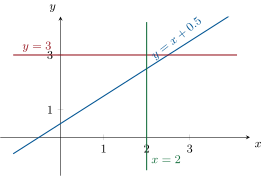
Method 7.3 (Finding the equation of a line through two points)
Given and with :
- compute the slope ;
- write and substitute the coordinates of (or ) to find ;
- check the final equation with the other point.
If , the line is vertical: its equation is .
Example 7.4
Line through and . Slope: . Then ; the point gives , so . Equation: . Check with : .
Proposition 7.5 (Parallel lines)
Two non-vertical lines are parallel if and only if they have the same slope. Two distinct parallel lines have no common point; two lines with different slopes have exactly one.
Proof. Let and be the two lines. A common point solves , i.e. . If , this has exactly one solution : one intersection point. If , the equation reads : no solution when (distinct parallels), every when (same line). Parallelism (having no intersection, or being equal) is thus equivalent to . ∎
Remark 7.6 (Direction vector)
The line goes up units for each unit to the right, so the vector is a direction vector of the line: the line is parallel to . Two lines are parallel exactly when their direction vectors are collinear (Theorem 6.13).
7.2 Linear systems
Definition 7.7 (Linear system)
A system of two linear equations in the unknowns and is a pair of equations
to be satisfied simultaneously. A solution is a pair satisfying both. Each equation describes a line, so solving the system means finding the intersection of two lines.
Method 7.8 (Substitution)
Example 7.9
Solve by substitution. The second equation gives . Substitute into the first:
then . The solution is the pair . Check: and .
Method 7.10 (Elimination)
Example 7.11
Solve by elimination. To eliminate , multiply the first equation by and the second by :
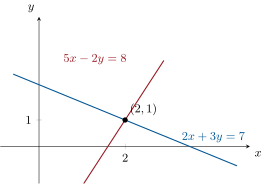
Adding them: , so . Substituting into : , so . Solution: . Check in the second equation: .
Remark 7.12 (How many solutions?)
Like two lines, a linear system has exactly one solution in general (non-parallel lines), and exceptionally none (distinct parallel lines) or infinitely many (twice the same line). The criterion of Theorem 6.13 decides: the system has a unique solution exactly when .
Example 7.13 (Modeling with a system)
Three notebooks and two pens cost ; one notebook and four pens cost . Let be the price of a notebook and that of a pen:
From the second equation, ; substituting, , so , giving and then . A notebook costs and a pen costs .
7.3 Exercises
Exercise 7.1 ★
For each line, read off the slope and the -intercept, and sketch it:
Solution
Solution of Exercise 7.1.
: slope , intercept . : slope , intercept . : slope , intercept (horizontal line). : vertical line, no slope and no reduced equation.
Exercise 7.2 ★
Does the point belong to the line ? And ? And the point ?
Solution
Solution of Exercise 7.2.
: yes, is on the line. : is not. : yes, is on the line.
Exercise 7.3 ★
Find the reduced equation of the line through:
Solution
Solution of Exercise 7.3.
(a) and (the point is on the -axis): .
(b) ; then gives : .
(c) : vertical line .
Exercise 7.4 ★
Among the lines , , , , which are parallel to each other? Which are actually equal?
Solution
Solution of Exercise 7.4.
. The lines with slope are , and : those three are parallel to each other; no two of them are equal (different intercepts), and none is parallel to .
Exercise 7.5 ★
Solve by substitution:
Solution
Solution of Exercise 7.5.
First system: substitute into : , so , , then . Solution: .
Second system: from , . Then , so , , then . Solution: .
Exercise 7.6 ★
Solve by elimination:
Exercise 7.7 ★★
Determine, without solving them, how many solutions each system has:
Solution
Solution of Exercise 7.7.
Compute in each case.
First: , and the second equation is times the first: twice the same line, infinitely many solutions.
Second: again, but the right-hand sides are not in the ratio (): two distinct parallel lines, no solution.
Third: : exactly one solution.
Exercise 7.8 ★★
Two hundred tickets were sold for a school play, some at (children) and some at (adults), for a total of . How many tickets of each kind were sold?
Solution
Solution of Exercise 7.8.
Let be the number of child tickets and the number of adult tickets:
From the first equation ; substituting, , so , , then . So child tickets and adult tickets. Check: .
Exercise 7.9 ★★
Let be the line and .
- Give the equation of the line parallel to passing through .
- Compute the intersection point of with the -axis.
Solution
Solution of Exercise 7.9.
1. Parallel means same slope : with , so : .
2. On the -axis, : gives . The intersection point is .
Exercise 7.10 ★★★
Let , and .
- Find the equations of the medians of the triangle issued from and from (a median joins a vertex to the midpoint of the opposite side).
- Compute their intersection point , and check that is also on the third median. (You should find that the coordinates of are the averages of those of , , .)
Solution
Solution of Exercise 7.10.
1. Midpoint of : . The median from has slope : equation .
Midpoint of : . The median from has slope : it is the horizontal line .
2. Intersection: gives , so . The third median joins to the midpoint of , ; its slope is , equation . At : : is on it. And indeed : the centroid averages the coordinates of the vertices.
7.4 Problem: One solution, none, or infinitely many
Problem 7.1
Weekend problem — two lines have three possible destinies, a determinant decides between them, and the world’s oldest textbook already knew
Two linear equations, two unknowns: the pair of lines they draw can cross once, never, or be one and the same line — and every linear system inherits one of these three destinies. This problem classifies them, meets the number that decides (an old acquaintance from the vectors chapter), solves the two-thousand-year-old pheasants-and-rabbits of the Chinese Nine Chapters, and ends with corners of regions — the first step of the optimization used by every airline and factory today.
Part I — The line, fluently.
- Find the reduced equation of the line through and (Method 7.3).
- Among , and : which two lines are parallel (Proposition 7.5), and where do the non-parallel pairs meet? (Compute one intersection.)
- The line through and : why does it have no reduced equation , and what is its equation?
- Is the point on the line ? And ?
- The line through with slope : give its equation, its two axis intercepts, and the area of the triangle it cuts from the first quadrant.
Part II — Three destinies.
- Solve by substitution (Method 7.8):
- Solve by elimination (Method 7.10):
Classify — and interpret with lines — the two systems
State the complete trichotomy: crossing, parallel, identical — one solution, none, infinitely many.
- For the general system , , the deciding number is — the same determinant as the collinearity test of Problem 6.1. Explain the coincidence (which two vectors are collinear exactly when the lines are parallel or identical?), and evaluate for the three systems of questions 7 and 8.
- For which value of does have no solution? Solve the system for all other values of … or at least explain how you would.
Part III — The Nine Chapters.
- From the Nine Chapters on the Mathematical Art (China, about 2000 years ago): a cage holds pheasants and rabbits — heads and legs in all. How many of each?
- A juice stand blends a -fruit syrup with a -fruit drink to obtain L at fruit. How many liters of each?
- A two-digit number has digit sum ; swapping its digits decreases it by . Find it, using the digit algebra of the digit-algebra weekend problem of the Middle School volume to set up the system.
- At the bakery, coffees and croissants cost euros; coffees and croissants cost euros. Solve elegantly: what do adding the two equations and subtracting them each tell you directly?
- A market stall claims: apples pear for euros, and apples pears for euros. Solve — or rather, explain what the system’s destiny reveals about the stall’s arithmetic.
Part IV — Corners rule.
- The line splits the plane in two. Which side is the origin on? Describe the set and how one tests a point against it.
Draw the region defined by the four constraints
and compute its four corner points.
- A workshop’s profit is on the region of question 17. Evaluate at the four corners. Admitting that the maximum of such a linear quantity on such a region is always reached at a corner (picture the lines constant sweeping across), give the optimal production plan.
- The two taxis of the two-thermometers weekend problem of the Middle School volume as a system: write and solve and interpret the solution.
- Finale, the dictionary: one equation one line; one system two lines with three destinies, decided by ; many inequalities a region whose corners carry the optimum. State it in three sentences — you have just toured the entrance hall of linear algebra and linear programming, both built in full in the university volumes.
Solution
Solution of Problem 7.1.
1. Slope ; through : .
2. and : same slope, parallel (and distinct). Crossing with : gives , : point .
3. Both points share : the line is vertical, equation . A reduced form answers “one per ”, which a vertical line refuses: its slope would be infinite.
4. : yes, is on the line. : no.
5. ; crosses the axes at and . Triangle area: .
6. Substituting: , , : solution .
7. Adding: , ; then , : solution .
8. First system: the second equation is twice the first: one line counted twice — infinitely many solutions (all points of ). Second system: same left sides proportional, right sides not (): two parallel lines — no solution. Trichotomy: distinct slopes one crossing; equal slopes, different intercepts parallel, none; equal everything same line, infinitely many.
9. The lines’ direction vectors are and (or: slopes and ), collinear exactly when — the determinant of Problem 6.1 in a new job. Values: question 7: : unique solution. Question 8: for both: parallel-or-identical, and the constants separate the two cases.
10. : zero for . There against : doubling the first gives : parallel, no solution. For , elimination gives the unique solution , then .
11. , : halving, , so and : twenty-three pheasants, twelve rabbits — the Nine Chapters’ own answer.
12. and : subtracting the first, : L of syrup, L of drink.
13. Digits , : and , so : , : the number is .
14. Adding: , so — one coffee plus one croissant. Subtracting: . Hence and euros: the symmetric shortcut solved it without any substitution.
15. Doubling the first claim gives apples pears euros, but the stall charges : the system is inconsistent — parallel lines, empty solution set. Verdict: the two price claims cannot both be right; either a discount is hiding, or the arithmetic is.
16. At the origin: : true, so lies in the region (above the line). Test any point by plugging it in: above/below according to the inequality’s truth.
17. Corners: ; (axes and ); (axis and ); and with : , : .
18. ; ; ; . Maximum at the corner : the plan , earns — corners rule, as the sweeping parallel lines make visible.
19. gives , : at six kilometers both taxis charge twelve euros — the break-even crossing of the two-thermometers weekend problem of the Middle School volume, now a system’s unique solution.
20. A linear equation’s solutions draw a line; a system superposes two lines, and tells at a glance whether they cross once (nonzero) or fall into the parallel-or-identical cases (zero). Pile up inequalities instead and the solutions form a polygonal region whose corners carry any linear optimum. Linear algebra generalizes the determinant to any number of unknowns; linear programming industrializes the corners.